
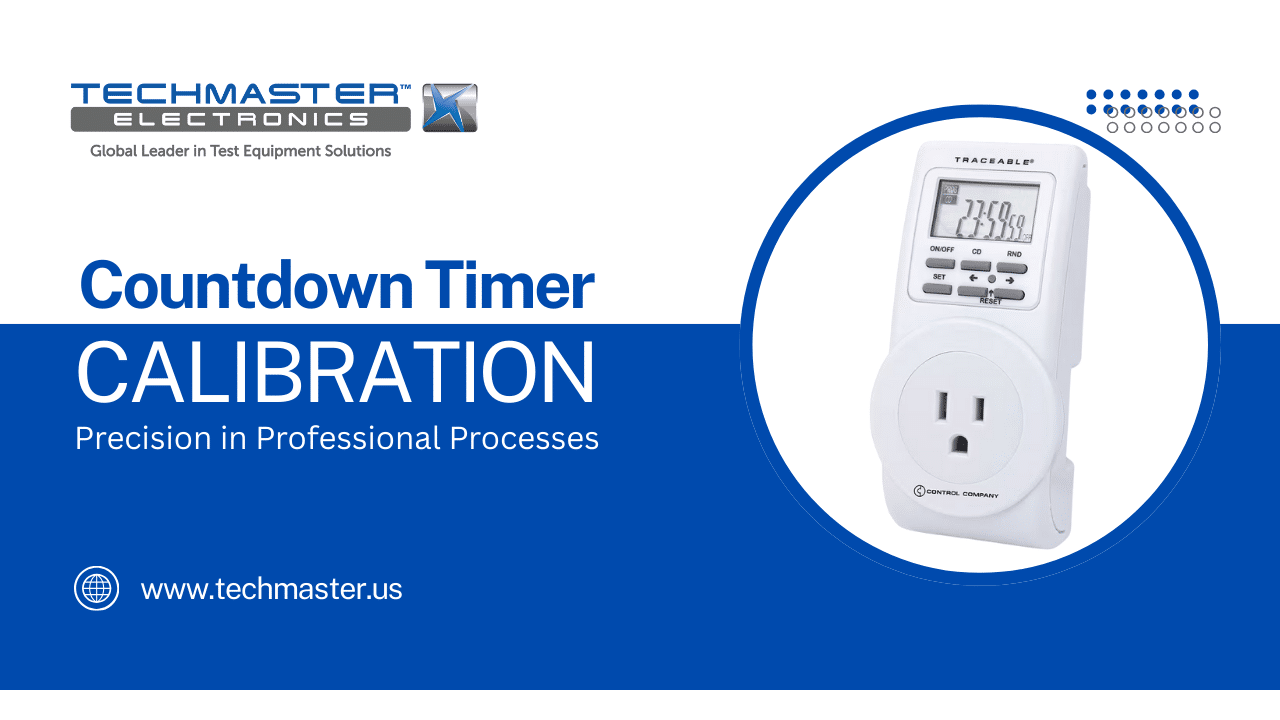
Countdown Timer Calibration
Frequency response at a glance
How Countdown Timer calibration works
- Intake & visual inspection
- Environmental stabilization
- As-found measurement
- Comparison to NIST-traceable standards
- Adjustment if required
- As-left results & certificate
Your calibration, covered
In-lab vs on-site calibration
In-lab calibration
- Accredited bench with full reference standards
- Best achievable measurement uncertainties
- Pickup & return logistics handled
- Ideal for precision and reference work
On-site calibration
- We calibrate the Countdown Timer at your facility
- No shipping risk or transit downtime
- As-found data captured before any move
- Ideal for fixed, large or sensitive assets
In-depth guide
Countdown Timers: Mastering Process Control and the Vital Role of Countdown Timer Calibration
In every sector, from scientific laboratories to industrial assembly lines, time is a critical variable. A countdown timer is more than just a convenience. It is a precision instrument that ensures processes occur for the exact duration required. However, many professionals overlook the accuracy of these devices. A deviation of just a few seconds can lead to the failure of a batch worth thousands of dollars. This is why the process of Countdown Timer Calibration has become an essential link in modern quality management systems.
1. The Countdown Timer: A Guardian of Precision
Quartz Drift – Conceptual Illustration
A countdown timer in a professional setting is built to withstand rigorous use. It helps operators maintain strict control over time-limited intervals. Unlike consumer-grade clocks, industrial timers must provide consistent results under varying temperatures and conditions.
However, the internal electronics are not infallible. Most digital timers rely on quartz crystal oscillators. These crystals can drift due to aging and environmental factors. Over time, a “second” on your display might not equal a true second in reality. Countdown Timer Calibration identifies these small discrepancies. This process ensures that the time you set is the actual time the device delivers.
2. Diverse Applications in High-Stakes Industries
Lab & Biochemistry
Absolute control of reaction time and sample incubation.
Meets GMP standards for drying, mixing, and sterilization.
The Time & Temperature principle in HACCP.
Manufacturing
Synchronize the production line, reduce waste.
Countdown timers are the “heartbeat” of any process requiring precise repetition. You will find them in almost every critical technical field:
2.1. Chemical and Biological Laboratories
Many chemical reactions are time-sensitive. Leaving a reaction for too long can create unwanted by-products. In microbiology, the incubation period determines the success of bacterial growth. Using a device that has passed Countdown Timer Calibration gives scientists total confidence in their research data.
2.2. Pharmaceutical and Medical Sectors
In drug manufacturing, the duration of mixing and drying cycles must follow a strict formula. In hospitals, timers assist in medical testing and the sterilization of surgical tools. A timing error in these fields could directly endanger human health. Therefore, these sectors prioritize periodic calibration to maintain safety standards.
2.3. Food and Beverage Industry
Food safety relies on the “Time and Temperature” principle ($T&T$). The duration of cooking or pasteurization must be sufficient to kill bacteria without ruining the flavor. Calibrated timers help businesses comply with HACCP standards. This ensures that every product batch is uniform and safe for consumers.
2.4. Industrial Process Control
On automated assembly lines, timers control stages such as surface treatment, powder coating, or cooling. Maintaining a steady production rhythm optimizes efficiency and reduces waste. Accurate timing prevents bottlenecks and ensures that mechanical parts receive the exact treatment they require.
3. Why is Countdown Timer Calibration Critical?
If you believe a digital timer is always accurate because it is “digital,” you might be risking your quality control. Here are the primary reasons why Countdown Timer Calibration is a mandatory requirement:
-
Compensating for Quartz Drift: The quartz crystals inside timers are sensitive to ambient temperature. Calibration measures how much the clock frequency has drifted over time.
-
Ensuring International Traceability: For quality reports to be globally recognized, measurement tools must have “traceability.” Calibration connects your timer’s readings to national and international time standards.
-
Compliance with ISO and GMP Standards: Regulatory bodies require all tools affecting product quality to be monitored. A Countdown Timer Calibration certificate is vital evidence during quality audits.
-
Cost Optimization: Early detection of a fast or slow timer prevents the loss of expensive materials. You avoid discarding entire batches due to timing errors in the production cycle.
4. The Professional Calibration Procedure
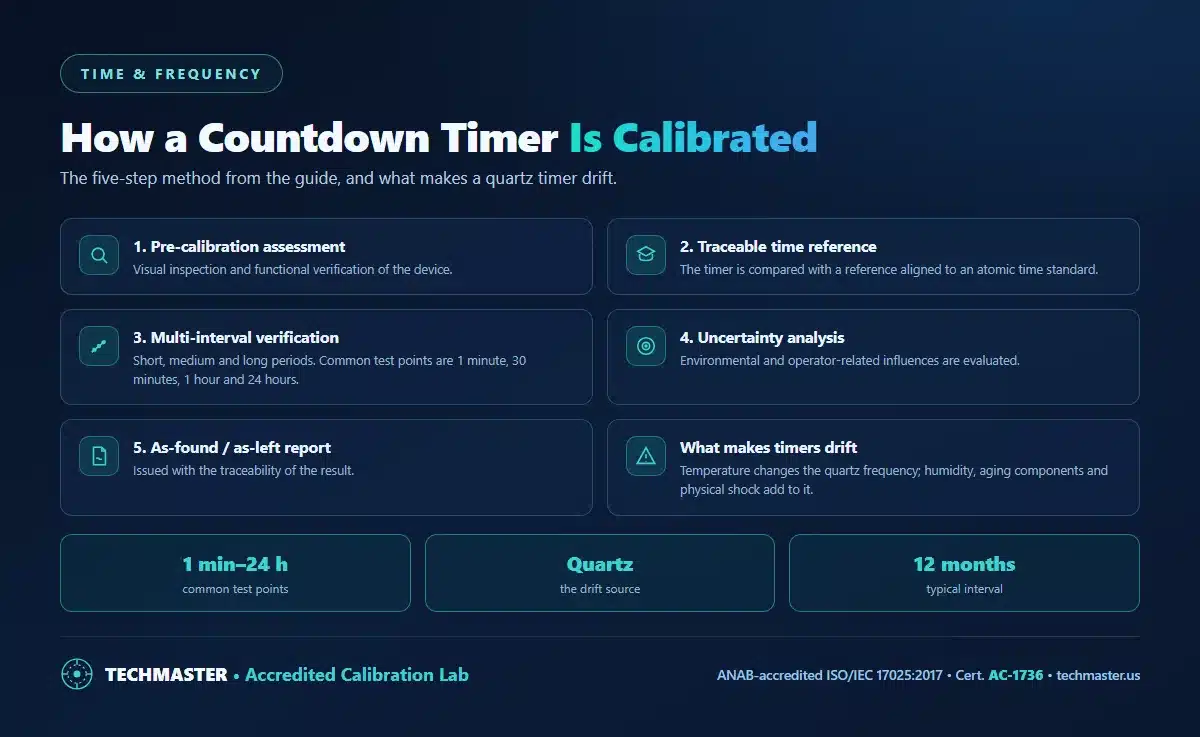
True calibration is not simply comparing a timer to a smartphone. In a certified laboratory, the Countdown Timer Calibration procedure follows strict protocols:
-
Visual and Functional Inspection: Technicians ensure the display is clear, buttons are responsive, and there is no physical damage.
-
Using High-Level Reference Standards: The lab uses a standard time base or an atomic clock. These references are thousands of times more accurate than the device under test.
-
Testing at Key Intervals: The timer is checked at multiple points. Common test points include 1 minute, 30 minutes, 1 hour, and 24 hours.
-
Measurement Uncertainty Analysis: The lab calculates external factors that might influence the results. This provides a comprehensive view of the measurement’s reliability.
-
Certification and Labeling: A device that meets the standards receives a calibration sticker. The lab then issues a detailed report documenting all “As-Found” and “As-Left” data.
5. Factors That Influence Timer Accuracy
To understand the need for Countdown Timer Calibration, we must consider the environmental factors that cause errors:
-
Temperature Extremes: High or low temperatures alter the vibration frequency of the internal quartz.
-
Humidity: Moisture can cause minor electrical leakage on the circuit board. This affects the stability of the pulse count.
-
Component Aging: Electronic components naturally degrade after years of use. This leads to a larger drift in timing accuracy.
-
Physical Shock: Dropping a timer can crack or change the characteristics of the internal crystal.
6. Maintenance Tips to Preserve Timing Accuracy
After completing your Countdown Timer Calibration, follow these best practices to keep your device accurate:
-
Avoid Electromagnetic Interference (EMI): Do not place timers near large motors or radio transmitters. These can interfere with the counting circuits.
-
Regular Battery Replacement: Low voltage can cause the oscillator to become unstable. Always use high-quality batteries to ensure a steady power supply.
-
Keep it Clean: Prevent dust from entering the buttons or ports. Dust can trap moisture, which leads to internal corrosion.
-
Periodic Cross-Checks: Between official calibrations, perform a quick check against a reliable online time source to ensure there are no major deviations.
Conclusion
Time is a technical specification that no business can afford to ignore. A good countdown timer is a helpful tool, but an accurate countdown timer is the key to success. Investing in periodic Countdown Timer Calibration is the best way to protect your production process and your brand’s reputation. Do not let a few seconds of error disrupt your grand plans. Ensure every moment in your process remains under absolute control.
Frequently asked questions
What is Countdown Timer Calibration?
How often should a Countdown Timer be calibrated?
What standards apply to Countdown Timer Calibration?
What is included on the certificate?
Can you calibrate the Countdown Timer on-site?
Need Countdown Timer calibration?
ANAB-accredited, NIST-traceable, fast turnaround, in-lab or on-site across the USA.
Contact us for a quoteReferences & industry standards
- ISO/IEC 17025 testing & calibration laboratory requirements
- NIST calibration services and measurement traceability
- NIST Time and Frequency Division
- A2LA / ANAB accreditation for calibration laboratories
External standards bodies. Techmaster Electronics is an ISO/IEC 17025-accredited, NIST-traceable calibration laboratory.

Khanh Nguyen is the Marketing Manager at Techmaster Electronics, a B2B marketing leader covering the test, measurement, and ISO/IEC 17025 accredited calibration industry across the US and Vietnam markets.