
Dewpoint Meter Calibration
Why calibration intervals matter
How Dewpoint Meter calibration works
- Intake & visual inspection
- Environmental stabilization
- As-found measurement
- Comparison to NIST-traceable standards
- Adjustment if required
- As-left results & certificate
Your calibration, covered
In-lab vs on-site calibration
In-lab calibration
- Accredited bench with full reference standards
- Best achievable measurement uncertainties
- Pickup & return logistics handled
- Ideal for precision and reference work
On-site calibration
- We calibrate the Dewpoint Meter at your facility
- No shipping risk or transit downtime
- As-found data captured before any move
- Ideal for fixed, large or sensitive assets
In-depth guide
In industrial environments, ranging from pharmaceutical cleanrooms to high-pressure compressed air systems, the difference between a dew point of and isn’t just a number; it’s the difference between product integrity and system failure. Dewpoint meter calibration is the critical process of verifying that your hygrometers and sensors are providing truthful data. Over time, sensors drift due to contamination, aging, or extreme pressure changes. Without regular dewpoint instrument adjustment, you risk pipe corrosion, frozen lines, and compromised end-products. In this complete guide, we explore the technicalities of ISO 17025 dew point calibration, the benefits of an on-site dew point audit, and how to maintain the highest standards of measurement traceability.
What is a Dewpoint Meter?
A dewpoint meter is a high-precision tool that measures moisture in compressed air or process gases. While standard hygrometers track Relative Humidity (RH), a dewpoint meter finds the exact temperature where water vapor turns into liquid (dew).
In industrial settings, dewpoint serves as a “fixed” and highly sensitive marker. A lower dewpoint means drier gas. To keep your systems running smoothly and prevent gear failure, you must maintain accuracy through regular dewpoint meter calibration.
Common Sensor Types
-
Chilled Mirror: The top choice for labs. It uses a cooled mirror to spot condensation. Experts use this as the main reference for ISO 17025 dew point calibration.
-
Aluminum Oxide: A rugged choice for industry. It measures extremely low dewpoints, reaching down to $-100^{\circ}\text{C}$.
-
Polymer Capacitive: Best for higher humidity. It reacts fast and keeps monitoring costs low.
Strategic Industrial Applications
Knowing where you use these tools helps you decide how often to schedule an on-site dew point audit to keep your production safe.
A. Compressed Air Systems
Too much moisture in compressed air rusts pipes, breaks control valves, and freezes pneumatic parts. A calibrated meter helps you:
-
Check if your air dryer works correctly.
-
Save energy by not over-drying the air.
B. Pharmaceutical & Food Production (HACCP)
Moisture ruins sterility in cleanrooms and drug labs. Using regular dewpoint instrument adjustment helps:
-
Stop mold and bacteria from growing in packaging.
-
Keep moisture-sensitive powders and tablets stable.
C. Oil & Gas Processing
In natural gas plants, operators must strictly control the water dew point. This stops “hydrates”, ice-like crystals, from blocking pipelines entirely.
D. Heat Treating & Semiconductor Manufacturing
Metal furnaces and chip factories need extremely dry shielding gases (like Nitrogen or Argon) to stop surface rust. In these high-stakes areas, even a $1^{\circ}\text{C}$ error can lead to millions of dollars in wasted product.
Why Do Dewpoint Meters Drift?
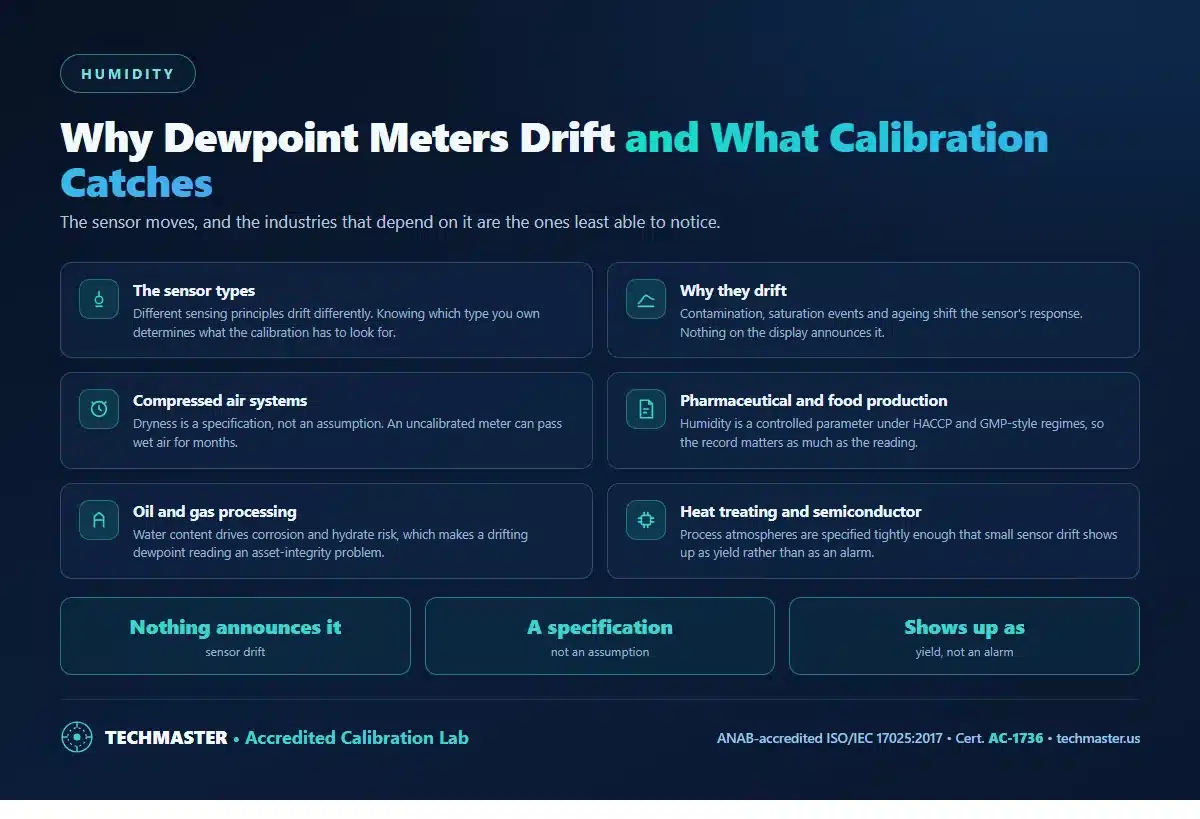
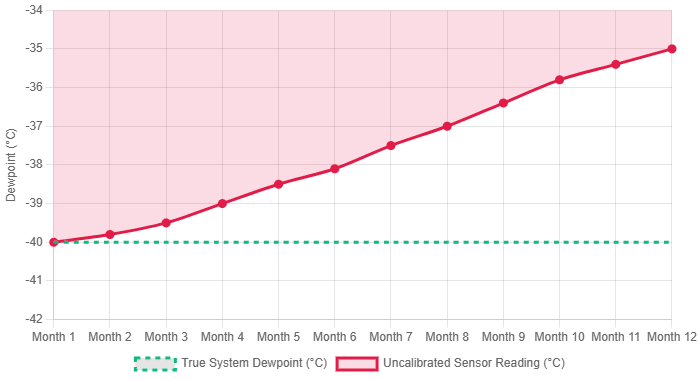
Before diving into the calibration process, we must address the “why.” Most modern dewpoint meters utilize metal-oxide or polymer capacitive sensors. While highly sensitive, these components are susceptible to:
-
Contamination: Oil aerosols and particulates from compressors.
-
Chemical Exposure: Vaporized chemicals can “poison” the sensor substrate.
-
Sensor Aging: Natural degradation of the dielectric layer over time.
Regular dewpoint instrument adjustment ensures these variables don’t lead to “measurement creep,” where your readings slowly move away from the actual value.
ISO 17025 Dew Point Calibration: The Gold Standard
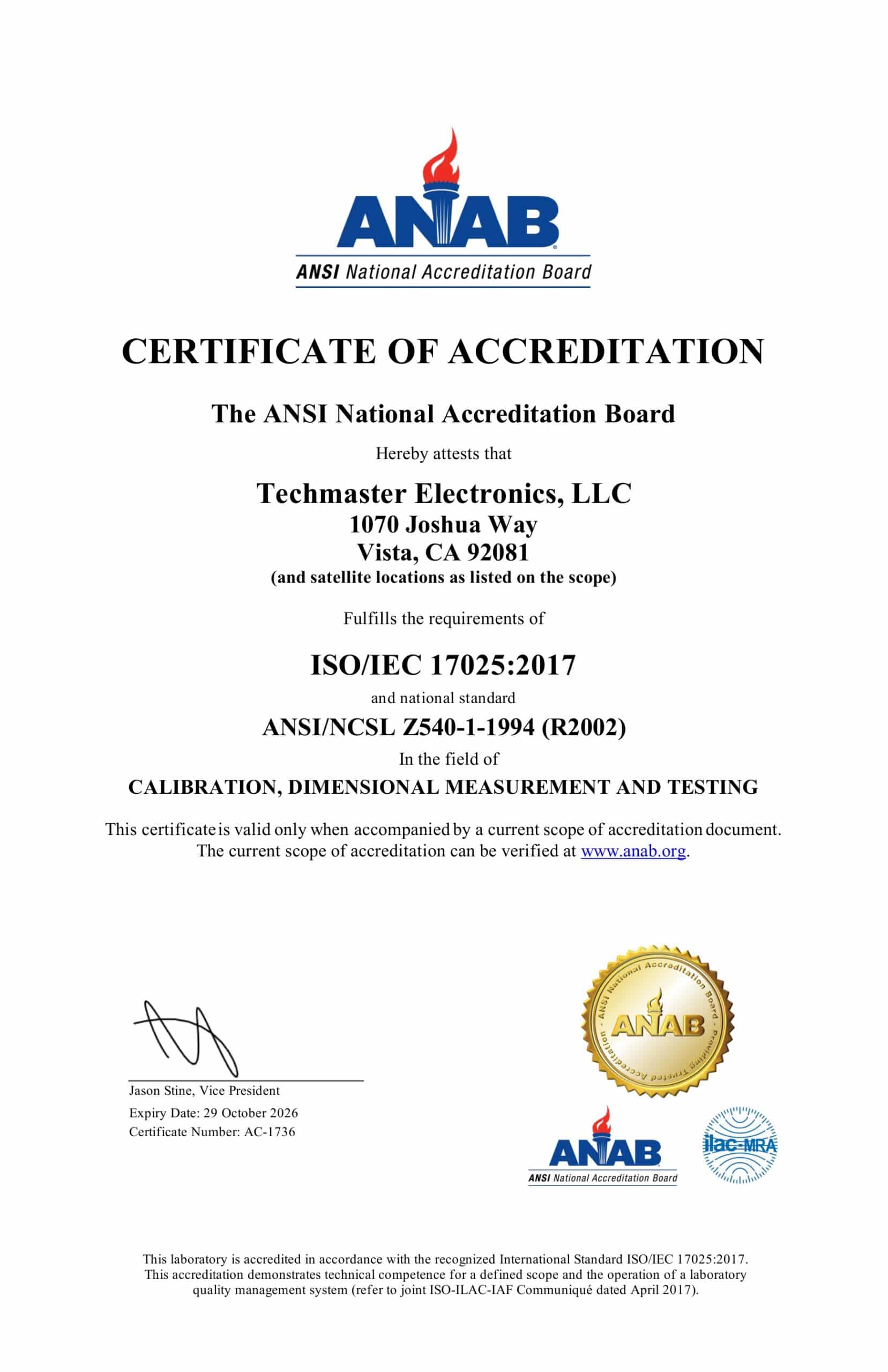
For compliance, not all calibrations are created equal. An ISO 17025 dew point calibration means the laboratory has been independently audited and proven to have the technical competence to produce precise and accurate test data.
Key Components of ISO 17025 Calibration:
-
Traceability: Measurements are traced back to national standards (NIST or equivalent).
-
Uncertainty Budgets: The lab provides a calculated coverage factor for measurement uncertainty.
-
Controlled Environment: Calibration occurs in a laboratory where ambient temperature and pressure are strictly monitored.

The Calibration Process: Step-by-Step Technical Breakdown
A professional calibration typically follows a multi-point verification process.
Step 1: Pre-Calibration Inspection
The instrument is checked for physical damage and “as-found” data is recorded to determine how much the sensor drifted since its last service.
Step 2: Reference Comparison
The sensor is placed in a moisture generator alongside a Chilled Mirror Hygrometer, the primary reference standard. The generator produces precise frost/dew points (e.g., and ).
Step 3: Stabilization
Dew point measurement is slow. The system must reach equilibrium. We wait for the sensor output to stabilize, often requiring 30–60 minutes per calibration point.
Step 4: Adjustment and Verification
If the device is out of tolerance, a dewpoint instrument adjustment is performed. Afterward, a second set of “as-left” readings is taken to confirm the device is now within the manufacturer’s specified accuracy.
On-Site Dew Point Audit vs. Laboratory Calibration

| Feature | Lab Calibration (ISO) | On-Site Audit |
|---|---|---|
| Accuracy | Highest (Controlled) | Moderate (Real-world) |
| Traceability | Full NIST/National | Portable master verification |
| Downtime | Requires shipping unit | Zero downtime (Live) |
| Compliance | Required for ISO audits | Excellent interim check |
While lab calibration is the most precise, an on-site dew point audit (or field audit) offers real-world validation.
Optimizing Your Compressed Air System Performance
Beyond the meter itself, the sampling system plays a vital role. During a related keyphrase synonyms: on-site dew point audit, technicians often find that the meter is accurate, but the sampling line is leaking, leading to false high readings.
Best Practices for Sampling:
-
Use stainless steel or PTFE tubing (avoid rubber/plastic which absorbs moisture).
-
Ensure the flow rate is optimized (usually to liters per minute).
-
Install a “bleed” valve to ensure the sensor sees a representative flow of the main air stream.
FAQ
How often should I calibrate my dewpoint meter?
Most manufacturers recommend an annual calibration. However, in harsh environments with high oil or chemical vapor, a 6-month cycle is safer.
What is the difference between calibration and adjustment?
Calibration is the act of comparing a device to a known standard. Adjustment is the act of physically or digitally changing the device’s output to match that standard.
Can I perform dewpoint calibration in-house?
Unless you have a NIST-traceable chilled mirror hygrometer and a stable moisture generator, in-house calibration is usually not recommended for compliance-heavy industries.
Conclusion: Data Integrity Starts with Calibration
Maintaining your dewpoint sensors is not just a maintenance task; it’s a quality assurance powerhouse. By investing in ISO 17025 dew point calibration and periodic on-site dew point audits, you protect your equipment, your products, and your bottom line.
Frequently asked questions
What is Dewpoint Meter Calibration?
How often should a Dewpoint Meter be calibrated?
What standards apply to Dewpoint Meter Calibration?
What is included on the certificate?
Can you calibrate the Dewpoint Meter on-site?
Need Dewpoint Meter calibration?
ANAB-accredited, NIST-traceable, fast turnaround, in-lab or on-site across the USA.
Contact us for a quoteReferences & industry standards
- ISO/IEC 17025 testing & calibration laboratory requirements
- NIST calibration services and measurement traceability
- A2LA / ANAB accreditation for calibration laboratories
External standards bodies. Techmaster Electronics is an ISO/IEC 17025-accredited, NIST-traceable calibration laboratory.

Khanh Nguyen is the Marketing Manager at Techmaster Electronics, a B2B marketing leader covering the test, measurement, and ISO/IEC 17025 accredited calibration industry across the US and Vietnam markets.