
Milliamp Calibrator Calibration
Accuracy across the range
How Milliamp Calibrator calibration works
- Intake & visual inspection
- Environmental stabilization
- As-found measurement
- Comparison to NIST-traceable standards
- Adjustment if required
- As-left results & certificate
Your calibration, covered
In-lab vs on-site calibration
In-lab calibration
- Accredited bench with full reference standards
- Best achievable measurement uncertainties
- Pickup & return logistics handled
- Ideal for precision and reference work
On-site calibration
- We calibrate the Milliamp Calibrator at your facility
- No shipping risk or transit downtime
- As-found data captured before any move
- Ideal for fixed, large or sensitive assets
In-depth guide
The Definitive Guide to Milliamp Calibrator Calibration: Ensuring Integrity in Process Control Systems
In the complex ecosystem of modern industrial automation, the 4-20mA current loop remains the undisputed “global language” for communication between field instruments and control rooms. Whether it is monitoring the pressure of a high-pressure steam boiler or modulating a critical control valve in a chemical plant, the precision of this milliamp signal is the foundation of safety and efficiency. However, the reliability of this communication hinges entirely on a single factor: Milliamp Calibrator Calibration.
This article explores the fundamental applications of milliamp calibrators, the technical necessity of their calibration, and how maintaining metrological traceability protects industrial infrastructure.
1. The Pulse of Industry: Understanding the 4-20mA Loop
To appreciate the importance of Milliamp Calibrator Calibration, one must first understand why the milliamp signal is so pervasive. The 4-20mA standard is favored because current signals are immune to electrical noise and signal loss over long distances, unlike voltage signals. In this standard, 4mA represents the “Live Zero” (0% of scale), and 20mA represents the full scale (100%).
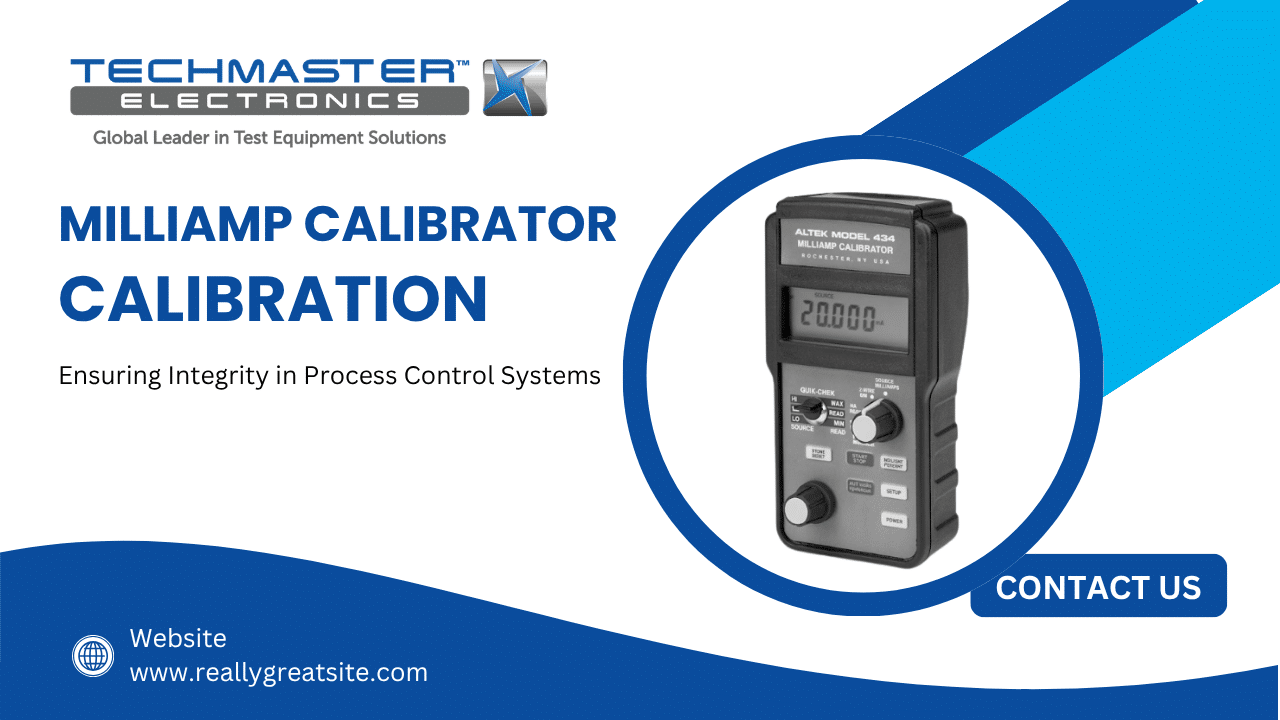
A Milliamp Calibrator is a specialized instrument used by technicians to “source” (generate) a precise current to test receivers, or “measure” a current produced by a transmitter. If the calibrator itself is inaccurate by even a fraction of a milliamp, the entire control loop is built on a lie.
2. Critical Applications of Milliamp Calibrators
Operational Modes
[Calibrator] --(+)-- [Receiver]
|                             |
+-------------(-)-------------+
-
- Source: Device provides 24V loop power and current.
- Simulate: Device acts as a transmitter in an externally powered loop.
- Measure: Passively monitors real-time current flow.
Loop Verification
Sourcing 4-20mA signals directly into PLC inputs to confirm that HMI readings match the electrical signal perfectly.
Valve Positioner Testing
Simulating current to verify valve seating at 4mA (closed) and full travel at 20mA (open) without process downtime.
Milliamp calibrators are not merely diagnostic tools; they are the gold standard for commissioning, maintenance, and troubleshooting across various industrial sectors.
2.1. Loop Verification and Troubleshooting
Industrial environments are harsh, subjected to electromagnetic interference, corrosion, and extreme temperatures. Over time, cable resistance can change, or ground loops can develop. Technicians use milliamp calibrators to perform “End-to-End” loop checks. By injecting a known 12mA signal at the field end, they verify if the PLC (Programmable Logic Controller) or DCS (Distributed Control System) correctly interprets exactly 50% of the process value.
2.2. Transmitter Calibration and Scaling
Field transmitters (temperature, pressure, flow, or level) convert physical variables into a 4-20mA signal. These devices frequently require calibration to account for sensor aging or process changes. A milliamp calibrator is used to read the transmitter’s output while a known physical input is applied. Without a recently performed Milliamp Calibrator Calibration, the technician might “adjust” a perfectly good transmitter to match a drifting calibrator, inadvertently introducing error into the system.
2.3. Control Valve and Positioner Profiling
Final control elements, such as valves, are the “muscles” of the plant. A valve positioner receives a 4-20mA signal to determine how far the valve should open. Using a calibrator to simulate a “Step Test” (moving from 4mA to 8mA to 12mA, etc.) allows technicians to identify “stiction” (static friction) or hysteresis in the valve movement. Precision here is vital; a valve that fails to close fully at 4mA can lead to leakage, wasted raw materials, or dangerous over-pressurization.
3. The Technical Necessity of Milliamp Calibrator Calibration
Annual Drift Projection (mA Deviation)
- ● Linearity Error: Inconsistent response across the span (4mA vs 20mA).
- ● Hysteresis: Differences in readings when ramping up vs. ramping down.
- ● Uncertainty: The statistical range of “doubt” in every measurement.
A common misconception in maintenance departments is that digital calibrators remain accurate indefinitely because they have no moving parts. In reality, electronic components, specifically precision resistors, voltage references, and Analog-to-Digital Converters (ADCs), suffer from “electronic drift” caused by:
-
Thermal Aging: Constant exposure to fluctuating temperatures in the field.
-
Component Fatigue: Subtle changes in the atomic structure of semiconductors over years of use.
-
Environmental Stress: Humidity and vibration affecting internal circuitry.
Milliamp Calibrator Calibration is the process of comparing the instrument against a reference standard of significantly higher accuracy (typically 4:1 or better). This process quantifies the drift and ensures the device operates within its manufacturer-specified tolerances.
4. The Strategic Role of Calibration in Quality Management
Beyond the immediate technical benefits, the calibration of these instruments serves a broader strategic purpose for industrial enterprises.
4.1. Metrological Traceability and ISO 17025
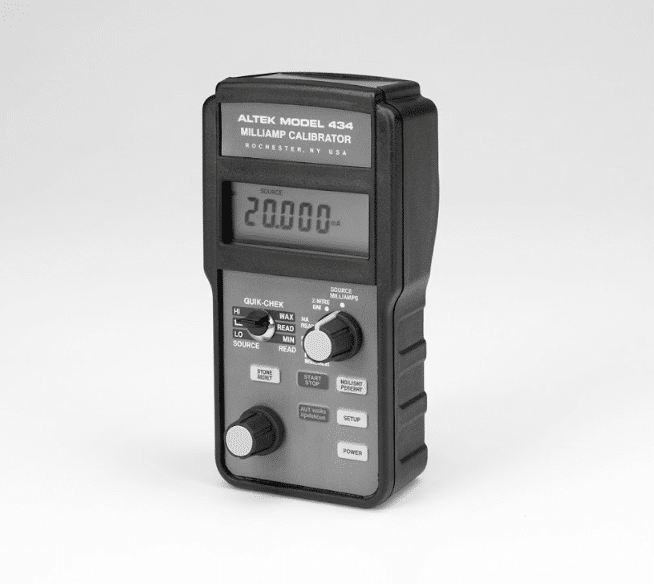
For any facility operating under ISO 9001 or ISO 14001, every measurement must be traceable to the International System of Units (SI). When you perform a Milliamp Calibrator Calibration at an accredited laboratory, you are establishing an unbroken chain of comparisons back to national standards. This traceability is a legal and commercial requirement during safety audits or when delivering products to international markets.
4.2. Risk Mitigation and Catastrophe Prevention
In industries like oil and gas or pharmaceuticals, a 0.5% error in a flow meter signal can result in financial losses of millions of dollars annually or, worse, a failure in a Safety Instrumented System (SIS). Calibration acts as a preventative insurance policy, identifying “out-of-tolerance” instruments before they cause a shutdown or an environmental incident.
4.3. Energy Efficiency and Sustainability
Inaccurate signals lead to “hunting” in control loops, where the system constantly over-corrects itself. This puts unnecessary wear on mechanical components and consumes excessive energy. Precision through calibration ensures that the plant operates at its “sweet spot,” maximizing throughput while minimizing the carbon footprint.
5. What Happens During a Professional Calibration?
A comprehensive Milliamp Calibrator Calibration at a professional metrology lab like Techmaster involves several rigorous stages:
-
As-Found Testing: The device is tested upon arrival to see if it was still accurate during its time in the field. This data is crucial for historical trend analysis.
-
Linearity and Hysteresis Check: Testing at multiple points (e.g., 4, 8, 12, 16, 20 mA) in both increasing and decreasing directions to ensure the electronic response is perfectly linear.
-
Stability Testing: Observing the signal over a period of time to ensure it does not fluctuate or produce “noise.”
-
Uncertainty Calculation: A professional certificate does not just provide a “Pass/Fail” result; it provides a calculated Measurement Uncertainty. This tells the user exactly how much confidence they can have in the reading, accounting for all environmental and equipment variables.
Conclusion: The Foundation of Reliable Automation
The move toward Industry 4.0 and the Industrial Internet of Things (IIoT) has not diminished the importance of the milliamp loop; it has increased the stakes. As systems become more automated and data-driven, the quality of the “input” data becomes paramount.
Milliamp Calibrator Calibration is not a luxury or a mere administrative task; it is the fundamental bridge between the digital control world and physical reality. By ensuring that your calibrators are accurate, traceable, and reliable, you are ensuring the longevity, safety, and profitability of the entire industrial process.
A common misconception in maintenance departments is that digital calibrators remain accurate indefinitely because they have no moving parts. In reality, electronic components, specifically precision resistors, voltage references, and Analog-to-Digital Converters (ADCs), suffer from “electronic drift” caused by:
Strategic Calibration Planning
Calibration is not an expense; it is insurance against unplanned downtime and material waste. Ensure your calibrators are ISO/IEC 17025 compliant today.
Frequently asked questions
What is Milliamp Calibrator Calibration?
How often should a Milliamp Calibrator be calibrated?
What standards apply to Milliamp Calibrator Calibration?
What is included on the certificate?
Can you calibrate the Milliamp Calibrator on-site?
Need Milliamp Calibrator calibration?
ANAB-accredited, NIST-traceable, fast turnaround, in-lab or on-site across the USA.
Contact us for a quoteReferences & industry standards
- ISO/IEC 17025 testing & calibration laboratory requirements
- NIST calibration services and measurement traceability
- A2LA / ANAB accreditation for calibration laboratories
External standards bodies. Techmaster Electronics is an ISO/IEC 17025-accredited, NIST-traceable calibration laboratory.

Khanh Nguyen is the Marketing Manager at Techmaster Electronics, a B2B marketing leader covering the test, measurement, and ISO/IEC 17025 accredited calibration industry in the United States.