


In the world of electrical manufacturing, the AC Hipot (High Potential) Safety Tester is the gatekeeper of consumer safety. Whether you are testing household appliances or industrial motors, the integrity of your dielectric withstand test depends entirely on one factor: Calibration. If your electrical safety analyzer is off by even a small percentage, you risk either shipping dangerous products or failing perfectly good units.
This guide explores everything you need to know about AC Hipot safety tester calibration, from the technical verification process to choosing on-site services that meet ISO 17025 standards.
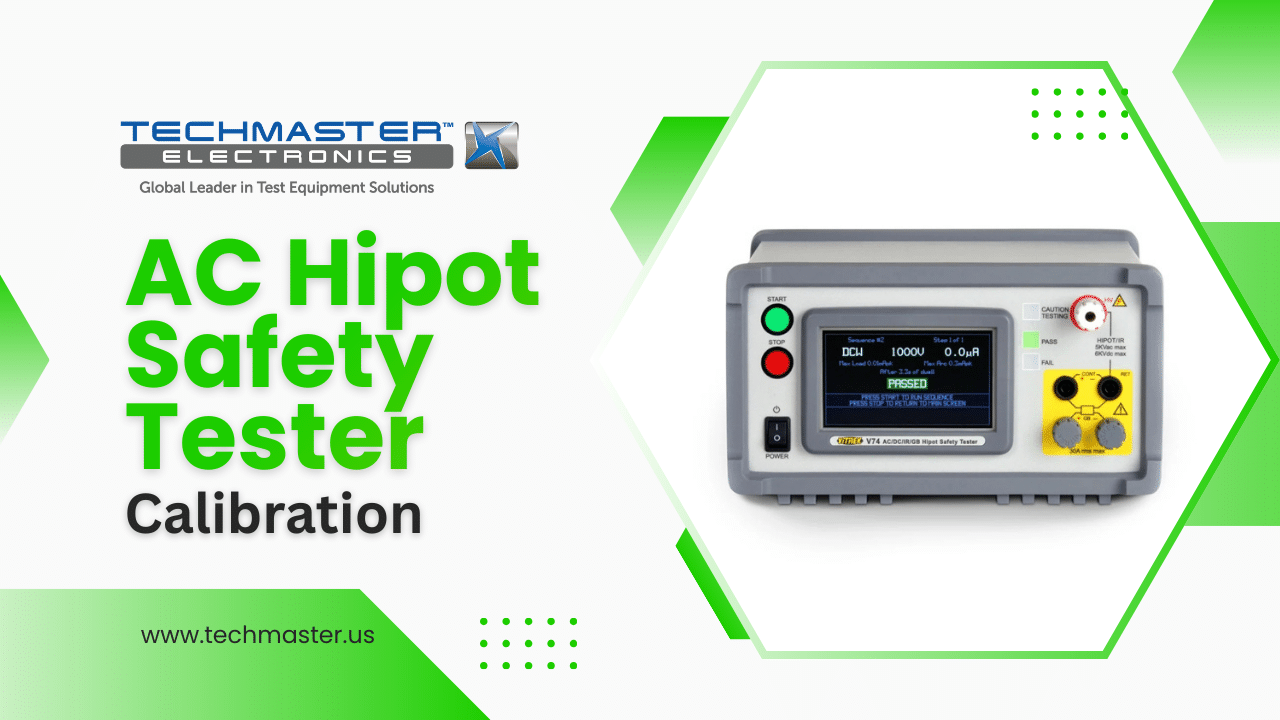
1. What is an AC Hipot Safety Tester?
An AC Hipot tester is a specialized instrument used to verify the electrical insulation of a device. By applying a high voltage—typically much higher than the operating voltage—between the product’s current-carrying components and its chassis, the tester ensures that no “leakage” occurs that could cause an electric shock.
Common Applications
-
Production Line Testing: Routine safety checks for consumer electronics.
-
Laboratory R&D: Stress-testing new insulation materials.
-
Field Maintenance: Verifying the integrity of installed transformers and switchgears.
2. Why Calibration is Non-Negotiable
A tester set to 5kV might output 4.8kV, failing to meet minimum UL/IEC standards.
ISO 9001/17025 facilities must prove measurement traceability to NIST standards.
A “false pass” leads to shipping dangerous products, risking brand reputation and litigation.
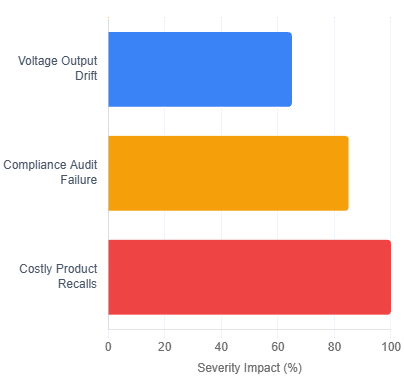
Relative severity of risks associated with uncalibrated equipment.
Electrical safety analyzer calibration is not just a “good-to-have” procedure; it is a regulatory requirement. Here is why:
Ensuring Accuracy in High Voltage
Over time, internal components like capacitors and resistors drift. A tester set to $5kV$ might actually be outputting $4.8kV$, failing to meet the minimum safety standard required by UL or IEC.
Compliance and Audit Readiness
If your facility is ISO 9001 or ISO 17025 certified, you must prove that your measuring equipment is traceable to national standards (NIST).
Avoiding Costly Recalls
A “false pass” is a nightmare scenario. Professional high voltage safety tester verification ensures that your safety margins are real, protecting your brand from litigation and recalls.
3. The Calibration Process: Step-by-Step
Pre-power check for frayed cables, damaged interlocks, and secure grounding connections.
Output is measured at specific intervals (e.g., 500V, 1000V, 5000V) using a high-voltage probe and calibrated DMM.
A fault is simulated to ensure the tester’s safety mechanisms trip within milliseconds of exceeding the current limit.
Using NIST-traceable stopwatches to confirm internal timers apply voltage for the exact standard duration (e.g., 60 seconds).
Effective calibration involves comparing the tester’s output against a high-precision standard (Master Meter).
Step 1: Visual Inspection
Before applying power, technicians check for frayed cables, damaged interlocks, and secure grounding.
Step 2: Voltage Accuracy Verification
The tester is set to specific intervals (e.g., $500V, 1000V, 5000V$). A high-voltage probe and a calibrated digital multimeter measure the actual output.
Step 3: Leakage Current Measurement
One of the most critical parts of electrical safety analyzer calibration is verifying the trip current. We simulate a fault to ensure the tester shuts down within milliseconds of exceeding the limit.
Step 4: Timer Verification
Most safety standards require the voltage to be applied for a specific duration (e.g., 60 seconds). We use NIST-traceable stopwatches to verify internal timer accuracy.
4. On-Site Hipot Tester Calibration Services
Many facilities cannot afford the downtime of shipping heavy equipment to a lab. On-site Hipot tester calibration services offer a strategic advantage.
Benefits of On-Site Calibration:
-
Zero Downtime: Equipment remains on your production line.
-
Reduced Risk: No chance of shipping damage to sensitive high-voltage components.
-
Environmental Testing: The equipment is calibrated in the exact temperature and humidity conditions where it operates.
5. Understanding Semantic Requirements: Verification vs. Calibration
In technical circles, high voltage safety tester verification is often confused with calibration.
-
Calibration is the formal process of measuring performance against a standard and adjusting if necessary.
-
Verification (or a “bump test”) is a daily check using a “Go/No-Go” box to ensure the machine is still functioning before a shift begins.
Both are essential for a robust quality management system.
Service Frequency & Logistics
Determine the right calibration schedule and execution strategy for your facility.

Recommended calibration intervals based on facility volume.
✓
Equipment never leaves the production line, eliminating shipping delays.
✓
Eliminates the risk of shipping damage to highly sensitive high-voltage components.
✓
Calibrated in the exact temperature and humidity conditions of its actual operating environment.
6. FAQ
How often should a Hipot tester be calibrated?
Most manufacturers and ISO standards recommend annual calibration (every 12 months). However, in high-volume production environments, semi-annual calibration is preferred.
What is the difference between AC and DC Hipot testing?
AC Hipot testing uses alternating current and is better for testing products that will operate on AC power, as it stresses the insulation’s capacitance. DC Hipot testing is often used for cables and long runs where AC leakage current would be too high.
Can I calibrate my Hipot tester in-house?
Only if you have NIST-traceable high-voltage standards and a controlled environment. For most companies, using an ISO 17025 accredited laboratory is more cost-effective and legally sound.
How often should our team schedule AC Hipot Safety Tester Calibration?
Most manufacturers recommend that you perform AC Hipot Safety Tester Calibration every 12 months to maintain ISO 17025 compliance and ensure your equipment provides accurate safety readings.
Does our facility need High voltage safety tester verification between official calibrations?
Yes, your operators should execute High voltage safety tester verification daily using a “Go/No-Go” load box to confirm the unit functions correctly before starting any production shift.
7. Conclusion
Investing in professional AC Hipot safety tester calibration is an investment in your company’s reputation and safety record. By ensuring your electrical safety analyzer is accurate, you protect your customers and your bottom line.
