


In the world of high-voltage electrical engineering, precision isn’t just a goal—it’s a safety requirement. When you are measuring the performance of a Current Transformer (CT), your results are only as reliable as the instrument you use. This brings us to a critical but often overlooked process: Current Transformer Tester calibration. Whether you are using a legacy unit or a modern digital analyzer like the Vanguard EZCT 2000, regular verification and instrument transformer tester adjustment are the only ways to guarantee that your “pass” or “fail” readings actually reflect reality.
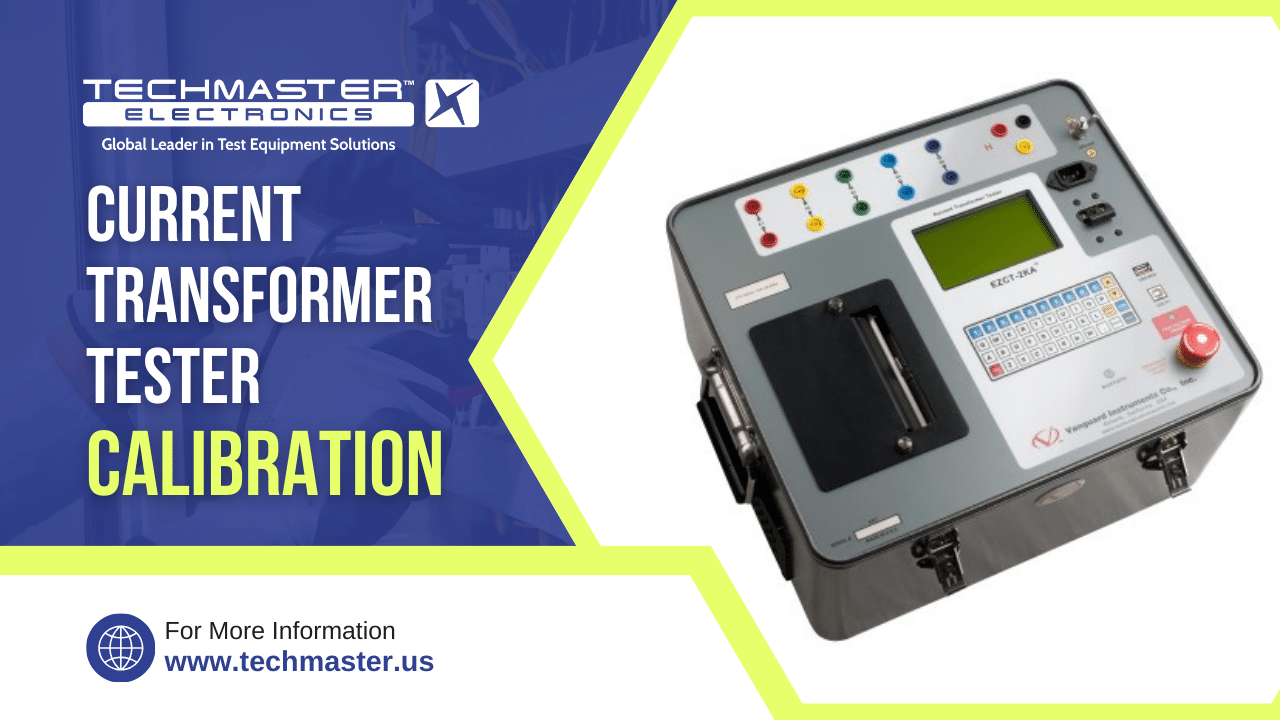
What is a Current Transformer (CT) Tester?
A Current Transformer Tester is a specialized instrument designed to evaluate the health and accuracy of CTs. These devices perform a battery of essential tests, including:
-
Excitation (Saturation) Testing: Determining the knee point of the CT.
-
Ratio Testing: Comparing the primary current to the secondary output.
-
Polarity Testing: Ensuring the CT is installed in the correct orientation.
-
Winding Resistance: Measuring the DC resistance of the internal coils.
Applications in the Field
These testers are indispensable for:
-
Commissioning: Verifying new CTs before they go live in a substation.
-
Preventive Maintenance: Detecting insulation breakdown or core saturation issues before they cause system failures.
-
Troubleshooting: Identifying why protection relays are tripping unexpectedly.
The “Hidden” Risks of Accuracy Drift
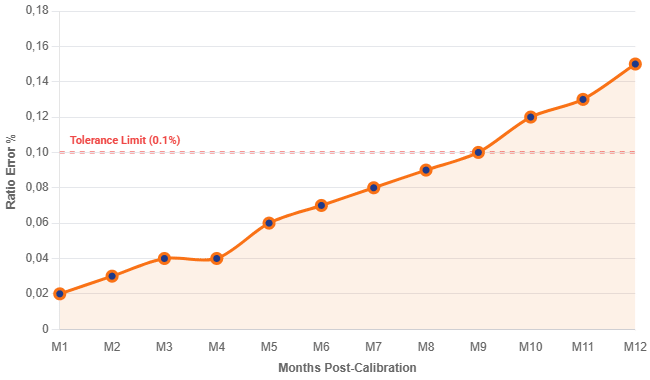
While many technicians trust their screen readings implicitly, accuracy drift in CT analyzers often occurs without a single error code or warning light. Consequently, internal reference components—such as the high-precision shunts and voltage dividers inside a Vanguard EZCT 2000—undergo subtle thermal and mechanical aging. Moreover, the harsh electromagnetic interference (EMI) found in active 500kV substations can degrade the calibration constants stored in the unit’s EEPROM over time.
Nevertheless, the danger isn’t just a slightly wrong number; it is the compounding of measurement uncertainty. If your tester has drifted by just $0.5\%$, and your CT is already at the edge of its $1.0\%$ accuracy class, you might “pass” a defective unit that will later cause a protection relay to miscalculate a fault. Therefore, regular instrument transformer tester adjustment acts as a critical failsafe, ensuring that your field data aligns with the rigid traceability requirements of NIST and ISO/IEC 17025.
Why Calibration and Verification are Non-Negotiable
You might ask, “If my tester turns on and gives a reading, why do I need to calibrate it?” Here is why instrument transformer tester adjustment is vital:
1. Accuracy and Traceability
Calibration links your device’s measurements to a national standard (like NIST). This “chain of traceability” is often required for insurance purposes and regulatory compliance.
2. Avoiding Nuisance Tripping
If a CT tester provides an inaccurate ratio reading, a technician might incorrectly adjust a protective relay. This can lead to nuisance tripping (cutting power when there is no fault) or, worse, a failure to trip during a real fault, leading to catastrophic equipment damage.
3. Compliance with IEEE and IEC Standards
Standard bodies like the IEEE (C57.13) and IEC (61869) set strict limits on CT error. To certify that a CT meets these standards, your testing equipment must have an uncertainty level significantly lower than the CT itself.
The Professional Calibration Process
Current transformer analyzer verification is a meticulous process usually performed in a controlled laboratory environment. Here is how a professional lab handles a unit like the Vanguard EZCT 2000:
Step 1: Visual Inspection and Firmware Check
Before electrical testing, the unit is inspected for physical damage to terminals and screens. Firmware is updated to ensure the latest measurement algorithms are being used.
Step 2: Reference Comparison (Ratio & Phase)
The lab uses a high-precision “Standard CT” and a calibrated burden. The tester is used to measure this known standard. Any deviation between the tester’s reading and the standard’s value is recorded as the “as-found” data.
Step 3: Voltage and Current Injection Verification
The lab verifies the tester’s internal source. For the EZCT 2000, this involves checking the accuracy of the 0-200V excitation voltage and the current measurement circuits across multiple ranges.
Step 4: Adjustment
If the “as-found” data exceeds the manufacturer’s tolerance (e.g., for ratio), the technician performs an adjustment. This involves tweaking the internal software constants so the displayed values align with the reference standards.
Step 5: Final Certification
Post-adjustment, a final set of “as-left” data is recorded. A Calibration Certificate is issued, detailing the uncertainty of measurement and the environmental conditions during the test.
Technical Comparison & Decision Logic
Choosing the right calibration strategy requires understanding how different architectures handle measurement. For instance, legacy “voltage injection” units like the EZCT 2000 series are renowned for their “bulletproof” durability and built-in insulation resistance (IR) testing—a feature often missing in newer, lighter competitors. On the other hand, modern model-based analyzers utilize low-voltage injection and complex mathematical algorithms to “predict” the excitation curve.
While these lighter units offer speed, they require specialized software verification that differs significantly from traditional high-voltage injection testing. In contrast, calibrating a Vanguard unit involves a straightforward verification of its 2000Vac source and its secondary current measurement accuracy. Ultimately, whether you prioritize the integrated thermal printer of the EZCT or the portability of a digital analyzer, your current transformer analyzer verification must account for these specific hardware behaviors to ensure valid, repeatable results during commissioning.
FAQ
How often should I calibrate my CT Tester?
Most manufacturers recommend an annual (12-month) calibration cycle. However, if the unit is used in harsh environments or has been dropped, a mid-cycle verification is advised.
Can I verify the EZCT 2000 in the field?
While full calibration requires a lab, you can perform a field verification by testing a “Check CT”—a high-accuracy CT that you keep specifically for reference and never install in a permanent circuit.
What is the difference between calibration and verification?
Verification is checking the device against a standard to see if it is still within limits. Calibration involves the full process of measuring, documenting, and (if necessary) adjusting the device to bring it back into spec.
What is the purpose of instrument transformer tester adjustment?
While verification identifies if a device is out of tolerance, instrument transformer tester adjustment is the corrective action taken to re-align the unit’s internal sensors with a known reference standard. This ensures your Vanguard EZCT 2000 provides the highest level of measurement certainty required for critical substation commissioning and protection relay testing.
Conclusion
A Current Transformer Tester is a precision instrument, not a simple multimeter. Ensuring that your Vanguard EZCT 2000 or any other CT analyzer undergoes regular professional calibration is the only way to maintain the integrity of your power system data. Don’t let a “drifting” instrument compromise the safety and reliability of your electrical infrastructure.
Secure Your Infrastructure
A Current Transformer Tester is a precision instrument, not a simple multimeter. Don’t let a “drifting” instrument compromise the safety, reliability, and legality of your electrical data.
