


Imagine this: You manage a pharmaceutical warehouse storing millions of dollars in life-saving vaccines. Your data loggers report a steady 5°C, safely within the required margin. However, during a routine regulatory audit, the inspector discovers that you haven’t put your devices through professional ISO 17025 data logger calibration against a traceable standard in over 14 months. Suddenly, you risk the integrity of your entire inventory. You face potential product recalls, massive financial losses, and a ruined reputation. The problem isn’t that your loggers failed; the problem is that you cannot prove their accuracy. This lack of “metrological traceability” acts as a ticking time bomb for any business relying on environmental monitoring. A robust, ISO 17025-accredited calibration regime provides the solution, transforming your data from simple numbers into legally defensible evidence of quality.
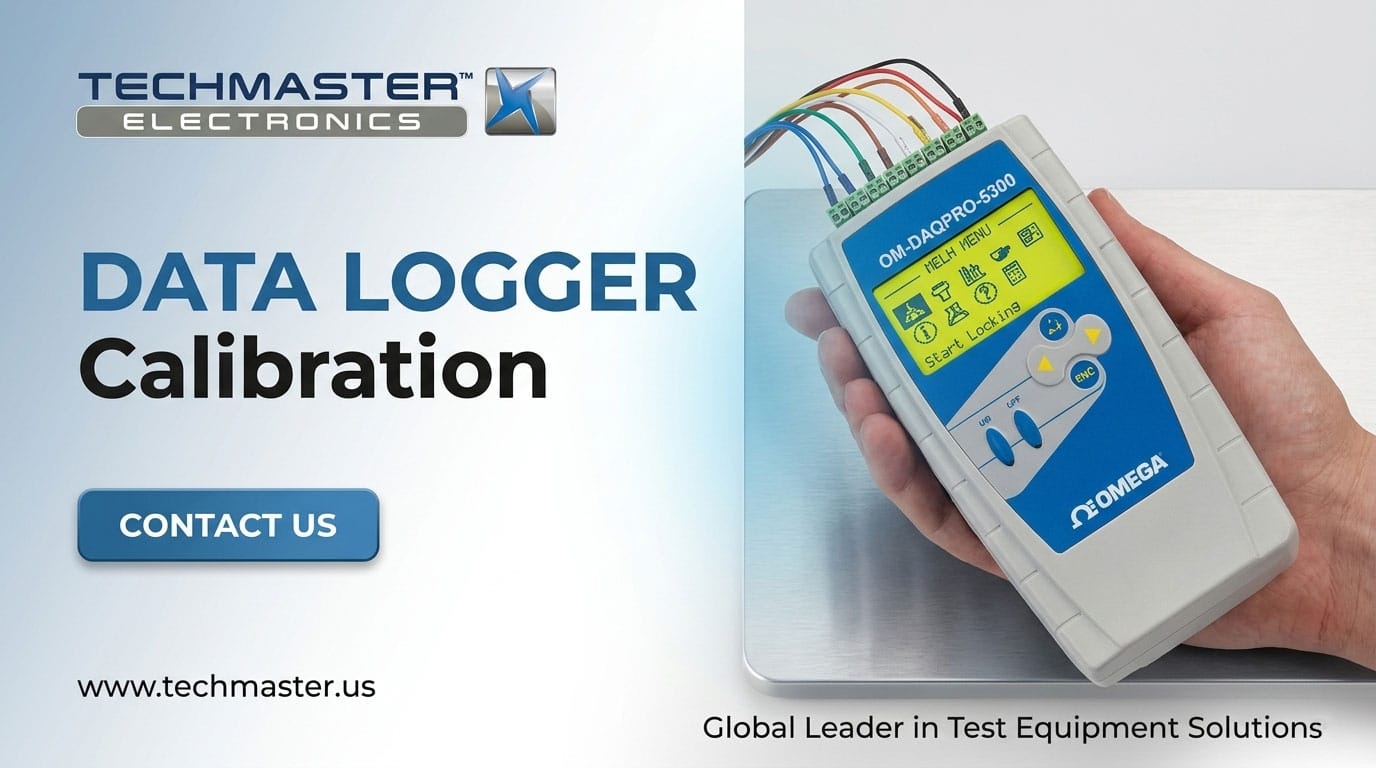
Overview of Data Loggers and Their Critical Applications
A Data Logger is an electronic device that records data over time or in relation to location, using either built-in sensors or external instruments. In today’s data-driven industries, these devices serve as the “silent sentinels” of quality control.
From monitoring the Cold Chain in logistics to maintaining stability in semiconductor Clean Rooms, data loggers play a vital role everywhere. Key industries rely on them:
- Healthcare & Pharma: They monitor blood banks, vaccine fridges, and incubators to comply with 21 CFR Part 11.
- Food Industry: They track temperatures during pasteurization, storage, and transport for HACCP compliance.
- HVAC/R: They assess building performance and energy efficiency.
- Laboratory Research: They maintain the precise environmental conditions required for sensitive chemical reactions.
Without regular calibration, even the most expensive digital logger eventually suffers from “sensor drift.” This natural phenomenon occurs when aging, environmental stress, or physical shock causes the device’s readings to deviate from the truth.
1. Why Data Logger Calibration is Non-Negotiable
The Science of Sensor Drift
Every sensor—whether a thermistor, thermocouple, or capacitive humidity sensor—changes over time. External factors like extreme temperatures, high humidity, or chemical exposure accelerate this process. Calibration reveals exactly how far your device has “drifted” from a known reference point.
Financial and Legal Implications
In the world of audits (ISO, FDA, WHO), the mantra remains: “if you didn’t document and calibrate it, it didn’t happen.” A NIST traceable calibration certificate serves as your insurance policy. It proves the link between your measurements and the International System of Units (SI) through an unbroken chain of comparisons.
2. ISO/IEC 17025: The Gold Standard for Calibration
When you evaluate Data Logger Calibration services, prioritize the ISO/IEC 17025 accreditation. While ISO 9001 focuses on management systems, ISO 17025 specifically certifies a laboratory’s technical competence.
Components of an ISO 17025 Accredited Calibration:
- Uncertainty Budgets: The laboratory must calculate and report the “Measurement Uncertainty.” This value quantifies the exact level of “doubt” regarding the calibration result.
- Environment Control: The lab must perform the calibration in a facility where technicians strictly control temperature and humidity to prevent external influence on the sensors.
- Competent Personnel: Only trained metrologists may perform the tests and sign off on the official results.
3. The Step-by-Step ISO/IEC 17025 Calibration Procedure
The ISO 17025 Calibration Procedure
Step 1: Pre-Calibration Inspection (As-Found)
Inspection for physical damage. Initial readings reveal if the logger recorded incorrectly before adjustments, triggering Root Cause Analysis if out of tolerance.
Step 2: Stabilization & Soak
Devices are placed in a highly stable environment (e.g., dry-block calibrator) with a Master Reference Standard to reach thermal equilibrium.
Step 3: Multi-Point Testing
Testing across the operational range (e.g., -20°C, 0°C, +40°C) to verify linearity, rather than relying on a single data point.
Step 4: Comparison & Adjustment
Readings are checked against the NIST-traceable Master. Deviations exceeding manufacturer specs prompt physical/software adjustments.
Step 5: Post-Verification (As-Left)
The multi-point test is repeated. These final readings confirm the device performs strictly within specified accuracy limits.
Step 6: Certificate Issuance
Generation of legal proof containing serial numbers, conditions, detailed measurement data, uncertainty values, and the traceability statement.
A professional calibration is a systematic process. Here is how a high-level laboratory handles your device:
Step 1: Pre-Calibration Inspection (As-Found Data)
The device is inspected for physical damage and battery health. The first set of readings taken is the “As-Found” data. This is crucial because it tells you if your logger was recording incorrectly before any adjustments were made. If the As-Found data is outside of tolerance, you may need to perform a “Root Cause Analysis” on your past stored data.
Step 2: Stabilization in a Controlled Environment
Data loggers cannot be calibrated instantly. They must be placed in a stable environment (like a dry-block calibrator or a humidity chamber) along with a Master Reference Standard. The devices must “soak” until they reach thermal equilibrium.
Step 3: Multi-Point Testing
Calibration is never done at just one point. For a standard temperature logger, we typically test at three or more points (e.g., -20°C, 0°C, and +40°C) to check for linearity across the device’s entire operating range.
Step 4: Comparison and Adjustment
The readings from the Data Logger are compared against the Master Reference (which is NIST traceable). If the error exceeds the manufacturer’s specifications, the device is adjusted (if possible).
Step 5: Post-Calibration Verification (As-Left Data)
After adjustment, the multi-point test is repeated. These final readings are recorded as “As-Left” data, confirming the device is now performing within its specified accuracy limits.
Step 6: Certificate Issuance
A comprehensive report is generated, including:
- Serial numbers of the logger and reference standards.
- Calibration dates and environmental conditions.
- Detailed measurement data and uncertainty values.
- Traceability statement.
4. On-Site Data Logger Calibration Services: Efficiency vs. Precision
For many facilities, sending 500 loggers to a lab is a logistical nightmare. This is where On-site data logger calibration services become invaluable.
Advantages of On-Site Calibration:
- Zero Downtime: Devices stay within your facility; you don’t lose days to shipping.
- Environmental Context: Loggers are calibrated in the actual environment where they operate.
- Immediate Results: Technicians can identify failing units on the spot, allowing for immediate replacement.
When to Choose the Lab:
While on-site service is convenient, laboratory calibration is generally preferred for high-precision requirements where the lowest possible measurement uncertainty is required, as labs offer superior environmental stability.
5. How Often Should You Calibrate?
The industry standard is annually (12 months). However, a expert-level “Risk-Based Approach” suggests:
- High-Risk Applications (Vaccines/Biologicals): Every 6 months.
- Stable Warehouse Monitoring: Every 12-24 months.
- Post-Incident: Always calibrate if a device is dropped, exposed to extreme conditions, or shows suspicious data spikes.
6. Expert Tips for Maintaining Data Integrity
Based on decades of field experience, here is how you can ensure your data loggers stay reliable between calibration cycles:
- Perform “Ice-Point Checks”: Every month, place your temperature probes in a well-mixed ice bath (0°C). It’s a simple, low-cost way to verify there hasn’t been a massive shift in accuracy.
- Battery Management: A low battery can cause a processor to glitch or a sensor to provide erratic voltage signals. Always replace batteries before sending them for calibration.
- Sensor Placement: Avoid placing loggers directly against walls or near cooling fans. This creates “micro-climates” that don’t represent the actual room temperature.
- Protect from Contaminants: In food or chemical environments, sensors can become coated in oils or dust. Use protective caps or “socks” if the manufacturer allows, as buildup on a sensor drastically increases response time and error.
- Digital Twin Documentation: Maintain a digital folder for every serial number, containing its entire calibration history. This “cradle-to-grave” record is exactly what auditors look for to prove a culture of quality.
7. FAQ
Q1: Can I calibrate my own data loggers using a reference thermometer? Answer: You can perform a “verification,” but unless you have an accredited quality system, NIST-traceable standards, and a controlled environment, this will not be accepted as a formal “Calibration” by regulatory bodies like the FDA or ISO auditors.
Q2: What is the difference between “Traceable” and “Accredited” calibration? Answer: Traceable means there is a paper trail back to NIST. Accredited (ISO 17025) means a third-party body has verified the lab’s technical competence to perform that specific measurement. Most high-stakes industries require both.
Q3: My logger is brand new. Do I need to calibrate it? Answer: Yes. Most loggers come with a “Certificate of Conformance” from the factory, but this is often not a full calibration report. To meet ISO standards, you should have an initial calibration performed to establish a baseline.
Q4: What happens if my logger fails calibration? Answer: The lab will issue a “Fail” or “Out of Tolerance” report. You must then perform a “Deviation Report” or “Impact Assessment” to determine if the products monitored by that logger during the previous period were compromised.
Q5: Is NIST traceability valid outside the USA? Answer: Yes, through the ILAC Mutual Recognition Arrangement (MRA), NIST traceability is recognized globally, including by VILAS in Vietnam and other international accreditation bodies.
Conclusion
Data Logger calibration is not just a line item in your maintenance budget—it is the foundation of your quality assurance. By utilizing ISO 17025 data logger calibration and insisting on a NIST traceable calibration certificate, you protect your products, your customers, and your brand’s integrity. Whether you opt for the convenience of On-site data logger calibration services or the extreme precision of a laboratory, the key is consistency and technical rigor.
Don’t leave your compliance to chance.
Contact Our Accredited Calibration Team Now
