


In the modern industrial landscape, even a microsecond of power instability can result in millions of dollars in losses, equipment failure, or catastrophic safety incidents. Most facilities rely on sophisticated diagnostic tools, yet a critical question remains: when was the last time your Power Quality Analyzer was verified for accuracy? Inaccurate readings from an uncalibrated device are often more dangerous than no readings at all, as they provide a false sense of security while your infrastructure suffers from harmonic distortion or transient voltages. Power Quality Analyzer calibration is not just a maintenance checkbox; it is the cornerstone of electrical reliability, ensuring that your Three-Phase measurements reflect the true state of your power grid and preventing costly downtime through high-precision diagnostics.
1. Overview of Power Quality Analyzer and Their Applications
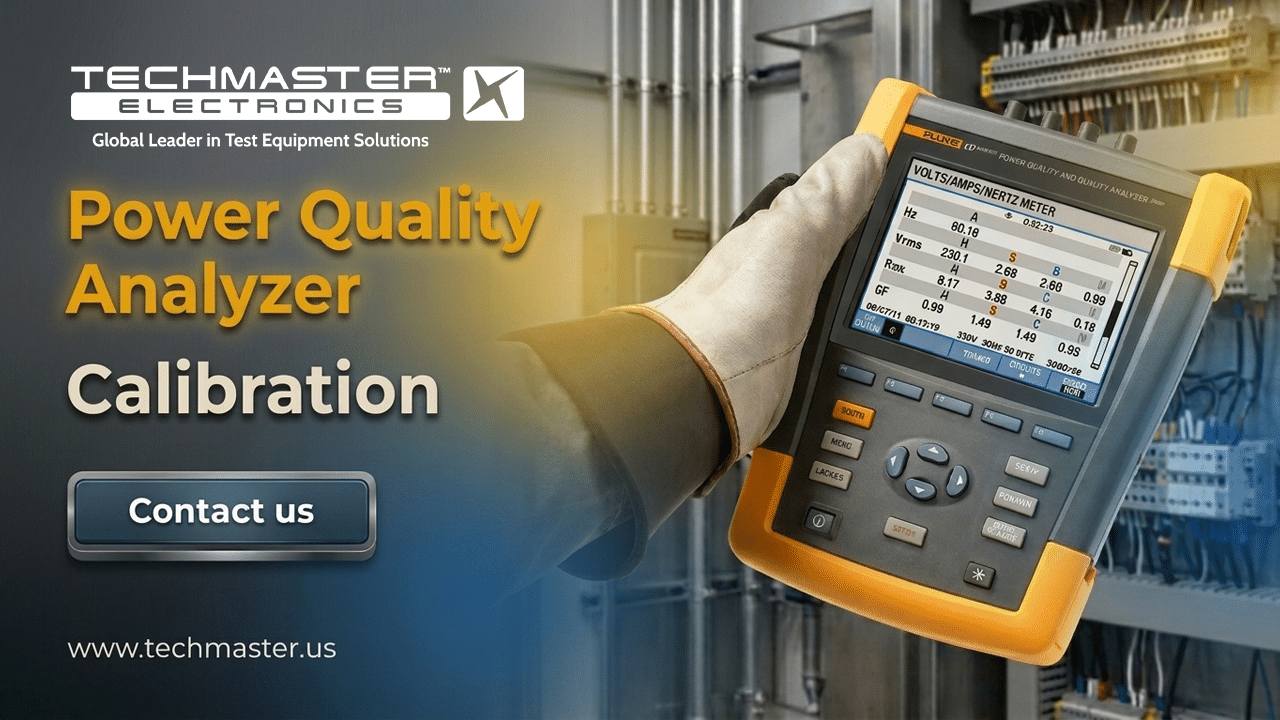
Power Quality Analyzers (PQAs) are the “stethoscopes” of the electrical world. These complex instruments measure a wide array of parameters, including voltage, current, frequency, harmonics, flicker, and transients. Unlike simple multimeters, a Power Analyzer calibration process must account for the synchronized measurement of multiple phases and the high-speed capture of anomalous events.
The Role of Three-Phase Power Quality Analyzers
In industrial and commercial environments, energy is almost exclusively delivered via three-phase systems. Three-Phase Power Quality Analyzer are designed to monitor the balance between these phases. An imbalance or harmonic distortion in a three-phase motor, for instance, can lead to excessive heat, reduced efficiency, and premature winding failure. Proper calibration ensures that the phase angle relationships and magnitude differences are reported with absolute certainty.
Key Applications
- Energy Audits: Identifying energy waste and optimizing consumption.
- Predictive Maintenance: Detecting harmonic issues before they burn out transformers.
- Troubleshooting: Pinpointing the source of mysterious equipment resets or failures.
- Compliance: Ensuring the facility meets international standards like IEEE 519 or EN 50160.
2. Why Calibration is Non-Negotiable
Electronic components drift over time. Factors such as temperature fluctuations, humidity, mechanical shock, and the aging of internal reference standards affect the accuracy of the PQA.
When you perform a Fluke power quality analyzer calibration, you are essentially comparing the instrument’s performance against a known traceable standard. If the device is “out of tolerance,” it is adjusted to bring it back within the manufacturer’s specified limits. Without this process, your data integrity is compromised, leading to:
- Incorrect Harmonic Analysis: Overlooking high-order harmonics that damage sensitive electronics.
- Financial Discrepancies: Inaccurate power factor readings leading to utility penalties.
- Safety Risks: Failing to detect dangerous transient overvoltages.
3. The ISO/IEC 17025 Calibration Process
To achieve the highest level of trust, calibration should be performed in a laboratory accredited to ISO/IEC 17025. This standard ensures that the lab has a proven management system and the technical competence to produce valid results.
H3: Step 1: Visual Inspection and Preliminary Testing
Before the actual measurement starts, the device undergoes a physical check. Technicians look for damaged terminals, cracked screens, or frayed leads. A “pre-test” or “as-found” reading is recorded to see how much the device drifted since its last service.
H3: Step 2: Test Setup and Environmental Stabilization
The analyzer is placed in a climate-controlled environment (typically $23^\circ \text{C} \pm 3^\circ \text{C}$) to stabilize. This is crucial because thermal expansion in the internal circuitry can affect high-precision measurements.
H3: Step 3: Multi-Parameter Reference Comparison
Using a high-precision multi-product calibrator (like the Fluke 6100B series), the following parameters are verified across all phases of the Three-Phase unit:
- Voltage Magnitude: Testing from 0V up to the maximum rated capacity.
- Current Magnitude: Using current coils or direct input to verify amperage accuracy.
- Phase Angle: Ensuring the $120^\circ$ separation between phases is measured accurately.
- Harmonics: Injecting specific harmonic frequencies (up to the 50th or 100th) to verify the FFT (Fast Fourier Transform) accuracy.
- Flicker and Transients: Simulating rapid voltage changes to test the instrument’s response time.
H4: Traceability and Uncertainty
Every measurement must be traceable to SI units through a National Metrology Institute (like NIST). Furthermore, the lab must calculate the Measurement Uncertainty, providing a statistical “margin of error” for the calibration.
H3: Step 4: Adjustment and “As-Left” Documentation
If the PQA is out of spec, technicians perform an internal adjustment. A second set of readings, the “As-Left” data, is recorded to prove the device is now functioning within the manufacturer’s tolerances.
4. Specific Considerations for Fluke Power Quality Analyzer Calibration
Fluke is the industry standard for power quality. However, Fluke power quality analyzer calibration requires specialized software and hardware. Many Fluke models utilize proprietary algorithms for calculating “Energy Loss” or “Inrush Current.” A generic calibration lab might verify basic Volts and Amps but fail to test the sophisticated logic that makes a Fluke PQA valuable. Always ensure your service provider has the specific procedures for your Fluke model (e.g., Fluke 435-II, 1770 Series).
5. Expert Tips for Maintaining Device Reliability
Drawing from two decades in the field, here is how you can extend the life and accuracy of your equipment between calibration cycles:
- Lead Management: Your measurement is only as good as your probes. Never kink or tightly coil your current clamps or voltage leads. Inspect the insulation for nicks before every use.
- Battery Health: Modern PQAs are power-hungry. Always store the device with a 40-60% charge if not in use for long periods. A leaking or dead battery can cause internal voltage reference issues.
- Firmware Updates: Manufacturers frequently release firmware to improve calculation accuracy. Ensure your firmware is updated before sending it for calibration, as updates can sometimes shift the calibration constants.
- Zeroing the Probes: Before taking measurements on a Three-Phase system, always perform a “Zero” or “Null” calibration of your current clamps in the field to account for ambient magnetic interference.
- Environmental Shielding: When logging data in the field, avoid placing the analyzer directly on top of high-vibration equipment or near strong electromagnetic fields (like VFDs), which can introduce noise into the internal ADC (Analog-to-Digital Converter).
6. FAQ
Q1: How often should I calibrate my Power Quality Analyzer?
- Answer: The standard industry recommendation is every 12 months. However, if the device is used daily in harsh environments or if you are performing a critical compliance audit, a 6-month cycle is safer.
Q2: Can I calibrate my PQA in-house?
- Answer: Unless you have a multi-thousand dollar reference calibrator and a controlled environment, in-house calibration is usually just a “functional check.” It does not provide the traceability required for ISO compliance.
Q3: What is the difference between “Calibration” and “Verification”?
- Answer: Verification is a quick check to see if the device is working. Calibration is a formal process that compares the device to a standard, documents the error, and involves adjustments to meet specifications.
Q4: My PQA is brand new; do I need to calibrate it?
- Answer: Yes. While devices come with a factory certificate, shipping and storage conditions can affect accuracy. Most quality systems require a “Freshly Calibrated” certificate before a tool is entered into the asset management system.
Q5: Will calibration fix a broken screen or faulty buttons?
- Answer: No. Calibration is for measurement accuracy. Physical repairs are a separate service, though most accredited labs will notify you of physical defects during the initial inspection.
7. Conclusion
In the world of electrical engineering, precision is the difference between a high-performing facility and a disaster waiting to happen. Regular Power Quality Analyzer calibration, especially for sophisticated Three-Phase Power Quality Analyzer, ensures that your data is defensible, your equipment is protected, and your energy audits are accurate. By adhering to ISO/IEC 17025 standards and maintaining your Three-Phase instruments with expert care, you safeguard both your professional reputation and your company’s bottom line.
Is your equipment due for a check-up? Don’t wait for a power failure to find out your analyzer was wrong. Contact an accredited calibration laboratory today to schedule your Power Analyzer calibration and ensure your facility is running at peak precision.
