


Precision is the backbone of every industrial process. From pharmaceutical production to oil & gas, from laboratory testing to HVAC control, accurate measurements ensure safety, efficiency, and regulatory compliance. Among all calibration tools available today, Precision Calibrators stand out for their superior accuracy and stability—making them essential in modern instrumentation work.
This guide provides a deep, practical look at Precision Calibrator Calibration, bringing together industry standards, real-world applications, and expert insights from Techmaster—one of Vietnam’s leading ISO 17025-accredited calibration laboratories.
Whether you’re an engineer, a QA/Compliance manager, a procurement officer, or someone new to calibration, this article gives you a clear, trustworthy roadmap.
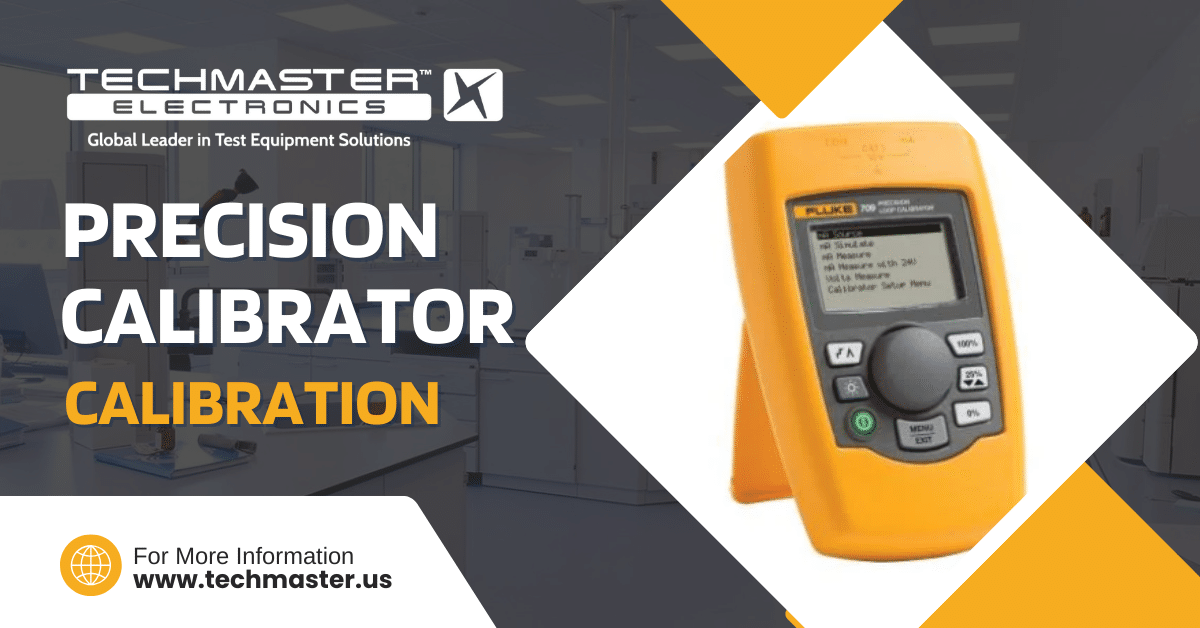
1. What Is a Precision Calibrator?
A Precision Calibrator is a high-accuracy device used to source or measure electrical signals—typically voltage, current, resistance, frequency, or temperature simulation—with extremely low uncertainty.
These are often used for:
-
Calibration of transmitters and sensors
-
Verification of PLC input/output
-
Testing multimeters and panel meters
-
Ensuring accuracy in laboratory equipment
-
Troubleshooting signal integrity issues
Compared to standard process calibrators, precision models deliver higher resolution, better stability, and lower measurement uncertainty — making them ideal for critical or regulated environments.
2. Why Precision Calibrator Calibration Matters
Even the best precision calibrators drift over time. Electrical components age. Temperature cycles cause mechanical stress. Regular usage wears down internal references.
Calibration ensures that:
-
The output values remain within manufacturer specifications
-
Measurement accuracy is traceable to international standards (ISO/IEC 17025)
-
Results are accepted in audits such as GMP, GLP, ISO 9001, ISO 14001, IATF 16949
-
Engineers maintain confidence in every reading
For industries with strict regulation—pharmaceutical, food & beverage, energy, laboratories—precision calibration is not optional; it is a compliance requirement.
3. How Precision Calibration Differs from Standard Process Calibration
| Feature | Precision Calibration | Standard Process Calibration |
|---|---|---|
| Accuracy | Very high (ppm level) | Medium (industrial tolerance) |
| Stability | Long-term, low drift | Adequate for field use |
| Use Case | Reference labs, QA checks, R&D, critical processes | Field maintenance, troubleshooting |
| Equipment Cost | Higher | Moderate |
| Required Expertise | Advanced | Intermediate |
In short, precision calibrators are the “master references” while process calibrators are the frontline tools used daily in the field.
4. Types of Precision Calibrators
A comprehensive understanding includes 3 main categories:
4.1 Electrical Precision Calibrators
Output high-stability V, mV, mA, ohm, frequency
Used to calibrate DMMs, PLC inputs, automation controllers.
4.2 Temperature Precision Calibrators
Simulate RTD, thermocouple signals
Used for thermal systems, HVAC, lab furnaces.
4.3 Multifunction Precision Calibrators
Combine multiple output types in one unit
Ideal for labs needing versatile, ISO-traceable verification tools.
5. What Is Precision Calibrator Calibration?
Precision Calibrator Calibration is the process of verifying and adjusting the calibrator against a higher-accuracy reference standard. This ensures its output values are precise and traceable.
A proper process includes:
-
Pre-inspection – visual check, functional check, battery/connector condition
-
Warm-up period – 30 minutes to ensure internal references stabilize
-
Environmental control – strict temperature & humidity conditions
-
Measurement comparison – between calibrator output and laboratory reference
-
Adjustment (if required) – fine-tuning internal reference modules
-
Verification – confirming performance meets specification
-
Documentation – generating a traceable calibration certificate
This is why not all labs can perform precision calibrator calibration services: it requires high-end reference equipment, controlled environmental rooms, and ISO 17025 competence.
6. Standards & Compliance Requirements
A professional calibration process follows:
-
ISO/IEC 17025 — competence of testing/calibration labs
-
IEC 61010 — electrical safety
-
IEC 61326 — EMC performance
-
Manufacturer specifications (Fluke, WIKA, Ametek, Additel, Keysight)
-
Industry-specific regulatory needs:
-
GMP & FDA 21 CFR Part 11
-
ISO 9001 quality audits
-
IATF 16949 automotive requirements
-
Your calibration certificate should always include:
-
As-found & as-left data
-
Uncertainty values
-
Environmental conditions
-
Traceability details
-
Pass/Fail status
-
Technician signature & lab accreditation seal
7. Typical Calibration Procedures
7.1 Voltage Output Test
-
Source DCV across ranges
-
Compare with 8½ or 7½-digit reference DMM
-
Record deviation & uncertainty
7.2 Current Output Test
-
Measure mA loop output using precision shunt
-
Test linearity at 0–20–100%
7.3 Resistance Simulation Test
-
Verify decade resistance values
-
Include low-ohm, mid, and high ranges
7.4 Frequency Output
-
Use reference frequency counter
-
Evaluate high-frequency stability
7.5 Temperature Simulation
-
RTD simulation (Pt100, Pt1000, Ni120)
-
Thermocouple simulation (K, J, T, R, S…) with CJC correction
By covering all these parameters, a lab ensures your device returns to you performing like a true high-accuracy reference.
8. Common Issues Found During Calibration
Engineers and QA teams often overlook these:
-
Output drift beyond manufacturer spec
-
Instability at low mV or low mA ranges
-
Noise or ripple in high-frequency output
-
CJC errors in thermocouple simulation
-
Damaged banana sockets or worn rotary selectors
These issues directly affect measurement accuracy in the field, so early detection saves production downtime.
Precision Calibrator Calibration — Key Concepts
Where Precision Calibrators Are Used
- R&D & Metrology Labs
- Manufacturing & Production Lines
- Aerospace & Defense Testing
- Energy, Utilities & Industrial Maintenance
- Calibration Service Providers
Traceability Pyramid
Sources of Measurement Uncertainty
Recommended Calibration Intervals
9. How Often Should You Calibrate a Precision Calibrator?
Most manufacturers recommend:
➡️ 12-month cycle for industrial applications
➡️ 6 months for high-critical or regulated environments
Rescheduling depends on:
-
Usage frequency
-
Working temperature environment
-
QA audit requirements
-
Industry regulation
10. Techmaster’s Capabilities in Precision Calibrator Calibration
As one of the top calibration service providers in Vietnam, Techmaster offers a complete solution for high-accuracy calibration needs.
10.1 ISO/IEC 17025 Accreditation
Techmaster’s laboratory is accredited to ISO 17025, ensuring full traceability to international standards.
10.2 High-End Reference Standards
Our lab is equipped with:
-
8½-digit Reference Multimeters
-
Precision resistance bridges
-
Multifunction electrical calibrators
-
Reference temperature sources
-
Automated calibration benches
This allows us to provide precision calibrator calibration services that meet or exceed OEM specifications.
10.3 Expert Engineering Team
Our technicians are professionally trained, with years of experience in:
-
Electrical calibration
-
Temperature simulation
-
Automation control instrumentation
We deliver results that engineers, QA teams, and procurement departments can trust.
10.4 Full Documentation for Audit Compliance
Every calibration includes:
-
As-found / As-left data
-
Uncertainty budget
-
Environmental conditions
-
Traceability chain
-
Pass/Fail evaluation
Ready for audits from ISO, GMP, FDA, or customer quality assessments.
11. Choosing the Right Lab: What to Look For
When selecting a calibration provider, ensure they have:
✔ ISO 17025 accreditation
✔ Environmental-controlled calibration rooms
✔ High-accuracy reference standards
✔ Long-term stability measurement capability
✔ Clear, transparent uncertainty reporting
✔ Quick lead time & reliable support
Techmaster meets all these criteria—making it a trusted partner for precision calibration across Vietnam and Southeast Asia.
12. Conclusion
Precision calibrators are the backbone of accurate industrial measurement. To maintain their reliability, Precision Calibrator Calibration must be performed regularly, using traceable standards, by a professionally accredited lab.
This guide has given you:
-
A clear understanding of precision calibrators
-
Their role in modern industry
-
Calibration processes, standards & procedures
-
Practical advice for QA teams, engineers & beginners
-
Insight into Techmaster’s professional capabilities
If you’re looking for trusted, ISO 17025-certified precision calibrator calibration services, Techmaster provides a solution that delivers accuracy, traceability, and peace of mind.
Need Support Selecting the Right Calibration Service?
Our certified engineers are ready to guide you through precision calibrator requirements,
standards, and calibration best practices.
