


Stop Watch Calibration: The Definitive Guide to Precise Time Measurement
In the landscape of modern industry, scientific research, and quality control, time is a critical dimension. Whether it is measuring the speed of a chemical reaction, the cycle time of a manufacturing process, or the duration of a safety-critical event, the accuracy of your measurement is paramount. A discrepancy of even a fraction of a second can lead to failed experiments, non-compliance, or significant financial loss. This is where Stop Watch Calibration becomes an essential pillar of industrial integrity.
⏱
Resolution
Typically ranges from 1/100 s to 1/1000 s for industrial-grade devices.
📝
ISO Standard
Ensures traceability in compliance with ISO/IEC 17025.
⚡
Quartz Frequency
Stable oscillation at the standard frequency of 32,768 Hz.
1. What is a Stop Watch?
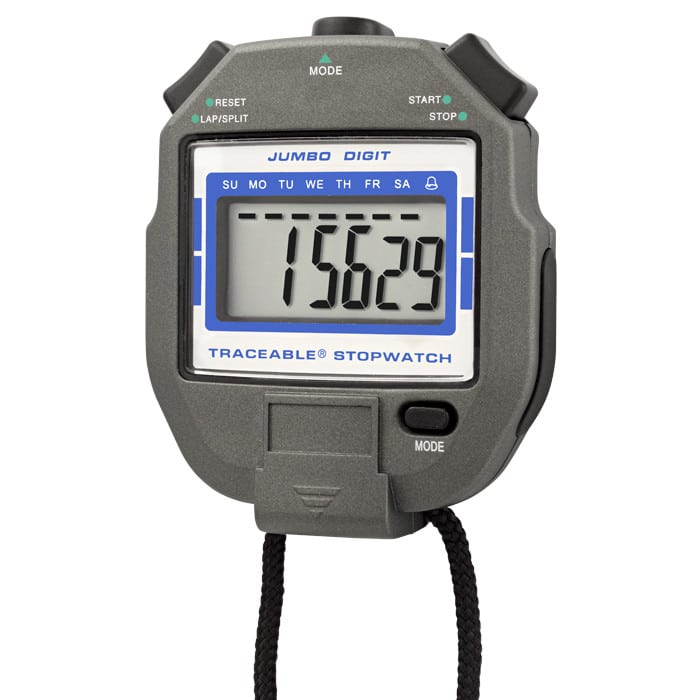
A Stop Watch is a precision timepiece designed to measure the amount of elapsed time from a particular starting point to the moment the instrument is stopped. Unlike a standard clock that tracks the time of day, a stop watch is built for event-specific measurement.
In professional environments, these devices are expected to provide high-resolution data, typically down to 0.01 seconds or even 0.001 seconds. They are categorized into two main types:
-
Mechanical Stop Watches: Utilizing a balance wheel and hairspring (largely replaced by digital versions in modern industry).
-
Digital Stop Watches: Powered by electronic circuits and crystal oscillators, offering superior durability and higher precision.
2. Working Principle: The Science of the Quartz Oscillator
Most industrial-grade digital stop watches operate on the Quartz Crystal Principle. This technology is what makes modern time measurement so reliable.
2.1. The Heart of the Device
Inside the stop watch lies a tiny, precision-cut piece of synthetic quartz. When an electric current from the battery is applied, the crystal vibrates (oscillates) at a very specific and stable frequency—typically 32,768 Hz (32,768 cycles per second).
2.2. Frequency Division
An Integrated Circuit (IC) within the device “counts” these oscillations. By using a series of flip-flops or frequency dividers, the IC divides the $32,768$ vibrations by $2^{15}$, resulting in exactly one electrical pulse per second. For high-resolution stop watches, the IC divides the frequency at different intervals to capture milliseconds.
2.3. Digital Display
The processed pulses are then sent to the Liquid Crystal Display (LCD). Because the vibration of quartz is so consistent, the stop watch can maintain remarkable accuracy over long periods—provided it is regularly verified through Stop Watch Calibration.
3. Critical Applications in Global Industry
🛠
Lean Manufacturing
Cycle time analysis to optimize production efficiency.
🔬
Laboratory Testing
Control reaction time and fluid flow measurements.
⚙
Equipment Validation
Verification of timers in industrial equipment.
The stop watch is far more than a tool for the athletic track; it is a foundational instrument in the following sectors:
3.1. Industrial Engineering and Lean Manufacturing
In the world of “Six Sigma” and “Lean,” every second counts. Engineers use calibrated stop watches to perform Time Studies. By measuring “Cycle Time” and “Takt Time,” factories can identify bottlenecks, set labor standards, and optimize production throughput.
3.2. Laboratory and Chemical Research
In R&D, the timing of a reaction can determine the success of a formula. From measuring the viscosity of a fluid as it flows through a viscometer to timing the incubation period of a biological sample, precise time measurement is a requirement for peer-reviewed results.
3.3. Equipment Verification
A calibrated stop watch is often used as a “Master Standard” to verify the accuracy of internal timers on other machines, such as:
-
Centrifuges in medical labs.
-
Industrial ovens and kilns.
-
Injection molding machines.
4. Why Stop Watch Calibration is Essential
Even though quartz technology is highly stable, it is not immune to the laws of physics. Over time, all electronic timers experience “Drift.”
4.1. The Impact of Temperature and Aging
Quartz crystals are sensitive to environmental changes. Extreme heat or cold can cause the crystal to expand or contract, slightly altering its vibration frequency. Additionally, electronic components undergo “Aging,” where their electrical properties shift subtly over years of use.
4.2. Determining Absolute Error
Calibration is the process of comparing your stop watch against a higher-tier reference standard, such as an Atomic Clock or a GPS-disciplined frequency generator. The goal is to determine the absolute error:
CALIBRATION FORMULA
E = T(measured) − T(standard)
Includes uncertainty from resolution, reference accuracy, and human reaction time.
Knowing this error allows you to apply a correction factor to your data, ensuring total accuracy.
4.3. Compliance and ISO/IEC 17025
For any facility operating under ISO 9001 or ISO 17025 standards, Stop Watch Calibration is a compliance requirement. Traceability—the ability to link your measurement back to national standards (like NIST)—is the only way to legally defend your quality control data during an audit.
5. The Professional Calibration Procedure
0️⃣1️⃣
Visual & Functional Check
Inspect buttons, display clarity, and battery condition.
0️⃣2️⃣
Reference Comparison
Compare with a frequency generator or atomic time standard.
0️⃣3️⃣
Multi-point Evaluation
Test at multiple intervals (1 min, 15 min, 1 hour).
When you send a stop watch to an accredited metrology lab, it undergoes a rigorous multi-step process:
-
Functional Check: Verification that buttons (Start, Stop, Lap, Reset) operate without mechanical delay or “contact bounce.”
-
Comparison Method: The stop watch is compared against a primary time standard. This is often done using an optical sensor or a high-speed camera system to eliminate the human “reaction time” error.
-
Multi-Point Testing: Calibration is performed across various intervals (e.g., 1 minute, 10 minutes, 1 hour) to check for linearity and stability over time.
-
Uncertainty Calculation: The lab provides a statement of Measurement Uncertainty, giving you a statistical range of how much “doubt” exists in the measurement.
6. Maintenance for Long-Term Accuracy
To maintain the integrity of your device between Stop Watch Calibration cycles, follow these best practices:
-
Battery Management: Low voltage can affect the IC’s ability to count pulses accurately. Replace batteries at the first sign of a fading display.
-
Environmental Protection: Avoid storing stop watches near strong electromagnetic fields (like large motors or magnets) which can interfere with the electronic circuitry.
-
Calibration Frequency: A 12-month calibration cycle is the industry standard. However, for high-precision laboratory work, a 6-month cycle is recommended.
Conclusion
A stop watch is a small tool with a massive impact on industrial efficiency and scientific validity. While the internal quartz crystal provides the foundation for measurement, only regular Stop Watch Calibration provides the certainty required by modern quality standards. By investing in professional calibration, you protect your data, your products, and your professional reputation.
STOP WATCH CALIBRATION
From Concept to Advanced Procedure
In metrology, time is not just a number — it is a critical parameter that defines data integrity.
