


Industrial Temperature Control Solutions: From Operating Principles to Standard Calibration Procedures
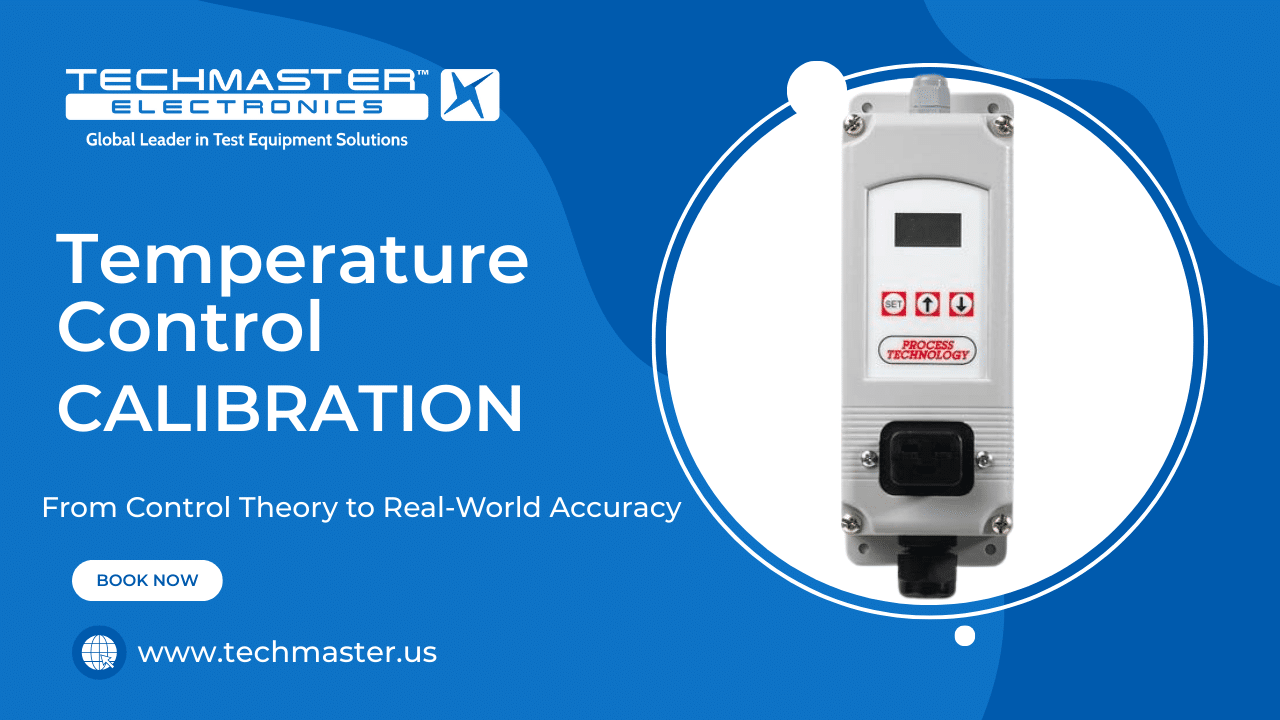
In modern manufacturing systems, temperature is one of the most critical variables requiring stringent control. To achieve thermal stability, engineers rely on a “brain” known as the Digital Temperature Controller. However, understanding how it functions and maintaining its accuracy through regular calibration is the ultimate factor in determining the success of your process.
1. What is a Digital Temperature Controller?
1.1. Definition
A Digital Temperature Controller is an electronic device designed to measure, monitor, and maintain the temperature of a specific environment (such as liquid in a plating tank or air in a drying oven) at a desired value, known as the Setpoint.
Unlike legacy mechanical controllers, digital models utilize microprocessors for high-speed calculations. They feature intuitive LED/LCD displays and support advanced control algorithms like PID (Proportional-Integral-Derivative) to achieve extreme precision.
179.9°C
180.0°C
1.2. Operating Principle: The Closed-Loop Feedback System
The controller operates in a continuous cycle to minimize the error between the measured temperature and the desired target.
Receive signals from PT100/Thermocouple
PID calculation comparing PV & SV
Command SSR/Relay or Analog signal
Adjust heat/cooling energy into the system
Every digital temperature controller operates based on a four-step closed-loop control cycle. First, this cycle ensures stable operation. At the same time, it helps maintain accurate temperature control across industrial processes.
- Signal acquisition (input) takes place. The controller continuously receives electrical signals from temperature sensors such as thermocouples or RTDs (for example, PT100). In simple terms, these sensors convert real temperature changes into electrical signals that the controller can read.
- Comparison and calculation occur inside the controller. The internal processor compares the measured temperature with the user-defined setpoint. As a result, it determines whether the temperature is too high or too low and calculates how much correction is needed.
- Control signal output is generated. If a difference exists, the controller sends a control signal through a relay, SSR, or a 4–20 mA output. In this step, the signal tells the system how to respond.
- Energy actuation completes the loop. The actuator—such as a heater, cooling valve, or compressor—adjusts power levels. Consequently, the temperature moves back toward the setpoint. Over time, this continuous feedback keeps the system stable and reliable.
2. Practical Industrial Applications of Temperature Control
Electroplating
Ensures consistent reaction rates and uniform coating thickness in chemical baths.
Food & Beverage
Strict control for pasteurization and sterilization, preserving nutrition and safety.
Semiconductors
Prevents thermal shock during wafer processing, significantly reducing defect rates.
Temperature control is more than simply turning a heat source on or off. In fact, in demanding industrial environments, a deviation of just 1–2°C can result in the failure of an entire production batch. Therefore, precise temperature control is critical for both product quality and process safety.
2.1. Electroplating and Metal Surface Treatment
In electroplating processes, temperature directly affects chemical reaction speed and coating adhesion. As a result, precise controllers are required to maintain stable bath conditions. If overheating occurs, chemicals can break down. On the other hand, underheating often leads to defects such as pitting or peeling. By maintaining a stable temperature, manufacturers achieve consistent and durable surface finishes.
2.2. Semiconductor and Electronics Manufacturing
Similarly, semiconductor and electronics manufacturing demands an even higher level of control. Processes such as wafer cleaning and chip packaging require extremely stable temperature ranges. To achieve this, advanced PID control algorithms are used. These algorithms help reduce thermal overshoot, which in turn protects sensitive components from heat-related damage and improves overall yield.
2.3. Chemical and Food Industries
In chemical processing, accurate thermal control in storage tanks ensures reactions follow the correct sequence. At the same time, it reduces the risk of dangerous pressure buildup or explosions. Meanwhile, in the food industry, precise temperature management is essential for sterilization. More importantly, it allows manufacturers to ensure food safety while preserving nutritional value and product quality.
3. Why Calibration is the “Key” to Every Process
No matter how high-end your controller is, the value displayed on the screen can drift over time. This is where professional calibration becomes indispensable.
-
Mitigating Sensor Drift: Electronic components and sensors (PT100, Thermocouples) age under harsh thermal conditions. Calibration detects the gap between the displayed value and the true value, allowing for precise re-adjustment.
-
Ensuring Consistency and Repeatability: In mass production, uniformity is a priority. Calibration ensures that every machine in the line “understands” the same temperature level, resulting in 100% consistent output.
-
Meeting ISO International Standards: For businesses aiming for export or joining global supply chains, holding a valid calibration certificate is a mandatory requirement for certifications like ISO 9001 or IATF 16949.
4. The Standard Temperature Controller Calibration Process
Visual inspection of screen, buttons, and wiring integrity.
Set up a high-precision Reference Source (Calibrator).
Multi-point comparison (0% to 100%) across the operating range.
Adjust internal Offset/Gain parameters if deviations exceed limits.
Affix calibration labels and issue ISO-compliant certificates.
Calibration is not just checking if the machine works; it is about quantifying error and returning the device to its ideal state. A professional process includes:
-
Visual and Connection Inspection: Technicians check the display, buttons, and electrical contact points to ensure no physical damage affects signal transmission.
-
Standard Environment Setup: A Temperature Calibrator (signal simulator) or a high-stability reference thermal bath is used. These reference tools must be 3-4 times more accurate than the device under test.
-
Multi-point Testing: Measurements are taken at various points across the device’s operating range (e.g., 0°C, 50°C, 100°C, 200°C).
-
Data Recording: Compare the controller’s reading against the actual value of the reference source.
-
Error Evaluation: Determine if the error falls within the manufacturer’s allowable tolerance or the factory’s ISO standards.
-
-
Adjustment: If the error exceeds thresholds, the technician accesses the device’s engineering menu to adjust Offset or Gain parameters to align the display with the standard value.
-
Certification and Labeling: Upon completion, the device is issued a Calibration Certificate detailing measurement parameters, uncertainty, and the next re-calibration date.
Conclusion
Understanding digital temperature controllers and adhering to a strict calibration procedure are the keys to optimizing operating costs and enhancing market position. An accurate temperature system is the strongest commitment to product quality.
Do you need expert advice on temperature control solutions or on-site calibration services? Contact us today for the best technical consultation and quotation!
Need on-site calibration or a custom thermal solution?
