
Metrology guide · ISO/IEC 17025 · ANAB-accredited
Hot Plate Stirrer Calibration
Hot Plate Stirrer Calibration verifies a Hot Plate Stirrer against NIST-traceable standards under ISO/IEC 17025. Techmaster performs a documented multi-point check, reports measurement uncertainty, and issues an ANAB-accredited certificate — in-lab or on-site across the USA.
ANAB accredited ISO/IEC 17025 NIST traceable
ISO 17025Accredited method
NISTTraceability
12 moTypical interval
ANABAccreditation
In this guide
Why calibration intervals matter
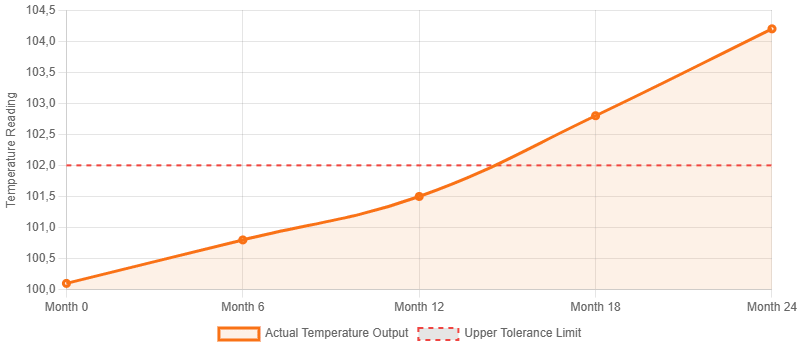
Uncorrected drift creeps toward the tolerance limit over time; scheduled calibration resets it before measurements fall out of spec.
How Hot Plate Stirrer calibration works
- Intake & visual inspection
- Environmental stabilization
- As-found measurement
- Comparison to NIST-traceable standards
- Adjustment if required
- As-left results & certificate
Your calibration, covered
In-lab calibrationAccredited bench service with pickup
On-site calibrationWe calibrate at your facility
Expedited turnaroundRush options to cut downtime
Accredited certificateANAB ISO 17025 with uncertainty
In-lab vs on-site calibration
In-lab calibration
- Accredited bench with full reference standards
- Best achievable measurement uncertainties
- Pickup & return logistics handled
- Ideal for precision and reference work
On-site calibration
- We calibrate the Hot Plate Stirrer at your facility
- No shipping risk or transit downtime
- As-found data captured before any move
- Ideal for fixed, large or sensitive assets
In-depth guide
Inaccurate temperature control or unstable stirring speeds in a Hot Plate Stirrer can ruin months of research, lead to batch failures, and pose significant safety risks. For laboratory managers, the real “pain point” isn’t just a flickering display; it is the soul-crushing fear of failing a strict ISO or GMP audit because of untraceable records or equipment that drifted out of tolerance months ago. Implementing a robust, ISO 17025-compliant calibration process ensures your Stirring Hot Plates provide repeatable results, maintain legal compliance, and pass every audit with flying colors.
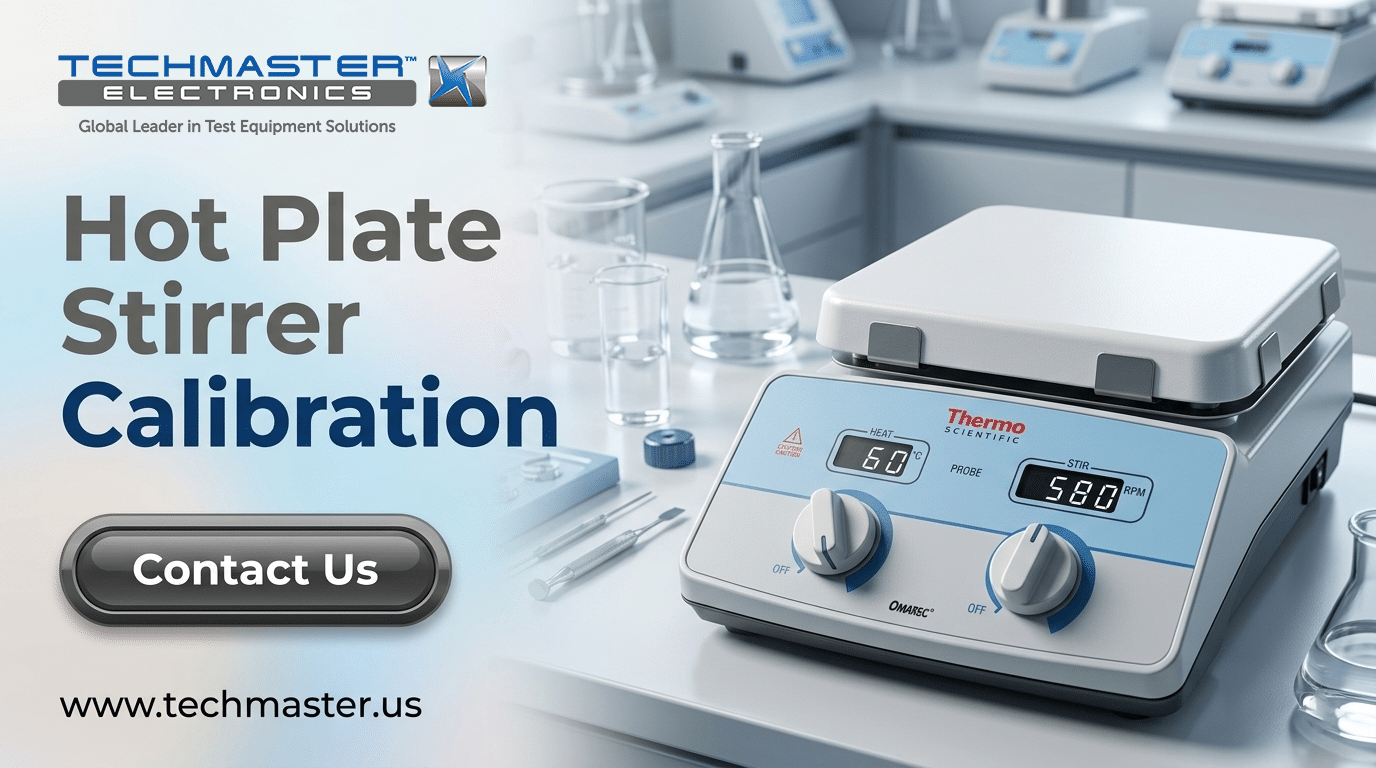 An ISO 17025-compliant process requires a controlled environment, calibrated master standards with a high accuracy ratio, and a documented procedure that accounts for environmental factors. This systematic approach ensures that every measurement taken is accurate, repeatable, and globally recognized by auditing bodies.
1. What is Hot Plate Stirrer Calibration?
Hot Plate Stirrer calibration is the technical process of verifying that the device’s actual heating output and rotational speed align with its intended performance. It involves comparing the unit against high-precision reference standards to determine the necessary corrections and measurement uncertainty, ensuring all data remains traceable to international metrology standards. In modern laboratories, these devices are essential workhorses for chemical synthesis, titration, and sample preparation. Whether you are using high-end digital models or analog units, the goal remains the same: ensuring the energy transferred to your sample is exactly what the process requires. Without periodic verification, mechanical wear or electronic sensor drift can lead to systematic errors that compromise your entire data integrity and research outcomes.2. Why Stirring Hot Plate Calibration is Critical for Industry
Calibration is essential to keep your processes consistent and prevent dangerous overheating. It meets strict standards like ISO 17025 or FDA, turning a simple heater into a reliable tool that gives the same accurate results every time, regardless of when or where it is used.
Good calibration does more than just follow rules; it protects your work and budget. In fields like medicine or chemicals, even a small temperature error can change a reaction, creating bad or even dangerous products. Regular calibration builds the “technical trust” needed for high-stakes lab work where accuracy is a must.3. The ISO/IEC 17025 Standard Hot Plate Stirrer Calibration Process
Step by Step
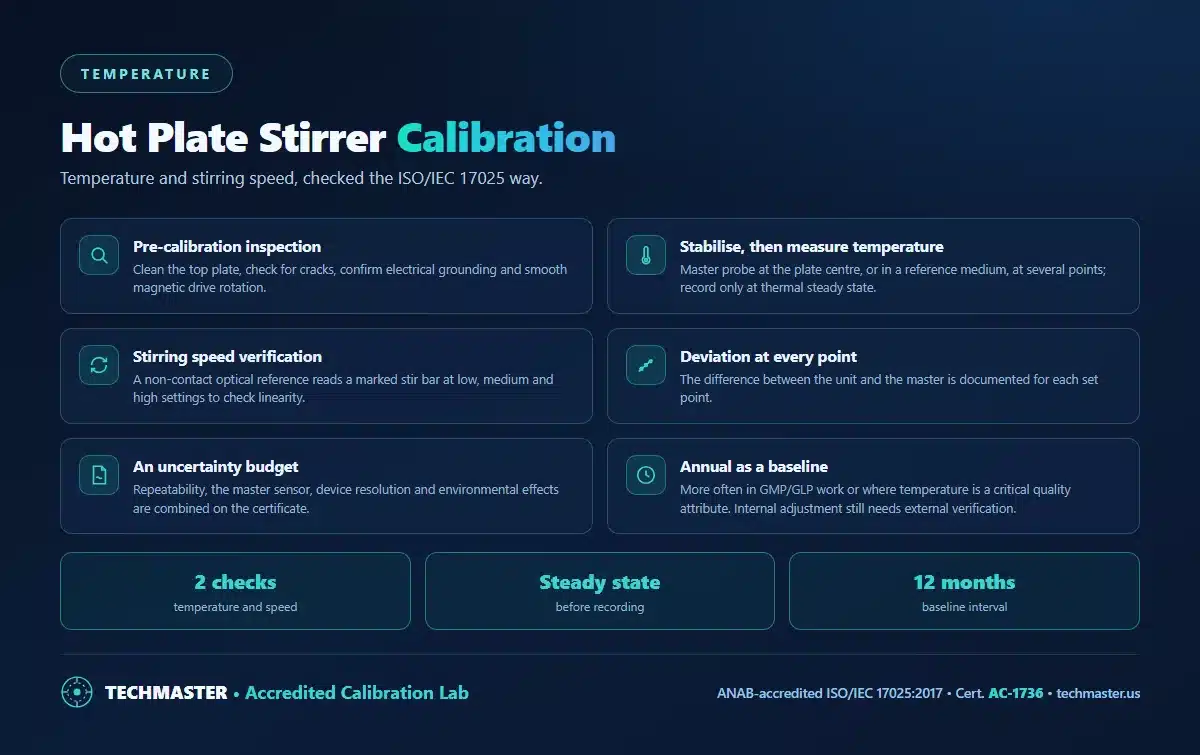
The ISO/IEC 17025 Standard Calibration Process
An ISO 17025-compliant process requires a controlled environment, calibrated master standards with a high accuracy ratio, and a documented procedure. This systematic approach ensures that every measurement taken is accurate, repeatable, and globally recognized by auditing bodies.
1
📋
Pre-Calibration
Clean top plate, check structure, safety grounding, and magnetic drive.
2
🌡️
Stabilization
Allow unit and reference sensors to stabilize in the lab environment.
3
🔥
Temp Verification
Test multiple points. Ensure ‘Steady State’ of thermal equilibrium.
4
🔄
Speed Verification
Measure rotational performance at low, medium, and high settings.
5
📊
Data Recording
Document deviations and calculate expanded measurement uncertainty.
Step-by-Step Procedure:
- Pre-Calibration Inspection: Thoroughly clean the ceramic or aluminum top plate. Check for structural cracks, ensure electrical safety grounding, and verify the smooth rotation of the magnetic drive system.
- Environmental Stabilization: Allow the unit and the master reference sensors (high-precision probes and tachometers) to stabilize in the laboratory environment to avoid errors caused by thermal shock or condensation.
- Temperature Verification: * Place the master reference sensor at the center of the plate for surface-level checks or inside a reference medium for immersion-style calibration.
- Test at multiple functional points across the device’s operating range.
- Ensure the system reaches a “Steady State” of thermal equilibrium before any data points are recorded.
- Stirring Speed Verification: * Use a non-contact optical reference system and reflective markers on a standard magnetic bar.
- Measure rotational performance at low, medium, and high settings to check linearity.
- Data Recording & Calculation: Document the deviation between the unit under test and the reference standard, calculating the expanded measurement uncertainty at a high confidence level.
Risk Monitoring
Equipment Drift Over Time
Why calibrate annually? Mechanical wear and electronic sensor drift lead to systematic errors over time. In regulated environments, this undetected drift pushes equipment outside of acceptable process tolerances, compromising data integrity.
Simulated thermal drift showing how an uncalibrated device exceeds acceptable tolerance over 24 months.
4. Traceability and Measurement Uncertainty Analysis
Traceability ensures your Hot Plate measurements are linked to National Metrology Institutes through an unbroken chain of comparisons. Measurement Uncertainty quantifies the inherent “doubt” in your result, factoring in the master sensor’s performance, device resolution, and environmental fluctuations. When an auditor looks at your calibration certificate, they aren’t just looking for a simple confirmation. They are evaluating the Uncertainty Budget. This comprehensive analysis includes:- Repeatability: The consistency of readings observed during multiple tests at the same set point.
- Resolution: The limit of the device’s display and its impact on measurement precision.
- Hysteresis: Any differences in performance when the device is heating up versus cooling down.
- Standard Uncertainty: The known error profile of the equipment used by the calibration technician.
5. Notes for Popular Models: IKA, Corning, and Velp
Different manufacturers utilize varying sensor technologies and plate materials, requiring specific calibration strategies. High-end models often feature internal adjustment modes, but these must always be verified by an external, independent reference to satisfy ISO 17025 audit requirements.- High-Torque Models: Focus on the “Safety Temperature” circuit during calibration to prevent fire hazards and ensure emergency cut-offs function correctly.
- High-Temperature Series: Specifically check for plate uniformity to ensure the temperature gradient across the surface is within acceptable limits for the application.
- Brushless Motor Systems: Prioritize the stability of the rotational drive; consistency in stirring speed over long durations is the primary performance indicator here.
6. Expert Advice on Maintenance & Audit Readiness
Audit success is built on “Continuous Compliance,” not just a periodic calibration event. Implementing routine verification checks and maintaining a rigorous maintenance log are the most effective ways to ensure your Stirring Hot Plates are always ready for an inspector’s scrutiny.Pro-Tips:
- Frequent Verification: Use a calibrated independent thermometer to check a primary set point regularly. Record these findings in a dedicated logbook to demonstrate “in-control” status between official calibrations.
- Spill Management: Chemical ingress into the internal electronics is the leading cause of speed and temperature drift. Clean all spills immediately using manufacturer-approved methods.
- Magnet Integrity: Over time, internal drive magnets can lose strength. If the stir bar decouples or “jumps” at lower speeds, it indicates a need for mechanical service rather than just a calibration adjustment.
- Environmental Storage: Keep devices in low-humidity areas to prevent corrosion of internal heating elements and control boards.
7. Performance Comparison Summary
| Parameter | Focus Areas | Verification Method | Quality Indicator |
|---|---|---|---|
| Surface Heating | Uniformity & Stability | Surface Reference Probe | Thermal Equilibrium Time |
| Liquid Heating | Probe Accuracy & Lag | Immersion Master Sensor | Regulation Precision |
| Stirring Control | Rotational Linearity | Optical Tachometry | Speed Stability |
| Safety Features | Over-temp Protection | Functional Trip Test | Cut-off Reliability |
8. FAQ: Expert Answers to Common Calibration Questions
Q1: How often should I calibrate my Hot Plate Stirrer?- Expert Answer: For most standard laboratories, an annual interval is the baseline. However, in regulated environments (GMP/GLP) or for processes where temperature is a critical quality attribute, a more frequent cycle is necessary to mitigate the risk of undetected drift.
- Expert Answer: Yes. On-site service is highly recommended as it validates the equipment’s performance under its actual working conditions, including local power stability and ambient airflow.
- Expert Answer: Immediately isolate the device and mark it as “Out of Service.” Perform a “Root Cause Analysis” to evaluate if the failure impacted previous batches or research data, then proceed with professional repair or adjustment.
- Expert Answer: No. There is always a thermal gradient between the heat source and the sample. Calibration should ideally be performed using the method that most closely mimics your actual laboratory process.
- Expert Answer: This usually stems from magnetic decoupling or using an improperly sized stir bar for the vessel. Always ensure you are using balanced, high-quality magnetic accessories during the verification process.
9. Conclusion & CTA
Precision is the heartbeat of every successful laboratory. A Hot Plate Stirrer might seem like a basic tool, but its accuracy is the foundation of your scientific integrity and audit compliance. Don’t let a “minor” equipment deviation lead to a “major” audit finding.Ensure your laboratory stays compliant.
Contact our expert metrology team today for professional, ISO 17025-accredited calibration services.
Frequently asked questions
What is Hot Plate Stirrer Calibration?
Hot Plate Stirrer Calibration is the documented comparison of a Hot Plate Stirrer against NIST-traceable reference standards under ISO/IEC 17025, measuring its error and measurement uncertainty and confirming it performs within tolerance.
How often should a Hot Plate Stirrer be calibrated?
Most quality systems calibrate a Hot Plate Stirrer every 12 months, and sooner after repair, overload or heavy use. Follow the manufacturer specification and your ISO 9001/13485/AS9100 program.
What standards apply to Hot Plate Stirrer Calibration?
Calibration is performed under ISO/IEC 17025 with NIST-traceable references and the relevant manufacturer specification. Techmaster is ANAB-accredited.
What is included on the certificate?
An ANAB-accredited ISO/IEC 17025 certificate with as-found and as-left results and the measurement uncertainty for each point.
Can you calibrate the Hot Plate Stirrer on-site?
Yes. Techmaster offers in-lab calibration with pickup and on-site service across the USA to minimize downtime.
Need Hot Plate Stirrer calibration?
ANAB-accredited, NIST-traceable, fast turnaround — in-lab or on-site across the USA.
Contact us for a quoteReferences & industry standards
- ISO/IEC 17025 testing & calibration laboratory requirements
- NIST calibration services and measurement traceability
- A2LA / ANAB accreditation for calibration laboratories
External standards bodies. Techmaster Electronics is an ISO/IEC 17025-accredited, NIST-traceable calibration laboratory.

Khanh Nguyen is the Marketing Manager at Techmaster Electronics, a B2B marketing leader covering the test, measurement, and ISO/IEC 17025 accredited calibration industry across the US and Vietnam markets.