
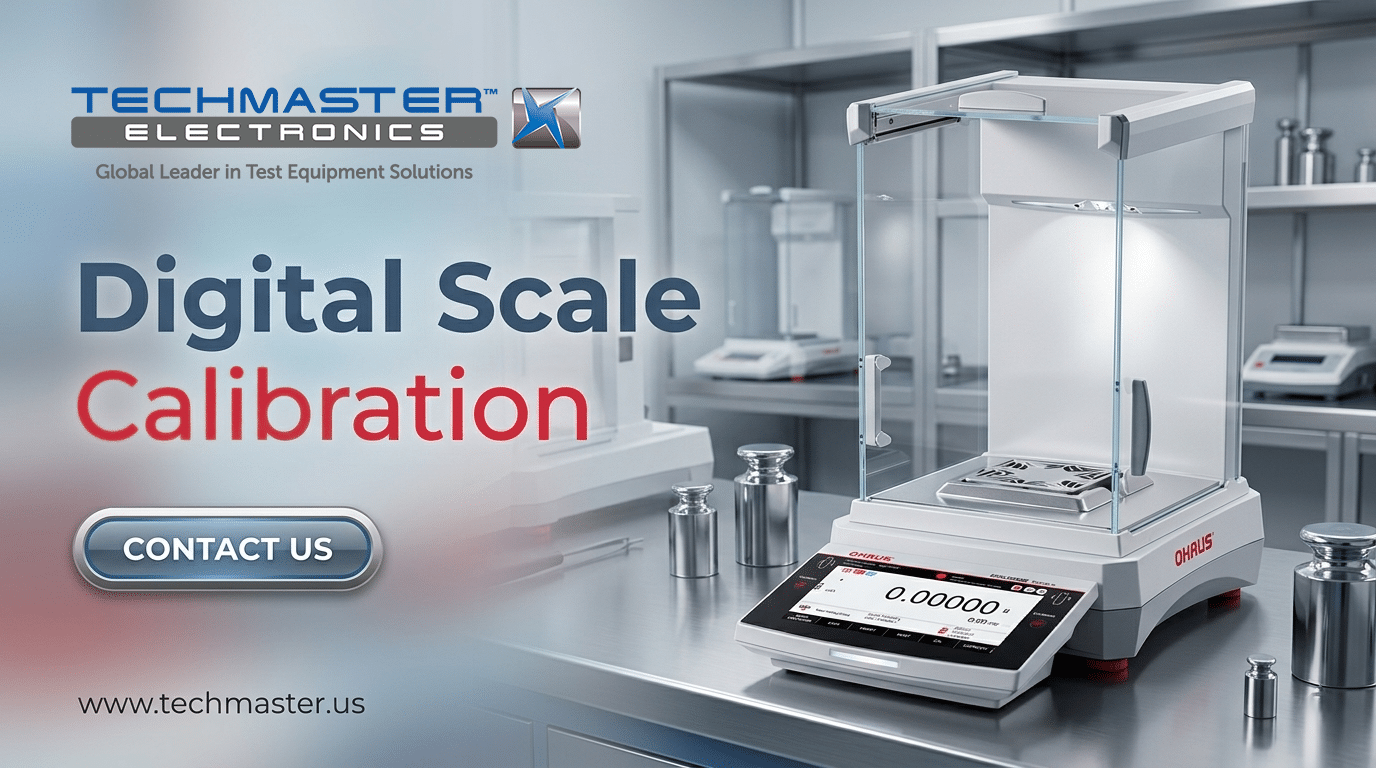
Digital Scale Calibration

Accuracy across the range
How Digital Scale calibration works
- Intake & visual inspection
- Environmental stabilization
- As-found measurement
- Comparison to NIST-traceable standards
- Adjustment if required
- As-left results & certificate
Your calibration, covered
In-lab vs on-site calibration
In-lab calibration
- Accredited bench with full reference standards
- Best achievable measurement uncertainties
- Pickup & return logistics handled
- Ideal for precision and reference work
On-site calibration
- We calibrate the Digital Scale at your facility
- No shipping risk or transit downtime
- As-found data captured before any move
- Ideal for fixed, large or sensitive assets
In-depth guide
Intro: The High Cost of a “Small” Deviation
Is your digital scale actually telling the truth, or is it silently draining your profits? Even a microscopic deviation in weighing accuracy can lead to catastrophic financial losses, compromised product quality, and severe legal penalties during regulatory audits. As a senior metrology expert, I have seen businesses lose millions simply because they treated digital scale calibration as an option rather than a critical necessity. The solution lies in a rigorous, ISO 17025 scale calibration framework that guarantees every measurement is accounted for.
For a short practical walk-through, see our scale calibration how-to.
HVAC technicians charge systems by weight, so see our guide to refrigerant scale calibration for that use.
Large platform and pallet scales need a different test-weight approach; see our guide to floor scale calibration.
Overview: The Critical Role of Digital Scales in Modern Industry
Digital scales are the silent heartbeat of global commerce, serving as the primary gatekeepers for quality control in pharmaceutical, chemical, and manufacturing sectors. They transform physical force into digital data, providing the foundation for formula precision and trade equity. Digital scales utilize strain gauge load cells to convert mechanical force into electrical signals. In high-precision industries, these devices ensure that raw materials are utilized efficiently, safety standards are met, and consumer trust is maintained through accurate labeling. Without regular verification, environmental factors and mechanical wear inevitably degrade their performance.Why Calibration is Non-Negotiable
In metrology, “close enough” is never enough. A proper digital scale calibration establishes the relationship between a known standard (traceable mass) and the measurement displayed by your instrument. Achieving a certified ISO 17025 scale calibration identifies the “offset” or error, allowing for corrections that prevent operational drift.
The ISO/IEC 17025 Standard Calibration Process
A professional calibration process follows a documented, step-by-step methodology to ensure repeatability and reliability. This involves environmental stabilization, eccentricity tests, repeatability checks, and linearity measurements using certified OIML or ASTM class weights.Step 1: Pre-Calibration Preparation to Calibrate a Digital Scale
Before any measurements occur, the scale must be cleaned and leveled. Most importantly, it requires a “warm-up” period to allow electronic components to reach thermal equilibrium. We always verify that the environment, temperature, humidity, and vibration, is within the manufacturer’s specified operating range for optimal performance.Step 2: Eccentricity (Corner Load) Test
We place a test load in the center and then in each of the four quadrants of the weighing pan. This ensures the scale provides a consistent reading regardless of where the object is placed. Any significant deviation here indicates a physical issue with the load cell mounting or the pan support.Step 3: Repeatability (Reproducibility) Test
This involves placing the same weight on the pan multiple times. We look for the standard deviation between readings. High repeatability is a hallmark of a healthy instrument; if the scale cannot give the same answer for the same mass consistently, it is fundamentally unreliable.Step 4: Linearity and Hysteresis Check
We test the scale across its entire range, from zero to maximum capacity, at various increments. This confirms the scale’s ability to maintain accuracy at both the low and high ends of its spectrum. Hysteresis tests further check if the scale returns to the same value when weight is added versus when it is removed.Traceability and Measurement Uncertainty Analysis
True calibration requires a “Chain of Traceability” back to the International System of Units (SI). Every certificate must include a statement of Measurement Uncertainty, which quantifies the “doubt” in the measurement result based on various influencing factors.The Chain of Traceability
When we perform digital scale calibration, we use “Working Standards” (weights). These weights were calibrated against “Secondary Standards,” which were calibrated against “Primary Standards” at a National Metrology Institute (NMI). This chain ensures that the mass measured in your lab is consistent with international standards.
Scales, balances and the weights used to check them are calibrated in our mass and mechanical calibration lab, which also covers force, torque and pressure instruments.
Understanding Uncertainty When You Calibrate a Digital Scale
Uncertainty is not an error; it is a range. It accounts for the scale’s resolution, the uncertainty of the reference weights, environmental fluctuations, and the operator’s influence. A professional ISO 17025 scale calibration certificate without a defined coverage factor for expanded uncertainty is essentially just a piece of paper, not a valid technical document.
Comparative Data Table: Calibration Parameters
The following table outlines the general expectations for different classes of digital scales during a professional calibration.| Scale Class | Typical Application | Calibration Focus | Tolerance Level | Required Weight Class |
|---|---|---|---|---|
| Class I (Analytical) | Laboratory Research | High Sensitivity | Ultra-Fine | High Precision (E-Class) |
| Class II (Precision) | Pharmacy / Jewelry | Daily Precision | Fine | Precision (F-Class) |
| Class III (Industrial) | Shipping / Production | Durability & Bulk | Standard | Industrial (M-Class) |
Expert EEAT Advice: Maintenance and Reliability
Proactive care maintains longevity and precision. Experts recommend daily “user checks” with a single check-weight, maintaining a clean environment, and strictly adhering to “never-overload” policies to protect the sensitive load cells.
- Environmental Control: Static electricity and air drafts are the enemies of precision. Use an anti-static mat and draft shields for analytical balances.
- Loading Technique: Always place weights gently. Dropping an object on a scale can cause “shock loading,” which permanently deforms the internal strain gauge.
- Storage: When not in use, ensure the pan is empty. Constant pressure on the load cell leads to “creep,” where the sensor loses its ability to return to zero accurately.
- Professional Servicing: While internal calibration (Auto-Cal) is useful, it does not replace a third-party ISO 17025 accredited calibration, which provides the necessary legal and technical validation for audits.
FAQ: Common Concerns in Scale Metrology
Q: How often should I calibrate my digital scale? A: Frequency depends on usage and risk. For high-stakes industries (Pharma/Food), we recommend regular professional calibration, supplemented by daily internal “check-weighing” to catch drift early. Q: What is the difference between “Adjustment” and “Calibration”? A: Calibration is the act of checking the accuracy against a standard and recording the results. Adjustment is the act of modifying the scale’s internal settings to match the standard. You should always “calibrate” before and after any “adjustment.”Q: Why does my scale’s reading “drift” over time? A: Temperature changes typically cause drift by altering the load cell’s elasticity or affecting electronic components. To prevent this, give the scale sufficient time to warm up and keep it away from AC vents or heat sources.
Q: Can I use any heavy object for calibration? A: No. To meet compliance standards, you must use certified weights with a known mass and a valid calibration certificate. Household objects do not have the stable mass or density required for metrological traceability.Q: Is my scale broken if it fails the eccentricity test? A: Not necessarily. Uneven leveling feet or a misaligned internal support for the pan often cause this failure. A qualified technician can usually resolve these issues without replacing the entire unit.
Conclusion: Securing Your Bottom Line
Precision is the only buffer between a profitable operation and a legal liability. By implementing a rigorous ISO 17025-compliant calibration schedule, you protect your brand reputation, ensure product consistency, and eliminate the hidden costs of weighing errors. Don’t leave your accuracy to chance, invest in professional metrology services to ensure your data is as solid as your business.Frequently asked questions
What is Digital Scale Calibration?
How often should a Digital Scale be calibrated?
What standards apply to Digital Scale Calibration?
What is included on the certificate?
Can you calibrate the Digital Scale on-site?
Need Digital Scale calibration?
ANAB-accredited, NIST-traceable, fast turnaround, in-lab or on-site across the USA.
Contact us for a quoteReferences & industry standards
- ISO/IEC 17025 testing & calibration laboratory requirements
- NIST calibration services and measurement traceability
- NIST Mass and Force Group
- A2LA / ANAB accreditation for calibration laboratories
External standards bodies. Techmaster Electronics is an ISO/IEC 17025-accredited, NIST-traceable calibration laboratory.
Related reading: How to calculate USP <41> minimum weight on an analytical balance

Khanh Nguyen is the Marketing Manager at Techmaster Electronics, a B2B marketing leader covering the test, measurement, and ISO/IEC 17025 accredited calibration industry in the United States.