Buyer’s Guides

Calibration Buyer’s Guides for US Test & Measurement Teams

Plain-English guides from an ISO/IEC 17025 accredited calibration laboratory. Decide the right lab, the right calibration level, the right interval, and the right delivery mode for your instruments — without the marketing fluff.


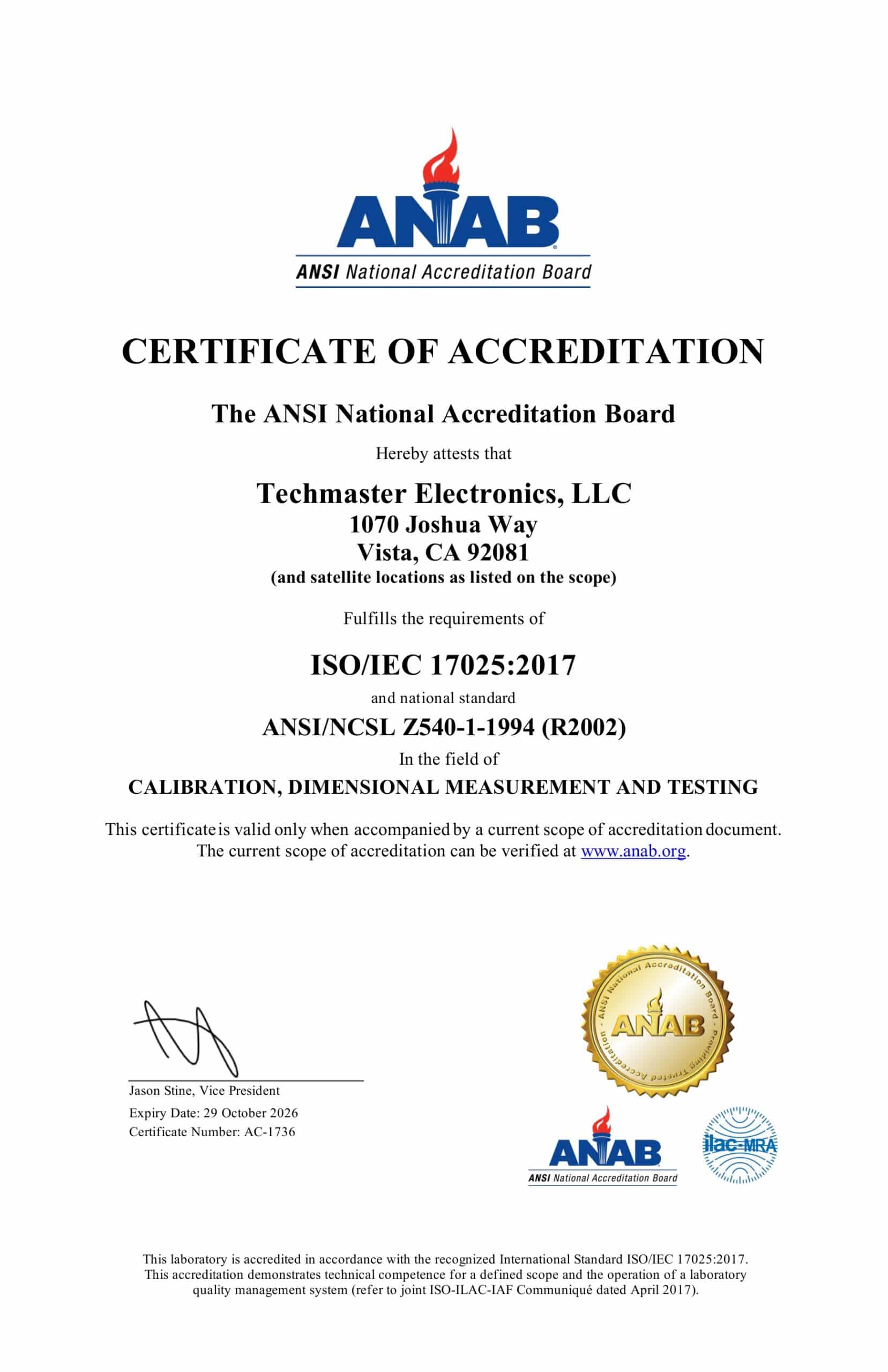
ISO/IEC 17025 accredited calibration laboratory · ANAB Cert AC-1736 · Six US locations

TL;DR — What this hub answers

If you buy calibration services in the United States, four decisions drive most of your cost, compliance risk, and downtime: which lab to use, which calibration level to specify, how often to recalibrate, and whether to ship instruments out or have the lab come on-site. Each guide below gives you a decision framework, a checklist, and the exact questions to ask before you commit.

Who these guides are for

Quality managers, metrology engineers, calibration coordinators, production supervisors, and procurement leaders at US aerospace, defense, semiconductor, medical device, electronics manufacturing, and telecommunications companies. If your instruments need traceable, accredited calibration — and you’re tired of vague answers from vendors — start here.

The four guides

Read in order if you’re new to outsourced calibration, or jump to the question you’re trying to answer today.

1989
Serving US industry since

AC-1736
ANAB ISO/IEC 17025 accreditation

6
US locations: CA, FL, TX, NC, NV

381,916
Calibrations performed (10 yrs)

Have a specific instrument in mind?

Skip the guides — get a calibration quote in one business day from any of our five US labs.

Request a Quote
Talk to a Lab

Frequently asked questions

Quick answers to questions buyers ask before reading the full guides.

What is a “buyer’s guide” in the calibration industry?

A buyer’s guide is a vendor-neutral framework that helps a quality, metrology, or procurement leader decide what to specify, what to ask for, and what to avoid when purchasing calibration services. Techmaster’s guides focus on US-specific accreditation (ANAB, A2LA), US standards (ANSI/NCSL Z540.3), and common US industry requirements (AS9100, FDA 21 CFR Part 820, NADCAP).

Is ISO/IEC 17025 calibration always more expensive than traceable calibration?

Yes, but not by as much as most buyers assume. An ISO/IEC 17025 accredited calibration includes a certificate, full data report, and a measurement uncertainty statement — typically 15-30% more than a traceable-only certificate. For regulated industries, the extra cost is offset by audit defensibility. Guide 02 walks through when each level is appropriate.

How often should I calibrate my test equipment?

The default is 12 months, but the correct answer depends on the instrument, how it is used, manufacturer recommendations, and your industry standard. ILAC G24 and NCSL RP-1 describe methods for setting and adjusting calibration intervals based on historical data. Guide 03 explains how to build an interval program your auditor will accept.

Can Techmaster perform calibration at my facility?

Yes. Techmaster offers on-site calibration across the United States from our Vista, Santa Clara, Orlando, San Antonio, and Holly Springs laboratories. Not every parameter on our ANAB scope (AC-1736) is available on-site — Guide 04 covers which instruments are best calibrated on-site versus shipped to a lab, and how to verify on-site accreditation status before scheduling.

Do these guides apply to industries outside aerospace and defense?

Yes. The frameworks apply to any US organization with measurement equipment under a quality management system: medical device manufacturers (FDA, ISO 13485), automotive (IATF 16949), semiconductor, telecommunications, energy, and electronics manufacturing services. Industry-specific notes appear inside each guide.

Ready to talk to an accredited lab?

Six US locations. ISO/IEC 17025 accredited calibration laboratory (ANAB AC-1736). Quotes in one business day.

Request a Quote