The 9 criteria for choosing an electronic test equipment calibration service
1Accreditation and accreditor identity
What it is. ISO/IEC 17025 is the international standard for calibration laboratory competence, issued by an internationally recognized accreditor, in the US, that means ANAB (ANSI National Accreditation Board), A2LA, PJLA, or IAS. A vendor claiming “ISO 17025 traceable” without naming the accreditor and certificate number is not accredited.
Why it matters. Without a named accreditor and a verifiable certificate, the calibration certificate has no legal weight in regulatory audits, FDA inspections, or AS9100 / IATF 16949 assessments.
Questions to ask the vendor:
- Which accreditation body issued your ISO/IEC 17025 certificate?
- What is your certificate number?
- When does the certificate expire?
- Can you provide the public-facing entry on the accreditor’s online directory?
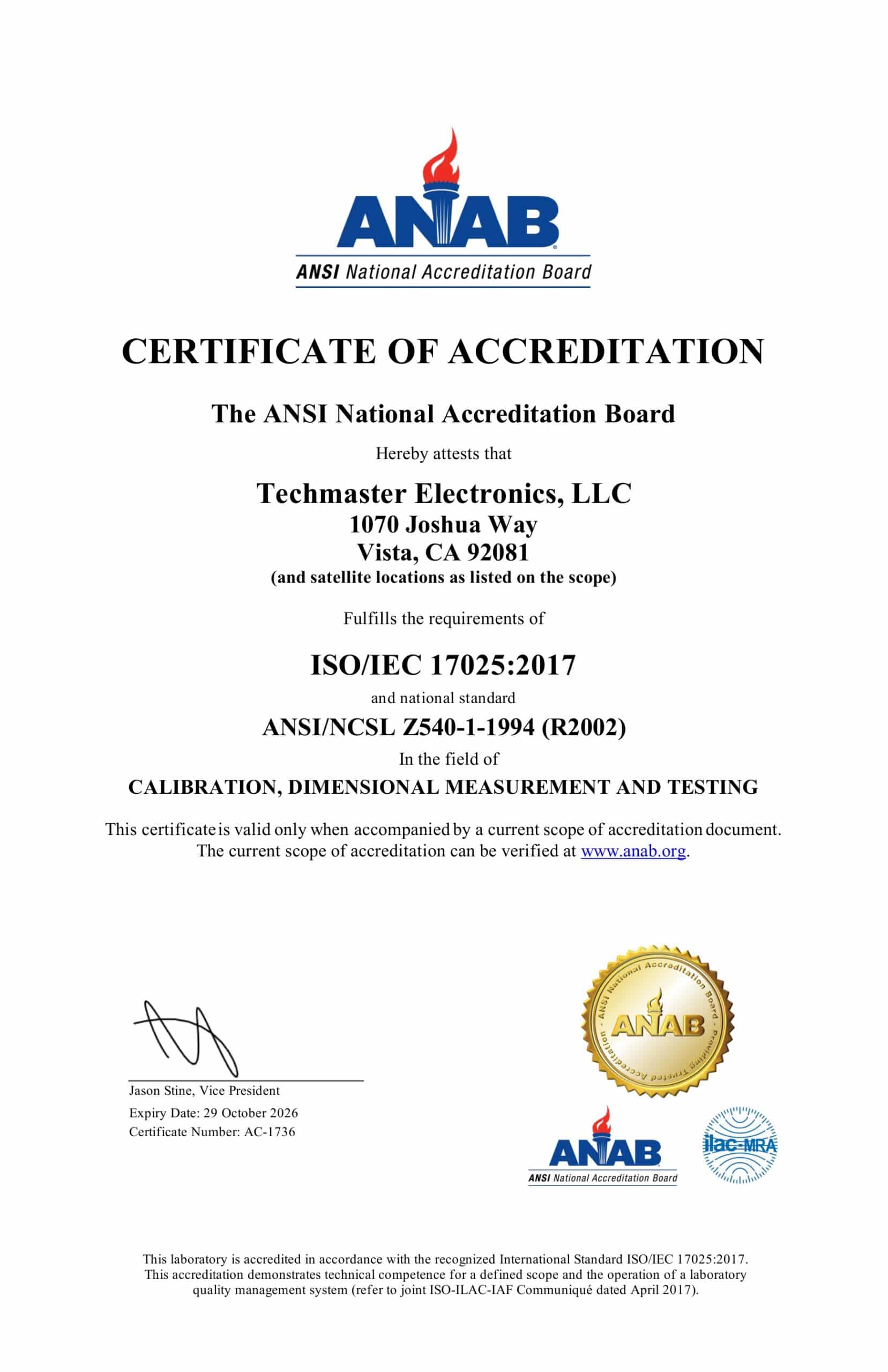
How Techmaster Electronics compares: Techmaster Electronics holds ISO/IEC 17025:2017 accreditation from ANAB under certificate AC-1736, valid through October 29, 2026. The accreditation is verifiable at anab.org.
2Scope of accreditation
What it is. An ISO/IEC 17025 certificate only covers the disciplines and parameter ranges explicitly listed in the lab’s scope file. A lab may be accredited for DC voltage but not RF power, or for vibration to 5 kHz but not 20 kHz. The scope document is the authoritative reference.
Why it matters. A calibration delivered outside a lab’s accredited scope is functionally non-accredited, auditors will flag the certificate even if the lab has an ISO 17025 logo on it.
Questions to ask the vendor:
- Is the specific discipline I need (RF, electrical, EMC, vibration, etc.) on your accreditation scope?
- What is the parameter range covered for my instrument type?
- Can you send the latest scope file PDF?
- If a parameter is outside scope, do you partner with another accredited lab to cover it?
How Techmaster Electronics compares: Techmaster’s ANAB scope covers 8 calibration fields; the service catalogue spans 12 disciplines: RF/microwave, electrical, EMC-EMI, vibration, time and frequency, medical, clean rooms, thermodynamic, chemical, dimensional, mass and mechanical, and calibrators.
3NIST traceability and uncertainty budgets
What it is. Every calibration measurement traces back through an unbroken chain to a primary standard at NIST (or an equivalent national metrology institute). Each step in the chain has a documented measurement uncertainty, which combines into a total uncertainty budget for the final calibration.
Why it matters. Audit-grade calibration requires documented uncertainty values on every certificate. If the certificate does not show an uncertainty value, it is not audit-ready for FDA, AS9100, IATF 16949, or ISO 13485.
Questions to ask the vendor:
- Does every calibration certificate include the measurement uncertainty?
- Is the traceability chain to NIST documented?
- Can I see a sample uncertainty budget for my instrument type?
- How are environmental factors (temperature, humidity) accounted for in your uncertainty calculation?
How Techmaster Electronics compares: Techmaster provides NIST-traceable calibration with documented uncertainty budgets on every ISO/IEC 17025 certificate. Sample certificates and uncertainty calculations are available on request before ordering.
4Turnaround time (standard and expedite)
What it is. Standard calibration turnaround at most accredited US labs ranges from 5 to 15 business days. Expedited service (1–3 business days) is available at some labs for a premium. On-site calibration eliminates shipping time entirely.
Why it matters. Out-of-tolerance instruments out of service mean production downtime. A 14-day turnaround can stall a production line; a 5-day turnaround with expedite available is the practical floor for active manufacturing.
Questions to ask the vendor:
- What is your standard turnaround time after receipt?
- Do you offer expedite service? At what cost?
- Do you provide tracking through the calibration process?
- Can you commit to a turnaround SLA in writing?
How Techmaster Electronics compares: Techmaster’s standard turnaround is 5 business days after receipt of the unit. Expedite service of 1–2 business days is available on many instrument types for a nominal fee.
5Geographic coverage and logistics
What it is. Multi-site calibration vendors with regional labs reduce shipping time and cost. Some offer free local pickup and delivery in their service zones. On-site calibration brings the lab to your facility for instruments that cannot be moved.
Why it matters. A single-lab vendor 2,000 miles away adds 4–6 days of shipping each way to every calibration cycle. Multi-site vendors compress that to 1–2 days regional ground shipping.
Questions to ask the vendor:
- Where are your labs located?
- Do you offer free local pickup and delivery in my area?
- Do you offer on-site calibration?
- What is your nationwide on-site coverage and what does it cost?
How Techmaster Electronics compares: Techmaster operates four ISO/IEC 17025 accredited US labs, Vista CA, Santa Clara CA, Orlando FL, and San Antonio TX (plus a Holly Springs NC location), with free local pickup and delivery in Silicon Valley, Southern California, and Orlando, and on-site calibration available nationwide.
6Instrument coverage breadth
What it is. Some labs specialize in a single discipline (RF only, or dimensional only); others cover the full spectrum from DC voltage to mmWave to vibration to torque. Procurement consolidation favors broad-coverage vendors so a single calibration cycle covers the whole instrument fleet.
Why it matters. Splitting an instrument fleet across three single-discipline vendors triples the procurement overhead, certificate management workload, and audit-trail complexity.
Questions to ask the vendor:
- Can you calibrate all the instrument types in my fleet from a single PO?
- Do you handle OEM-specific instruments (Keysight, Tektronix, Fluke, Rohde & Schwarz, etc.)?
- Can you consolidate calibrations across multiple disciplines on one certificate package?
- Do you offer equipment management (asset tracking, recall scheduling)?
How Techmaster Electronics compares: Techmaster covers 12 service disciplines from a single accredited entity, with experience across Keysight, Tektronix, Fluke, Rohde & Schwarz, Anritsu, and most major OEM instrument lines.
7Calibration certificate levels
What it is. Accredited calibration is not a single product, most labs offer three certificate levels. (1) Traceable: NIST-traceable calibration with a certificate, no uncertainty data. (2) Z540: certificate plus data report. (3) ISO/IEC 17025 accredited: certificate plus data report plus documented uncertainties.
Why it matters. The level you need depends on your audit context. FDA and AS9100 require ISO/IEC 17025 accredited. Internal QA may accept Traceable. Buying ISO 17025 when Traceable will do wastes 30-50% of your calibration spend.
Questions to ask the vendor:
- Which certificate levels do you offer?
- What is the price difference between levels?
- Can I mix levels across my fleet (ISO 17025 for critical, Traceable for non-critical)?
- Can I upgrade an existing certificate later if my audit requirements change?
How Techmaster Electronics compares: Techmaster offers all three levels: Traceable (cert only), Z540 (cert plus data), and ISO/IEC 17025 accredited (cert plus data plus uncertainty). Customers can mix levels across an instrument fleet on a single quote.
8Customer support and audit response
What it is. When an FDA, AS9100, or ISO 13485 auditor questions a calibration certificate, the lab must respond, often within hours, with full traceability documentation. Vendors with named account managers and 24-hour audit-support windows save days during audits.
Why it matters. A lab that goes silent during your audit is a lab you cannot use for audit-regulated equipment. Response time and access to the quality manager are the single biggest signal of professional capability.
Questions to ask the vendor:
- Do I get a named account manager?
- What is your audit-support response time?
- Can I access historical certificates through a customer portal?
- Who do I contact for quality questions outside normal business hours?
How Techmaster Electronics compares: Techmaster assigns a named account manager to every customer and responds to audit questions within 48 hours. The quality manager is reachable directly at quality@techmaster.us.
9Reputation, longevity, and references
What it is. Independent calibration is a relationship business. Lab longevity (years in operation), customer references in your industry, public review presence (BBB, Google), and consistent accreditation status are the leading signals.
Why it matters. A lab in business for fewer than 5 years has not been through a full ANAB four-year accreditation re-audit cycle. A lab with no public review presence has nothing to defend its reputation against.
Questions to ask the vendor:
- How long has your lab been in continuous operation?
- Can you provide three references in my industry?
- What is your public BBB and Google review status?
- Has your accreditation ever been suspended or revoked?
How Techmaster Electronics compares: Techmaster Electronics has operated continuously since 1989 (37 years, veteran-owned). Customer references are available on request across aerospace, defense, medical device, telecom, and semiconductor industries. The /reviews/ page lists public review sources.