
8 benefits of ISO/IEC 17025 accredited calibration for electronics
1Regulatory audit acceptance
What it is. ISO/IEC 17025 accredited calibration certificates are the recognized evidence standard in FDA inspections, FAA audits, AS9100 (aerospace), ISO 13485 (medical device), IATF 16949 (automotive), and IECEE assessments. Non-accredited certificates routinely fail these audits.
Why it matters. Without accredited cal records, a regulated manufacturer risks 483 observations, audit findings, production holds, and in severe cases consent decrees. The cost of a single audit failure typically exceeds a year of accredited calibration spend.
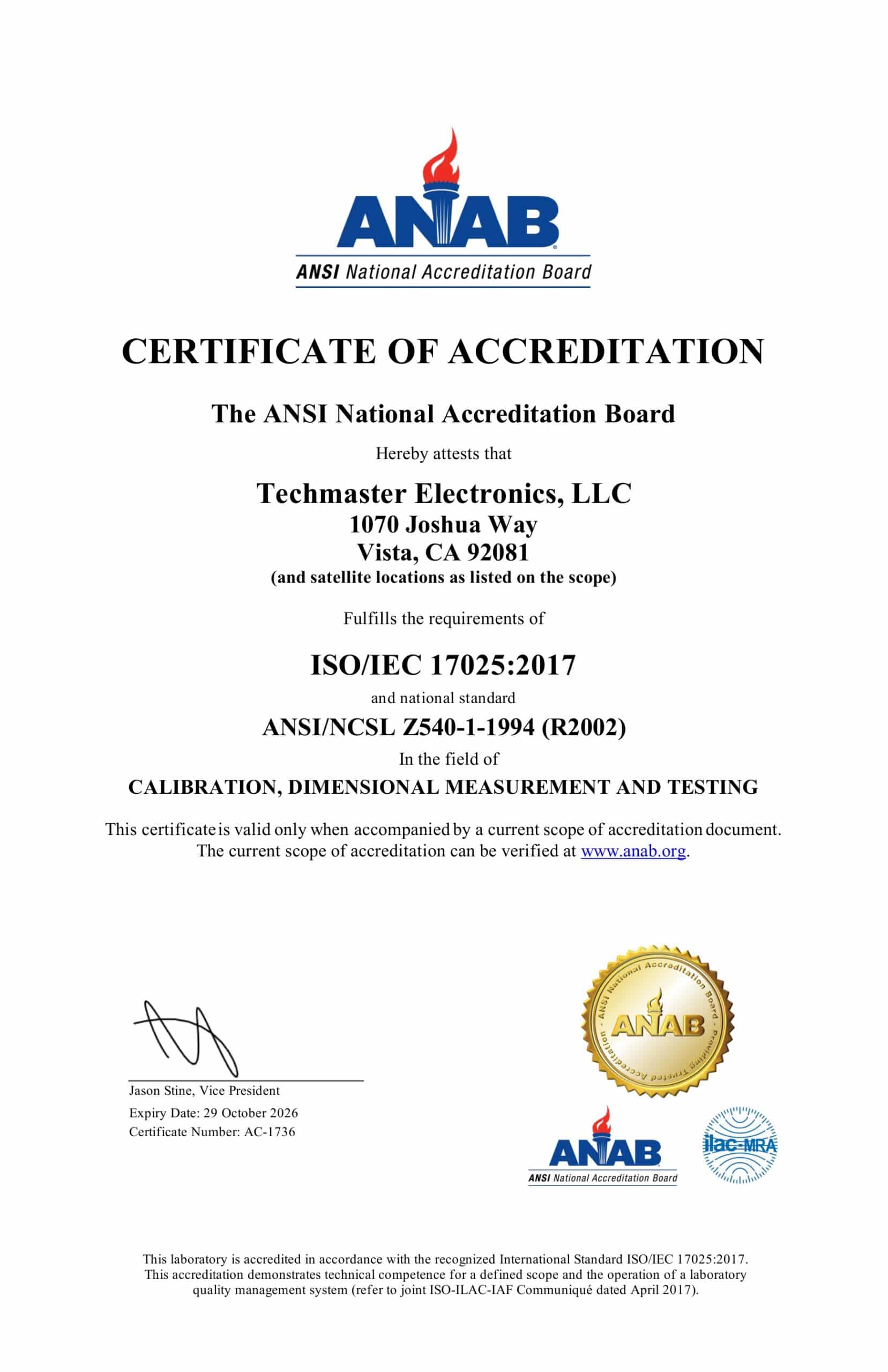
Real-world impact for electronics: Aerospace and medical device customers using Techmaster Electronics’ ANAB-accredited calibration (cert AC-1736) provide the certificate package directly to FDA, FAA, and AS9100 auditors with no additional documentation required.
2NIST-traceable uncertainty documentation
What it is. Every accredited cert carries a documented, NIST-traceable uncertainty value calculated per the GUM (Guide to the Expression of Uncertainty in Measurement). Non-accredited certs typically omit uncertainty or report a single “manufacturer spec” value.
Why it matters. Without uncertainty values, you cannot make defensible pass/fail decisions on borderline measurements. A device measured at 10.05 V against a 10.00 V ± 0.05 V spec is either in or out depending on the uncertainty of your test instrument.
Real-world impact for electronics: Techmaster’s ISO/IEC 17025 certificates include measurement uncertainty on every calibrated parameter, calculated against NIST-traceable reference standards.
3International recognition through ILAC MRA
What it is. The ILAC Mutual Recognition Arrangement is a treaty among national accreditation bodies. An ANAB-issued ISO 17025 certificate is recognized by 100+ countries’ accreditation bodies — including UKAS, DAkkS, JAB, CNAS, and INMETRO — without re-certification.
Why it matters. Electronics manufacturers shipping internationally avoid the cost and delay of re-certifying calibration records for every export market. Audit-equivalent recognition holds across the EU, UK, Japan, China, Brazil, and most of Asia.
Real-world impact for electronics: Techmaster customers with global operations submit ANAB cert AC-1736 documentation to overseas regulators without additional translation or re-certification, accelerating multi-country product launches.
4Legally defensible measurement evidence
What it is. Documented ISO 17025 calibration records — with uncertainty budgets, traceability chains, and accredited-lab credentials — are admissible as expert evidence in product liability, warranty, and patent infringement cases.
Why it matters. When a customer or competitor disputes a product specification, accredited calibration records make the manufacturer’s measurement defensible. Non-accredited records create discovery liability and shift the burden of proof.
Real-world impact for electronics: Techmaster maintains 10-year calibration record retention with full audit-trail documentation, retrievable on request by the customer for any covered instrument.
5Reduced false-pass and false-reject in production
What it is. Test-and-measurement uncertainty propagates through production decisions. Without documented uncertainty, manufacturers either tighten internal limits unnecessarily (causing false rejects and yield loss) or accept marginal units (causing field failures).
Why it matters. A 0.1% reduction in false-reject rate on a high-volume electronics line typically saves $250K–$1M annually. A 0.01% reduction in false-pass on safety-critical electronics avoids field recall events that can run into tens of millions.
Real-world impact for electronics: Techmaster’s 17025 certificates give production engineers the uncertainty data needed to set defensible internal limits and minimize both error types.
6Supplier qualification simplification
What it is. Most Tier-1 and Tier-2 manufacturers maintain approved supplier lists that pre-qualify ISO/IEC 17025 accredited calibration vendors. Using an accredited vendor skips the supplier-qualification overhead (typically 30–90 days and a full quality audit).
Why it matters. Single-source procurement for calibration across an entire instrument fleet becomes possible with one approved vendor, reducing procurement workload, certificate management, and audit complexity.
Real-world impact for electronics: Techmaster Electronics is pre-qualified in the approved-supplier programs of major aerospace, defense, and medical device OEMs across the United States.
7Continuous independent accreditor oversight
What it is. Accredited labs are re-assessed by their accreditor on a fixed cycle: a full assessment every 4 years and a surveillance audit every year. The accreditor reviews technical competence, traceability, uncertainty calculations, and quality system compliance.
Why it matters. Customers do not have to perform their own competence assessment of the calibration lab — the accreditor has already done it on a continuous basis. Non-accredited labs require customer-conducted audits to verify competence.
Real-world impact for electronics: Techmaster’s ANAB scope (cert AC-1736) is renewed through annual surveillance audits and a full four-year re-assessment, with the current scope file valid through October 29, 2026.
8Insurance, bonding, and contract eligibility
What it is. Errors and omissions (E&O) insurance, surety bonds for government contracts, and prime-contractor flow-down clauses commonly require ISO/IEC 17025 accredited calibration records for any safety-related test equipment.
Why it matters. Non-accredited calibration disqualifies a manufacturer from government contracts (DoD, NASA, DOE), most prime aerospace contracts, and major medical device tenders. Insurance carriers may deny E&O claims tied to non-accredited measurement records.
Real-world impact for electronics: Techmaster customers in DoD, NASA, and prime aerospace supply chains use ANAB-accredited cert AC-1736 records to meet flow-down clauses without exception.