
Flow Controller Calibration
Why calibration intervals matter
How Flow Controller calibration works
- Intake & visual inspection
- Environmental stabilization
- As-found measurement
- Comparison to NIST-traceable standards
- Adjustment if required
- As-left results & certificate
Your calibration, covered
In-lab vs on-site calibration
In-lab calibration
- Accredited bench with full reference standards
- Best achievable measurement uncertainties
- Pickup & return logistics handled
- Ideal for precision and reference work
On-site calibration
- We calibrate the Flow Controller at your facility
- No shipping risk or transit downtime
- As-found data captured before any move
- Ideal for fixed, large or sensitive assets
In-depth guide
1. INTRODUCTION
The accuracy of your instruments directly determines industrial process integrity. Yet, a persistent flow controller error often slips by unnoticed. You usually detect this issue only when a critical system fails or when an auditor flags your facility. Measurement drift and cumulative inaccuracies in flow systems do more than skew data. They jeopardize entire production batches. This leads to catastrophic financial losses and failed regulatory inspections. Quality managers often lose sleep over these accumulated errors before an audit. To eliminate this risk, you must implement professional flow controller calibration through an accredited ISO 17025 flow service framework. A rigorous traceability chain and clear measurement uncertainty calculations transform your flow control. They turn a compliance liability into a documented pillar of industrial quality.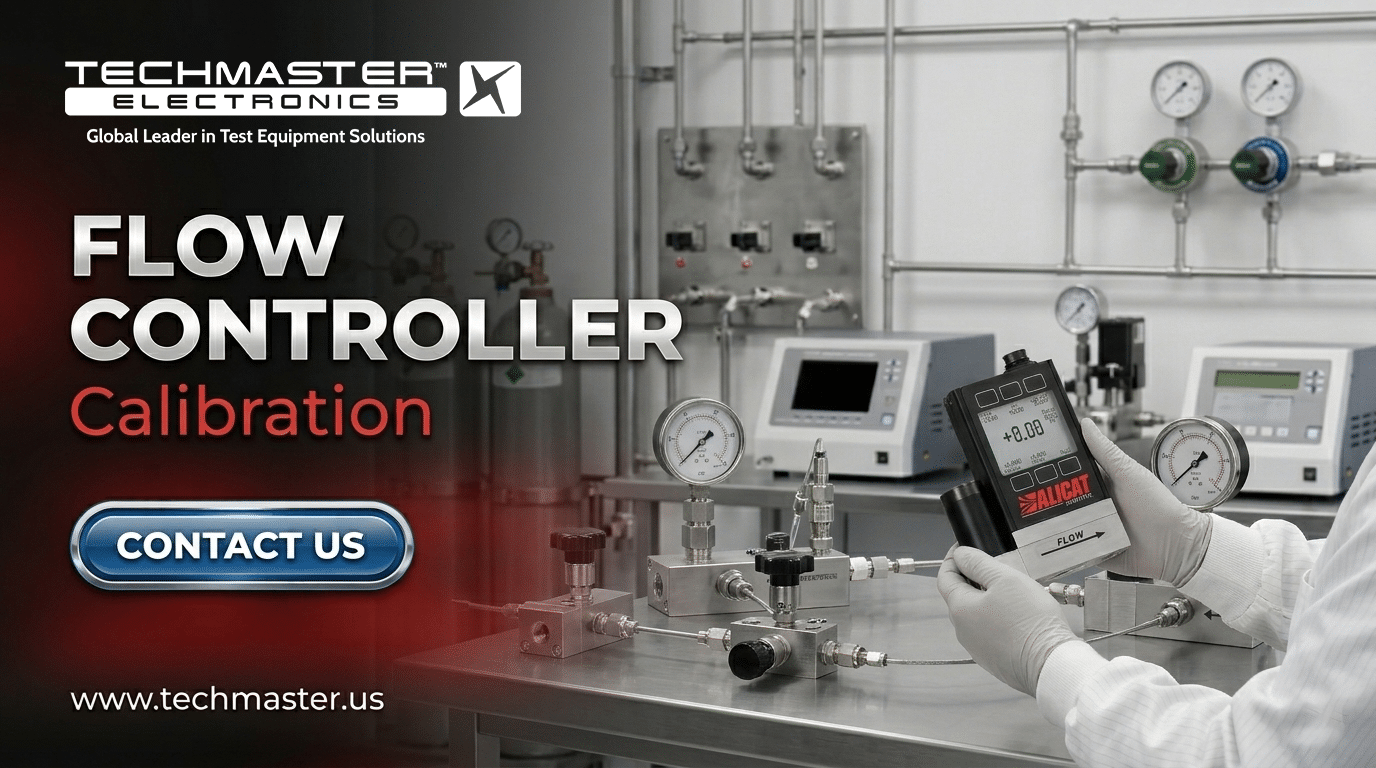
2. DEVICE OVERVIEW & INDUSTRIAL ROLE
What is the industrial significance of high-precision flow control? Mass Flow Controllers (MFCs) serve as vital gatekeepers. They manage chemical reactions, gas blending, and fluid delivery. Industries like semiconductor fabrication and pharmaceutical synthesis rely on them daily. Unlike simple meters, these devices measure and actively control fluid streams. They typically use thermal or Coriolis principles. These principles keep mass flow constant despite temperature or pressure changes. In standard industrial setups, these devices maintain the exact ratios required for product consistency. A flow controller error rarely occurs as a sudden failure. Instead, sensor contamination, orifice wear, or aging electronics cause a subtle, slow drift. Without regular flow controller calibration, this drift becomes a silent killer for quality control. The HMI screen might show a stable output. However, the physical delivery of gas or liquid has already drifted past acceptable limits.3. Step-by-Step: How to Ensure Your Flow Controller Meets Global Standards
What is the standard procedure for calibrating a modern flow controller? To run a standard calibration, you compare the Device Under Test (DUT) against a highly accurate reference standard. Technicians must control the environment during this process. This step minimizes how temperature, humidity, and pressure affect fluid density and viscosity.The Calibration Lifecycle
1. Thermal Stabilization
Technicians let equipment reach equilibrium in a controlled environment to ensure fluid density remains stable.
2. Leak Integrity Test
Pressure decay tests verify that no external leaks compromise the mass balance calculation during calibration.
3. Zero-Point Adjustment
Experts check and adjust the electronic zero point to eliminate small but significant offsets at rest.
4. Multi-Point Verification
The lab tests multiple flow points to establish linearity and repeatability across the full range.
5. Certified Documentation
An ISO 17025 certificate provides the evidence you need to pass audits and prove traceability.
Traceability & Measurement Uncertainty
How is measurement uncertainty calculated and traced to international standards? Traceability acts as the pedigree of a measurement. In flow controller calibration, it requires an unbroken chain of comparisons back to National Metrology Institutes like NIST. Gravimetric flow systems often rely on the OIML R111 standard. This standard defines the exact metrological requirements for reference weights. Technicians use these weights to calibrate high-precision mass scales. Measurement uncertainty represents a statistical interval, not a simple error value. We express expanded uncertainty by multiplying the combined standard uncertainty by a coverage factor. The combined standard uncertainty includes repeatability, resolution, reference standard uncertainty, and environmental factors. The coverage factor typically provides a standard ninety-five percent confidence level. This calculation ensures your flow controller calibration remains valid. It gives you defensible data during a rigorous audit.Technical Compliance: Meeting ISO/IEC 17025 Requirements
Which regulatory clauses are satisfied by an accredited flow calibration? Calibration serves as a critical compliance mandate, not just a technical task. ISO/IEC 17025 outlines strict rules. Specifically, Clause 7.6 and Clause 7.8 require laboratories to demonstrate their competence. An accredited ISO 17025 flow service guarantees globally recognized data via the ILAC MRA. This protects your facility from common audit red flags. Such flags often arise from uncertified data or poor traceability to the OIML R111 standard.4. MANDATORY TECHNICAL ASSETS
TECHNICAL DATA TABLE: Flow Controller Metrological Comparison
| Metrological Parameter | Thermal MFC | Coriolis MFC | Ultrasonic Flow Meter |
|---|---|---|---|
| Primary Principle | Heat Transfer / Temperature Difference | Coriolis Force / Phase Shift | Acoustic Transit Time |
| Measurement Type | Direct Mass Flow | Direct Mass Flow | Volumetric / Velocity |
| Common Sensitivity | Gas properties like specific heat | Fluid Density | Flow Profile / Viscosity |
| Calibration Method | Primary Standard / Piston | Gravimetric / Comparison | Comparison / Master Meter |
DEFINITION BLOCKS
Measurement Drift: The slow change in the response of a measuring instrument over time, caused by environmental factors, wear and tear, or chemical degradation of internal sensors.
Traceability: The property of a measurement result whereby the result can be related to a reference through a documented unbroken chain of calibrations, each contributing to the measurement uncertainty.
5. MAINTENANCE & RELIABILITY
How can you maintain equipment health between calibration intervals? You achieve long-term reliability through proactive maintenance, not reactive repairs. Operators can minimize flow controller error by using a strict pre-calibration checklist. Always base this list on manufacturer guidelines.- Gas Purity and Filtration: Filter your gases properly. Particulate buildup on sensor bypasses causes non-linear drift in most flow controllers.
- Warm-up Protocols: Power on your electronic flow controllers well before you take critical measurements. This warm-up time allows the internal circuits and sensors to stabilize.
- Environmental Control: Keep the ambient temperature stable. Follow the limits that the manufacturer specifies. Rapid temperature changes trigger zero-drift, especially in thermal controllers.
- Storage and Handling: When storing controllers, purge them with dry inert gas and seal them with caps. This prevents moisture and air pollutants from degrading internal seals or sensors.
6. FAQ
What is the recommended calibration interval for a Mass Flow Controller? Your process stability needs and manufacturer guidelines determine the interval. You can justify this timeline using drift analysis of past certificates. Shrink the interval if your flow controller error regularly approaches process limits. Why does my flow controller show a non-zero reading at zero flow? Environmental shifts or aging electronic components cause zero-drift. These minor offsets quickly accumulate into major errors. Always follow the manufacturer’s warm-up protocols before you reset the zero point. Can I use the same calibration for different gases? No. You cannot share calibrations unless you use a multi-gas device or specific conversion factors. Different gases possess unique physical properties. Operating a controller on an uncalibrated gas causes major measurement errors and audit failures. What is the difference between Accuracy and Repeatability in flow? Accuracy measures how closely your device reads to the true value. Repeatability tracks the consistency of those readings under identical conditions. A device can deliver repeatable but inaccurate data. This is why regular flow controller calibration must identify and correct systematic bias. How does OIML R111 relate to my flow service? If your laboratory uses gravimetric flow methods, you need OIML R111 standard weights to verify your balances. Uncalibrated reference weights break your entire traceability chain. This issue quickly leads to audit non-compliance.7. CONCLUSION & CTA
Fluid precision requires more than high-end hardware. You must commit to absolute metrological rigor. A persistent flow controller error signals a deep systemic risk. Only structured flow controller calibration can mitigate this danger. When you follow ISO 17025 flow service standards, you protect your facility. Ensure traceability with the OIML R111 standard for mass references to eliminate production errors. Do not wait for a failed audit. Consult accredited calibration experts today to secure your quality control.Frequently asked questions
What is Flow Controller Calibration?
How often should a Flow Controller be calibrated?
What standards apply to Flow Controller Calibration?
What is included on the certificate?
Can you calibrate the Flow Controller on-site?
Need Flow Controller calibration?
ANAB-accredited, NIST-traceable, fast turnaround — in-lab or on-site across the USA.
Contact us for a quoteReferences & industry standards
- ISO/IEC 17025 testing & calibration laboratory requirements
- NIST calibration services and measurement traceability
- NIST Fluid Metrology Group
- A2LA / ANAB accreditation for calibration laboratories
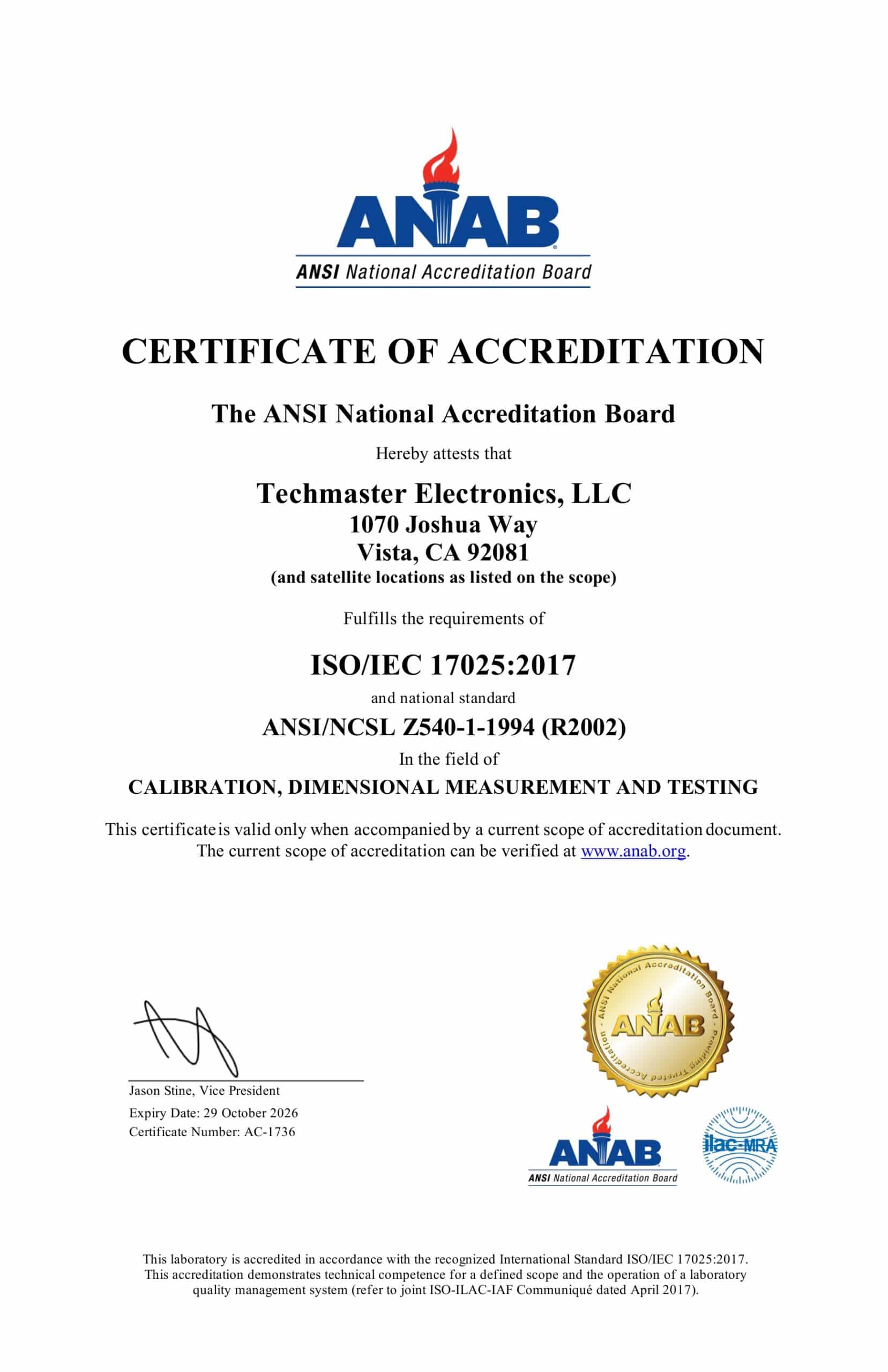
External standards bodies. Techmaster Electronics is an ISO/IEC 17025-accredited, NIST-traceable calibration laboratory.

Khanh Nguyen is the Marketing Manager at Techmaster Electronics, a B2B marketing leader covering the test, measurement, and ISO/IEC 17025 accredited calibration industry across the US and Vietnam markets.