
Class 1 Weight Calibration
Accuracy across the range
How Class 1 Weight calibration works
- Intake & visual inspection
- Environmental stabilization
- As-found measurement
- Comparison to NIST-traceable standards
- Adjustment if required
- As-left results & certificate
Your calibration, covered
In-lab vs on-site calibration
In-lab calibration
- Accredited bench with full reference standards
- Best achievable measurement uncertainties
- Pickup & return logistics handled
- Ideal for precision and reference work
On-site calibration
- We calibrate the Class 1 Weight at your facility
- No shipping risk or transit downtime
- As-found data captured before any move
- Ideal for fixed, large or sensitive assets
In-depth guide
Invisible mass degradation represents the most significant risk to laboratory integrity, where microscopic surface changes or environmental contaminants lead to undetected measurement drift that can invalidate months of research. A professional Class 1 weight calibration serves as the primary defense against these deviations, particularly for sensitive standards ranging from 1 mg to 20 g. By implementing a standardized ISO 17025 mass calibration program, organizations can transform “invisible” risks into quantifiable, traceable data, securing the validity of every analytical result. This technical guide explores the complexities of ASTM Class 1 calibration and the essential requirements for maintaining the “master” standards used to verify 4-5 decimal place analytical balances.
1. Device Overview: The Architecture of Small-Mass ASTM Class 1 Weights
ASTM Class 1 weights, specifically in the range of 1 mg to 20 g, represent the highest tier of commercial laboratory standards. These precision instruments calibrate and verify high-resolution analytical balances reading to 0.1 mg or 0.01 mg (4 to 5 decimal places). Manufacturers typically produce these small weights as a “monobloc”, a single piece of high-grade austenitic stainless steel or specialized alloy for milligram fractions, to ensure uniform density and eliminate air pockets.
The Class 1 weight functions by providing a stable, known mass. Users compare unknown quantities against this standard with microgram sensitivity. In the context of ASTM Class 1 calibration, the physical integrity of the weight’s surface remains the most critical factor. Because laboratories use these weights to calibrate balances with extreme resolution, even a microscopic scratch or a single fingerprint alters the mass enough to exceed permitted tolerances. These weights often serve as “primary” internal standards, checking the accuracy of lower-class weights or performing daily sensitivity checks on critical lab equipment. In industrial environments, these weights maintain the internal traceability chain as “master” standards. Neglecting regular Class 1 weight calibration compromises the reliability of this entire chain, leading to a “domino effect” of measurement errors. For weights as small as 1 mg or 10 mg, the margin for error effectively vanishes, making professional oversight a mandatory requirement for any laboratory operating under strict quality management systems.2. Standard Calibration Process: Step-by-Step ISO/IEC 17025 Protocols
Accredited laboratories perform ISO 17025 mass calibration for ASTM Class 1 weights within strictly controlled environments. Metrologists maintain stable temperature, humidity, and atmospheric pressure to ensure the measurement system captures the physical characteristics of the weight without environmental interference.
Step 1: Environmental Stabilization and Visual Inspection
Before any measurements occur, weights must undergo a “thermal soak” period in the calibration laboratory. This process allows the internal temperature of the weight to equilibrate with the laboratory environment, preventing convection currents that could lift or depress the balance pan. Following stabilization, metrologists perform a visual inspection under magnification. For weights like the 1 mg or 100 mg units, this inspection is vital to identify surface defects, oxidation, or microscopic contamination that would necessitate cleaning or potential disqualification from Class 1 status.Step 2: The Double Substitution Comparison Method
High-precision Class 1 weight calibration utilizes specialized comparison methods on mass comparators with extreme resolution. In this sequence, a reference standard of known value is compared against the test weight (e.g., your 20 g weight). The process involves multiple weighing cycles designed to mathematically eliminate any linear drift in the comparator’s electronics. By repeating the comparison multiple times, the laboratory can compensate for subtle environmental fluctuations that occur during the measurement cycle, ensuring the reported mass is as accurate as modern metrology allows.Step 3: Compensation for Environmental Buoyancy
For ASTM Class 1 calibration, accounting for air buoyancy is a technical necessity, even if specific formulas are handled by the laboratory software. Because different materials have different densities, the volume of air they displace varies. Even when two weights have the same mass, the “upward lift” provided by the surrounding air can differ based on current barometric pressure and humidity. Professional laboratories monitor these conditions in real-time, ensuring that the final reported mass reflects the “conventional mass” required for international regulatory compliance.Step 4: Verification and Certificate Generation
The final step involves comparing the measured deviation against the maximum permissible errors defined by ASTM standards. If the weight passes, a Class 1 calibration certificate is generated. This document provides the specific correction values for each weight, such as the exact deviation for a 100 mg standard, which the end-user must apply to their balance readings to achieve the highest level of accuracy during high-precision weighing tasks.3. Traceability & Measurement Uncertainty
Metrological traceability creates the essential link between your laboratory measurements and the International System of Units (SI). During ASTM Class 1 calibration, accredited facilities establish this connection by tracing their master standards back to a National Metrology Institute (NMI).
Measurement uncertainty quantifies the inherent “doubt” associated with the result. A valid certificate must report the expanded uncertainty, accounting for the master standard, comparison process, and environmental sensitivities.
Traceability guarantees that your 1 mg or 10 mg standards meet the rigorous demands of a 5-decimal place balance during audits.
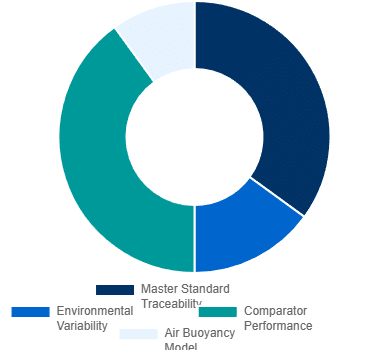
The comparison process and master standard contribute the most to overall measurement uncertainty.
4. Technical Compliance: Regulatory Frameworks
A Class 1 calibration certificate is a vital legal and technical document that confirms a laboratory’s adherence to global quality frameworks.- ISO/IEC 17025:2017: This standard ensures that the calibration laboratory is technically competent. It is the “gold standard” for laboratories providing mass calibration services.
- ASTM E617: This is the primary standard that defines the physical requirements (such as surface finish and magnetism) and the accuracy classes for mass standards like the 1 g and 20 g weights.
- Quality Management Systems: For industries governed by ISO 9001 or FDA regulations, periodic Class 1 weight calibration is mandatory. It ensures that the weights used to verify analytical balances are performing within their specified tolerances.
5. Expert Advisory: Mandatory Handling and Maintenance
To prevent “invisible degradation” between Class 1 weight calibration cycles, laboratories must implement strict handling and storage protocols. This is the most common point of failure for high-precision standards.Handling Protocols: The “No-Touch” Rule
- Absolute Prohibition of Manual Contact: Never touch a Class 1 weight with bare skin. This is critical for all sizes but catastrophic for small weights like 1 mg, 10 mg, or 20 mg. The oils, salts, and acids from a single fingerprint can add significant mass and permanently etch the stainless steel surface, effectively destroying its Class 1 status.
- Specialized Instrumentation: Always use non-magnetic forceps or tweezers with soft, non-scratch tips (typically PTFE, carbon fiber, or specialized plastics). For larger weights like the 20 g standard, ensure the lifters are clean and lined with lint-free materials.
- Static Control: Static electricity can cause erratic readings on analytical balances. Using an ionizer in the weighing area is a recommended practice when handling small Class 1 weights to ensure the weight does not “stick” or repel from the balance pan.
Storage and Environmental Control
-
Protective Housing: Always store weights in their original, padded cases. For milligram weights (1 mg to 100 mg), keep them under protective covers within the case to prevent dust accumulation.
- Thermal Equilibration: Before use, place the weights near the balance for at least one hour. This prevents temperature differentials that cause air currents inside the 5-decimal balance chamber, which would result in unstable readings.
Pre-Calibration “Cross-Checks”
A best practice for high-stakes laboratories is to perform internal “cross-checks” between official ISO 17025 mass calibration intervals. By comparing your “master” 20 g Class 1 weight against a secondary check-standard, you can identify sudden shifts in mass due to accidental damage or environmental stress before they impact your critical analytical data.6. Technical Components of a Calibration Certificate
When reviewing a Class 1 calibration certificate, several key sections must be verified to ensure the document supports your traceability requirements:| Component | Purpose in Metrology |
|---|---|
| Nominal Value | The intended mass of the weight (e.g., 1 mg, 100 mg, 20 g). |
| Conventional Mass | The actual measured mass under standard environmental conditions. |
| Correction Value | The value to be added/subtracted from the nominal for precision work. |
| Expanded Uncertainty | The range within which the true value is estimated to lie. |
| Traceability Statement | Documentation linking the result to National Standards (e.g., NIST). |
Metrological Terminology:
- Metrological Traceability: Property of a measurement result whereby the result can be related to a reference through a documented unbroken chain.
- Conventional Mass: The value of the mass of a weight under specified conditions (density of 8000 kg/m³ in air of density 1.2 kg/m³).
7. FAQ: Class 1 Weight Calibration Queries
What is the recommended calibration interval for a 1 mg to 20 g weight set?
Most laboratories find a 12-month interval appropriate for maintaining a Class 1 weight calibration. However, for weights that technicians use daily to check 5-decimal balances, a 6-month interval is safer. Specifically, this more frequent schedule mitigates the risk of mass drift caused by frequent handling.
Why is it forbidden to touch a 100 mg Class 1 weight with fingers?
A single fingerprint often weighs between 10 to 50 micrograms. Consequently, for a 100 mg weight, this error exceeds Class 1 tolerances immediately. In addition, skin acidity causes microscopic corrosion. Therefore, touching the weight leads to permanent mass change and voids the accuracy class.
Can a 20 g Class 1 weight be adjusted if it fails calibration?
No, they cannot. Because manufacturers design standard ASTM Class 1 weights with a monobloc construction, technicians have no way to make physical adjustments. Therefore, if a weight exceeds its maximum permissible error, the user must replace the instrument or downgrade it to a lower accuracy class.
Why do I need an ISO 17025 mass calibration for my analytical balance checks?
Analytical balances with 4 or 5 decimal places are extremely sensitive. An ISO 17025 mass calibration provides the verified uncertainty and traceability data required to prove that your balance verification process is technically sound and audit-ready.How should I clean a 1 g Class 1 weight if it looks dusty?
Cleaning should only be performed using a high-quality, soft-bristled brush specifically designed for metrology, or by a trained technician using approved solvents. Improper cleaning can strip surface molecules, voiding the Class 1 calibration certificate.8. Conclusion: Securing Metrological Integrity
Maintaining the precision of ASTM Class 1 weights, especially sensitive standards like the 1 mg to 20 g range, is a continuous commitment to excellence. The threat of “invisible degradation” is ever-present, but it can be effectively managed through a combination of rigorous handling protocols, never touching weights with bare hands, and a disciplined Class 1 weight calibration schedule. By ensuring that your standards are supported by an accredited ISO 17025 mass calibration and a detailed Class 1 calibration certificate, you protect your laboratory’s most valuable asset: the absolute integrity of its data.Protect Your Laboratory’s Data Integrity
Don’t let invisible mass degradation compromise your analytical results. Ensure your Class 1 weights meet the highest international standards today.
Schedule Your CalibrationFrequently asked questions
What is Class 1 Weight Calibration?
How often should a Class 1 Weight be calibrated?
What standards apply to Class 1 Weight Calibration?
What is included on the certificate?
Can you calibrate the Class 1 Weight on-site?
Need Class 1 Weight calibration?
ANAB-accredited, NIST-traceable, fast turnaround, in-lab or on-site across the USA.
Contact us for a quoteReferences & industry standards
- ISO/IEC 17025 testing & calibration laboratory requirements
- NIST calibration services and measurement traceability
- NIST Mass and Force Group
- A2LA / ANAB accreditation for calibration laboratories
External standards bodies. Techmaster Electronics is an ISO/IEC 17025-accredited, NIST-traceable calibration laboratory.
Related reading: how air buoyancy correction affects weight calibration at different elevations

Khanh Nguyen is the Marketing Manager at Techmaster Electronics, a B2B marketing leader covering the test, measurement, and ISO/IEC 17025 accredited calibration industry across the US and Vietnam markets.