
Stirrer Plate Calibration
Why calibration intervals matter
How Stirrer Plate calibration works
- Intake & visual inspection
- Environmental stabilization
- As-found measurement
- Comparison to NIST-traceable standards
- Adjustment if required
- As-left results & certificate
Your calibration, covered
In-lab vs on-site calibration
In-lab calibration
- Lab bench with full reference standards
- Best achievable measurement uncertainties
- Pickup & return logistics handled
- Ideal for precision and reference work
On-site calibration
- We calibrate the Stirrer Plate at your facility
- No shipping risk or transit downtime
- As-found data captured before any move
- Ideal for fixed, large or sensitive assets
In-depth guide
Inconsistent stirring speeds and erratic thermal patterns in a laboratory environment are more than just minor inconveniences; they are “silent killers” of experimental reproducibility. When your stirrer plate fails to maintain a steady RPM or uniform temperature, chemical reactions become unpredictable. Phenomena such as “jumping” stir bars or rotational speed deviations can lead to batch failures, safety threats from localized overheating, and severe financial losses during audits. For industries relying on precise kinetic data, uncalibrated equipment poses a major legal and technical risk. Therefore, a professional Stirrer plate calibration and ISO 17025 stirrer calibration solution ensures your device operates within strictly defined tolerance ranges, transforming a simple benchtop tool into a validated precision instrument that guarantees performance consistency across every shift and every operator.
1. Overview: The Critical Role of Stirrer Plates in Modern Industry
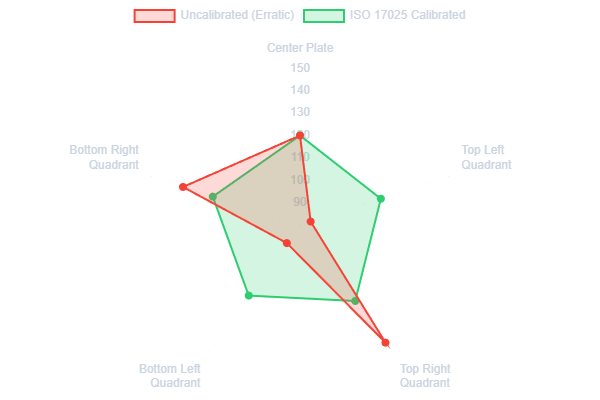
Stirrer plates are fundamental instruments used to automate fluid mixing and heating. Their precision is vital in pharmaceuticals, biotechnology, and material science to ensure homogenous reactions, prevent sedimentation, and maintain strictly controlled thermal environments required for sensitive molecular synthesis. Beyond simple mixing, these devices rely on sophisticated magnetic coupling. A motor rotates a high-strength magnet beneath the top plate, which in turn rotates a “stir bar” inside the vessel. In high-stakes environments like vaccine development or polymer synthesis, the stability of this magnetic field and the linearity of the motor’s response are critical. If the magnetic flux is uneven or the bearings are worn, the resulting “inconsistency” ruins the integrity of the data.Erratic Thermal Patterns
When a stirrer plate fails to maintain a uniform temperature, chemical reactions become entirely unpredictable. Localized overheating causes safety threats and permanently ruins sensitive batches, turning minor equipment neglect into a major laboratory hazard.
Rotational Speed Deviations
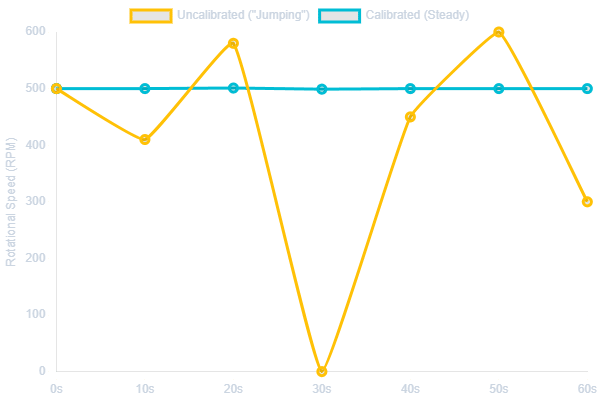
The phenomenon of “jumping” stir bars occurs when uncalibrated magnetic drives fail. This chart illustrates the stark difference between a failing motor’s erratic RPM fluctuations and the rock-solid stability of a calibrated magnetic field.
2. The Detailed ISO/IEC 17025 Stirrer Plate Calibration Process
The ISO/IEC 17025 calibration process for stirrer plates involves systematic verification of rotational speed and surface temperature stability. It requires traceable reference standards, controlled environmental conditions, and a multi-point testing approach to map the device’s performance across its entire operating range.Step 1: Pre-Calibration Inspection
Before technical measurements begin, the unit must undergo a physical audit. We check for:- Cracks or pitting on the ceramic or aluminum top plate.
- Integrity of the magnetic drive (checking for “dead spots”).
- Leveling of the unit (essential for centrifugal balance).
Step 2: Rotational Speed Verification
We use a calibrated non-contact Laser Tachometer. A reflective marker is placed on the stir bar or a specialized calibration jig.- Test Points: Measurements are taken at various intervals throughout the operating range of the device.
- Stability Check: The rotational speed is monitored over a set duration at each point to ensure no drifting occurs.
Step 3: Thermal Distribution and Accuracy
For hotplate stirrers, we utilize multi-channel thermometers or high-precision surface probes.- Mapping: We measure multiple locations across the plate to identify hot spots or cold zones.
- Equilibrium: We allow sufficient time for the plate to reach thermal equilibrium before recording data.
Step 4: Traceability and Uncertainty Analysis
Every measurement is compared against a reference standard with a higher accuracy class. We calculate the expanded uncertainty, accounting for environmental variables, the resolution of the unit under test, and the repeatability of the stir bar’s motion.3. Overcoming the Pain Point: Solving Inconsistency with Stirrer Plate Calibration
Inconsistency often comes from three simple issues: magnets losing grip, old motors, or uneven heat. We solve this by checking the magnetic strength, using better stir bars, and making sure the machine is perfectly level so the bar doesn’t jump.
Why the Stir Bar “Jumps”
When a stir bar starts rattling instead of spinning, it usually happens because the motor started too fast or the magnet isn’t strong enough. In the lab, we test this by seeing how thick a liquid can get before the magnet loses its hold on the stir bar.Technical Maintenance for Reliability:
- Magnet Re-alignment: Over time, internal magnets can shift. Ensure the drive magnet is perfectly centered under the plate markings.
- Bearing Lubrication: High-pitch squealing indicates bearing friction, which causes speed fluctuations.
- Top Plate Cleaning: Carbonized spills on the plate surface create localized insulation, leading to inconsistent heating.
4. Technical Data Table: Calibration Parameters
| Parameter | Calibration Method | Standard Tolerance | Recommended Approach |
|---|---|---|---|
| Rotational Speed | Non-contact Laser Tachometer | Based on Manufacturer/SOP | Multi-point verification |
| Surface Temp | High-precision Surface Probe | Based on Manufacturer/SOP | Quadrant mapping |
| Timer Accuracy | Calibrated Stopwatch | Based on Manufacturer/SOP | Interval testing |
| Stability | Continuous Data Logging | Minimal fluctuation over time | Long-term monitoring |
5. Expert Advice for Lab Managers
As a veteran in metrology, I cannot overstress the importance of the “Stir Bar Lifecycle.” Many labs blame the stirrer plate for inconsistency when the culprit is actually a demagnetized or unbalanced stir bar.- Pre-Calibration Tip: Always use the specific stir bar intended for the vessel size. An oversized bar in a small beaker creates turbulence that looks like mechanical failure.
- Storage: Never store stir bars in a way where they can demagnetize each other. Use a dedicated magnetic rack.
- Validation Interval: Regular calibration intervals are recommended based on usage and environment. If the unit is used with corrosive chemicals, more frequent inspections are safer.
6. FAQ: User Questions – Expert Answers
Q: Why does my stir bar keep jumping even at low speeds? Expert Answer: This problem typically indicates “Magnetic Decoupling.” Factors such as a mismatched stir bar size, a weakened internal drive magnet, or an unlevel surface often cause this issue. To resolve it, center your vessel exactly over the drive magnet and try using a stir bar with a center pivot ring to reduce friction.
Q: Can I calibrate the temperature using a thermometer in a beaker of water? Expert Answer: While this checks system accuracy, it is not a true plate calibration. To calibrate the plate itself, you must use a surface contact probe. Measuring via water introduces variables like evaporation and container glass thickness, which obscures the actual performance of the heating element. Q: What is the acceptable tolerance for RPM in a regulated lab? Expert Answer: This depends on your specific Quality Management System and ISO 17025 requirements. However, if your SOP defines a critical process parameter, your tolerance must be tighter than your process window. Q: How do I know if my stirrer motor is failing? Expert Answer: Watch for “hunting”, when the speed fluctuates up and down without user input. Also, listen for grinding noises. If measurements show high variance, the motor or control board likely needs replacement. Q: Does the plate material (Ceramic vs. Aluminum) affect calibration? Expert Answer: Absolutely. Ceramic plates have excellent chemical resistance but slower thermal response and can have more localized hot spots. Aluminum plates are much more uniform but prone to corrosion. Calibration profiles must be adjusted for the thermal conductivity of the specific material.7. Conclusion & CTA
Precision in the laboratory is a chain where every link must be strong. A stirrer plate might seem like a simple tool, but its consistency is the foundation of your chemical integrity. Don’t let jumping bars or thermal drift compromise your research.Return precision to your lab today.
Frequently asked questions
What is Stirrer Plate Calibration?
How often should a Stirrer Plate be calibrated?
What standards apply to Stirrer Plate Calibration?
What is included on the certificate?
Can you calibrate the Stirrer Plate on-site?
Need Stirrer Plate calibration?
NIST-traceable calibration, fast turnaround, in-lab or on-site across the USA.
Contact us for a quoteReferences & industry standards
- ISO/IEC 17025 testing & calibration laboratory requirements
- NIST calibration services and measurement traceability
- A2LA / ANAB accreditation for calibration laboratories
External standards bodies. Techmaster Electronics is an ISO/IEC 17025-accredited, NIST-traceable calibration laboratory.

Khanh Nguyen is the Marketing Manager at Techmaster Electronics, a B2B marketing leader covering the test, measurement, and ISO/IEC 17025 accredited calibration industry in the United States.