
AC Power Source Calibration: Ensuring Precision in Electrical Testing
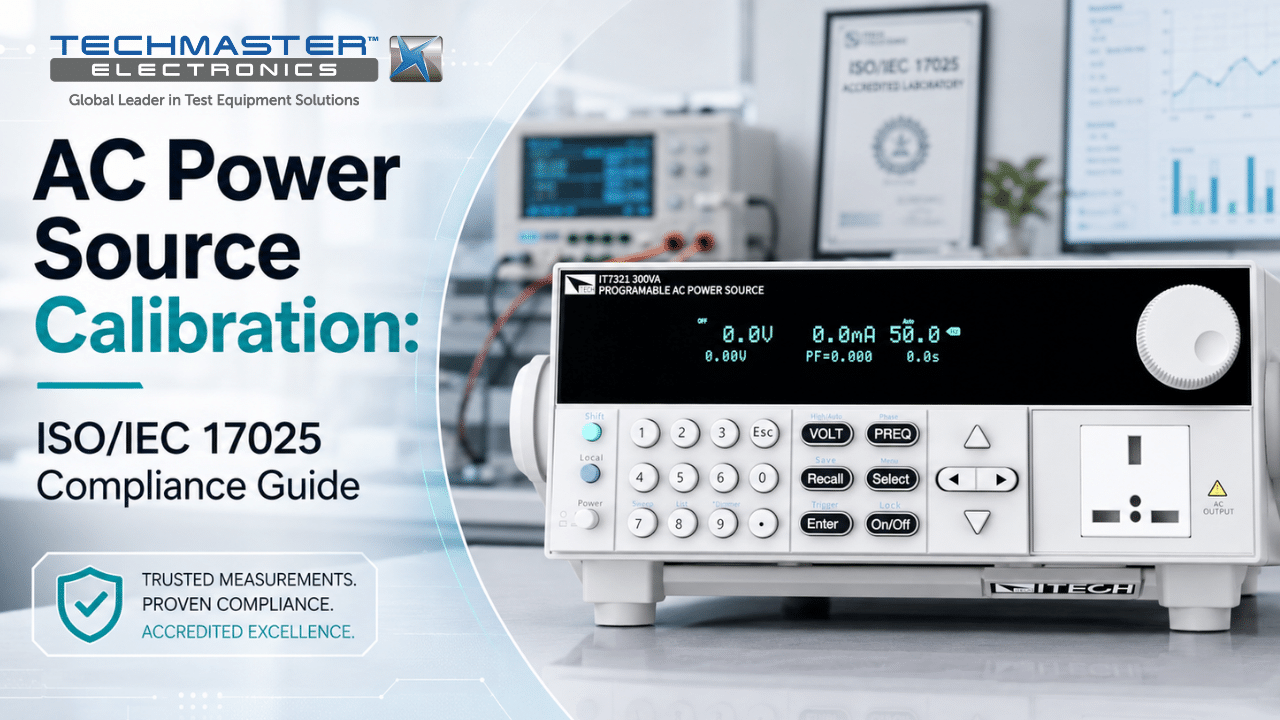
Reliable electrical testing depends on accurate instruments, especially the AC power source. During AC power source calibration, engineers verify that the equipment delivers accurate voltage, stable frequency, and low harmonic distortion. These parameters are essential because they ensure reliable testing of electronic components and systems. However, normal wear and environmental changes can cause output drift over time. As a result, regular calibration helps prevent inaccurate measurements, reduces the risk of product failures, and supports compliance with electromagnetic compatibility (EMC) standards.
1. Technical Principles: Understanding AC Power Source Accuracy
How is AC power source precision maintained?
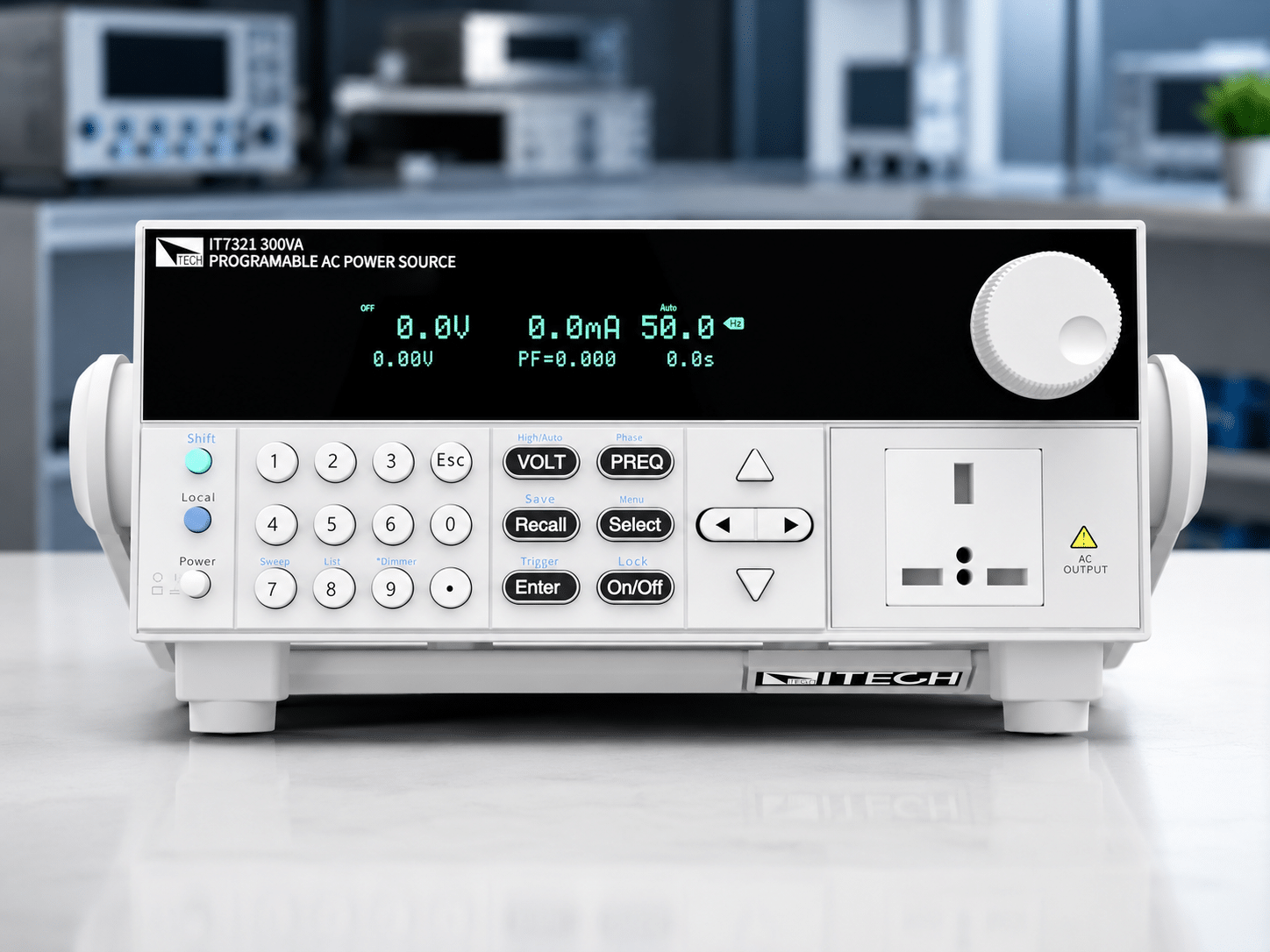
Modern AC power sources use fast feedback control and stable internal references to maintain voltage and frequency accuracy. During calibration, technicians compare the output with higher-level reference standards. Then, they measure voltage, frequency, phase, and total harmonic distortion (THD) to confirm that the instrument stays within its specified accuracy.
Calibration typically uses a high-accuracy power analyzer or a true RMS digital multimeter (DMM). Specifically, the technician verifies several key parameters:
- Voltage Accuracy: Confirms that the output voltage matches the programmed value throughout the operating range.
- Frequency Stability: In addition, checks that the output frequency remains accurate and stable.
- Harmonic Performance: Finally, measures THD to confirm waveform quality meets specification.
2. Industrial Applications: Why AC Power Source Calibration Matters
Which industries rely on accurate AC power source calibration?
Many industries depend on accurate power sources because product quality and safety begin with reliable electrical testing. For example, the following industries require regular calibration.
2.1 Renewable Energy
The renewable energy industry depends on highly accurate electrical testing to ensure reliable system performance. Manufacturers test solar inverters, wind turbine controllers, and energy storage systems using precise AC voltage profiles that closely simulate real utility grid conditions. As a result, engineers can evaluate equipment under realistic operating environments before installation. In addition, accurate AC power source calibration helps maintain consistent voltage and frequency throughout the testing process. This improves measurement reliability, supports product certification, and reduces the risk of failures during field operation.
2.2 Consumer Electronics
Consumer electronics manufacturers perform electrical testing throughout product development and production to verify product quality. They use calibrated AC power sources to supply stable input voltage when testing power supplies, household appliances, computers, and other electronic devices. Therefore, accurate calibration helps engineers collect reliable test data and identify potential performance issues before products reach the market. Furthermore, consistent power output supports compliance with international energy efficiency, safety, and EMC standards, helping manufacturers maintain product quality and customer confidence.
2.3 Aerospace and Defense
Aerospace and defense systems require extremely reliable electrical performance because even small measurement errors can affect mission-critical equipment. Engineers use calibrated AC power sources to test avionics, communication systems, navigation equipment, radar components, and defense electronics under different voltage and frequency conditions. Moreover, calibration ensures that the power source delivers stable output throughout every test. As a result, manufacturers can verify system performance with greater confidence, meet strict military and aerospace standards, and reduce the risk of unexpected failures in demanding electromagnetic environments.
3. The Role of ISO/IEC 17025
Why is ISO/IEC 17025 important?
ISO/IEC 17025 is the international standard for testing and calibration laboratories. In particular, it ensures measurement traceability, validated procedures, and documented measurement uncertainty.
When you calibrate an AC power source through an ISO/IEC 17025 accredited laboratory, you receive calibration results supported by NIST-traceable standards. Consequently, this documentation helps manufacturers meet quality requirements from customers, auditors, and regulatory agencies.
Furthermore, the standard demonstrates that the laboratory controls its measurement process and calculates uncertainty correctly. As a result, users gain greater confidence in the calibration results.
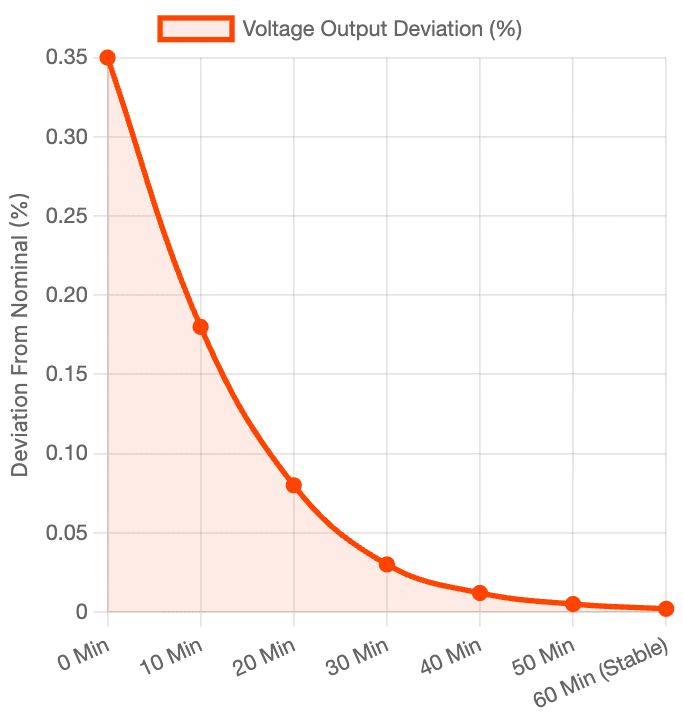
Thermal Drift & Stabilization
Visualizing the critical 60-minute pre-calibration warm-up phase. Internal reference circuits drift significantly before thermal equilibrium is met.
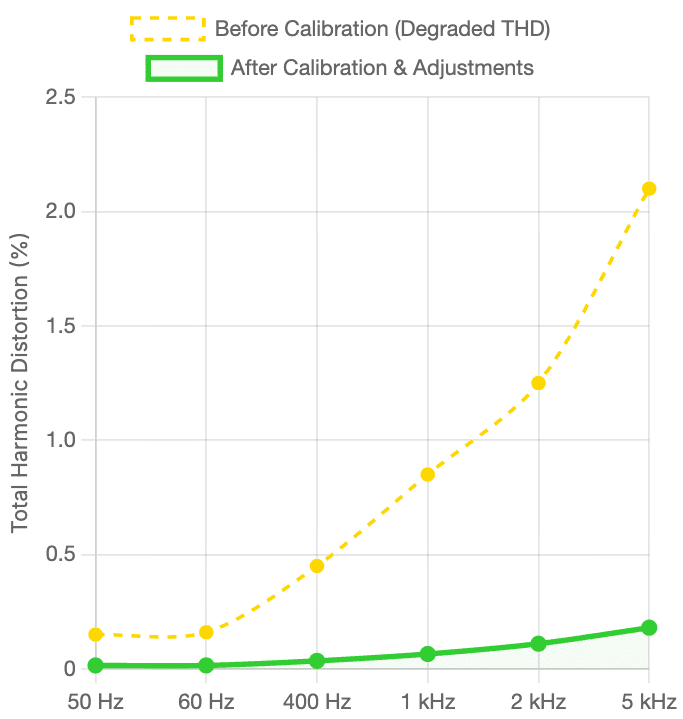
Waveform Purity (THD vs. Frequency)
The quantifiable impact of hardware tuning and correction loop calibrations on harmonic fidelity under variable operational load frequencies.
4. How to Prepare Your AC Power Source for Calibration
Before sending your equipment for calibration
Allow Warm-up
First, turn on the power source and let it stabilize for 30–60 minutes or follow the manufacturer’s recommended warm-up time.
Inspect the Equipment
Next, check all input and output terminals. If necessary, remove dirt or corrosion and inspect for physical damage that could affect measurement accuracy.
Prepare Documentation
Then, provide the user manual and any operating settings commonly used during production testing. This allowstechnicians to duplicate your normal operating conditions.
Disconnect External Loads
Finally, remove unnecessary loads before calibration. This way, technicians can evaluate the power source itself without outside influences.
Techmaster US: Expert Calibration Services
Techmaster Electronics, LLC has supported U.S. manufacturers since 1989 as an independent ISO/IEC 17025 accredited calibration laboratory. Today, our metrologists work from five laboratories (four ISO/IEC 17025 accredited) in California, Florida, Texas, and North Carolina.
We provide high-precision AC power source calibration using NIST-traceable standards. In addition, customers can choose laboratory calibration or on-site service to reduce equipment downtime.
Why Choose Techmaster US?
- ISO/IEC 17025 Accredited: We follow the ANAB AC-1736 quality system.
- On-site Calibration: Our technicians perform calibration at your facility. As a result, you reduce downtime.
- Comprehensive Services: Besides electrical calibration, we also support dimensional, mass, pressure, temperature, and other calibration requirements through one trusted provider.
Contact Techmaster US today to discuss your calibration needs and build a maintenance schedule that supports long-term accuracy and compliance.
Frequently Asked Questions
1. How often should an AC power source be calibrated?
Most manufacturers schedule calibration once every 12 months. However, equipment used for critical applications or frequent testing may require calibration every six months.
2. Does calibration include harmonic distortion testing?
Yes. Professional calibration verifies total harmonic distortion (THD). As a result, technicians can confirm that the output waveform remains within the manufacturer’s specifications.
3. Why does ISO/IEC 17025 accreditation matter?
An ISO/IEC 17025 accredited laboratory provides traceable measurements, validated procedures, and documented measurement uncertainty. Therefore, organizations can satisfy quality and regulatory requirements with greater confidence.
4. Does Techmaster US offer on-site calibration?
Yes. Techmaster Electronics provides ISO/IEC 17025 accredited on-site calibration services for many types of electrical test equipment. Consequently, customers reduce downtime while maintaining compliance.
5. Why do technicians use a power analyzer during calibration?
A high-accuracy power analyzer provides accurate true RMS, frequency, and phase measurements. Therefore, technicians can verify AC power source performance with greater confidence than they can with standard multimeters.
AC Power Source Calibration: The Engineering of Precision
Reliable electrical testing depends on traceable accuracy. From avionics transients to grid-tie simulations, precision in voltage, frequency, and spectral purity is the foundation of modern compliance.
CONTACT USReferences & industry standards
- ISO/IEC 17025 testing & calibration laboratory requirements
- NIST calibration services and measurement traceability
- NIST Fundamental Electrical Measurements
- A2LA / ANAB accreditation for calibration laboratories
External standards bodies. Techmaster Electronics is an ISO/IEC 17025-accredited, NIST-traceable calibration laboratory.
Frequently asked questions
What is ac power source calibration?
AC Power Source Calibration is the documented comparison of a AC power source against NIST-traceable reference standards under ISO/IEC 17025. It quantifies the AC power source’s error and measurement uncertainty and confirms it performs within tolerance, with as-found and as-left data on the certificate.
How often should a AC power source be calibrated?
Most quality systems calibrate a AC power source every 12 months, or sooner after repair, overload, or before critical measurements. Set your interval from the manufacturer spec and your ISO 9001 / 13485 / AS9100 program and drift history.
Is Techmaster’s AC power source calibration ISO 17025 accredited?
Yes. Techmaster Electronics is ISO/IEC 17025:2017 accredited by ANAB (Certificate AC-1736). Every AC power source calibration is NIST-traceable and issued with a full measurement-uncertainty budget.
What is the turnaround for AC power source calibration?
Standard turnaround is 5 business days, with 1–2 business-day expedite available. On-site calibration removes shipping time entirely for AC power sources that can’t leave the floor.
Do you calibrate AC power sources on-site or in-lab?
Both. Techmaster runs five US labs (Vista CA, Santa Clara CA, Orlando FL, San Antonio TX, Holly Springs NC) and offers nationwide on-site AC power source calibration to minimize downtime.

Khanh Nguyen is the Marketing Manager at Techmaster Electronics, a B2B marketing leader covering the test, measurement, and ISO/IEC 17025 accredited calibration industry across the US and Vietnam markets.