
On-site NIST certification is calibration performed at your facility, where a Techmaster technician verifies that your refrigerator and freezer monitoring sensors measure temperature accurately against NIST-traceable standards, without removing a single device. You get an ISO/IEC 17025 accredited certificate, typically the next business day, and your storage never goes unmonitored.
That last point is the whole reason on-site exists. Your vaccines, blood products, oncology drugs, and biopsies do not pause for a calibration cycle, and neither should the record that protects them.
Why does on-site calibration matter for hospitals and labs?
Because the alternative interrupts the one thing you cannot afford to interrupt: continuous, defensible proof of storage conditions. When a sensor is uninstalled and shipped out for calibration, your unit is either unmonitored or running on a temporary device, and your historical record develops a seam. In an audit or a temperature-excursion investigation, seams are exactly what an inspector looks for.
On-site certification removes that risk. The sensor stays where it is, keeps doing its job, and is certified in place. Techmaster has built this model specifically for healthcare environments where accuracy, traceability, and operational continuity are all non-negotiable.
How does Techmaster’s on-site module work?
The service follows four steps, all performed at your hospital, medical office building, or clinic:
- On-site NIST-traceable calibration. A Techmaster technician calibrates each monitoring sensor in place against NIST-traceable reference standards. No equipment is removed, and you receive daily progress reports during the visit.
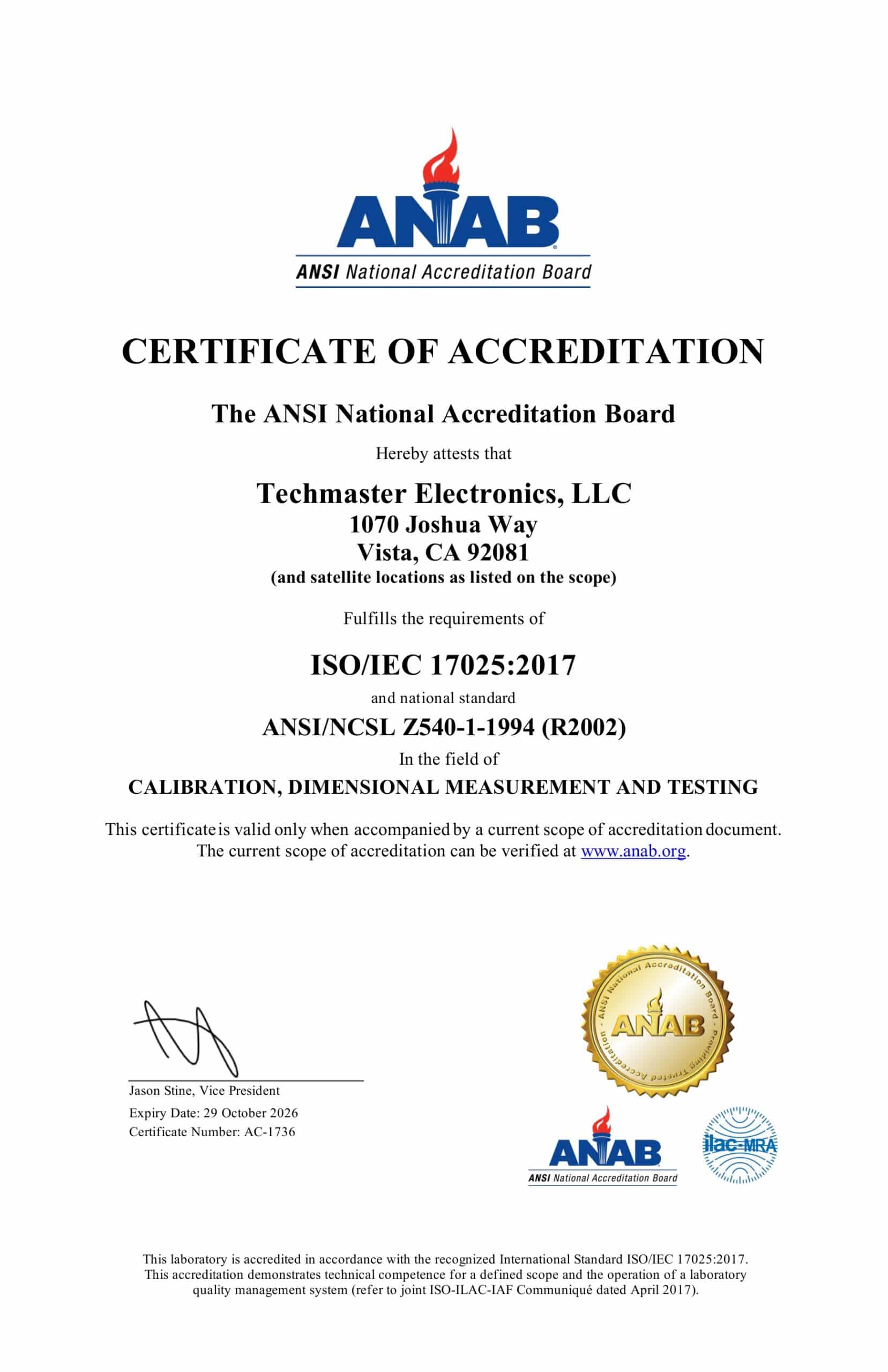
- ISO/IEC 17025 accredited certificates. Each certified sensor receives a formal Report of Calibration showing model, serial number, calibration date, a pass result, and the measurement uncertainty, backed by Techmaster’s ANAB accreditation, certificate AC-1736.
- Next-business-day delivery. Certificates are published to your secure Techmaster Portal the next business day after final report approval, with full audit-trail documentation.
- A continuous record. Because nothing was unplugged or swapped, your monitoring history stays unbroken, and audit-ready.
What makes a calibration certificate actually valid?
Not every “certificate” is certification. Under CDC and VFC program guidance, a monitoring device’s calibration must be NIST-traceable and performed by an ISO/IEC 17025 accredited provider. A valid Report of Calibration shows the model and serial number, the calibration date, a clear pass result, and a documented measurement uncertainty within suitable limits (the recommended tolerance for vaccine monitoring is ±0.5°C). A sticker with a date on it is not the same thing.
Techmaster has been an accredited calibration laboratory since 1989. Every certificate we issue is backed by real, traceable measurement, never paper for its own sake.
Who is this service for?
On-site NIST certification is built for the people responsible for proving storage integrity:
- Quality and accreditation directors preparing for Joint Commission, CMS, or CAP surveys.
- Lab and pharmacy managers protecting vaccines, reagents, and compounded medications, including VFC-enrolled sites.
- Biomedical and clinical engineering teams managing dozens or hundreds of sensors that must stay in tolerance.
- Blood bank and transfusion services safeguarding the blood supply.
Frequently asked questions
Do you have to remove our sensors to calibrate them?
No. Techmaster performs NIST-traceable calibration on-site, with no equipment removal, so your monitoring stays active and your record stays continuous.
How fast do we get certificates?
Certificates are published to your secure Techmaster Portal the next business day after final report approval, with full audit-trail documentation.
Is the calibration accredited?
Yes. Techmaster is an ISO/IEC 17025 accredited calibration laboratory (ANAB certificate AC-1736), and all calibrations are NIST-traceable.
How often should monitoring sensors be recalibrated?
CDC guidance recommends recalibrating data loggers every 1–2 years, or per the manufacturer’s schedule. Techmaster can manage that cycle for you so nothing lapses.
Ready to keep your storage certified and your record unbroken?
Request a quote for on-site NIST-traceable certification. No equipment removal. Certificates by the next business day.
References & industry standards
- ISO/IEC 17025 testing & calibration laboratory requirements
- NIST calibration services and measurement traceability
- NIST Time and Frequency Division
- A2LA / ANAB accreditation for calibration laboratories
External standards bodies. Techmaster Electronics is an ISO/IEC 17025-accredited, NIST-traceable calibration laboratory.
Related reading: what calibration your temperature mapping sensors need to pass an FDA audit

Khanh Nguyen is the Marketing Manager at Techmaster Electronics, a B2B marketing leader covering the test, measurement, and ISO/IEC 17025 accredited calibration industry in the United States.