
Digital Micro Ohmmeter Calibration
Accuracy across the range
How Digital Micro Ohmmeter calibration works
- Intake & visual inspection
- Environmental stabilization
- As-found measurement
- Comparison to NIST-traceable standards
- Adjustment if required
- As-left results & certificate
Your calibration, covered
In-lab vs on-site calibration
In-lab calibration
- Accredited bench with full reference standards
- Best achievable measurement uncertainties
- Pickup & return logistics handled
- Ideal for precision and reference work
On-site calibration
- We calibrate the Digital Micro Ohmmeter at your facility
- No shipping risk or transit downtime
- As-found data captured before any move
- Ideal for fixed, large or sensitive assets
In-depth guide
1. Introduction: The High Stakes of Low Resistance
Using a micro-ohmmeter without calibration creates serious risks. It can lead to missed contact resistance in high-voltage circuit breakers, which often causes major heat damage. Wrong readings break safety rules, fail to meet ISO/IEC 17025 legal standards, and cause huge money losses from unexpected downtime. Professional Digital Micro ohmmeter calibration along with a specialized Microohm 10A calibration service provides the best way to keep measurements exact.
2. Overview: The Role of Digital Micro ohmmeter calibration in Testing
Digital micro-ohmmeter calibration checks if a tool measures low resistance (microhms to milliohms) correctly against a known standard. This check ensures that important electrical parts, like busbars and switchgear, stay at low resistance to stop overheating and power loss. Digital micro-ohmmeters (DLROs) are special tools that measure very low resistance. Unlike regular multimeters, these tools use the Kelvin 4-wire method to remove the resistance of the test leads from the final result. In industries, especially power, transmission, and aerospace, even a tiny change in micro-ohms often shows a bad weld, a loose bolt, or rusty contacts. By doing regular calibration with a certified Microohm 10A calibration service, workers make sure that the 10A, 100A, or 200A test currents give reliable data for planning repairs.3. The ISO/IEC 17025 Standard Calibration Process
A standard-compliant calibration process involves environmental stabilization, 4-wire Kelvin connection setup, and multi-point verification against high-precision standard resistors. It requires documenting temperature, humidity, and the specific test current (e.g., 10A or 200A) to ensure results are reproducible and traceable to SI units.Step 1: Environmental Conditioning for Digital Micro ohmmeter calibration
Instruments must stabilize in a climate-controlled laboratory (typically 23 degrees Celsius plus or minus 3 degrees Celsius) for at least 4 to 24 hours. Temperature coefficients in low-resistance materials can significantly skew results if the device is not thermally indexed.Step 2: Visual and Functional Inspection
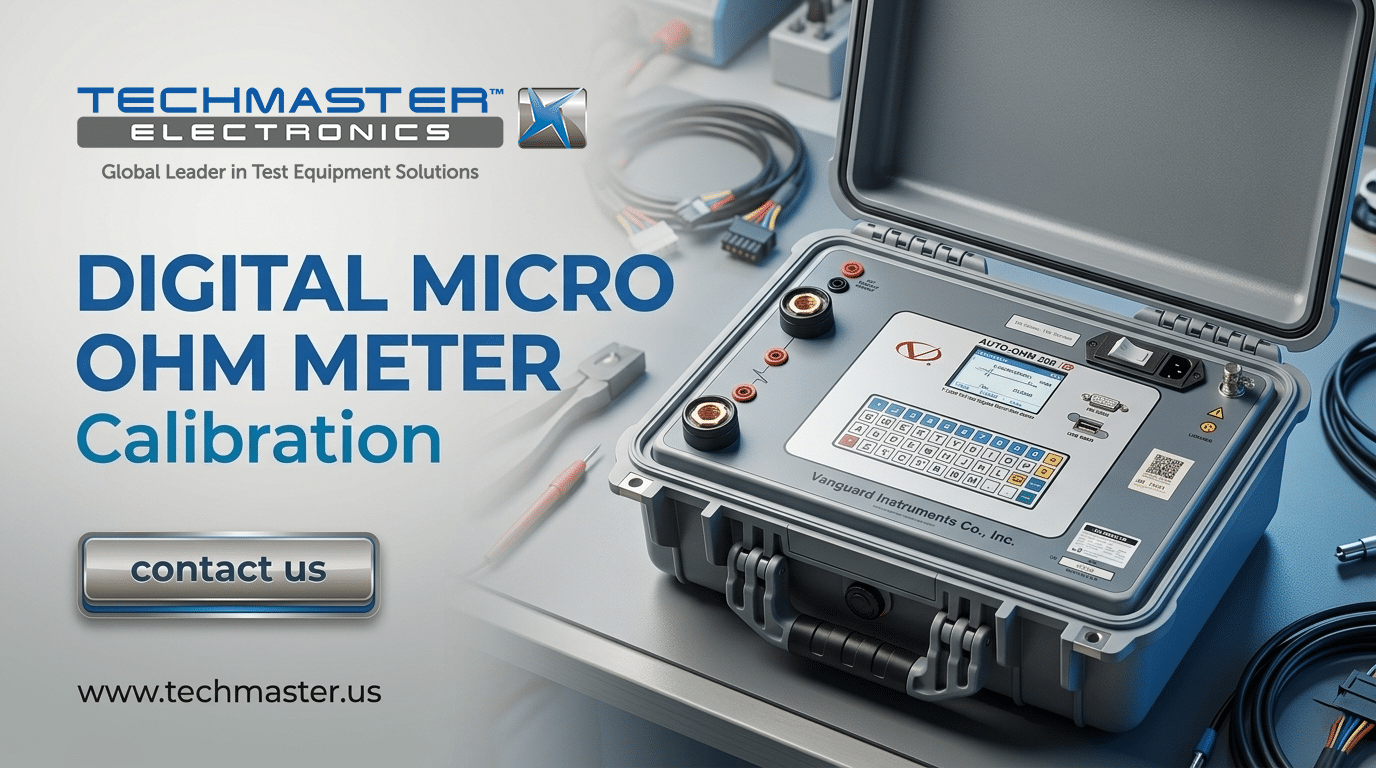
Before electrical testing, technicians inspect the terminals for oxidation and the test leads for insulation integrity. For high-current models like the Vanguard Auto-Ohm 200, checking the cooling fans and power supply stability is mandatory.Step 3: Zeroing and Lead Compensation
Using a gold-standard shorting bar, the meter is checked for its ability to produce a true zero reading. This compensates for any residual internal offsets within the measurement circuitry.Step 4: Multi-Point Verification
Resistance is measured at various decades:- 100 micro-ohm (Micro-ohm range)
- 1 milli-ohm (Milli-ohm range)
- 10 milli-ohm, 100 milli-ohm, 1 ohm.
Testing must occur at the instrument’s rated currents (e.g., testing a Metrel MI 3250 at its full 10A capability). Facilities providing a specialized Microohm 10A calibration service use precision resistance standards to verify these points with minimal error.
4. Traceability and Measurement Uncertainty Analysis
Traceability is the unbroken chain of comparisons to national standards (NIST/NPL). Measurement uncertainty accounts for variables like standard resistor accuracy, temperature fluctuations, and instrument resolution, providing a statistical “confidence interval” (typically 95 percent) for every measurement recorded. In micro-ohm metrology, “Uncertainty” is as important as the reading itself. We calculate the Expanded Uncertainty based on a coverage factor (usually k=2) and the combined standard uncertainty. Key contributors to uncertainty in micro-ohm calibration include:- Standard Resistor Drift: The annual stability of the lab’s reference standards.
- Thermoelectric EMF: Small voltages generated at the junction of dissimilar metals, which can be mitigated by reversing current flow during the test.
- Contact Resistance: Even with 4-wire setups, poor clamp placement on a 10 micro-ohm standard can introduce significant errors.
5. Model-Specific Notes: Vanguard and Metrel
High-current systems like the Vanguard Auto-Ohm 200 require specialized high-wattage standards to handle 200A without overheating. In contrast, portable units like the Metrel MI 3250 focus on battery-operated stability and 10A current precision for field-based testing of inductive loads.VANGUARD INST. CO. AUTO-OHM 200 SERIES 3
This is a true heavy-duty instrument. During calibration, emphasis is placed on Current Linearity. Because it can output up to 200A, the calibration must verify that the resistance reading remains stable as the current ramps up. Technicians must ensure the test cables provided are the exact ones used during the test to match the manufacturer’s specification.Metrel MI 3250 (10A)
The MI 3250 is often used for measuring the resistance of transformers and motors. Calibration focuses on its noise rejection capabilities and its performance at lower current settings (100mA to 10A). Testing the “Long Test” mode is critical to ensure the internal thermal management does not cause drift during extended measurement cycles.6. Technical Data: Range and Tolerance Table
This table outlines typical calibration parameters for a high-tier digital micro-ohmmeter.| Resistance Range | Typical Test Current | Allowable Tolerance (Typical) | Recommended Standard |
|---|---|---|---|
| 1.000 to 999.9 micro-ohm | 100A to 200A | plus/minus 1% reading plus/minus 2 digits | 100 micro-ohm Shunt or Resistor |
| 1.000 to 9.999 milli-ohm | 10A to 50A | plus/minus 0.5% reading plus/minus 2 digits | 1 milli-ohm Standard Resistor |
| 10.00 to 99.99 milli-ohm | 1A to 10A | plus/minus 0.2% reading plus/minus 1 digit | 10 milli-ohm Standard Resistor |
| 100.0 to 999.9 milli-ohm | 100mA to 1A | plus/minus 0.2% reading plus/minus 1 digit | 100 milli-ohm Standard Resistor |
| 1.000 to 10.00 ohm | less than 100mA | plus/minus 0.5% reading plus/minus 2 digits | 1 ohm or 10 ohm Standard Resistor |
7. Expert Advice on Reliability
As a senior metrologist, I have seen thousands of “failed” calibrations. However, most of these failures actually come from poor equipment handling instead of internal tool faults. To increase your tool’s life and reliability, you should follow these steps:
- First, Clean the Clamps: Rust on Kelvin clips is the main cause of shaky readings. Therefore, always use a good electrical cleaner to keep the metal edges of the clips shiny.
- Next, Check Battery Health: In portable tools like the Metrel 3250, a weak battery can lead to power drops during the 10A test. Consequently, this causes the screen to show unstable values.
- Also, Manage Your Cables: Never roll up your test cables while doing high-current tests. This is important because rolled cables create extra power interference that can mess up the quick DC checks used by modern digital meters.
- Finally, Do a Pre-Test Check: Always keep a known 1 milli-ohm or 10 milli-ohm check part in your kit. If the meter gives a weird reading on a circuit breaker, then you should check the meter against this part right away.
8. FAQ: Common Metrology Concerns
Question: How often should I calibrate my digital micro-ohmmeter? Expert Answer: The standard interval is 12 months. However, if the device is used daily in harsh field environments or has been subjected to physical impact, a 6-month interval is recommended to ensure in-tolerance conditions are maintained. Question: What is the difference between a micro-ohmmeter and a milliohmmeter? Expert Answer: A micro-ohmmeter is designed for extremely low resistances and usually employs higher test currents (10A to 600A) to achieve sufficient voltage drop for measurement. Milliohmmeters typically use lower currents and cover higher resistance ranges. Question: Why are my readings drifting during a 200A test? Expert Answer: This is usually due to Thermoelectric EMF or the heating of the test subject itself. High current generates heat, which increases resistance. Ensure you are using the auto-reversing current feature to cancel out these thermal effects. Question: Can I use standard multimeter leads for micro-ohm measurements? Expert Answer: No. Standard leads do not support the 4-wire Kelvin configuration required to bypass lead resistance. Using 2-wire leads will include the resistance of the leads themselves (often 0.1 to 0.5 ohm) instead of the actual test subject. Question: What does “Error: Current Loop Open” mean? Expert Answer: This indicates that the instrument cannot complete the high-current circuit. This is often caused by a broken internal wire in the test lead, a blown fuse, or poor contact between the clamps and the test surface.Conclusion
Precision in low-resistance measurement is not an option; it is a safety mandate. Whether you are using a Vanguard Auto-Ohm 200 or a Metrel MI 3250, adhering to a strict ISO/IEC 17025 calibration schedule ensures your data is defensible and your operations are safe.Ready to ensure your equipment is within tolerance?Contact our ISO 17025 accredited laboratory today for professional Microohm 10A calibration service.
Frequently asked questions
What is Digital Micro Ohmmeter Calibration?
How often should a Digital Micro Ohmmeter be calibrated?
What standards apply to Digital Micro Ohmmeter Calibration?
What is included on the certificate?
Can you calibrate the Digital Micro Ohmmeter on-site?
Need Digital Micro Ohmmeter calibration?
ANAB-accredited, NIST-traceable, fast turnaround, in-lab or on-site across the USA.
Contact us for a quoteReferences & industry standards
- ISO/IEC 17025 testing & calibration laboratory requirements
- NIST calibration services and measurement traceability
- A2LA / ANAB accreditation for calibration laboratories
External standards bodies. Techmaster Electronics is an ISO/IEC 17025-accredited, NIST-traceable calibration laboratory.

Khanh Nguyen is the Marketing Manager at Techmaster Electronics, a B2B marketing leader covering the test, measurement, and ISO/IEC 17025 accredited calibration industry across the US and Vietnam markets.