
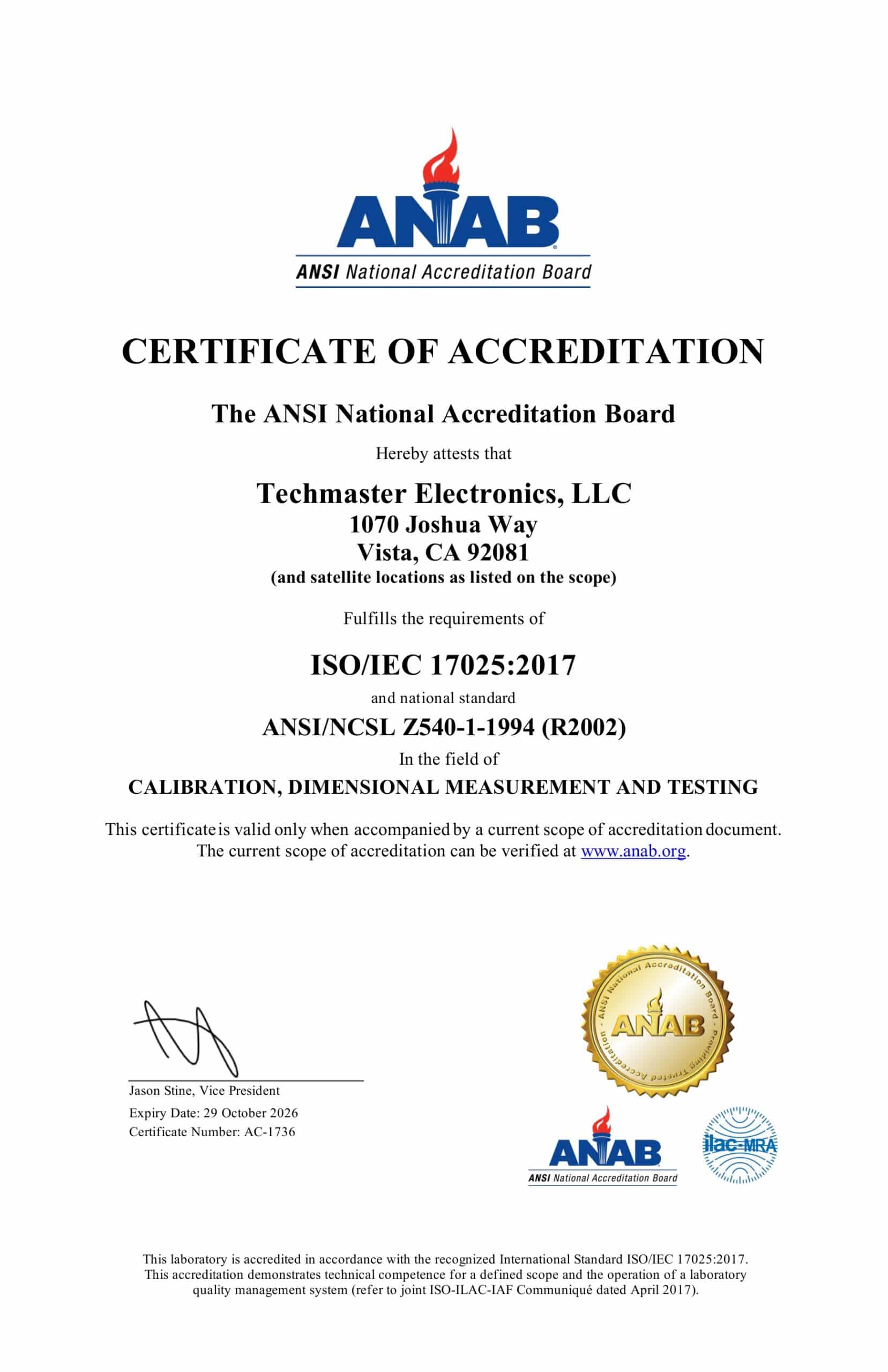
Metrology guide · ISO/IEC 17025 · ANAB-accredited
Resistance Meter Calibration
Resistance Meter Calibration verifies a Resistance Meter against NIST-traceable standards under ISO/IEC 17025. Techmaster performs a documented multi-point check, reports measurement uncertainty, and issues an ANAB-accredited certificate, in-lab or on-site across the USA.
ANAB accredited ISO/IEC 17025 NIST traceable
ISO 17025Accredited method
NISTTraceability
12 moTypical interval
ANABAccreditation
In this guide
Accuracy across the range
Typical as-found results: the indicated error at each test point stays inside the acceptance tolerance band, with measurement uncertainty reported per point.
How Resistance Meter calibration works
- Intake & visual inspection
- Environmental stabilization
- As-found measurement
- Comparison to NIST-traceable standards
- Adjustment if required
- As-left results & certificate
Your calibration, covered
In-lab calibrationAccredited bench service with pickup
On-site calibrationWe calibrate at your facility
Expedited turnaroundRush options to cut downtime
Accredited certificateANAB ISO 17025 with uncertainty
In-lab vs on-site calibration
In-lab calibration
- Accredited bench with full reference standards
- Best achievable measurement uncertainties
- Pickup & return logistics handled
- Ideal for precision and reference work
On-site calibration
- We calibrate the Resistance Meter at your facility
- No shipping risk or transit downtime
- As-found data captured before any move
- Ideal for fixed, large or sensitive assets
In-depth guide
Introduction: The High Cost of Micro-Ohm Inaccuracy
In high-voltage electrical testing, a deviation of just a few micro-ohms in a resistance meter can mask a failing circuit breaker contact or a degrading busbar joint. These “invisible” errors lead to catastrophic equipment failure, massive financial losses from unplanned downtime, and severe safety risks to personnel. Professional resistance meter calibration, particularly for high-current instruments like the Vanguard Auto-Ohm 200 S4, is the only way to ensure measurement integrity, regulatory compliance, and long-term asset reliability.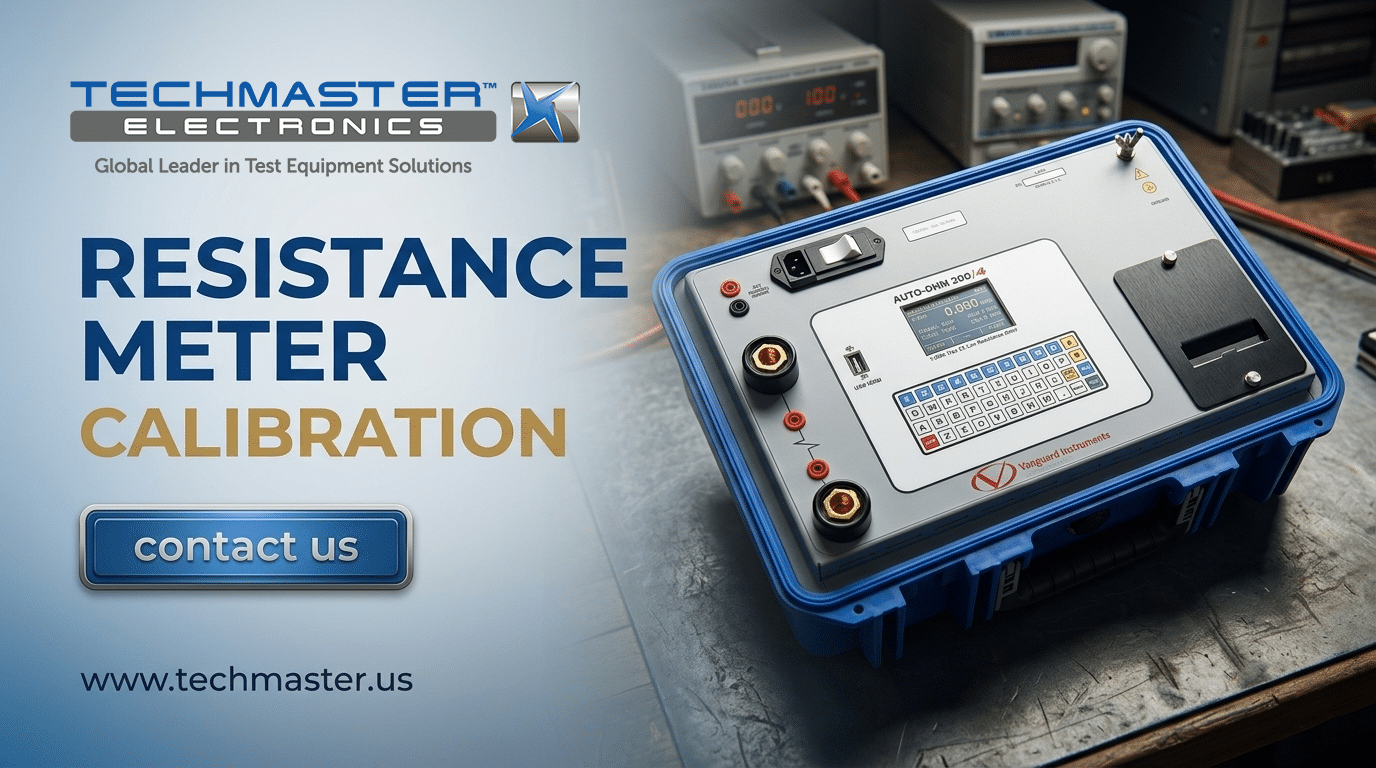
What is Resistance Meter Calibration and Why Does It Matter?
Resistance meter calibration is the formal process of comparing an instrument’s readings against a known reference standard of higher accuracy. It ensures that measurements of electrical resistance, from micro-ohms in contact testing to mega-ohms in insulation, remain within the manufacturer’s specified tolerances and are traceable to SI units. Resistance meters, or ohmmeters, are the workhorses of the electrical maintenance industry. They are used to verify the integrity of electrical paths. In industrial settings, we specifically look at “low resistance” measurements where contact resistance is measured in the micro-ohm ($\mu\Omega$) range. This requires the “Kelvin” or 4-wire measurement technique to eliminate the resistance of the test leads themselves. The precision of these devices is not static. Environmental factors, mechanical stress, and component aging cause “drift.” Regular calibration corrects this drift and provides the user with a “Correction Factor” or “Offset,” which is critical for high-stakes decision-making in the field.Resistance Meter Calibration Services: From Handheld Devices to High-Current Industrial Solutions
Professional calibration services cover the entire spectrum of resistance measurement, ranging from standard laboratory multimeters to heavy-duty industrial systems. Each segment requires specific standards to verify accuracy, safety, and compliance with international electrical norms. To achieve total system reliability, we categorize our resistance meter calibration services into four primary technical segments:1. Standard Resistance Calibration (Benchtop & Handheld)
These are general-purpose ohmmeters or digital multimeters (DMMs) used in laboratory environments or basic electronic repair. Calibration ensures linearity across standard ranges (Ohms to Kilo-ohms), focusing on precision for circuit board testing and component verification.2. Insulation Resistance Meter Calibration (Megohmmeters)
Megohmmeters test the integrity of insulation by applying high voltages (often up to 5kV or 10kV). Calibration here is critical for safety, as it verifies the meter’s ability to accurately detect leakage currents and prevent electrical breakdown in motors and cables.3. Earth Resistance Meter Calibration (Ground Testers)
Verifying ground impedance is vital for lightning protection and system grounding. Calibration ensures these meters can accurately read low-impedance paths in soil, protecting personnel and infrastructure from fault currents.4. Low Resistance & Micro-Ohmmeter Calibration (High-Current Solutions)
This is where the Vanguard Auto-Ohm 200 S4 serves as the industry gold standard. As a heavy-duty solution for power systems and substations, this device is used for testing circuit breaker contacts and busbar joints where resistance must be measured in the micro-ohm range under extreme conditions.Case Study: Why the Vanguard Auto-Ohm 200 S4 Requires Rigorous High-Current Calibration
The Vanguard Auto-Ohm 200 S4 represents the pinnacle of industrial micro-ohmmeters. Unlike handheld testers that use milliamps, the S4 generates true DC current up to 200 Amperes. This high current is necessary to “stress-test” large contacts, as some faults only become apparent when the system is under significant load. A standard calibration is insufficient for such heavy-duty equipment. We apply a more stringent process to ensure operational safety for breakers and busbars:- Thermal Stability under Load: Because the S4 outputs 200A, internal components can heat up. Calibration must verify that the measurement remains accurate even during prolonged high-current discharge.
- Contact Integrity Simulation: We calibrate the S4 against high-precision shunts that can handle 200A without drifting. This ensures that when a technician tests a circuit breaker in a substation, a “Pass” result truly means the contact resistance is low enough to prevent an arc-flash or fire.
- Vulnerability of Sub-Millivolt Signals: At 200A, the voltage drop being measured is often less than 1mV. Our calibration process verifies the S4’s ability to filter out electromagnetic interference (EMI) typical of high-voltage environments, ensuring the sensor system captures the “true” feedback signal.
| Testing Phase | Industrial Measurement Objective | High-Current Verification Method | Expected Result |
|---|---|---|---|
| Low-End Linearity | Verify sensor sensitivity | Comparison with 0.1% Shunts | Maintain ultra-high stability |
| Operational Mid-Point | General system performance | Mid-scale resistance testing | Minimal deviation under load |
| Full-Scale Limit | Maximum measurement reach | 100% range verification | Consistent accuracy across range |
| 200A Stress Test | Real-world load capacity | Continuous DC phát dòng (200A) | Accuracy remains unchanged by heat |
ISO/IEC 17025 Resistance Meter Calibration Process
An ISO/IEC 17025 compliant calibration follows a rigorous, documented procedure including environmental stabilization, multi-point verification across all ranges, and the calculation of expanded uncertainty. This ensures that the calibration laboratory is technically competent to produce valid results.Step 1: Preliminary Inspection and Cleaning
Before any measurements are taken, the device must be inspected. We check the Vanguard S4 for:- Physical damage to the casing.
- Integrity of the high-current terminals (no pitting or oxidation).
- Cleanliness of the cooling fans.
- Firmware version check.
Step 2: Environmental Stabilization
Metrology is sensitive to temperature. The S4 must sit in the lab environment (typically $23^{\circ}C \pm 3^{\circ}C$) for at least 4 to 8 hours. This prevents thermal EMF (Electromotive Force) from affecting the micro-ohm readings.Step 3: Four-Wire (Kelvin) Connection Setup
We use a high-precision shunt or a decade resistance box designed for high-current applications. The connection must use the 4-wire method:- Current Leads (C1, C2): Deliver the 200A current.
- Potential Leads (P1, P2): Measure the voltage drop across the standard resistance.
Step 4: Multi-Point Testing
Calibration is performed at multiple points across the instrument’s range. For the Vanguard Auto-Ohm 200 S4, we typically test:- 10% of range (Checking linearity at the low end).
- 50% of range (Mid-point verification).
- 90-100% of range (Full-scale accuracy).
- High-current verification (Ensuring the meter maintains accuracy while pumping 200A).
Resistance Meter Calibration: Traceability and Uncertainty
Traceability is the unbroken chain of comparisons back to National Standards (like NIST). Measurement Uncertainty is the quantitative doubt of the result, calculated using factors like standard resolution, repeatability, and the uncertainty of the calibration standard itself. When we calibrate a resistance meter, we don’t just provide a “Pass” or “Fail.” We provide a value with a $k=2$ coverage factor (95% confidence interval).| Source of Uncertainty | Type | Impact on Micro-Ohm Measurement |
|---|---|---|
| Reference Standard | Type B | The accuracy of the lab’s shunt or resistance bridge. |
| Repeatability | Type A | Variation in consecutive readings on the S4. |
| Thermal EMF | Type B | Voltage generated by dissimilar metals at different temperatures. |
| Resolution | Type B | The smallest increment the S4 can display. |
Expert Advice on Resistance Meter Calibration Reliability
To maximize the lifespan and reliability of your resistance tester, prioritize lead maintenance, use clean power sources, and perform “cross-checks” between official calibration intervals.1. Lead Maintenance for Better Resistance Meter Calibration
The most common cause of “drift” is actually not the meter, but the leads. Oxidation on the Kelvin clamps increases contact resistance.- Expert Tip: Use an abrasive pad or contact cleaner on the clamps before every major testing session.
2. Pre-Calibration Check (Field Verification)
Before sending your unit for lab calibration, perform a field check using a “Check Standard.”- Expert Tip: Keep a high-precision, 0.1% tolerance resistor in your kit. If the S4 reads outside the resistor’s tolerance in the field, you know you have a cable or instrument issue before you rely on the data.
FAQ: High-Intent Technical Queries
1. How often should I calibrate my Vanguard Auto-Ohm 200 S4? Expert Answer: The standard interval is 12 months. However, if the device is used daily in harsh environments (e.g., outdoor substations) or has been dropped, a 6-month interval is recommended to maintain ISO compliance. 2. Why do I get inconsistent micro-ohm readings in the field? Expert Answer: Inconsistency is usually due to poor contact or thermal EMF. Ensure your clamps are tight and clean. Allow the circuit breaker contacts to cool if they were recently under load, as heat changes the resistance of the metal. 3. What is the difference between 2-wire and 4-wire resistance testing? Expert Answer: 2-wire testing includes the resistance of the test leads, which can be $0.5\Omega$ or more, useless for micro-ohm testing. 4-wire (Kelvin) testing separates the current source from the voltage measurement, bypassing lead resistance entirely. 4. Can I calibrate my resistance meter in-house? Expert Answer: Only if you have a reference standard (like a Guildline shunt) that is at least 4 times more accurate than the S4 and a controlled environment. For most, third-party ISO 17025 labs are necessary for legal and technical traceability. 5. What should I look for in a Calibration Certificate? Expert Answer: Ensure it contains “As-Found” and “As-Left” data, a statement of measurement uncertainty, the traceability chain, and the ISO 17025 accreditation seal.Conclusion: Resistance Meter Calibration Precision is Non-Negotiable
Resistance meter calibration is not just a checkbox for auditors; it is a foundational requirement for electrical safety and system reliability. Instruments like the Vanguard Auto-Ohm 200 S4 provide the critical data needed to manage high-voltage assets. By adhering to a strict ISO 17025 calibration schedule and following expert maintenance protocols, you ensure that every micro-ohm measured is a true reflection of reality.Ready to certify your equipment?
Ensure your high-current measurements are ISO-compliant with our professional calibration services.
✓
ISO/IEC 17025 Certified Results
Frequently asked questions
What is Resistance Meter Calibration?
Resistance Meter Calibration is the documented comparison of a Resistance Meter against NIST-traceable reference standards under ISO/IEC 17025, measuring its error and measurement uncertainty and confirming it performs within tolerance.
How often should a Resistance Meter be calibrated?
Most quality systems calibrate a Resistance Meter every 12 months, and sooner after repair, overload or heavy use. Follow the manufacturer specification and your ISO 9001/13485/AS9100 program.
What standards apply to Resistance Meter Calibration?
Calibration is performed under ISO/IEC 17025 with NIST-traceable references and the relevant manufacturer specification. Techmaster is ANAB-accredited.
What is included on the certificate?
An ANAB-accredited ISO/IEC 17025 certificate with as-found and as-left results and the measurement uncertainty for each point.
Can you calibrate the Resistance Meter on-site?
Yes. Techmaster offers in-lab calibration with pickup and on-site service across the USA to minimize downtime.
Need Resistance Meter calibration?
ANAB-accredited, NIST-traceable, fast turnaround, in-lab or on-site across the USA.
Contact us for a quoteReferences & industry standards
- ISO/IEC 17025 testing & calibration laboratory requirements
- NIST calibration services and measurement traceability
- NIST Fundamental Electrical Measurements
- A2LA / ANAB accreditation for calibration laboratories
External standards bodies. Techmaster Electronics is an ISO/IEC 17025-accredited, NIST-traceable calibration laboratory.

Khanh Nguyen is the Marketing Manager at Techmaster Electronics, a B2B marketing leader covering the test, measurement, and ISO/IEC 17025 accredited calibration industry across the US and Vietnam markets.