
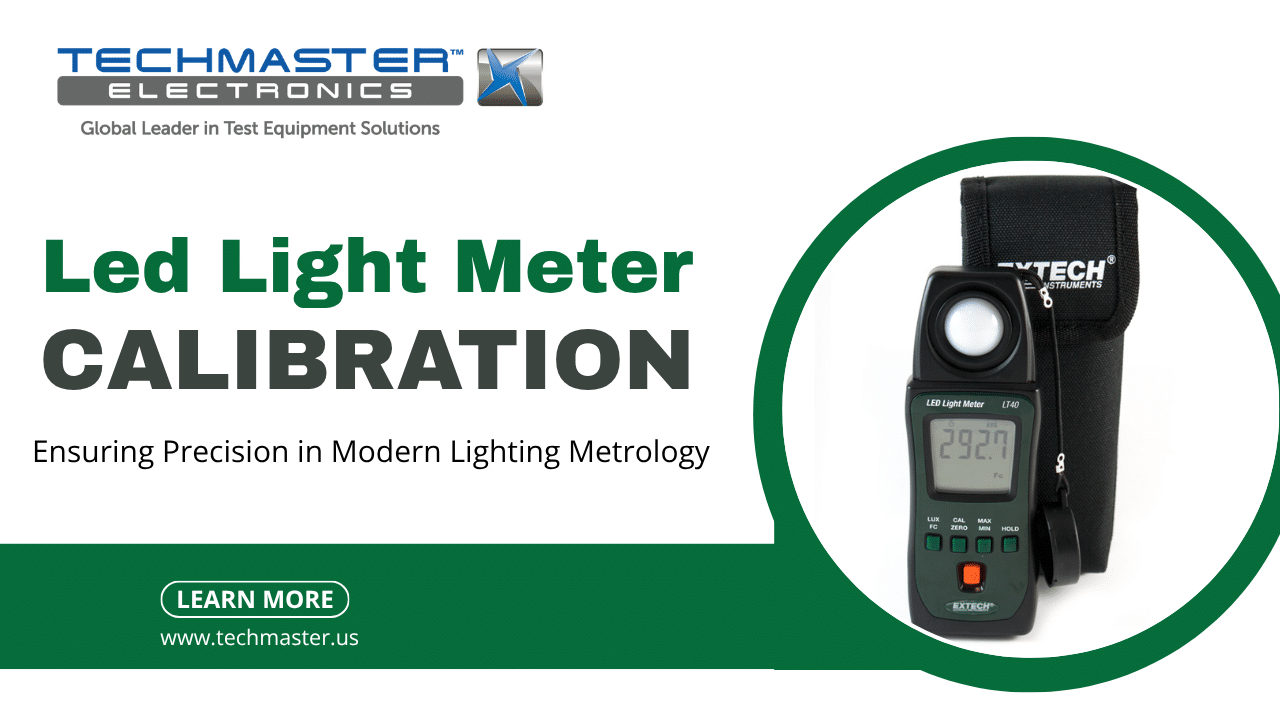
Led Light Meter Calibration
LED light meter calibration is not on Techmaster’s ANAB ISO/IEC 17025 scope (certificate AC-1736). We calibrate lED light meters with NIST-traceable reference standards and issue a NIST-traceable certificate. See what is on our accredited scope.
Accuracy across the range
How Led Light Meter calibration works
- Intake & visual inspection
- Environmental stabilization
- As-found measurement
- Comparison to NIST-traceable standards
- Adjustment if required
- As-left results & certificate
Your calibration, covered
In-lab vs on-site calibration
In-lab calibration
- Lab bench with full reference standards
- Best achievable measurement uncertainties
- Pickup & return logistics handled
- Ideal for precision and reference work
On-site calibration
- We calibrate the Led Light Meter at your facility
- No shipping risk or transit downtime
- As-found data captured before any move
- Ideal for fixed, large or sensitive assets
In-depth guide
Led Light Meter Calibration: Ensuring Precision in Modern Lighting Metrology
The transition from traditional incandescent and fluorescent lighting to Light Emitting Diodes (LEDs) has revolutionized energy efficiency across global industries. However, this shift has introduced new complexities in optical measurement. Measuring LED output requires more than just a standard photometer; it demands specialized equipment and, more importantly, a rigorous Led Light Meter Calibration program to ensure accuracy.
For quality managers and facility engineers, understanding the nuances of LED light measurement is critical to maintaining safety, productivity, and regulatory compliance.
1. The Critical Need for Specialized LED Light Meters
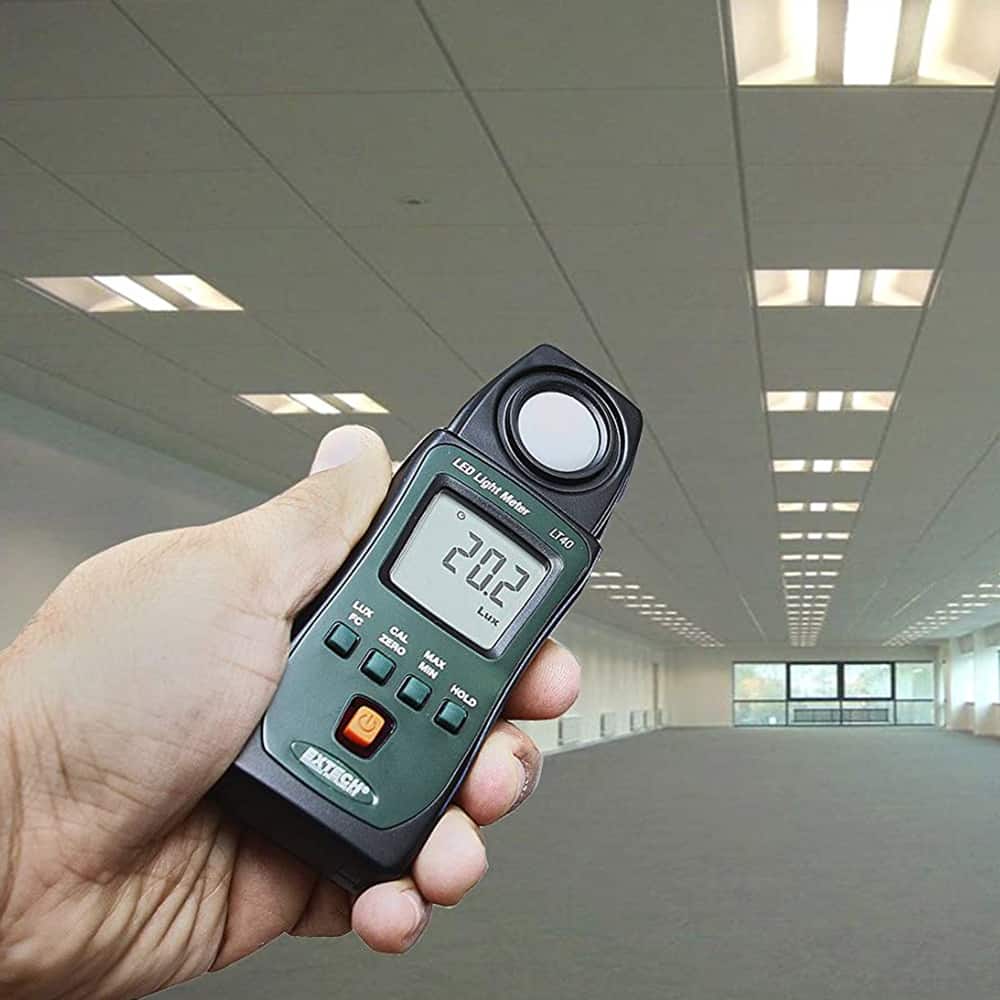
Standard light meters are often calibrated using an incandescent “Standard Illuminant A” (2856K). While effective for traditional bulbs, these meters can incur significant spectral mismatch errors when measuring LEDs, which have narrow spectral power distributions.
Modern LED light meters are engineered with advanced color-correction filters and cosine-correction features to handle:
-
White LEDs: From warm 2700K to cool 6500K.
-
Colored LEDs: Red, Blue, Green, and Amber outputs used in signaling and architecture.
-
High-Intensity Discharge (HID) replacement: Industrial high-bay lighting.
2. Key Industrial Applications of LED Light Meters
The application of precise light measurement extends far beyond simple brightness checks. Accurate data is the backbone of several critical sectors.
2.1. Workplace Safety and OSHA Compliance
In the United States, OSHA (Occupational Safety and Health Administration) mandates specific illumination levels for different work environments. Insufficient lighting leads to eye strain, fatigue, and increased workplace accidents. Conversely, excessive glare can be equally hazardous. A calibrated LED light meter ensures that every square foot of a facility meets federal safety standards.
2.2. Precision Manufacturing and Quality Control
In industries such as semiconductor fabrication or pharmaceutical packaging, lighting must be perfectly uniform to ensure sensors and human inspectors can detect microscopic defects. Even a slight drift in light intensity can compromise the integrity of a high-speed production line.
2.3. Horticulture and Greenhouse Management
Modern agriculture relies heavily on “Grow Lights” (PAR – Photosynthetically Active Radiation). LED light meters are used to map light distribution across crops to optimize photosynthesis. In this sector, Led Light Meter Calibration is the difference between a record harvest and a failed crop.
2.4. Photography, Cinematography, and Display Tech
For film sets and display manufacturers, color temperature and luminance consistency are vital. Light meters ensure that LED panels and monitors provide color-accurate output that meets global broadcasting standards.
3. The Science Behind Led Light Meter Calibration
The Spectral Mismatch Challenge
Traditional light meters are often calibrated using “Standard Illuminant A” (2856K). However, LEDs have narrow spectral power distributions that incur significant errors in standard photometers.
Calibration is the process of comparing a device’s readings against a known, certified reference standard. For LED light meters, this involves verifying the device across a broad spectral range.
3.1. Correcting Spectral Mismatch
LEDs emit light differently than thermal radiators. Calibration ensures that the meter’s sensor accurately interprets the “blue-pump” peaks and phosphor-converted yellow emissions characteristic of modern LEDs.
3.2. Linearity and Range Verification
A professional Led Light Meter Calibration tests the device at multiple intensity levels, from dim emergency lighting to high-intensity floodlights. This ensures the sensor remains linear and accurate across its entire measurement scale.
3.3. Cosine Correction Validation
Light doesn’t always hit a sensor perpendicularly. Calibration verifies that the meter accurately calculates “illuminance” regardless of the angle of the light source, preventing significant errors in wide-area mapping.
4. Why NIST Traceability is Non-Negotiable
For manufacturers in the US and Mexico, a calibration certificate is only as good as its traceability. NIST (National Institute of Standards and Technology) traceability provides the documented “unbroken chain” of comparisons back to national standards.
When you invest in Led Light Meter Calibration through a certified laboratory, you are ensuring:
-
Legal Defense: Defensible data during safety audits or litigation.
-
Contractual Compliance: Meeting the strict requirements of Tier 1 automotive or aerospace contracts.
-
Global Consistency: Ensuring that a measurement in your San Diego facility matches data from your partner in Orlando or your plant in Mexico.
5. The Risks of Neglecting Calibration
Using an uncalibrated light meter is often more dangerous than having no meter at all. Inaccurate data creates a false sense of security.
-
Inaccurate Safety Assessments: A meter reading “safe” levels when they are actually below OSHA minimums.
-
Increased Energy Costs: Over-lighting a facility due to a meter that reads lower than actual output.
-
Product Rejections: Batch failures in paint shops or coating facilities due to inconsistent visual inspection conditions.
6. Techmaster Electronics: Your Partner in Optical Metrology
At Techmaster Electronics, we recognize that light is a critical component of your industrial process. Our laboratories across the United States provide world-class calibration services tailored for the latest LED technology.
-
Accredited laboratory: Techmaster is accredited to ISO/IEC 17025 by ANAB (AC-1736); LED light meter calibration itself is NIST-traceable.
-
State-of-the-Art Optical Labs: We utilize certified standard lamps and reference meters to ensure NIST traceability.
-
Comprehensive Reporting: Every Led Light Meter Calibration includes a detailed certificate with “As-Found” and “As-Left” data.
-
Local Expertise: With locations in San Diego, Orlando, Irvine, and across Mexico, we offer the rapid turnaround times required to keep your operations running smoothly.
Conclusion As LED technology continues to evolve, the methods we use to measure it must also advance. Routine Led Light Meter Calibration is the only way to ensure that your commitment to quality and safety is backed by accurate, verifiable data. Trust the experts at Techmaster Electronics to keep your precision in focus.
Your Partner in Optical Metrology
Techmaster Electronics provides world-class calibration services tailored for the latest LED technology across the United States.
Frequently asked questions
What is Led Light Meter Calibration?
How often should a Led Light Meter be calibrated?
What standards apply to Led Light Meter Calibration?
What is included on the certificate?
Can you calibrate the Led Light Meter on-site?
Need Led Light Meter calibration?
NIST-traceable calibration, fast turnaround, in-lab or on-site across the USA.
Contact us for a quoteReferences & industry standards
- ISO/IEC 17025 testing & calibration laboratory requirements
- NIST calibration services and measurement traceability
- A2LA / ANAB accreditation for calibration laboratories
External standards bodies. Techmaster Electronics is an ISO/IEC 17025-accredited, NIST-traceable calibration laboratory.

Khanh Nguyen is the Marketing Manager at Techmaster Electronics, a B2B marketing leader covering the test, measurement, and ISO/IEC 17025 accredited calibration industry across the US and Vietnam markets.