
Digital Light Meter Calibration
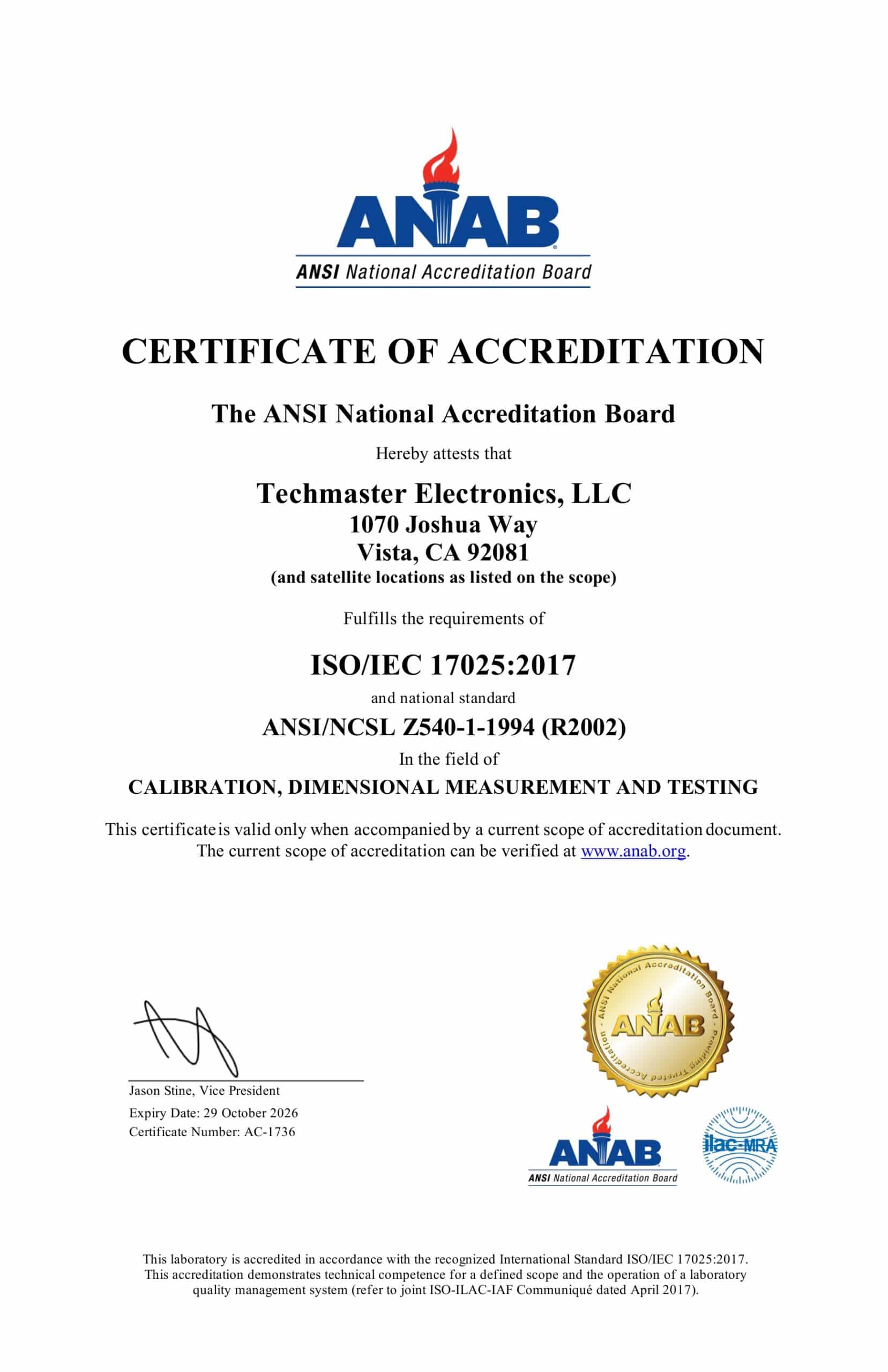
Digital light meter calibration is not on Techmaster’s ANAB ISO/IEC 17025 scope (certificate AC-1736). We calibrate digital light meters with NIST-traceable reference standards and issue a NIST-traceable certificate. See what is on our accredited scope.
Accuracy across the range
How Digital Light Meter calibration works
- Intake & visual inspection
- Environmental stabilization
- As-found measurement
- Comparison to NIST-traceable standards
- Adjustment if required
- As-left results & certificate
Your calibration, covered
In-lab vs on-site calibration
In-lab calibration
- Lab bench with full reference standards
- Best achievable measurement uncertainties
- Pickup & return logistics handled
- Ideal for precision and reference work
On-site calibration
- We calibrate the Digital Light Meter at your facility
- No shipping risk or transit downtime
- As-found data captured before any move
- Ideal for fixed, large or sensitive assets
In-depth guide
Digital Light Meter: The Tool That Determines Performance and The Absolute Necessity of Digital Light Meter Calibration
In every professional environment, from electronics manufacturing plants and medical laboratories to complex commercial spaces, light is a key physical factor that directly impacts health, safety, and productivity. To control this critical variable, the Digital Light Meter is an indispensable tool. It enables safety experts and facility managers to accurately determine illumination levels (Lux), thereby ensuring compliance with strict technical standards. However, every Lux measurement taken with a Digital Light Meter is only trustworthy when the sensor’s accuracy is guaranteed. Therefore, routine Digital Light Meter Calibration is an absolute requirement. This is a mandatory procedure to maintain data integrity and ensure the working environment is always up to standard.1. What is a Digital Light Meter?

The Digital Light Meter (Lux Meter) quantifies light intensity, ensuring the working environment complies with strict technical lighting standards.
Primary Measurement Units
Human Eye Simulation (V-lambda Curve)
All measurements must follow the human visual response curve.
- Principle: The device consists of a photo sensor connected to a digital processor. This sensor absorbs light and converts the light energy into an electrical signal.
- Measurement Units: The device primarily displays measurement results in:
- Lux (lx): The common unit in the International System of Units (SI), representing the luminous flux per square meter (lumen/m²).
- Foot-candle (fc): A common unit in the US, representing luminous flux per square foot.
- Human Eye Simulation: The photo sensor of the Digital Light Meter is specially designed to react to light wavelengths (colors) in the same way the human eye perceives them (the V-lambda curve). This is precisely why the sensor’s accuracy is critical; consequently, an inaccurate reading will not truly reflect the light level workers are exposed to.
2. The Key role of the Digital Light Meter in Applications

Workplace Safety & Compliance
Verify minimum Lux levels in hazardous areas (stairs, machinery) to prevent accidents and provide compliance proof for standards (OSHA, ISO).
Productivity & Vision Protection
Identify poorly lit spots causing eye strain in careful tasks (QC, electronic assembly), optimizing workspaces for efficiency.
Energy Cost Management
Assists in lighting audits, preventing unnecessary over-illumination, reducing needless electricity costs and operating expenses.
2.1. Ensuring Occupational Safety and Standard Compliance
- Accident Prevention: The Digital Light Meter is used to verify minimum Lux levels in hazardous areas such as stairwells, walkways, and machine operation zones. Poor lighting is a leading cause of accidents.
- Regulatory Compliance: National and international safety standards (e.g., OSHA, ISO) clearly specify the minimum required Lux levels for various work types. The Digital Light Meter provides accurate evidence to demonstrate this compliance.
2.2. Boosting Productivity and Protecting Vision
- Work Area Optimization: The Digital Light Meter identifies areas with insufficient light that cause eye fatigue, especially in careful tasks (QC, electronics assembly).
- Facility Management: The Digital Light Meter is used in lighting audits to evaluate the performance of old lighting systems and verify the installation of new LED systems.
2.3. Energy Savings
- Reducing Operating Costs: By measuring precisely, the Digital Light Meter helps facility managers avoid installing unnecessarily excessive lighting, thereby reducing wasted electricity costs.
3. Digital Light Meter Calibration: Ensuring Absolute Accuracy
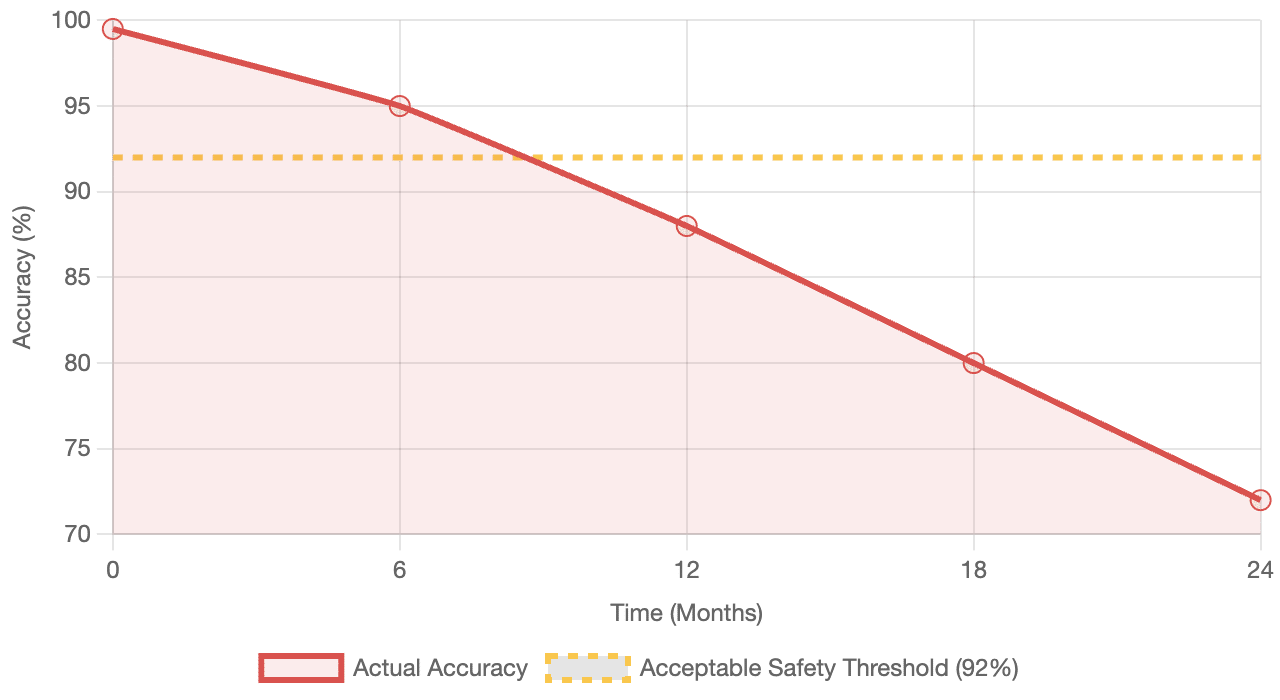
Sensor aging and component drift distort the Spectral Response, rendering Lux data unreliable. Calibration restores data integrity.
Sensor Accuracy Drift Over Time
Device must be calibrated before accuracy falls below the 92% safety threshold.
Sensor Error Due to Light Source Change
Error rate (deviation from V-lambda curve) when measuring different types of light sources.

3.1. Guaranteeing Accurate Spectral Response
- Correcting Errors: Light sensors can read incorrectly when switching between different light sources (sunlight, fluorescent, LED). Digital Light Meter Calibration checks and adjusts the sensor to adhere to the V-lambda curve (human visual response).
- Data Integrity: Digital Light Meter Calibration ensures that the displayed Lux values are true values, unaffected by sensor aging or component drift.
3.2. The Technical Process of Digital Light Meter Calibration
The Digital Light Meter Calibration process involves comparing the device under calibration with a highly accurate, traceable Reference Light Source. The main steps include:- Linearity Check: Verifying the accuracy of the Digital Light Meter across multiple light intensity ranges.
- Sensitivity Check: Ensuring the sensor’s ability to detect both weak and strong light effectively.
- Adjustment: If the error exceeds the allowed tolerance, the device will be adjusted back to standard specifications.
3.3. International Standard Compliance Requirements
- Traceability Certificate: Digital Light Meter Calibration provides a Traceability Certificate, which is indispensable evidence to demonstrate compliance with quality standards (such as ISO 9001, ISO 14001) during audits.
- Consistency: Digital Light Meter Calibration ensures that all Digital Light Meters used within the same organization yield consistent results.
4. Mandatory Frequency of Digital Light Meter Calibration
- Standard Recommendation: Most manufacturers recommend Digital Light Meter Calibration at least once every 12 months (annually).
- Operating Conditions: A Digital Light Meter that has been dropped, severely impacted, or exposed to extreme temperatures and humidity must be sent for Digital Light Meter Calibration immediately.
- Usage Intensity: Devices used frequently (daily) should be calibrated more often than those used infrequently.
Conclusion
The Digital Light Meter is a crucial investment for creating an optimal working environment. However, to maximize its potential and ensure that all data is trustworthy, Digital Light Meter Calibration is a mandatory procedure. The commitment to performing routine Digital Light Meter Calibration is a key strategic move to protect employee health, ensure compliance, and optimize operational efficiency.Frequently asked questions
What is Digital Light Meter Calibration?
How often should a Digital Light Meter be calibrated?
What standards apply to Digital Light Meter Calibration?
What is included on the certificate?
Can you calibrate the Digital Light Meter on-site?
Need Digital Light Meter calibration?
NIST-traceable calibration, fast turnaround, in-lab or on-site across the USA.
Contact us for a quoteReferences & industry standards
- ISO/IEC 17025 testing & calibration laboratory requirements
- NIST calibration services and measurement traceability
- A2LA / ANAB accreditation for calibration laboratories
External standards bodies. Techmaster Electronics is an ISO/IEC 17025-accredited, NIST-traceable calibration laboratory.

Khanh Nguyen is the Marketing Manager at Techmaster Electronics, a B2B marketing leader covering the test, measurement, and ISO/IEC 17025 accredited calibration industry across the US and Vietnam markets.