UV Light Meter Calibration
UV light meter calibration is not on Techmaster’s ANAB ISO/IEC 17025 scope (certificate AC-1736). We calibrate uV light meters with NIST-traceable reference standards and issue a NIST-traceable certificate. See what is on our accredited scope.
Accuracy across the range
How UV Light Meter calibration works
- Intake & visual inspection
- Environmental stabilization
- As-found measurement
- Comparison to NIST-traceable standards
- Adjustment if required
- As-left results & certificate
Your calibration, covered
In-lab vs on-site calibration
In-lab calibration
- Lab bench with full reference standards
- Best achievable measurement uncertainties
- Pickup & return logistics handled
- Ideal for precision and reference work
On-site calibration
- We calibrate the UV Light Meter at your facility
- No shipping risk or transit downtime
- As-found data captured before any move
- Ideal for fixed, large or sensitive assets
In-depth guide
UV Light Meter: The Critical Tool for Quality & Safety Control – The Absolute Necessity of Calibration

In numerous industrial and scientific fields, ultraviolet (UV) light plays a vital role. It detects material cracks, sterilizes surfaces, and cures adhesives. However, the effectiveness of these processes depends entirely on precise UV irradiance levels. If UV intensity is too low, inspection processes might miss critical defects. Conversely, if too high, it could harm personnel and materials. The UV Light Meter is an essential instrument. It measures and verifies the UV radiation intensity from light sources. This device helps us tightly control UV levels, thereby meeting regulatory standards. Yet, UV sensors are highly sensitive. They easily degrade in performance over time due to radiation exposure. Therefore, routine UV Light Meter Calibration is a mandatory requirement. This ensures that UV measurements are always accurate and reliable. Furthermore, it safeguards both product quality and occupational safety.
1. What is a UV Light Meter? The Core Operating Principle

A UV Light Meter is an optical instrument. We design it to measure the amount of UV radiant energy per unit area.
1.1. Objective and UV Wavelength Ranges
Main UV Wavelength Bands
UV-A
(315-400 nm)
NDT, Curing, Security
UV-B
(280-315 nm)
Sunburn, Medical
UV-C
(100-280 nm)
Sterilization, Germicidal
-
Objective: To accurately measure UV intensity. This optimizes processes and ensures standard compliance.
-
Key UV Wavelength Ranges:
-
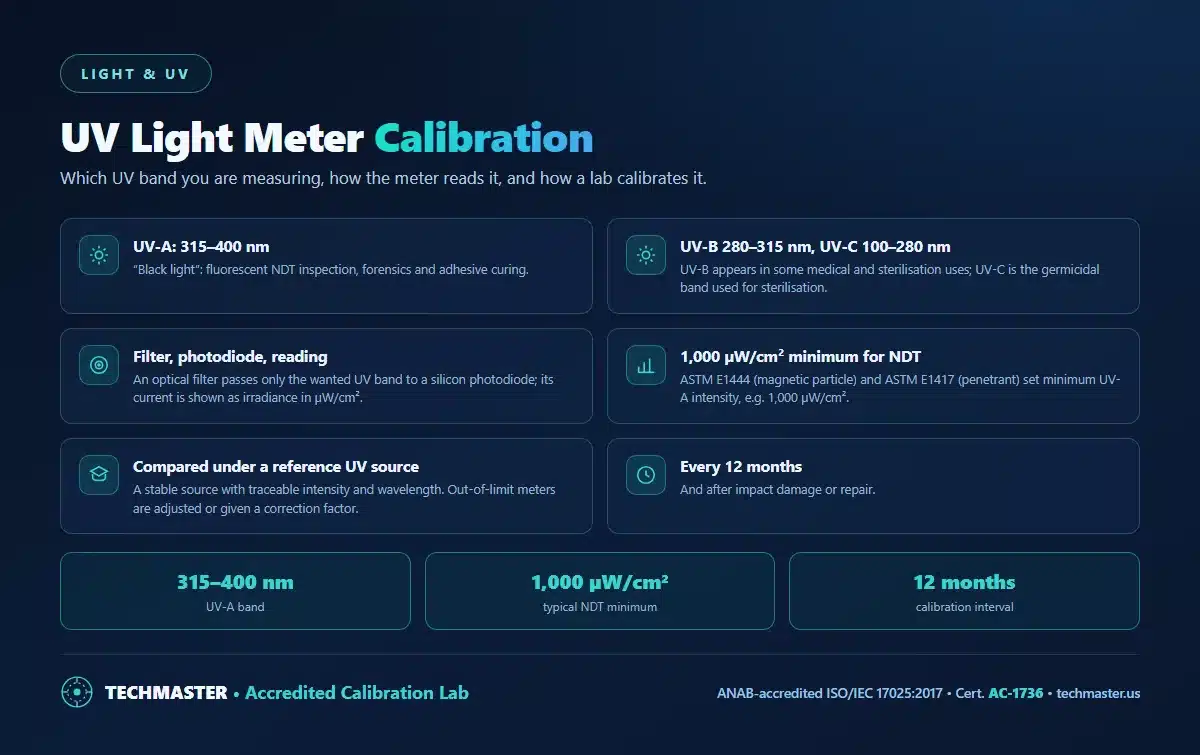
UV-A (315-400 nm): Also known as “black light.” Industries commonly use it in NDT (fluorescent inspection), forensics, and adhesive curing.
-
UV-B (280-315 nm): This range relates to sunburn. It also appears in some sterilization applications, but it is less common in general industrial use.
-
UV-C (100-280 nm): This range possesses the strongest germicidal properties. We use it widely for sterilizing air, water, and surfaces.
-
1.2. Basic Operating Principle
Core Operating Principle
-
Photodetector: The device uses a photodetector. Typically, this is a silicon photodiode sensitive to a specific UV wavelength range.
-
Optical Filter: A specialized filter operates. It only allows the desired UV light range to pass through. It rejects other wavelengths (such as visible or infrared light) that could distort results.
-
Signal Conversion: UV photon energy strikes the sensor. It generates an electrical current proportional to the UV intensity. We convert this current and display it as an irradiance value (e.g., $\mu W/cm^2$ or $mW/cm^2$).
2. Vital Applications in Industry and Science
Non-Destructive Testing (NDT)
Ensure UV-A intensity meets the minimum required level (e.g., 1000 μW/cm²) for fluorescent crack detection per ASTM standards.
UV Curing & Printing
Verify sufficient UV intensity for full curing of adhesives, inks, and coatings, ensuring product durability and quality.
Sterilization & Safety
Measure UV-C irradiance to confirm germicidal efficacy in medical and controlled environments. Check for UV leakage for worker safety.
Accurate UV measurement capability is a crucial factor. It is important in many industrial processes and helps ensure safety.
2.1. Non-Destructive Testing (NDT) – Magnetic Particle Inspection (MPI) & Liquid Penetrant Inspection (LPI)
-
Defect Detection: This is a core application. In fluorescent MPI and LPI, we apply fluorescent materials to surfaces. Under precise and adequate UV-A light intensity, defects (cracks, porosities) will fluoresce. This helps technicians detect them.
-
Inspection Standards: Standards such as ASTM E1444 (MPI) and ASTM E1417 (LPI) mandate minimum UV-A intensity (e.g., $1000 \mu W/cm^2$). This ensures the necessary detection sensitivity.
2.2. Material Curing and UV Printing
-
Quality Control: Many UV-curable inks, coatings, and adhesives polymerize under UV light. Accurate UV intensity measurement ensures complete curing. This directly impacts the durability, adhesion, and final quality of the product.
-
Process Optimization: The equipment helps manufacturers optimize time and cost. They avoid wasted UV energy or defective products due to insufficient curing.
2.3. Sterilization and Biological Safety
-
Germicidal Efficacy: UV-C lamps sterilize air, water, and surfaces. They apply in hospitals, laboratories, and food processing plants. The UV light meter confirms that lamps emit sufficient germicidal intensity.
-
Occupational Safety: UV radiation can harm eyes and skin. The UV light meter helps check for UV leakage. It also ensures a safe working environment, complying with exposure limits as per standards (e.g., ACGIH).
3. The Absolute Role of UV Light Meter Calibration
The potential for inaccurate UV readings can lead to serious consequences. This makes UV Light Meter Calibration paramount.
3.1. Ensuring Measurement Accuracy and Standard Compliance
-
The Risk of Undertesting (False Negatives): If the device reads UV intensity higher than it actually is, NDT processes might operate under insufficient UV intensity. As a result, critical defects are missed, endangering products or structures.
-
The Risk of Energy Waste or Process Failure (False Positives/Overexposure): If the device reads UV intensity lower than it actually is, operators might unnecessarily increase UV lamp intensity. This wastes energy, can damage sensitive materials, or heighten safety risks.
-
Value Verification: UV Light Meter Calibration verifies. The value displayed on the device matches the actual UV intensity, measured by a reference standard.
3.2. Legal Compliance and Safety Regulations
-
Standard Requirements: Many industry standards (e.g., ASTM, ISO, SAE) and occupational safety regulations mandate UV light meter calibration. An ISO/IEC 17025 accredited laboratory performs this periodically.
-
Traceable Evidence: The Calibration Certificate is the sole documentation. It proves UV measurements are valid and traceable. This certificate is essential for audits, quality records, and legal requirements.
4. How UV Light Meter Calibration Works
The process of UV Light Meter Calibration requires specialized equipment and a controlled environment:
-
Reference UV Source: We use a stable UV light source. Its intensity and wavelength are precisely defined and traceable.
-
Comparison: We place the UV light meter needing calibration under the reference UV source. Then, we compare the device’s reading with the actual intensity of the reference source.
-
Adjustment (if necessary): If a deviation beyond permissible limits appears, we adjust the device. Alternatively, a correction factor will be recorded on the certificate.
-
Certification: We issue a Calibration Certificate. It confirms the device’s accuracy and the next calibration due date.
Conclusion
The UV Light Meter is an indispensable tool. It controls process quality and ensures safety in many industries. However, its value depends entirely on measurement accuracy. Routine UV Light Meter Calibration is not optional; it is a mandatory procedure. It ensures that UV applications operate effectively, products meet standards. Furthermore, it keeps the working environment safe, complying with the strictest regulations.
Frequently asked questions
What is UV Light Meter Calibration?
How often should a UV Light Meter be calibrated?
What standards apply to UV Light Meter Calibration?
What is included on the certificate?
Can you calibrate the UV Light Meter on-site?
Need UV Light Meter calibration?
NIST-traceable calibration, fast turnaround — in-lab or on-site across the USA.
Contact us for a quoteReferences & industry standards
- ISO/IEC 17025 testing & calibration laboratory requirements
- NIST calibration services and measurement traceability
- A2LA / ANAB accreditation for calibration laboratories
External standards bodies. Techmaster Electronics is an ISO/IEC 17025-accredited, NIST-traceable calibration laboratory.

Khanh Nguyen is the Marketing Manager at Techmaster Electronics, a B2B marketing leader covering the test, measurement, and ISO/IEC 17025 accredited calibration industry across the US and Vietnam markets.