
What is air buoyancy correction in mass calibration?
A balance is a force transducer, not a mass meter. The force it senses has two parts: one proportional to the mass of the object, and one proportional to its volume, the buoyant force. When you compare an unknown weight against a reference standard, the buoyant forces on the two objects only cancel if the two objects displace the same volume of air. They almost never do.
NIST states the case bluntly in SOP 2, Recommended Standard Operating Procedure for Applying Air Buoyancy Corrections (published within NISTIR 6969): “If uncorrected, the effect of air buoyancy on the objects being compared is frequently the largest source of error in mass measurement.” That sentence is the reason a serious mass and mechanical calibration laboratory logs temperature, barometric pressure and relative humidity for every comparison, not for comfort, but because those three numbers set the air density that drives the correction.
The confusion worth clearing up first: buoyancy is not gravity. Local gravitational acceleration varies across the United States by roughly 0.1 %, but in a substitution weighing the unknown and the standard sit in the same gravitational field, so g cancels. Air density does not cancel, because the two objects have different volumes. Local gravity matters when you calibrate force, a deadweight force machine or a load cell, not when you compare mass against mass.
Why does conventional mass already assume 1.2 mg/cm³ of air?
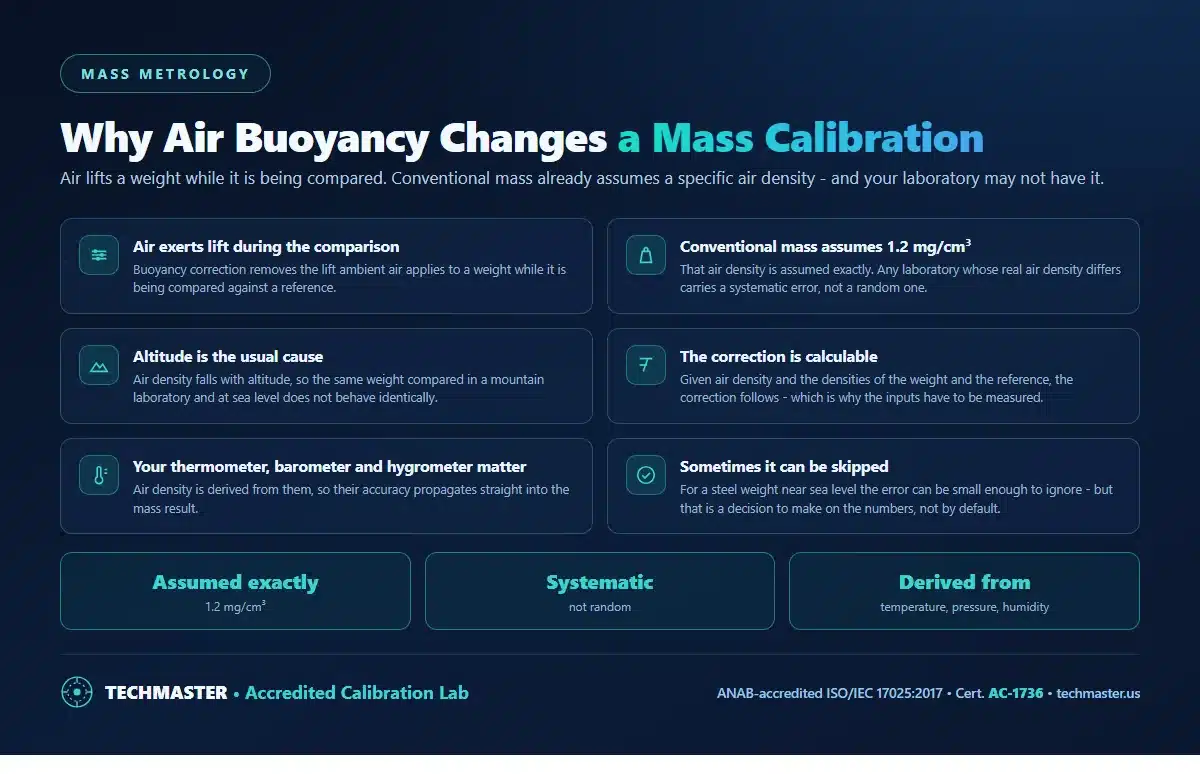
Per NIST SOP 2 and OIML D 28, the conventional value of the result of weighing a body in air is fixed by three conventions: a reference density of 8.0 g/cm³, a reference temperature of 20 °C, and a normal air density of 0.0012 g/cm³ (1.2 mg/cm³). Conventional mass was formerly called “apparent mass versus 8.0 g/cm³” in the United States, and an older 8.4 g/cm³ brass scale is still occasionally encountered on legacy certificates, a genuine trap when you inherit weight sets from an acquired site.
The convention is elegant because it makes ordinary steel weights interchangeable without anyone doing buoyancy arithmetic. It quietly fails in two situations, and both are common:
- Your air is not 1.2 mg/cm³. Altitude is the dominant driver, and it is not a small effect at elevation.
- Your artifact is not near 8.0 g/cm³. Aluminum fixtures, plastic check standards, water and solvent samples, and honeycomb aerospace test articles are all far from steel.
NIST is explicit that use of the conventional mass scale “does not indiscriminately eliminate the need for buoyancy corrections as is sometimes assumed.” That single sentence overturns the most widespread assumption in industrial weighing.
How do you calculate the air buoyancy correction?
| Symbol | Meaning | Typical value |
|---|---|---|
| m0 | Nominal mass of the artifact | 1 000 g |
| ρa | Air density at the moment of the comparison | 0.99–1.20 mg/cm³ in US labs |
| ρn | Density of “normal” air, fixed by convention | 1.200 mg/cm³ |
| ρx | Density of the unknown artifact | 7.95 g/cm³ austenitic stainless |
| ρs | Density of the reference standard (or 8.0 for the conventional scale) | 8.00 g/cm³ |
Two routes exist for the air density itself. NIST SOP 2 gives a simplified equation (after Jones, 1978) that takes barometric pressure in mmHg, temperature in °C and relative humidity as a whole number, accurate enough for most industrial work. The preferred route is the full CIPM-2007 equation of state, whose stated uncertainty is 0.000 026 4 mg/cm³, or 0.0022 % of normal air density. Both appear in SOP 2; both require a calibrated barometer, thermometer and hygrometer with demonstrated traceability.
One practical warning that catches new technicians: SOP 2 instructs you to record the station pressure and explicitly says do not correct the barometric pressure to sea level. A weather-service sea-level-corrected reading will silently reintroduce exactly the altitude error you are trying to remove.
How much does altitude change a 1 kg mass calibration?
| Location | Elevation | Station pressure | Air density | Correction, 1 kg | % of E2 MPE |
|---|---|---|---|---|---|
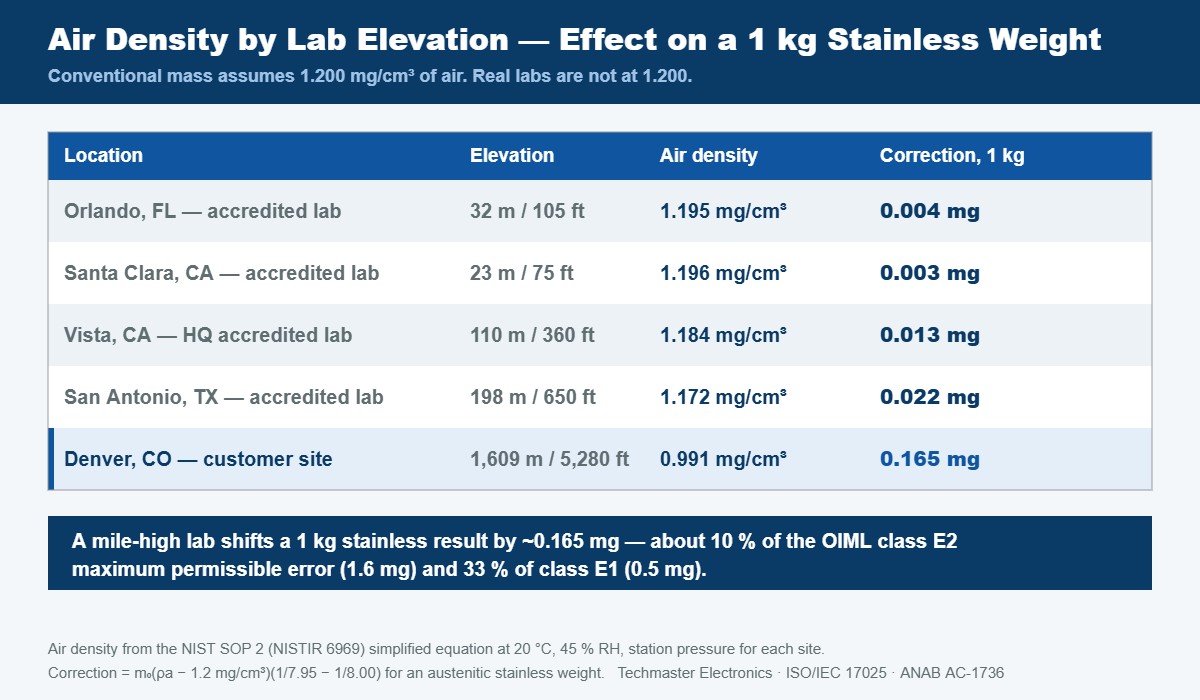
| Santa Clara, CA, accredited lab | 23 m / 75 ft | 1 010 hPa | 1.196 mg/cm³ | 0.003 mg | 0.2 % |
| Orlando, FL, accredited lab | 32 m / 105 ft | 1 009 hPa | 1.195 mg/cm³ | 0.004 mg | 0.2 % |
| Vista, CA, HQ accredited lab | 110 m / 360 ft | 1 000 hPa | 1.184 mg/cm³ | 0.013 mg | 0.8 % |
| San Antonio, TX, accredited lab | 198 m / 650 ft | 990 hPa | 1.172 mg/cm³ | 0.022 mg | 1.4 % |
| Denver, CO, customer site | 1 609 m / 5 280 ft | 837 hPa | 0.991 mg/cm³ | 0.165 mg | 10.3 % |
Read those numbers the way an uncertainty budget reads them. The OIML R 111-1 maximum permissible error for a 1 kg weight is 0.5 mg for class E1, 1.6 mg for E2 and 5 mg for F1. At sea level the steel-on-steel buoyancy term is buried in the noise. At 5 280 ft it consumes 33 % of an E1 tolerance before the balance has contributed anything at all, which is precisely why a certificate issued at altitude without a stated air density is not fully interpretable.
Weather also moves air density day to day, but far less than geography: NIST notes that day-to-day variation in ρa is usually no more than 3 %. Humidity is the weakest of the three inputs, swinging a lab from 20 % to 80 % RH at 20 °C changes air density by roughly 0.5 %, consistent with the ±11.3 % RH row in Table 4. Pressure dominates, temperature follows, humidity trails. That ranking should drive where you spend money on calibration laboratory environmental monitoring.
Which artifacts actually break because of buoyancy?
| Artifact material | Density | Sea-level lab | Mile-high site | Verdict vs E2 (1.6 mg) |
|---|---|---|---|---|
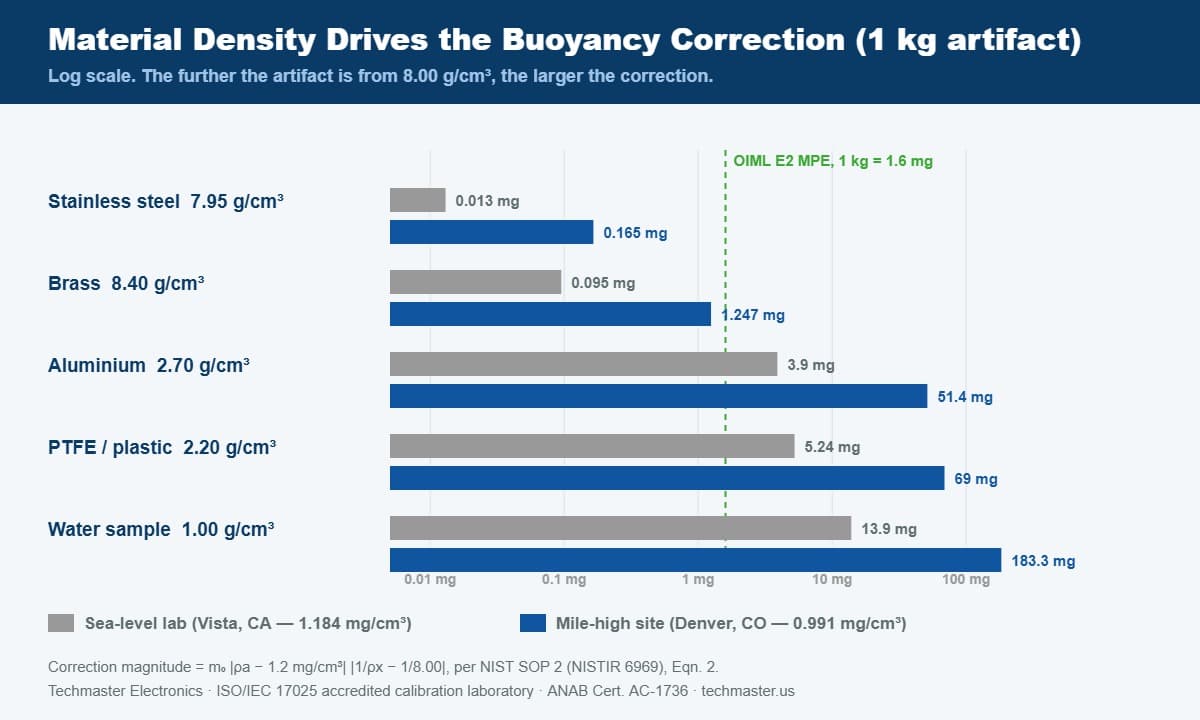
| Austenitic stainless steel | 7.95 g/cm³ | 0.013 mg | 0.165 mg | Negligible either way |
| Brass | 8.40 g/cm³ | 0.095 mg | 1.25 mg | Borderline at altitude |
| Aluminum | 2.70 g/cm³ | 3.90 mg | 51.4 mg | Exceeds E2 everywhere |
| PTFE / engineering plastic | 2.20 g/cm³ | 5.24 mg | 69.0 mg | Exceeds E2 everywhere |
| Water or aqueous sample | 1.00 g/cm³ | 13.9 mg | 183 mg | Dominates the budget |
Notice brass. It sits above 8.0 g/cm³ rather than below, so its correction runs the opposite way, and because 8.40 is further from the 8.00 convention than 7.95 is, a brass artifact is more sensitive than a stainless one. This is why OIML R 111-1:2004 constrains the permissible density of weights class by class, tight around 8.0 g/cm³ for E1 and E2, progressively looser down to M-class. The density limits are not a materials preference; they are a device for bounding the buoyancy uncertainty a user inherits when they never do the arithmetic.
Direction is easy to reason about physically. Less air means less upward lift, so at altitude a low-density artifact behaves as though it gained mass relative to a sea-level comparison. Move a 1 kg PTFE check standard from a sea-level laboratory to a mile-high site and, uncorrected, it will read heavier by roughly 64 mg, the difference between the 69.0 mg and 5.24 mg entries in Table 3, which is more than 600 times the 0.1 mg resolution of a typical analytical balance.
In Techmaster’s ten-year calibration record, 381,916 calibrations across 4,913 manufacturers, the artifacts that most often arrive with a density problem are not weight sets at all. They are customer-built aluminum and composite fixtures, plastic-bodied flow and volume standards, and filled liquid reference vessels submitted for gravimetric verification. Steel weight sets are the easy case; the fixtures are where the surprise lives.
How accurate must your thermometer, barometer and hygrometer be?
| Variable | For ±0.1 % of air density | For ±1.0 % of air density | SOP 2 recommendation |
|---|---|---|---|
| Air pressure | ±101 Pa (±0.76 mmHg) | ±1 010 Pa (±7.6 mmHg) | ±66.5 Pa (±0.5 mmHg) |
| Air temperature | ±0.29 °C | ±2.9 °C | ±0.10 °C |
| Relative humidity | ±11.3 % | not limiting | ±10 % |
The table settles a recurring budget argument. A hygrometer good to ±10 % RH is entirely adequate for buoyancy; a barometer good to only ±7.6 mmHg is not, because it alone permits a 1 % air-density error. If you are choosing where to invest in environmental instrumentation for a mass laboratory, buy the barometer first. NIST also cautions that it is unrealistic to expect the relative uncertainty of air density to fall below 0.05 % even with the best available techniques, a useful floor when you build the ISO/IEC 17025 measurement uncertainty budget for a mass CMC.
What should an ISO/IEC 17025 mass certificate report?
Use this as an incoming-inspection checklist when a certificate lands on your desk:
- Mass scale declared. “Conventional mass” (8.0 g/cm³, 20 °C, 1.2 mg/cm³) or true mass. If it says “apparent mass vs 8.4”, you are holding a legacy brass-scale value and must convert before use.
- Artifact density or volume. Either measured, or assumed with the assumption stated. A certificate that reports mass without density has withheld the information you need for your own buoyancy arithmetic.
- Environmental conditions. Temperature, barometric pressure and relative humidity at the time of the comparison, station pressure, not sea-level corrected.
- Correction status. Explicitly “buoyancy correction applied” or “not applied; treated as an uncorrected systematic error and included in the uncertainty.” SOP 2 permits the second approach when the correction is small relative to tolerance, but it must be declared.
- Traceable environmental instruments. The barometer, thermometer and hygrometer themselves need current calibration certificates. An accreditation body will ask.
- Accredited scope coverage. Confirm the mass parameter and range appear on the laboratory’s accreditation scope, for Techmaster, ANAB Cert. AC-1736. Learn more on our ISO/IEC 17025 accreditation page, and verify any laboratory independently through the ANAB accredited laboratory directory.
Need a mass certificate that already carries the density and environmental fields? Request a calibration quote from Techmaster’s ANAB-accredited mass and mechanical laboratories.
If any of the first four items is missing, ask for a revised certificate. Certification bodies and FDA or aerospace auditors increasingly do exactly that, because the buoyancy fields are what make a mass value portable between sites.
When can you safely skip the correction?
The honest workflow is three steps, and the first is non-negotiable:
- Calculate the correction. Use Eqn. 2 with the actual air density. This takes seconds in a spreadsheet.
- Compare it with the tolerance and the expanded uncertainty. If the correction is well under, say, 10 % of the maximum permissible error and small next to your process uncertainty, it can be carried as an uncorrected systematic error.
- Document the decision in the procedure and the uncertainty budget. “We didn’t think about it” is not the same finding as “we evaluated it at 0.8 % of MPE and declared it negligible.” Auditors can tell the difference.
Practical rules of thumb that fall out of the tables above: for stainless-on-stainless comparisons below about 1 000 ft, buoyancy is under 1 % of an E2 tolerance. For any artifact below 4 g/cm³, correct it, always. Above 3 000 ft, correct everything, including steel, if you are working to E1 or E2. And for gravimetric volume work, filling a vessel with water and weighing it, buoyancy is not a correction at all; it is a first-order term of the method.
Key takeaways
- Air buoyancy is, uncorrected, frequently the largest error source in mass measurement (NIST SOP 2 / NISTIR 6969).
- Conventional mass hard-codes 8.0 g/cm³, 20 °C and 1.2 mg/cm³ air, it cancels buoyancy only when reality matches those assumptions.
- Estimate with MABC = m0(ρa − ρn)(1/ρx − 1/ρs); get ρa from measured station pressure, temperature and humidity.
- Altitude is the dominant environmental driver: 0.99 mg/cm³ at 5 280 ft versus 1.20 mg/cm³ at sea level, worth 0.165 mg on 1 kg of stainless.
- Density mismatch is the bigger lever: a 1 kg aluminum or plastic artifact carries a correction hundreds of times larger than the same nominal in steel.
- Buy the barometer first, pressure error dominates air density; ±10 % RH on the hygrometer is sufficient.
- A certificate that omits artifact density and environmental conditions cannot be transferred to another elevation. Ask for a revision.
Frequently asked questions about air buoyancy correction
Is air buoyancy correction required by ISO/IEC 17025?
ISO/IEC 17025 does not name buoyancy explicitly. It requires that a laboratory identify the contributions to measurement uncertainty and apply corrections for recognized systematic effects. Because air buoyancy is a recognized systematic effect in mass metrology, an accredited laboratory must either correct for it or evaluate it and include it in the uncertainty budget, with the decision documented.
What air density should I use if I cannot measure pressure?
Use the conventional value of 1.2 mg/cm³ only if your laboratory is near sea level and your artifacts are close to 8.0 g/cm³. Otherwise estimate air density from the site elevation using a standard atmosphere, and inflate the uncertainty accordingly. NIST SOP 2 requires station pressure, not sea-level-corrected barometric pressure, whenever accuracy matters.
Does relative humidity matter for mass calibration?
Much less than pressure or temperature. Moving a 20 °C laboratory from 20 % to 80 % relative humidity changes air density by roughly 0.5 %. NIST SOP 2 accepts a hygrometer accurate to about 10 % RH. Humidity matters far more for electrostatic effects on the artifact and for surface adsorption than for buoyancy itself.
Why does brass need a bigger correction than stainless steel?
Because the conventional mass scale is anchored at 8.0 g/cm³. Brass at about 8.40 g/cm³ sits 0.40 g/cm³ away from the convention, while austenitic stainless at 7.95 sits only 0.05 away. The correction scales with the difference of reciprocal densities, so brass is roughly eight times more sensitive, and its correction runs in the opposite direction.
Does local gravity affect a mass calibration the way buoyancy does?
No. In a substitution weighing the unknown and the reference standard experience the same local gravitational acceleration, so gravity cancels. Air buoyancy does not cancel, because the two artifacts displace different volumes of air. Local gravity does matter for force calibration, which is why deadweight force machines are assigned a site-specific gravity value.
Does Techmaster apply buoyancy corrections in its mass and mechanical calibrations?
Yes. Techmaster Electronics records temperature, barometric pressure and relative humidity for mass comparisons and applies or evaluates the air buoyancy correction per NIST SOP 2 at its ISO/IEC 17025 accredited laboratories in Vista and Santa Clara, California; Orlando, Florida; and San Antonio, Texas, under ANAB Cert. AC-1736.
Need mass calibration that documents the buoyancy correction?
Techmaster Electronics has served US industry since 1989 and operates ISO/IEC 17025 accredited calibration laboratories under ANAB Cert. AC-1736. Our mass and mechanical certificates report the artifact density and the environmental conditions behind every value.
Request a Calibration QuoteFurther reading: ASTM Class 1 weight calibration standards from 1 mg to 20 g, USP General Chapter 41 minimum weight for analytical balances, and the full Techmaster calibration services hub.
Related reading: how the Z factor applies air buoyancy in ISO 8655 pipette calibration

Khanh Nguyen is the Marketing Manager at Techmaster Electronics, a B2B marketing leader covering the test, measurement, and ISO/IEC 17025 accredited calibration industry across the US and Vietnam markets.