
TL;DR: A calibration certificate worth filing contains eight things: the lab’s accreditation identity, a unique certificate ID and dates, your instrument’s identification, the standards used (with their own traceability), environmental conditions, as-found/as-left data, stated measurement uncertainty, and the decision rule with sign-off. The sticker on the instrument is a pointer; the certificate is the evidence.
Auditors don’t audit stickers. When a customer or registrar questions your measurements, the calibration certificate is what you produce, and half the certificates in circulation can’t carry that weight. Here’s how to read one, field by field, and what missing fields tell you about the lab.
What is a calibration certificate?
A calibration certificate is the document a calibration lab issues after comparing your instrument against reference standards of known accuracy. It records what was measured, how far the instrument was off, how certain those results are, and how they trace back to national standards such as NIST. In short, it is the evidence that your instrument measured correctly on the day it was calibrated.
Each certificate covers one instrument, identified by its serial number, on one date. It does not expire, and it does not prove the instrument is still accurate today. That depends on your calibration interval, which you set. In fact, ISO/IEC 17025 does not allow an accredited lab to print a recommended interval on the certificate unless you have agreed to it.
Not every certificate carries the same weight. An accredited certificate shows the accreditation body’s symbol, such as ANAB’s, and covers results within the lab’s published scope. A traceable certificate is issued on the lab’s own authority. Both can trace to NIST, but only the accredited one comes from a measurement an independent body has assessed the lab to perform.
Four documents are often confused with each other:
| Document | Issued by | What it shows |
|---|---|---|
| Calibration certificate | The calibration lab | Measured results, uncertainty and traceability for one instrument on one date. This is the evidence. |
| Calibration label (sticker) | The calibration lab | The instrument ID and calibration date, often with a due date. It points to the certificate but proves nothing on its own. |
| Certificate of conformance | The manufacturer or seller | A statement that the product meets its specification, usually without any measurement data. |
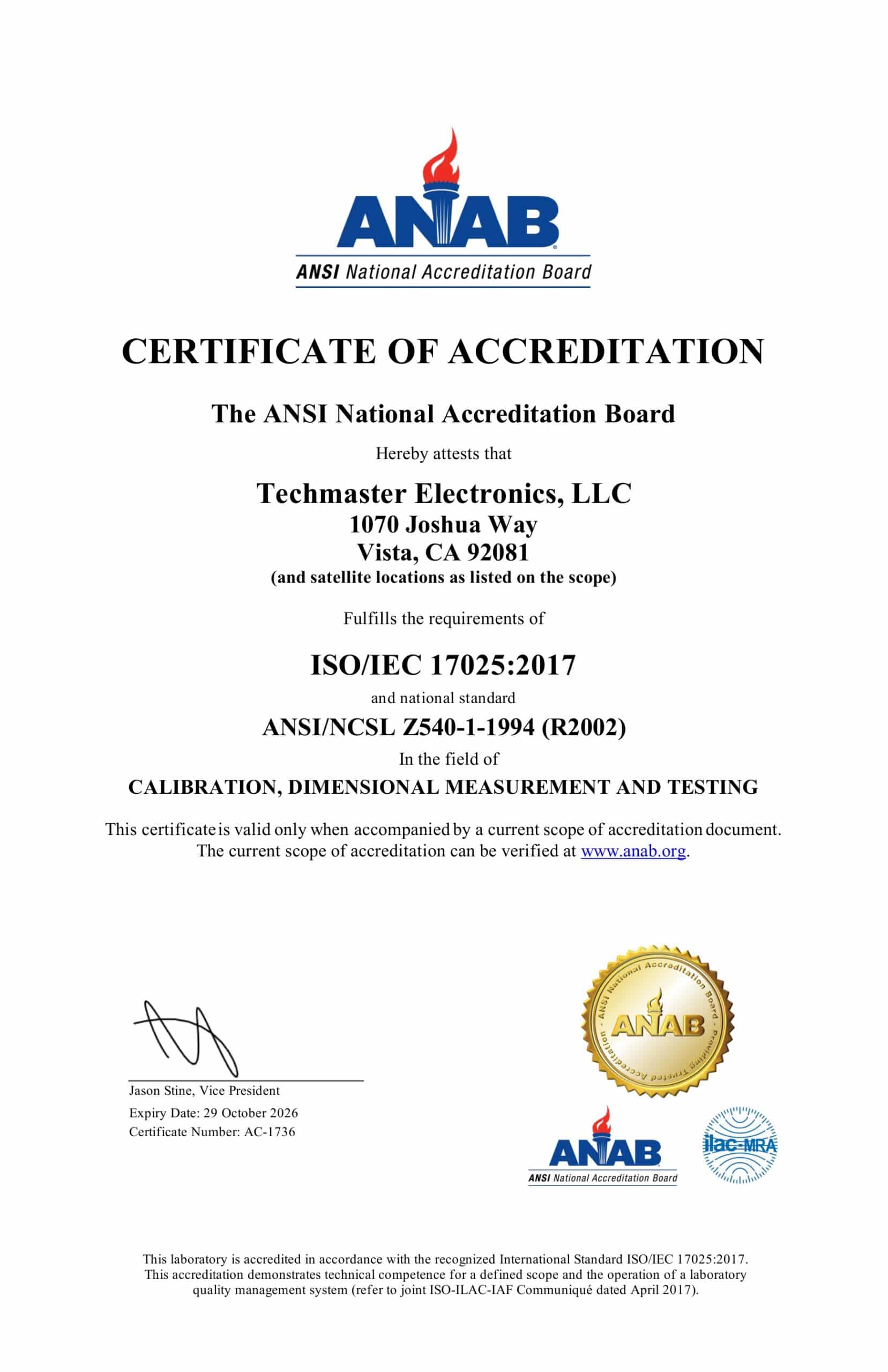
| Accreditation certificate | An accreditation body, such as ANAB | That the lab is competent to calibrate what is listed on its scope. Techmaster’s is AC-1736. |
The rest of this guide shows how to read a calibration certificate, field by field.
What are the eight fields every certificate should contain?
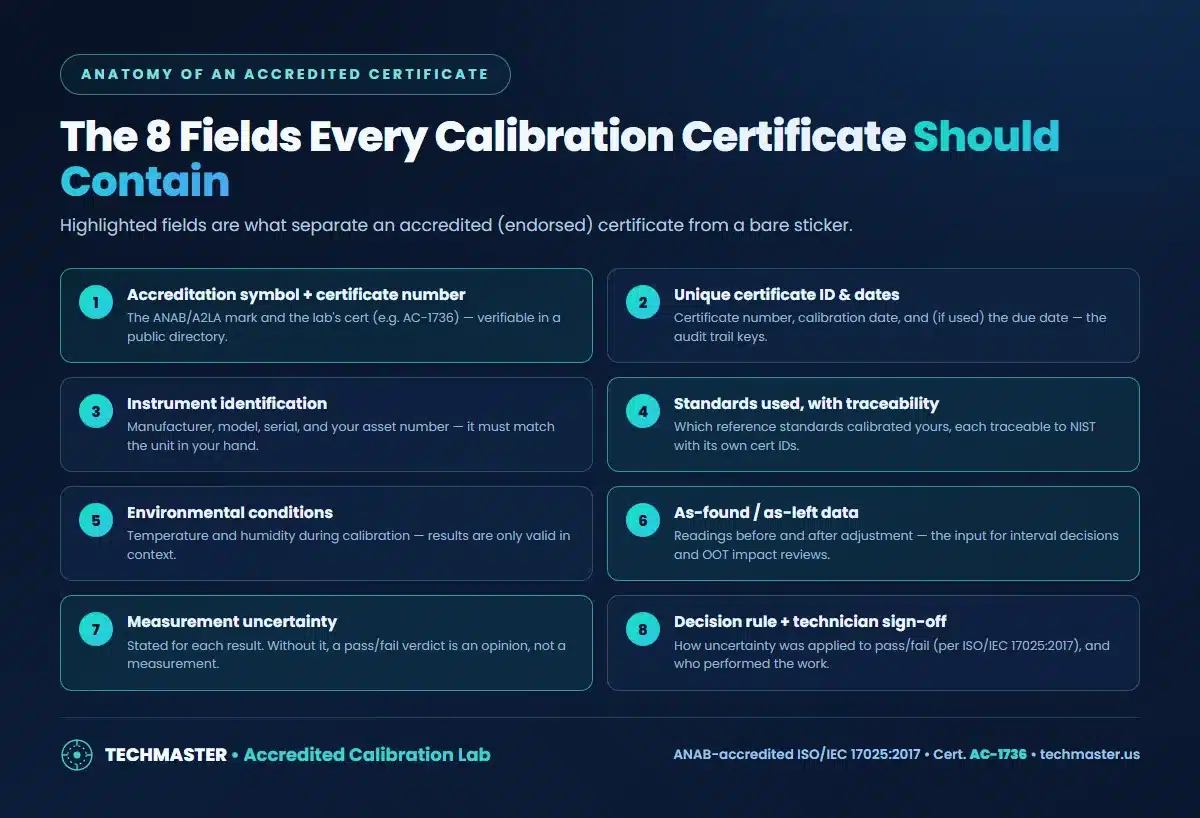
Four of the eight do the audit-proofing work:
Accreditation symbol and certificate number
The ANAB or A2LA mark plus the lab’s certificate number (Techmaster’s is AC-1736) makes the whole document independently verifiable in a public directory, here’s how to verify it in five steps. No symbol means you’re trusting the lab’s own word for everything below.
Standards used, with traceability
A proper certificate names the reference standards that calibrated your instrument, each with its own certificate IDs, the visible links of the NIST traceability chain.
As-found / as-left data
The before-and-after readings. This is what lets you trend drift, defend past measurements after an out-of-tolerance finding, and set calibration intervals on evidence. Bare pass/fail certificates give you none of that.
Measurement uncertainty and the decision rule
Uncertainty states how good each result is; the decision rule (required by ISO/IEC 17025:2017) states how uncertainty was applied to the pass/fail verdict. Together they’re the difference between a measurement and an opinion.
What do missing fields tell you?
No accreditation symbol on RF work the lab claims is accredited → the work may be off-scope. No data option at any price → the lab may not record it. No uncertainty → walk away; the lab either can’t compute it or won’t stand behind it. Certificates are the cheapest possible window into a lab’s actual quality system, use them when choosing a calibration service.
Frequently asked questions
What is a calibration certificate?
A calibration certificate is the document a calibration lab issues after comparing your instrument against reference standards of known accuracy. It records what was measured, how far the instrument was off, how certain those results are, and how they trace back to national standards such as NIST.
What should a calibration certificate include?
At minimum: the lab’s identity and accreditation number, a unique certificate ID and calibration date, instrument identification, the standards used with their traceability, environmental conditions, as-found/as-left measurement data, stated uncertainty, and the decision rule with technician sign-off.
What is the difference between an endorsed and a standard certificate?
An endorsed (accredited) certificate carries the accreditation body’s symbol and reports results covered by the lab’s ISO/IEC 17025 scope, with data and uncertainty included. A standard certificate is issued on the lab’s own authority and may omit data, verify what your quality system requires before ordering.
What does as-found and as-left mean on a certificate?
As-found is the instrument’s reading when it arrived, before any adjustment; as-left is the reading after adjustment. Comparing the two tells you whether the instrument drifted during the interval, essential data for interval decisions and out-of-tolerance impact reviews.
Is a calibration sticker enough for an audit?
No. The sticker only signals that a calibration event occurred. Auditors ask for the certificate behind it, with traceability, data, and uncertainty. If your lab’s certificates can’t support the sticker, the calibration won’t survive the audit.
The bottom line
Read the certificate before you need it: verify the accreditation number, confirm the data and uncertainty are there, and file it where you can find it at audit time. Every accredited certificate from Techmaster Electronics includes full as-found/as-left data and stated uncertainty as standard.
Get an accredited calibration quote
ANAB-accredited ISO/IEC 17025:2017 (Cert. AC-1736) • 4 accredited US labs • 5-day standard, 1–2 day expedite • in-lab or on-site.
Request a quoteRelated reading: what a bench DMM calibration certificate should include, point by point
References & industry standards
- ISO/IEC 17025 testing & calibration laboratory requirements
- NIST calibration services and measurement traceability
- A2LA / ANAB accreditation for calibration laboratories
External standards bodies. Techmaster Electronics is an ISO/IEC 17025-accredited, NIST-traceable calibration laboratory.

Khanh Nguyen is the Marketing Manager at Techmaster Electronics, a B2B marketing leader covering the test, measurement, and ISO/IEC 17025 accredited calibration industry in the United States.