TL;DR: To choose a calibration service, verify three things first: a current ISO/IEC 17025:2017 accreditation from ANAB or A2LA, a published scope of accreditation that covers your exact instruments, and NIST-traceable standards with stated uncertainties. Then compare turnaround, onsite options, data reporting, and price. The 12-point checklist below walks through each step, in the order experienced quality managers use.
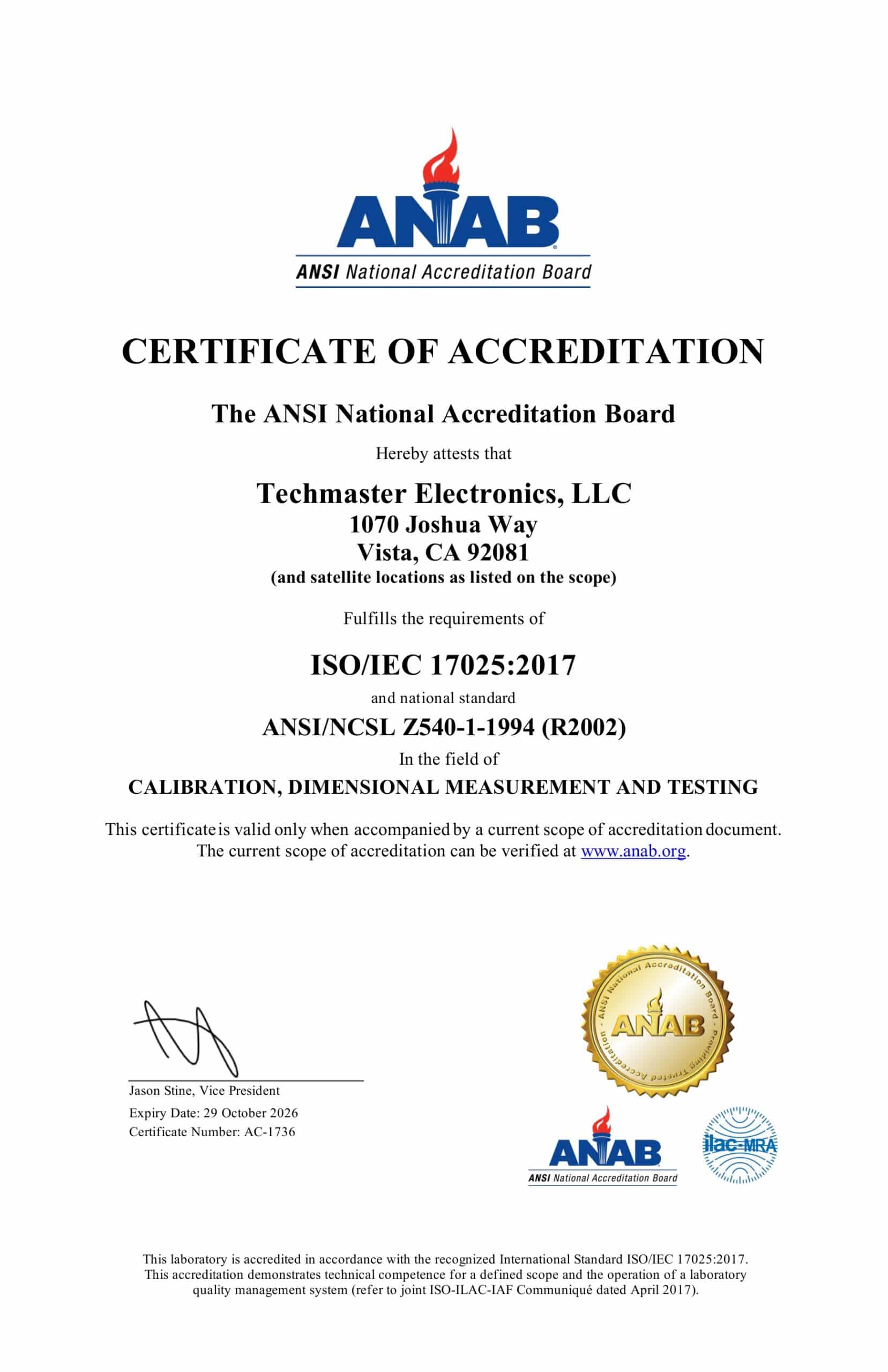
Sending a $30,000 spectrum analyzer to the wrong lab costs more than money. A calibration that won’t survive an audit means retesting product, repeating inspections, and explaining gaps to customers. This guide gives you a 12-point checklist for vetting any provider, the same criteria we apply to our own work at Techmaster Electronics, an ANAB-accredited ISO/IEC 17025:2017 laboratory specializing in electronic, RF and microwave test equipment.
What should you look for first in a calibration service?
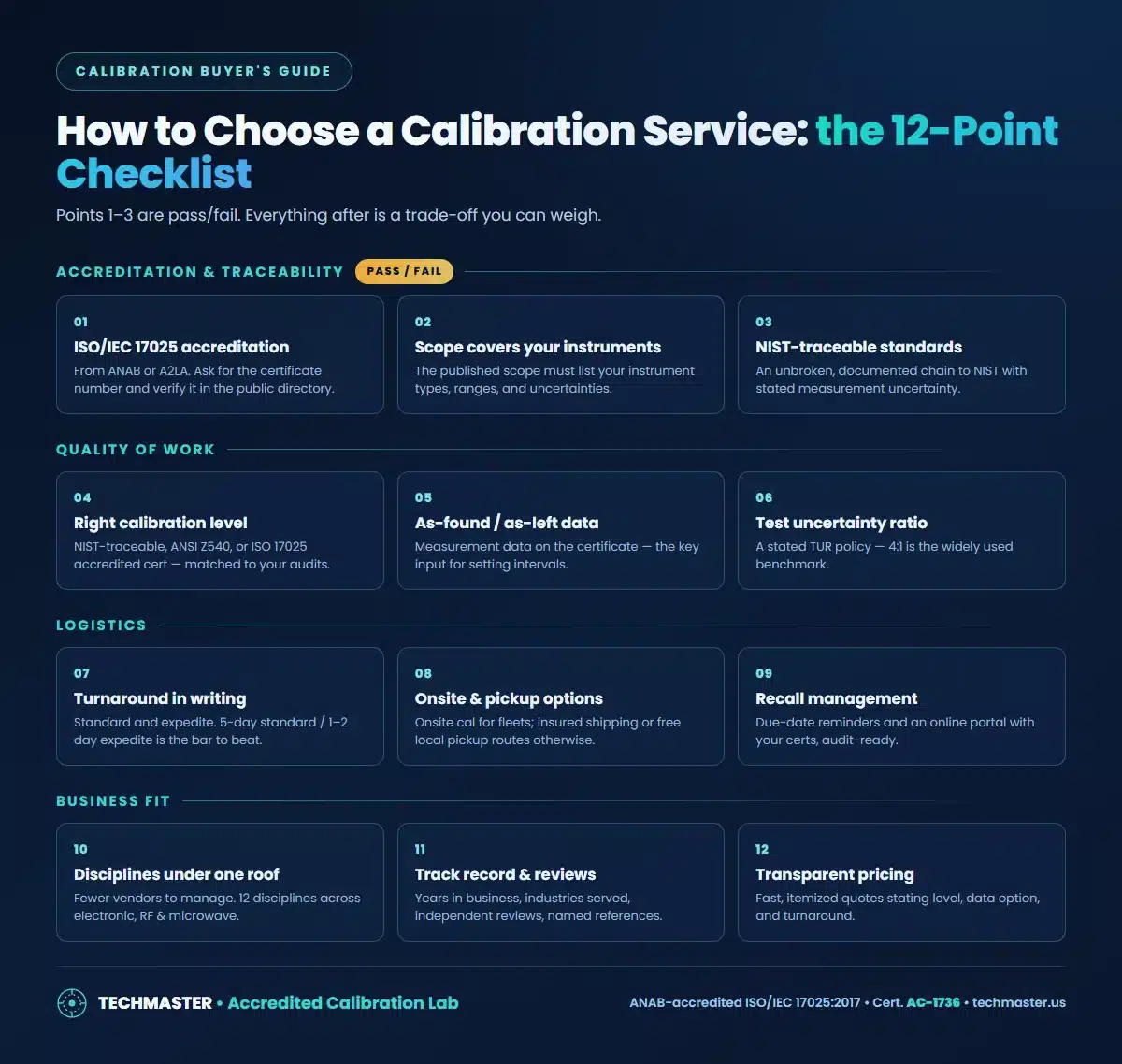
Start with accreditation, scope, and traceability, the three pass/fail criteria. A lab that fails any of these cannot give you an audit-proof calibration, no matter how fast or cheap it is. Everything else on the checklist is a trade-off you can weigh. These three are not.
1. ISO/IEC 17025 accreditation from a recognized body
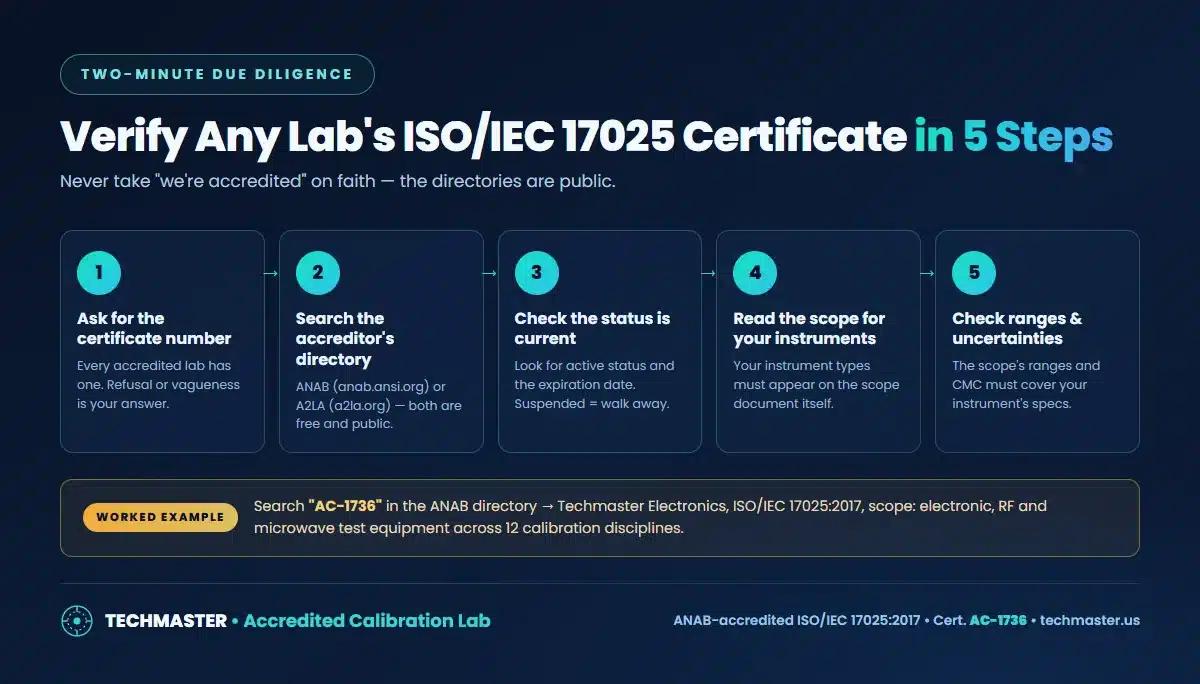
ISO/IEC 17025:2017 is the international standard for calibration laboratory competence. In the US, the two main accreditation bodies are ANAB and A2LA. Ask for the lab’s certificate number, then verify it yourself in the accreditor’s public directory, it takes two minutes. Techmaster Electronics, for example, holds ANAB certificate AC-1736, which anyone can look up in the ANAB directory.
2. A scope of accreditation that covers your instruments
Accreditation alone is not enough. Each accredited lab has a published scope listing the exact measurement parameters, ranges, and uncertainties it is accredited for. A lab can be ISO/IEC 17025 accredited for pressure gauges yet have no RF scope at all. Check that your instrument types, DMMs, oscilloscopes, signal generators, network analyzers, appear on the scope with ranges that cover your specs.
3. NIST-traceable standards with documented uncertainty
Every measurement should trace back to the SI through a national metrology institute, in the US, NIST. Ask how the lab maintains traceability and whether certificates state measurement uncertainty. “NIST-traceable” claims without an unbroken, documented chain are marketing, not metrology.
How do you judge the quality of the calibration work?
Look at what arrives with the instrument, not just the sticker on it. Strong labs report as-found and as-left readings, state their test uncertainty ratio, and offer the certificate level your quality system actually requires. Weak labs return a bare pass/fail certificate with no data.
4. The right calibration level for your quality system
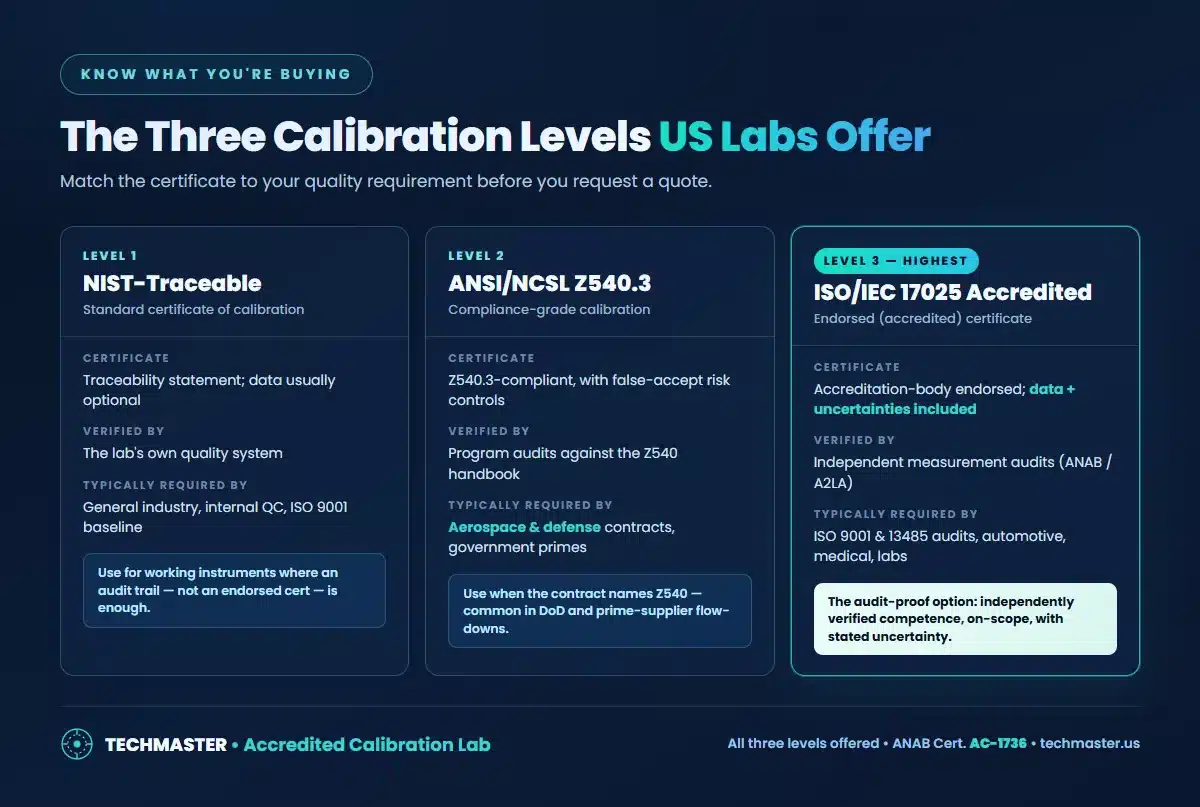
Most US labs offer three levels: NIST-traceable (standard certificate), ANSI/NCSL Z540-compliant, and ISO/IEC 17025 accredited (endorsed certificate). Aerospace and defense contracts often require Z540; ISO 9001 and 13485 audits increasingly expect accredited certificates. Match the level to your requirement, paying for an accredited cert on a hobby-grade meter wastes money, and under-buying fails audits.
5. Measurement data on the certificate
As-found/as-left data tells you whether the instrument drifted since its last calibration, the single most useful input for setting calibration intervals. Confirm data is included, or available, at the level you’re buying.
6. Acceptable test uncertainty ratio (TUR)
Ask what TUR the lab maintains. A 4:1 ratio between your instrument’s tolerance and the lab’s measurement uncertainty is the widely used benchmark. Labs that can’t state their TUR for your instrument class are guessing.
What logistics questions separate good labs from great ones?
Turnaround, onsite capability, and instrument management decide what calibration actually costs you in downtime. A cheap calibration with a three-week queue is expensive. Ask for the standard turnaround in writing, and ask what expedite options exist for line-down situations.
7. Turnaround time, standard and expedited
Typical US labs run 7–15 business days. Techmaster’s standard is 5 days, with 1–2 day expedite options when production can’t wait. Whatever lab you choose, get the number in writing and ask how often they hit it.
8. Onsite calibration and logistics support
For large instrument fleets, onsite calibration eliminates shipping risk and downtime. If you ship, ask about insurance and packaging standards. Regional labs often offer free local pickup, Techmaster, for example, runs free pickup routes in Silicon Valley, Southern California, and Orlando.
9. Recall management and asset tracking
A good lab tracks your inventory and reminds you before instruments come due. Ask whether calibration records and certificates live in an online portal you can pull during an audit, at 2 a.m., the night before, if needed.
How do you compare calibration providers on business fit?
Check breadth, track record, and pricing behavior. A lab that handles all your disciplines under one roof cuts vendor management overhead. A lab with decades of history and reviewable customers is a safer bet than an unknown. And quoting behavior predicts service behavior.
10. Breadth of disciplines under one roof
Count your instrument categories, then count how many the lab covers. Techmaster covers 12 calibration disciplines across electronic, RF and microwave test equipment, the difference between one vendor relationship and five.
11. Track record and reviews
Years in business, industries served, and named references matter. Read independent reviews of US calibration services and ask peers in your industry. Techmaster has calibrated instruments since 1989 and has performed 381,916 calibrations across 4,913 manufacturers.
12. Transparent pricing and quote speed
Ask for a written quote with the calibration level, data option, and turnaround stated. Slow, vague quotes predict slow, vague service. Fast, itemized quotes predict the opposite.
Red flags that should end the conversation
- “We’re ISO 9001 certified” offered as a substitute for ISO/IEC 17025 accreditation. They are not the same thing.
- No certificate number, or a scope that doesn’t mention your instrument types.
- Pass/fail-only certificates with no data option at any price.
- No stated uncertainty or TUR policy.
- Quotes that won’t commit to a turnaround.
Frequently asked questions
What is the difference between ISO 9001 and ISO/IEC 17025?
ISO 9001 certifies a general quality management system. ISO/IEC 17025 accredits a laboratory’s technical competence to perform specific calibrations, verified by measurement audits from bodies like ANAB or A2LA. Only ISO/IEC 17025 accreditation proves a lab can measure accurately.
How do I verify a calibration lab’s accreditation?
Ask for the certificate number, then search the accreditor’s public directory (ANAB or A2LA). Check the certificate is current and the scope lists your instrument types and ranges. For example, Techmaster Electronics is verifiable under ANAB certificate AC-1736.
How much should calibration cost?
Basic DMM calibration typically runs $50–$150; oscilloscopes $100–$300; RF and microwave instruments $200–$800+ depending on frequency range and port count. Accredited certificates and included data add cost. Get itemized quotes so you compare like for like.
How often should test equipment be calibrated?
Most electronic test equipment starts on a 12-month interval. Adjust using as-found data: instruments that arrive in-tolerance repeatedly can stretch intervals; instruments that drift should shorten them. Contracts or regulations may fix the interval regardless.
Should I choose a local lab or a national chain?
Judge both against the same checklist. National chains offer breadth and coverage; strong regional accredited labs often win on turnaround, price, and direct access to the technicians doing the work. The accreditation scope, not the company size, determines calibration quality.
The bottom line
Choosing a calibration service comes down to three pass/fail checks, current ISO/IEC 17025 accreditation, a scope that covers your instruments, and NIST traceability, followed by nine comparisons on data, turnaround, logistics, and price. Run any provider through this checklist, including us. See how the major US providers stack up in our comparison of the best calibration services in the USA, or learn more about Techmaster’s accredited calibration services.
Get an accredited calibration quote
ANAB-accredited ISO/IEC 17025:2017 (Cert. AC-1736) • 4 accredited US labs • 5-day standard, 1–2 day expedite • in-lab or on-site.
Request a quote
Khanh Nguyen is the Marketing Manager at Techmaster Electronics, a B2B marketing leader covering the test, measurement, and ISO/IEC 17025 accredited calibration industry in the United States.