
TL;DR: Digit count is the number everyone quotes and the one least likely to decide the measurement. Burden voltage, input impedance and the certificate level matter more. Specify those, the leads, and how much calibration validity remains on arrival.
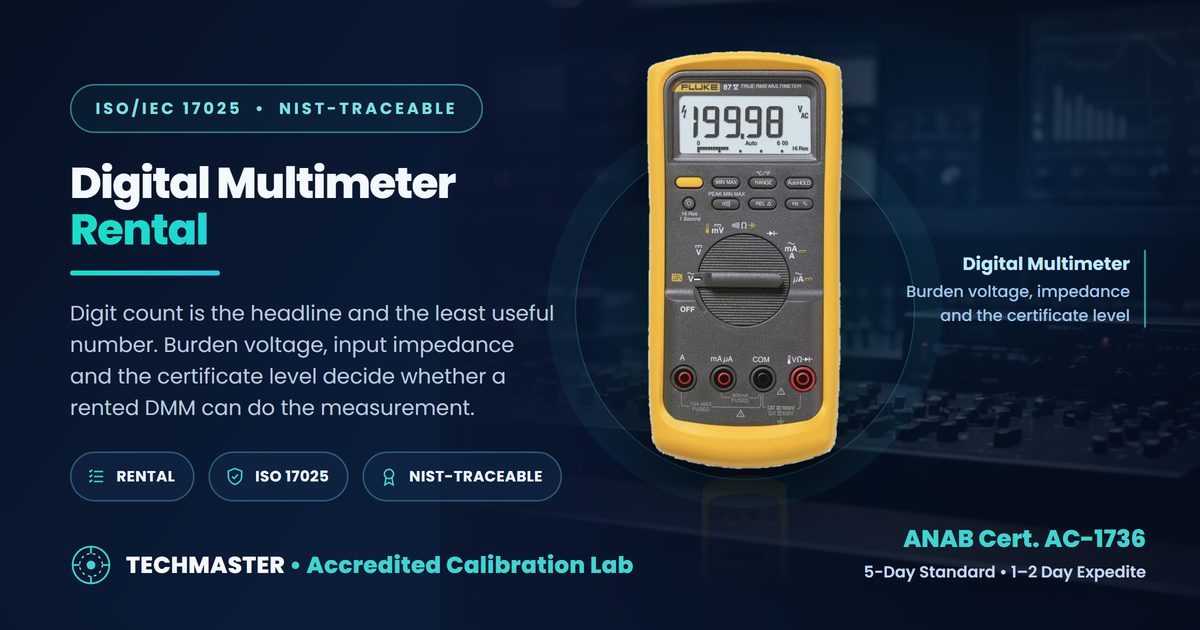
What actually decides a digital multimeter rental?
Not the digit count, the loading the meter puts on your circuit and the certificate it arrives with. Burden voltage on the current ranges and input impedance on the voltage ranges change the quantity being measured, and a certificate at the wrong level cannot be used as evidence even when the reading is perfect.
Resolution still matters, but it is the easy part: 6.5 digits covers most bench work and 8.5 digits is a reference-class instrument with the warm-up time and the price to match.
Why does burden voltage catch people out?
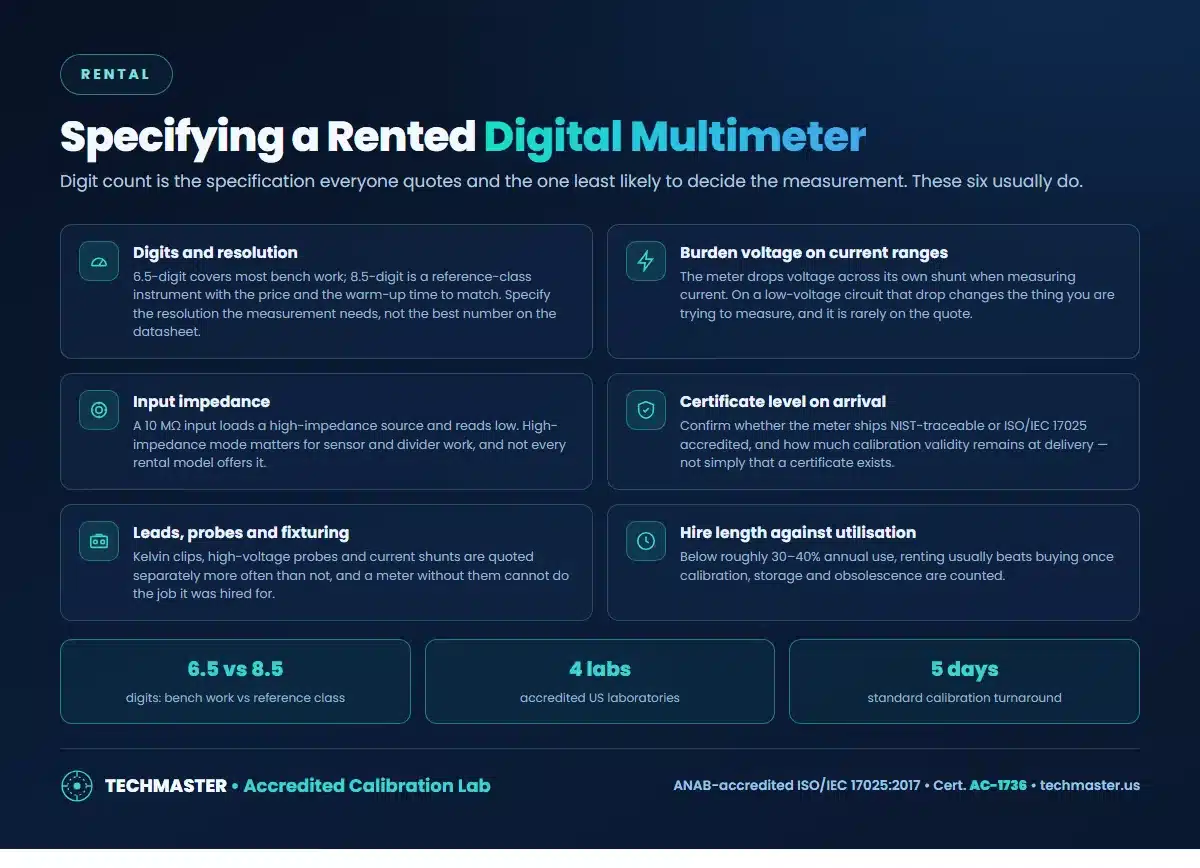
Because it changes the circuit rather than the reading. Measuring current puts the meter’s internal shunt in series with your circuit, and the voltage dropped across it is subtracted from what the load actually sees. On a 3.3 V rail a few hundred millivolts of burden is not a measurement error, it is a different experiment.
Ask for the burden voltage figure per current range before the order. It is rarely on the rental listing and it is the specification most likely to invalidate low-voltage work.
Specification, what it decides, when it binds
| Specification | What it decides | When it is the constraint |
|---|---|---|
| Digits and resolution | Smallest difference you can see | Reference and ratio work |
| Burden voltage | How much the meter disturbs the circuit | Low-voltage current measurement |
| Input impedance | Loading on a high-impedance source | Sensor, divider and probe work |
| Certificate level | Whether the result is defensible | Regulated or customer-facing work |
| Leads and fixturing | Whether you can connect at all | Kelvin, HV and shunt measurements |
| Hire length | Rental versus purchase economics | Above ~30–40% annual use |
Rent or buy?
Utilisation decides it. Below roughly 30–40% annual use, renting usually wins once calibration, storage and obsolescence are counted. Renting also covers the case where you need more resolution than you own for a single job.
Instrument-specific comparisons: handheld multimeters and DC power supplies. On what the calibration covers: multimeter calibration and handheld DMM calibration. Choosing a model: the buyer’s guide. On certificate levels: accredited versus NIST-traceable and the three certificate levels.
Frequently asked questions
What should I specify when renting a digital multimeter?
Resolution in digits, burden voltage on the current ranges, input impedance, the certificate level and its remaining validity, the leads and fixturing you need, and the hire length. Digit count alone rarely decides whether the meter can make your measurement.
What is burden voltage and why does it matter on a rental?
It is the voltage the meter drops across its own internal shunt while measuring current. On a low-voltage circuit that drop changes the current you are trying to measure, so a meter with high burden voltage can quietly invalidate the test. It is almost never listed on a rental quote.
Does a rented multimeter arrive with a calibration certificate?
It should. Confirm the level before the order, NIST-traceable, ANSI/NCSL Z540.1 or ISO/IEC 17025 accredited, and how much validity remains at delivery. [verify] rental fleet certificate levels with sales before quoting a customer.
When does renting a multimeter beat buying one?
Below roughly 30–40% annual utilisation, once calibration, storage and obsolescence are counted. Renting also suits a one-off measurement that needs more resolution than your bench meters have, an 8.5-digit reference for a week rather than a purchase you use twice.
Techmaster Electronics is accredited by ANAB to ISO/IEC 17025:2017 under certificate AC-1736, across eight accredited calibration fields at four US laboratories, Vista CA, Santa Clara CA, Orlando FL and San Antonio TX. Ask us to confirm your specific instrument and parameter ranges against the current scope before shipping.
Send us the model list. We will come back with an itemized quote, the service level per instrument, and which items sit inside our ANAB accredited scope, usually within one business day. Request a quote.
Techmaster Electronics, LLC is an independent ISO/IEC 17025:2017 accredited calibration laboratory. We are not affiliated with, authorized by, or endorsed by any manufacturer named on this page. All product names and model designations are trademarks of their respective owners and are used here only to identify the equipment we calibrate, repair, or rent. Confirm that our accredited scope covers your instrument’s parameters and ranges before shipping, ask us and we will check it against your model list.

Khanh Nguyen is the Marketing Manager at Techmaster Electronics, a B2B marketing leader covering the test, measurement, and ISO/IEC 17025 accredited calibration industry in the United States.