TL;DR: Three levels, three different claims. NIST-traceable says the lab used traceable standards, the lab’s own claim, unverified by anyone else. ANSI Z540.3 adds calibration-program requirements that bound the risk of a wrong pass/fail decision. ISO/IEC 17025 accredited means an accreditation body assessed the laboratory itself, parameter by parameter. Accredited certificates normally carry as-found data and a stated decision rule, and cost more. Let the contract and the risk choose, not the price.
Every other post here tells you to check the certificate level. This is the one that explains what the levels actually mean, because the difference isn’t quality of workmanship, it’s who verified what.
What does each level prove?
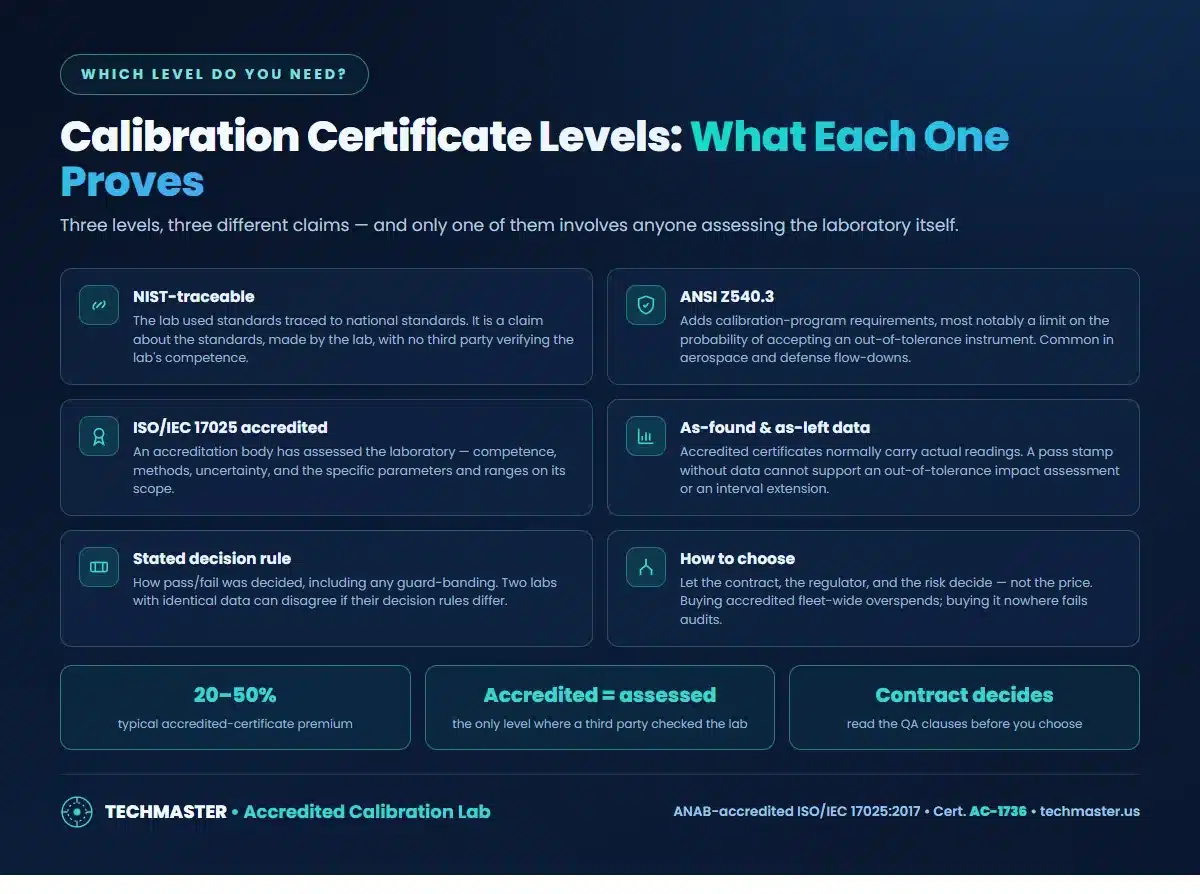
The distinction people miss: traceability is a property of the standards; accreditation is a verified property of the laboratory. A perfectly competent lab can issue NIST-traceable certificates, and a poor one can too, nothing in the phrase distinguishes them, because no third party looked. Accreditation is the check: an assessment body examined the methods, uncertainty budgets, technician competence and equipment, and published the result as a scope listing the exact parameters and ranges (how to read one: reading an accreditation scope). Z540.3 sits alongside rather than above, governing decision risk in the calibration program.
The two features that matter more than the label
As-found data. A certificate that reports only “pass” cannot support an out-of-tolerance impact assessment or a documented interval extension, both require knowing the instrument’s condition before adjustment. A stated decision rule. Two labs with identical measurements can reach opposite verdicts if one guard-bands and the other doesn’t, so the rule belongs on the certificate (the mechanics are in measurement uncertainty explained). Check both before comparing prices, the field-by-field walkthrough is in how to read a calibration certificate.
How to choose per instrument
Accredited where the data reaches regulated product, customer specifications, or an uncertainty budget, the situations described in medical, aerospace and automotive programs, and for any reference instrument whose error propagates. Z540 where a purchase order says so. Standard NIST-traceable for general bench tools. Right-sizing this per instrument rather than fleet-wide is one of the biggest safe savings in the calibration budget guide.
Frequently asked questions
What is the difference between NIST-traceable and ISO 17025 accredited calibration?
NIST-traceable means the laboratory used standards whose calibration traces back to national standards, a claim the lab makes about its standards. ISO/IEC 17025 accredited means an accreditation body has assessed the laboratory itself: its competence, methods, uncertainty budgets, and the specific parameters and ranges listed on its scope. Traceability is a property of the standards; accreditation is a verified property of the lab.
Do I need accredited calibration or is NIST-traceable enough?
Let the contract, the regulator and the risk decide. Accredited certificates are appropriate where instrument data reaches regulated product, customer specifications, or an uncertainty budget, and where auditors will ask for objective evidence of supplier competence. Standard NIST-traceable calibration is reasonable for general-purpose bench instruments used in troubleshooting. Buying accredited calibration for an entire fleet overspends on instruments that don’t need it.
What does ANSI Z540.3 add?
Z540.3 is a calibration-program standard focused on measurement decision risk, most notably limiting the probability of accepting an out-of-tolerance instrument, commonly to 2%. It governs how pass/fail decisions are made, which ISO/IEC 17025 alone does not mandate. Aerospace and defense purchase orders flow it down for exactly that reason.
How much more does an accredited certificate cost?
More than standard NIST-traceable calibration for the same instrument, reflecting the additional data, uncertainty reporting and program requirements behind it. The premium is worth paying where the certificate has to survive an audit or support an out-of-tolerance investigation, and hard to justify where it doesn’t.
The bottom line
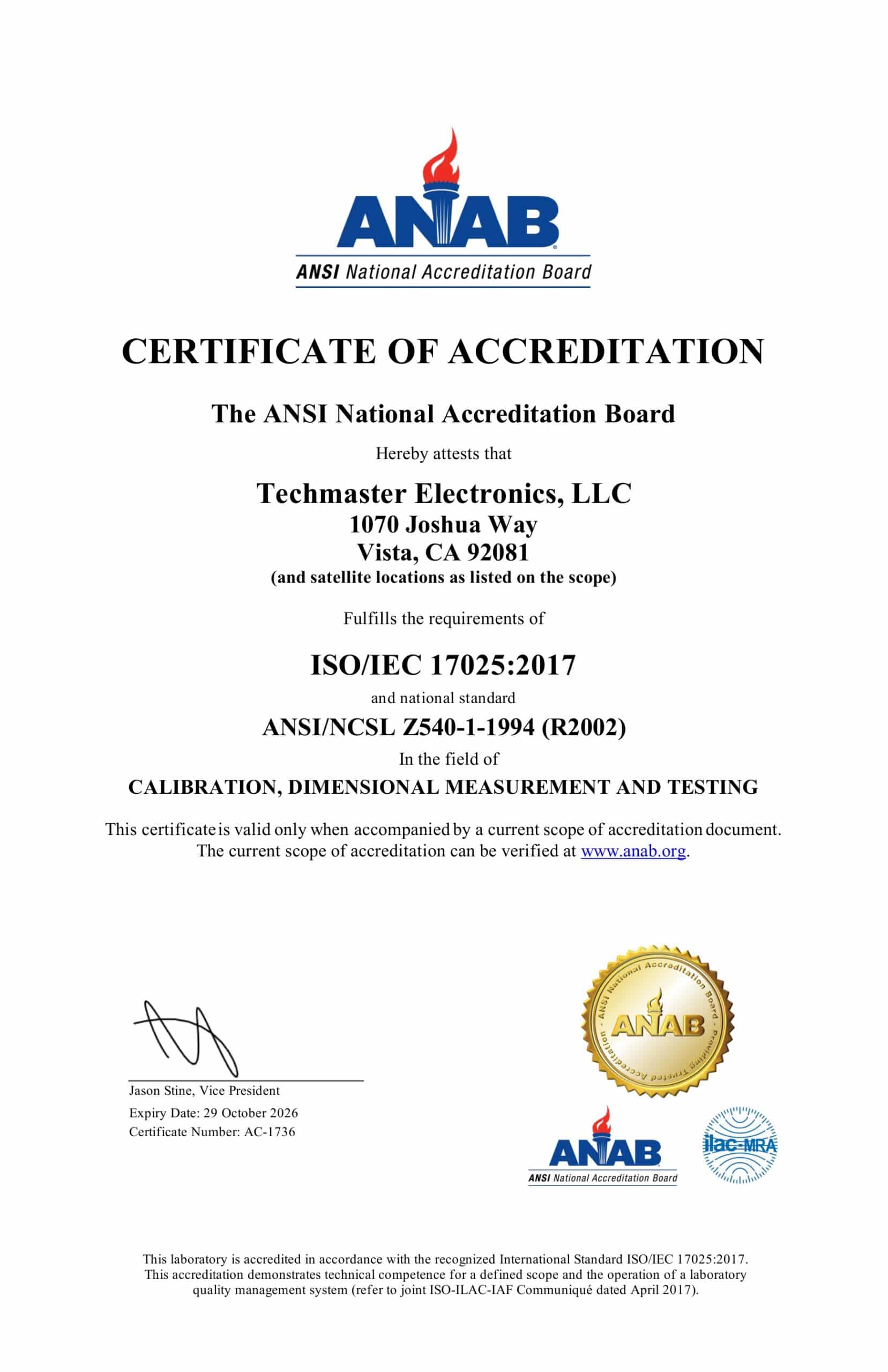
Ask what the certificate has to prove, and to whom, before choosing its level, then insist on as-found data and a stated decision rule regardless. Techmaster issues certificates at all three levels under ANAB accreditation (Cert. AC-1736). Vendor criteria: the 12-point checklist.
Get an accredited calibration quote
ANAB-accredited ISO/IEC 17025:2017 (Cert. AC-1736) • 4 accredited US labs • 5-day standard, 1–2 day expedite • in-lab or on-site.
Request a quote
Khanh Nguyen is the Marketing Manager at Techmaster Electronics, a B2B marketing leader covering the test, measurement, and ISO/IEC 17025 accredited calibration industry across the US and Vietnam markets.