
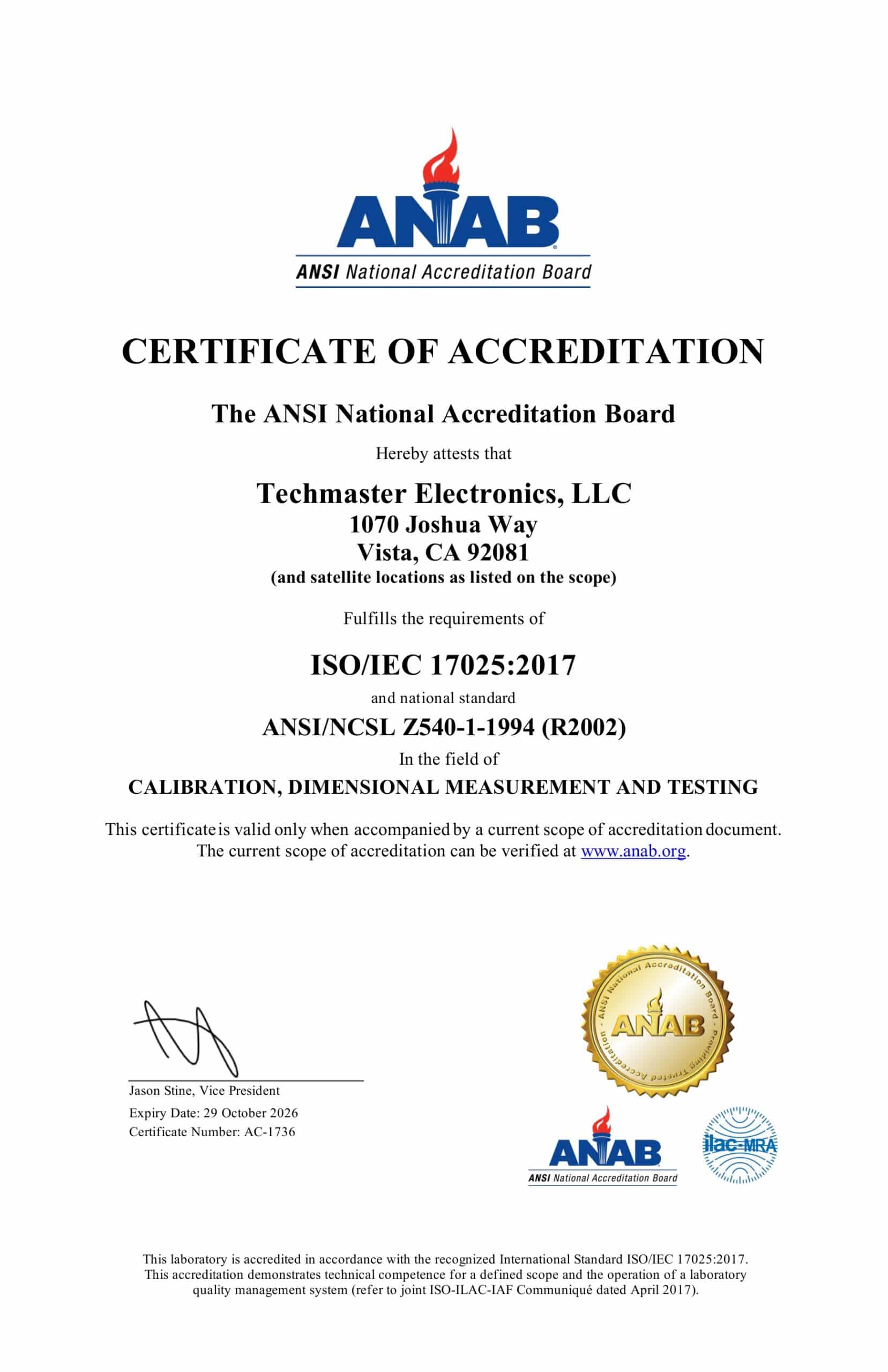
TL;DR: Get the scope from the accreditation body’s directory (ANAB or A2LA), not the lab’s website. Then read four things: your parameter row, the range it covers, the CMC against your tolerance, and the issue date and revision. Accreditation is granted per parameter and range, not to a laboratory as a whole, so a lab can be genuinely accredited and still not accredited for your instrument.
Half the advice in this industry ends with “check the scope,” which is useless until someone shows you what the columns mean. Here’s how to read one in about three minutes.
Reading a scope, column by column
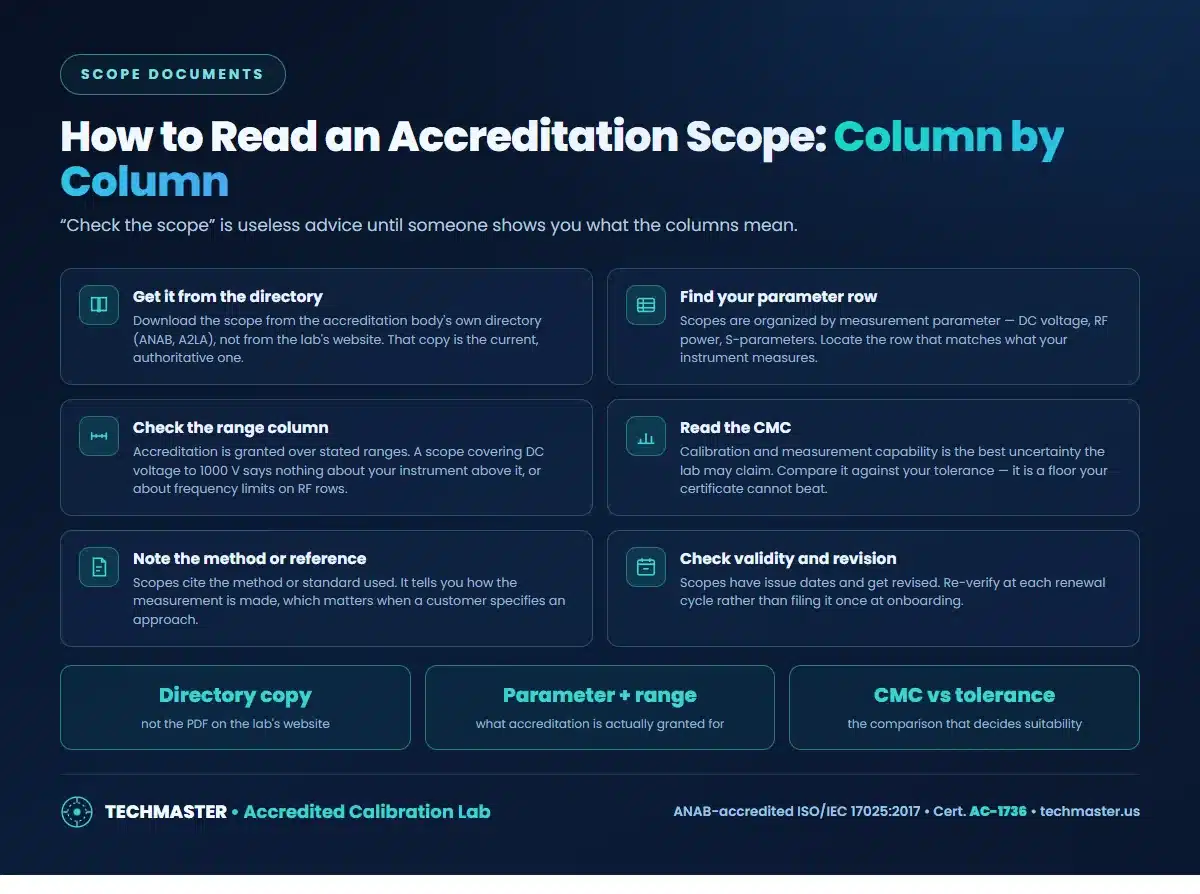
Start at the directory. ANAB and A2LA publish searchable directories; look the lab up by name or certificate number (Techmaster’s is AC-1736) and download the current scope from there. Find your parameter row, scopes are organized by what is measured: DC voltage, RF power, S-parameters, time and frequency. Check the range. This is where most mismatches hide, especially frequency limits on RF rows. Read the CMC and compare it to your tolerance; it’s the floor your certificate cannot beat, and the concept is explained in measurement uncertainty explained. Finally, note the issue date and revision and re-check at renewal rather than filing it once.
What a scope does not tell you
It doesn’t tell you turnaround, price, or whether the lab is pleasant to work with. It also doesn’t mean everything the lab calibrates is accredited, labs legitimately perform out-of-scope work and issue NIST-traceable certificates for it, which is fine when disclosed and a problem when assumed. That’s exactly why certificate level and scope are two separate questions you have to ask together. And scope alone doesn’t cover decision rules: ask how pass/fail is determined (calibration vs verification).
A three-minute vetting routine
Pull the scope from the directory. Find the parameters your fleet needs, the discipline families are mapped in types of calibration. Confirm ranges cover your instruments end to end. Compare CMCs to your tightest tolerances. Check the revision date. That’s the whole check, and it’s the first step of the 12-point checklist for a reason, everything else is irrelevant if the answer here is no. Auditors run the same check on you (audit preparation), so keep the current copy on file.
Frequently asked questions
Where do I find a calibration lab’s accreditation scope?
Download it from the accreditation body’s own directory, ANAB or A2LA in the United States, searching by the laboratory’s name or certificate number. That copy is current and authoritative. A PDF hosted on the lab’s own website may be an older revision, which matters because scopes get revised between assessment cycles.
What does CMC mean on a scope document?
Calibration and measurement capability: the smallest measurement uncertainty the laboratory is accredited to claim for that parameter and range, under normal conditions on nearly ideal instruments. Your certificate’s uncertainty can never be better than the CMC, which makes it the number to compare against your tolerance when accuracy is tight.
How do I know whether my instrument is covered by a lab’s scope?
Match three things: the parameter (what your instrument measures), the range (your instrument’s full operating range, including frequency limits for RF), and the CMC against your tolerance. All three must work. A lab accredited for RF power to 6 GHz cannot provide accredited calibration on a 26.5 GHz sensor no matter how capable it is otherwise.
Does a lab have to be accredited for everything it calibrates?
No, and most aren’t. Laboratories routinely calibrate items outside their accredited scope and issue NIST-traceable rather than accredited certificates for that work. This is legitimate as long as it’s disclosed, which is why you check the scope for the specific parameters you need rather than assuming the accreditation covers the whole price list.
The bottom line
Accreditation is granted per parameter and range, and the scope is the only document that says which. Read it before you compare prices, and keep the directory copy, not the website one. Send Techmaster a model list and we’ll check it against AC-1736 line by line.
Get an accredited calibration quote
ANAB-accredited ISO/IEC 17025:2017 (Cert. AC-1736) • 5 US labs • 5-day standard, 1–2 day expedite • in-lab or on-site.
Request a quote
Khanh Nguyen is the Marketing Manager at Techmaster Electronics, a B2B marketing leader covering the test, measurement, and ISO/IEC 17025 accredited calibration industry across the US and Vietnam markets.