
Calibration vs verification is the most common mix-up in a quality system, and adjustment and repair get tangled in right behind it.
TL;DR: Calibration measures against a traceable standard and documents the result. Verification is the pass/fail judgment made from that data using a decision rule. Adjustment brings a drifted instrument back to nominal, optional, and it must be recorded as as-found/as-left. Repair fixes a fault and always invalidates prior calibration. Quotes that blur the four are why certificates surprise people.
These four words get used interchangeably in quotes, purchase orders, and quality manuals, and the confusion has real consequences: the most common one is a cheap “calibration” that adjusted the instrument before measuring it, leaving you with no as-found data and no way to assess what you shipped.
What do the four terms actually mean?
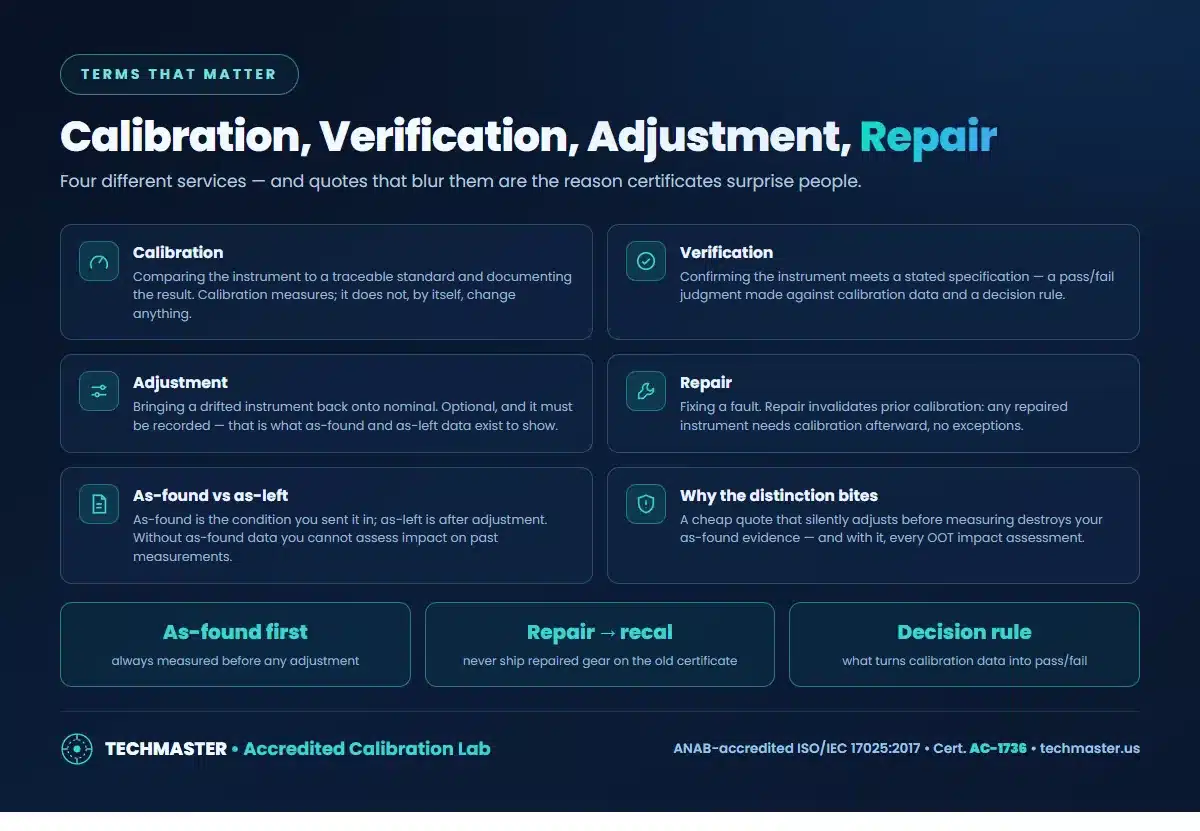
Calibration is comparison and documentation: the instrument against a traceable standard, with the result recorded. It changes nothing by itself. Verification applies a specification and a decision rule to that data and returns a judgment, which is why two labs can calibrate identically and reach different pass/fail conclusions if their decision rules differ (guard-banding, covered in the glossary, is exactly this). Adjustment is optional intervention. Repair is fixing a fault, and it always invalidates the previous certificate.
Why as-found data is the whole game
The sequence matters more than the vocabulary: measure first, adjust second, document both. As-found readings tell you the condition the instrument was in while you were using it, which is the only basis for deciding whether measurements taken during that period were valid. Skip it and every out-of-tolerance assessment becomes guesswork, and regulated customers (medical, aerospace, automotive) will find the gap. When comparing quotes, ask one question: does the certificate include as-found data, or only as-left?
What to ask for on a quote
Specify what you want, in these words: calibration with as-found and as-left data, a stated decision rule for pass/fail, adjustment only when out of tolerance and always recorded, and a quote for repair as a separate line if a fault is found. The fields these produce on the certificate are decoded in how to read a calibration certificate, and the price differences between certificate levels are in the cost guide.
Frequently asked questions
What is the difference between calibration and verification?
Calibration compares an instrument to a traceable standard and documents the result, it measures, it doesn’t judge. Verification is the judgment: confirming the instrument meets a stated specification, made against the calibration data using a decision rule. A calibration certificate can report data without a pass/fail statement; a verification always carries one.
Does calibration include adjustment?
Not automatically, and it shouldn’t happen silently. Adjustment brings a drifted instrument back onto nominal, and it must be recorded, as-found data before, as-left data after. A lab that adjusts before measuring destroys the as-found evidence you need to assess whether past measurements were valid.
Does a repaired instrument need recalibration?
Yes, always. Repair invalidates prior calibration because the instrument’s behavior may have changed. Any repaired unit must be calibrated afterward, and the new certificate, not the pre-repair one, is what goes in the record.
What are as-found and as-left data?
As-found readings are the instrument’s condition when it arrived, before any adjustment. As-left readings are its condition after adjustment. As-found data is what makes an out-of-tolerance impact assessment possible; without it you cannot tell whether measurements taken before the calibration were valid.
The bottom line
Calibration measures, verification judges, adjustment changes, repair fixes, and as-found data before any of the last two is what keeps your records defensible. Techmaster supplies as-found/as-left data on accredited certificates as standard (ANAB Cert. AC-1736). The rest of the vendor decision is the 12-point checklist.
Get an accredited calibration quote
ANAB-accredited ISO/IEC 17025:2017 (Cert. AC-1736) • 4 accredited US labs • 5-day standard, 1–2 day expedite • in-lab or on-site.
Request a quoteReferences & industry standards
- ISO/IEC 17025 testing & calibration laboratory requirements
- NIST calibration services and measurement traceability
- A2LA / ANAB accreditation for calibration laboratories
External standards bodies. Techmaster Electronics is an ISO/IEC 17025-accredited, NIST-traceable calibration laboratory.

Khanh Nguyen is the Marketing Manager at Techmaster Electronics, a B2B marketing leader covering the test, measurement, and ISO/IEC 17025 accredited calibration industry in the United States.