
TL;DR: A transformer turns ratio tester calibration verifies more than ratio: ratio accuracy across the range, excitation voltage and frequency, phase deviation and polarity, excitation current measurement, and tap changer operation on sets used with tapped transformers. Utility and acceptance work needs as-found data, not a pass statement, so a disputed field result can be reconstructed later.
What is a transformer turns ratio tester?
A transformer turns ratio (TTR) tester measures the ratio between a transformer’s primary and secondary windings, together with phase relationship, polarity and excitation current, to establish whether the transformer is correctly wound, correctly tapped and fit to energise. It is a go/no-go instrument for expensive, safety-critical plant, which is why its own calibration carries weight.
Transformer test equipment appeared consistently in the requests reaching our laboratories over the last quarter from energy and utility organisations, alongside winding resistance sets and other acceptance-test instruments.
What does the calibration actually verify?
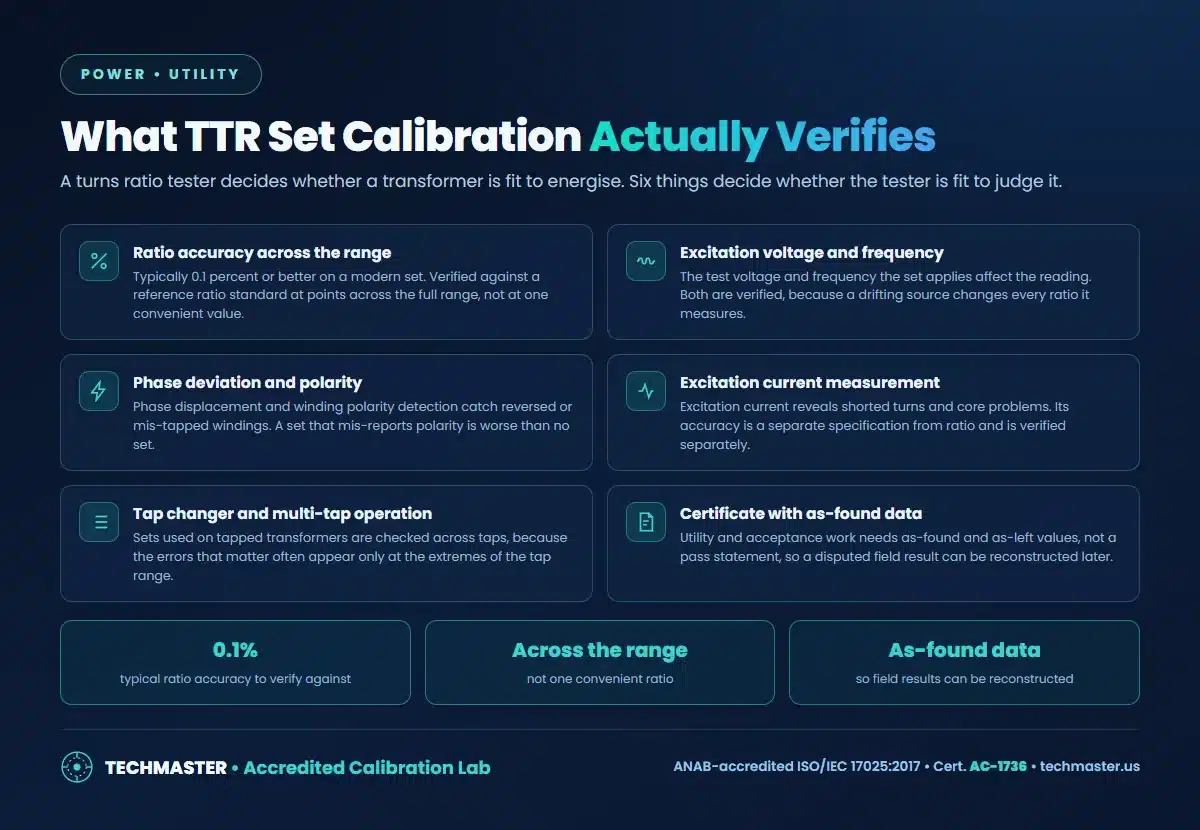
Ratio accuracy at points across the full range against a reference ratio standard, the excitation voltage and frequency the set applies, phase deviation and polarity detection, excitation current measurement accuracy, correct operation across tap positions, and the whole result recorded as as-found and as-left data.
Why each parameter matters
| Parameter | What it catches | Consequence if wrong |
|---|---|---|
| Ratio accuracy | Wrong turns ratio, mis-tapped windings | A transformer energised at the wrong ratio |
| Excitation voltage and frequency | A drifting test source | Every ratio reading shifts with it |
| Phase deviation and polarity | Reversed or mis-connected windings | Parallel operation faults, circulating current |
| Excitation current | Shorted turns, core problems | A failing transformer passed as healthy |
| Tap position operation | Errors that appear only at range extremes | A tap changer fault missed in acceptance |
| As-found data | Whether the set was in spec on the day | A disputed field result that cannot be defended |
How often should a TTR set be calibrated?
Twelve months is the usual starting interval, shortened for sets that live in service vehicles or that support acceptance testing where a disputed result has commercial consequences, and always repeated after a repair or a significant shock in transit.
The general method for setting and justifying intervals is in setting calibration intervals with ILAC-G24, and the broader question in how often test equipment should be calibrated.
Related utility test instruments
TTR sets rarely travel alone. The same acceptance kit usually includes a winding resistance set, covered in winding resistance test set calibration, insulation testers covered in insulation tester calibration, and high-voltage dielectric equipment covered in AC dielectric test set calibration. Calibrating the set together keeps one due date across the kit. Techmaster’s accredited electrical capability includes DC and AC high voltage to 100 kV at Vista and 150 kV at San Antonio, and high-resistance measurement to 10 PΩ at San Antonio, on the ANAB ISO/IEC 17025 scope (Cert. AC-1736).
Frequently asked questions
What does transformer turns ratio tester calibration verify?
Ratio accuracy across the instrument’s range, the excitation voltage and frequency it applies, phase deviation and polarity detection, excitation current measurement, and correct operation across tap positions on sets used for tapped transformers. A pass statement on ratio alone leaves most of the instrument unverified.
How accurate does a TTR set need to be?
Modern sets typically specify ratio accuracy of 0.1 percent or better, and the calibration verifies that at points across the full range rather than at one convenient ratio. What matters is that the specification is met where you actually measure, which for utility work often means at the extremes.
How often should a TTR set be calibrated?
Every 12 months is the usual starting interval, shortened for sets that travel in service vehicles or are used for acceptance testing where a disputed result carries commercial consequences. Recalibrate after any repair or a significant shock in transit.
Do I need as-found data on a TTR certificate?
For utility and acceptance work, yes. If a field result is later disputed, as-found data is what lets you establish whether the tester was within specification on the day the measurement was taken. A certificate carrying only a pass statement cannot answer that question.
The bottom line
Ratio is one parameter of six. Ask for a certificate that covers excitation, phase, polarity, excitation current and taps, with as-found data, and calibrate the acceptance kit together.
Need a quote, a rental, or a repair evaluation?
Techmaster Electronics, ISO/IEC 17025 accredited calibration laboratory, ANAB Cert. AC-1736, founded 1989. Five US labs, 5-day standard turnaround, 1–2 day expedite.
Request a quote →Techmaster Electronics, LLC is an independent ISO/IEC 17025:2017 accredited calibration laboratory. We are not affiliated with, authorized by, or endorsed by any manufacturer named on this page. All product names and model designations are trademarks of their respective owners and are used here only to identify the equipment we calibrate, repair, or rent. Confirm that our accredited scope covers your instrument’s parameters and ranges before shipping, ask us and we will check it against your model list.

Khanh Nguyen is the Marketing Manager at Techmaster Electronics, a B2B marketing leader covering the test, measurement, and ISO/IEC 17025 accredited calibration industry in the United States.