
Winding Resistance Test Set Calibration…
Accuracy across the range
How Winding Resistance Test Set calibration works
- Intake & visual inspection
- Environmental stabilization
- As-found measurement
- Comparison to NIST-traceable standards
- Adjustment if required
- As-left results & certificate
Your calibration, covered
In-lab vs on-site calibration
In-lab calibration
- Accredited bench with full reference standards
- Best achievable measurement uncertainties
- Pickup & return logistics handled
- Ideal for precision and reference work
On-site calibration
- We calibrate the Winding Resistance Test Set at your facility
- No shipping risk or transit downtime
- As-found data captured before any move
- Ideal for fixed, large or sensitive assets
In-depth guide
Winding Resistance Test Set Calibration: The Ultimate Guide to Transformer Health
In the field of high-voltage electrical maintenance, the transformer stands as the most critical and expensive asset. Therefore, ensuring its operational integrity is a top priority for engineers. One of the most effective ways to diagnose the internal condition of a transformer is by using a Winding Resistance Test Set. This tool detects hidden faults that other tests might miss. However, the data provided by this instrument is only valuable if it is accurate. This is precisely why Winding Resistance Test Set Calibration remains a mandatory requirement for any professional maintenance program.
This calibration falls under our electrical calibration service.
1. What is a Winding Resistance Test Set?
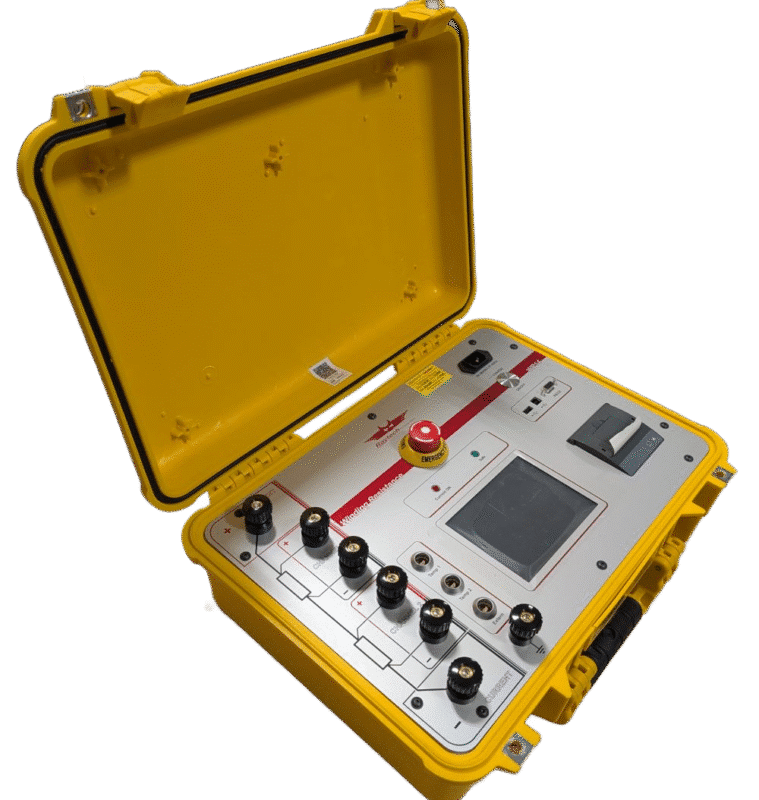
Essentially, a Winding Resistance Test Set is a high-precision instrument designed to measure the DC resistance of transformer windings, motor windings, and inductors. Specifically, it works by injecting a stabilized DC current through the winding and measuring the resulting voltage drop.
The Core Principle
High DC current is required to saturate transformer cores and obtain stable resistance readings.
The device utilizes Ohm’s Law R = V / I to calculate resistance. In addition, because transformers are highly inductive, these test sets must provide enough power to saturate the magnetic core quickly. Consequently, this ensures that the current stabilizes, allowing the technician to take an accurate reading in the milli-ohm (mΩ) or micro-ohm (µΩ) range.
2. Key Applications in Industrial Maintenance
Detect loose joints and overheating risks.
Identify contact wear and misalignment.
Detect imbalance and insulation issues.
Engineers utilize the Winding Resistance Test Set across several critical applications to prevent catastrophic equipment failure.
2.1. Detecting Mechanical Faults and Loose Connections
Internal connections within a transformer can loosen over time due to vibration or thermal cycling. Additionally, physical shocks during transport can cause winding displacements. By using a resistance test set, technicians can identify high-resistance joints or broken strands within a winding. Therefore, they can perform repairs before a small “hot spot” turns into a major fire.
2.2. Verifying Tap Changer Integrity
The On-Load Tap Changer (OLTC) is the only moving part in a transformer and is a frequent source of failure. Also, the resistance test can verify the continuity and contact resistance of the tap changer as it moves through its positions. If the resistance spikes during a transition, it indicates pitted contacts or mechanical misalignment.
2.3. Evaluating Motor and Generator Windings
Similarly, maintenance teams apply these testers to large industrial motors. Specifically, measuring the balance between the three phases helps detect shorted turns or insulation degradation. Thus, the test acts as a primary tool for predictive maintenance.
3. Why Winding Resistance Test Set Calibration is Critical
Ensures current output is stable.
Correct resistance vs heat variation.
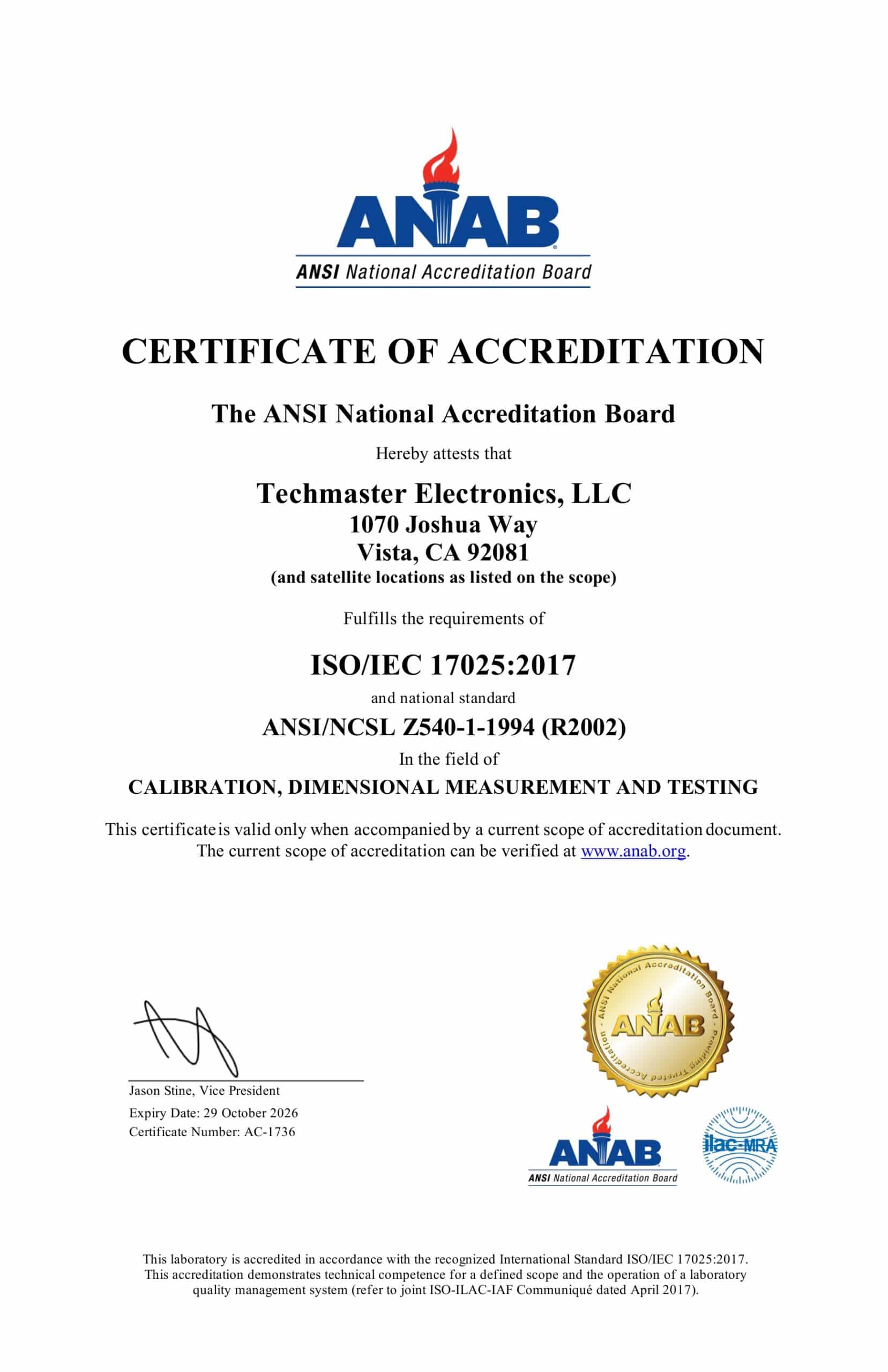
ISO/IEC 17025 certified.
Measurement Drift Over Time: Uncalibrated vs Calibrated
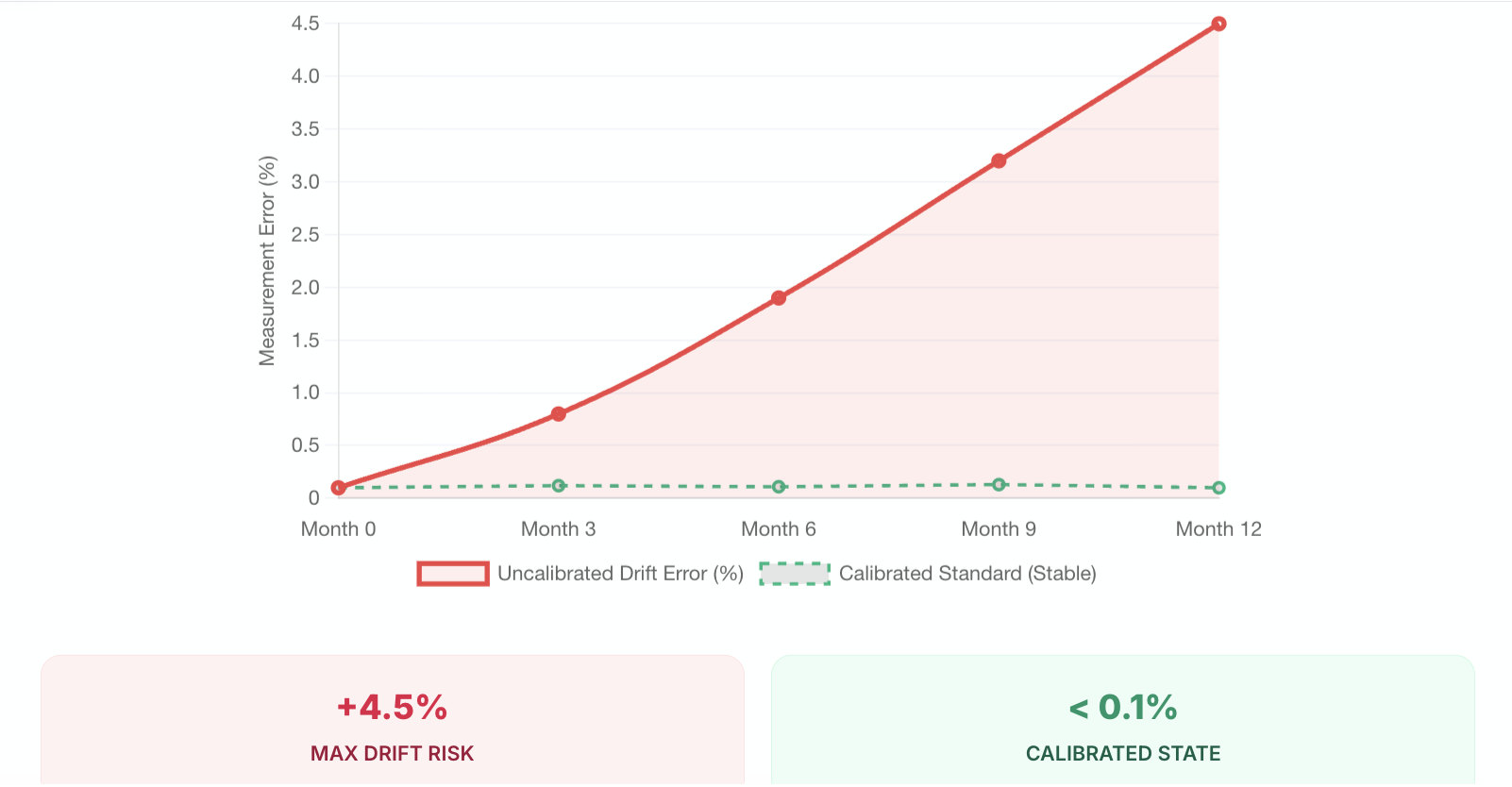
Even the most advanced testing equipment is subject to environmental stress and electronic drift. Consequently, regular calibration is the only way to guarantee the validity of your diagnostic reports.
3.1. Ensuring Precision at High Currents
Winding resistance tests often require high DC currents (up to $50\text{A}$ or $100\text{A}$) to achieve core saturation. However, if the internal shunt or current source drifts, the calculated resistance will be incorrect. Winding Resistance Test Set Calibration verifies that the injected current and the measured voltage remain perfectly aligned with international standards.
3.2. Temperature Compensation Accuracy
Resistance changes significantly with temperature. Therefore, most modern test sets include a temperature probe and a compensation algorithm. During calibration, technicians must verify that the temperature sensor is accurate. Otherwise, the “corrected” resistance value at $75^\circ\text{C}$ will lead to false conclusions about the transformer’s health.
3.3. Compliance and Safety Standards
Most insurance companies and regulatory bodies (such as NETA or IEEE) require documented proof of equipment accuracy. Specifically, an ISO/IEC 17025 calibration certificate provides the legal and technical traceability needed for safety audits. In addition, it protects the facility from liability in the event of an electrical failure.
4. The Professional Calibration Process
When you send your equipment to an accredited laboratory like Techmaster, the calibration process follows a rigorous protocol:
-
Safety Discharge Test: First, the lab verifies the unit’s internal discharge circuit. Since transformers store massive amounts of energy, this safety feature is vital for protecting the user.
-
Current Source Verification: Technicians measure the actual DC output across the entire range using a high-precision standard shunt.
-
Resistance Accuracy Check: Next, the lab connects the test set to a series of “Standard Resistors.” By comparing the indicated value to the known standard, the lab determines the equipment’s error.
-
Stability and Repeatability: Finally, the technician performs multiple tests at the same value to ensure the device provides consistent results. This ensures that the equipment won’t produce “ghost” readings in the field.
5. Best Practices for Field Use
To maintain the accuracy of your device between Winding Resistance Test Set Calibration cycles, follow these steps:
-
Use High-Quality Leads: Always use the original cables provided with the set. Also, ensure the Kelvin clips are clean, as dirt creates significant contact resistance.
-
Allow for Core Saturation: Never rush a measurement. Instead, wait for the current to stabilize completely to avoid inductive errors.
-
Monitor Ambient Temperature: Always record the oil and winding temperature accurately. Consequently, your trend analysis will remain valid over several years.
Conclusion
The Winding Resistance Test Set is an indispensable “stethoscope” for the electrical world, enabling engineers to listen closely to the hidden condition of critical assets like transformers, motors, and generators. However, its diagnostic power depends entirely on its precision, without accurate measurements, even the most advanced analysis becomes unreliable. This is why regular Winding Resistance Test Set Calibration is far more than a routine maintenance task. It ensures measurement integrity, supports compliance with international standards, and builds confidence in every diagnostic decision made in the field.
More importantly, consistent calibration plays a direct role in preventing costly failures, unplanned outages, and potential safety hazards. By maintaining traceable accuracy, organizations can detect early-stage faults, optimize maintenance strategies, and extend the operational life of high-value equipment. In this sense, calibration is not an expense but a strategic investment, one that safeguards both infrastructure performance and long-term reliability across the entire power system.Frequently asked questions
What is Winding Resistance Test Set Calibration?
How often should a Winding Resistance Test Set be calibrated?
What standards apply to Winding Resistance Test Set Calibration?
What is included on the certificate?
Can you calibrate the Winding Resistance Test Set on-site?
Need Winding Resistance Test Set calibration?
ANAB-accredited, NIST-traceable, fast turnaround, in-lab or on-site across the USA.
Contact us for a quoteReferences & industry standards
- ISO/IEC 17025 testing & calibration laboratory requirements
- NIST calibration services and measurement traceability
- NIST Fundamental Electrical Measurements
- A2LA / ANAB accreditation for calibration laboratories
External standards bodies. Techmaster Electronics is an ISO/IEC 17025-accredited, NIST-traceable calibration laboratory.

Khanh Nguyen is the Marketing Manager at Techmaster Electronics, a B2B marketing leader covering the test, measurement, and ISO/IEC 17025 accredited calibration industry in the United States.