
Bili-Meter Calibration
Why calibration intervals matter
How Bili-Meter calibration works
- Intake & visual inspection
- Environmental stabilization
- As-found measurement
- Comparison to NIST-traceable standards
- Adjustment if required
- As-left results & certificate
Your calibration, covered
In-lab vs on-site calibration
In-lab calibration
- Lab bench with full reference standards
- Best achievable measurement uncertainties
- Pickup & return logistics handled
- Ideal for precision and reference work
On-site calibration
- We calibrate the Bili-Meter at your facility
- No shipping risk or transit downtime
- As-found data captured before any move
- Ideal for fixed, large or sensitive assets
In-depth guide
Bili-Meter Calibration: Guarding Irradiance Precision in Neonatal Phototherapy Care
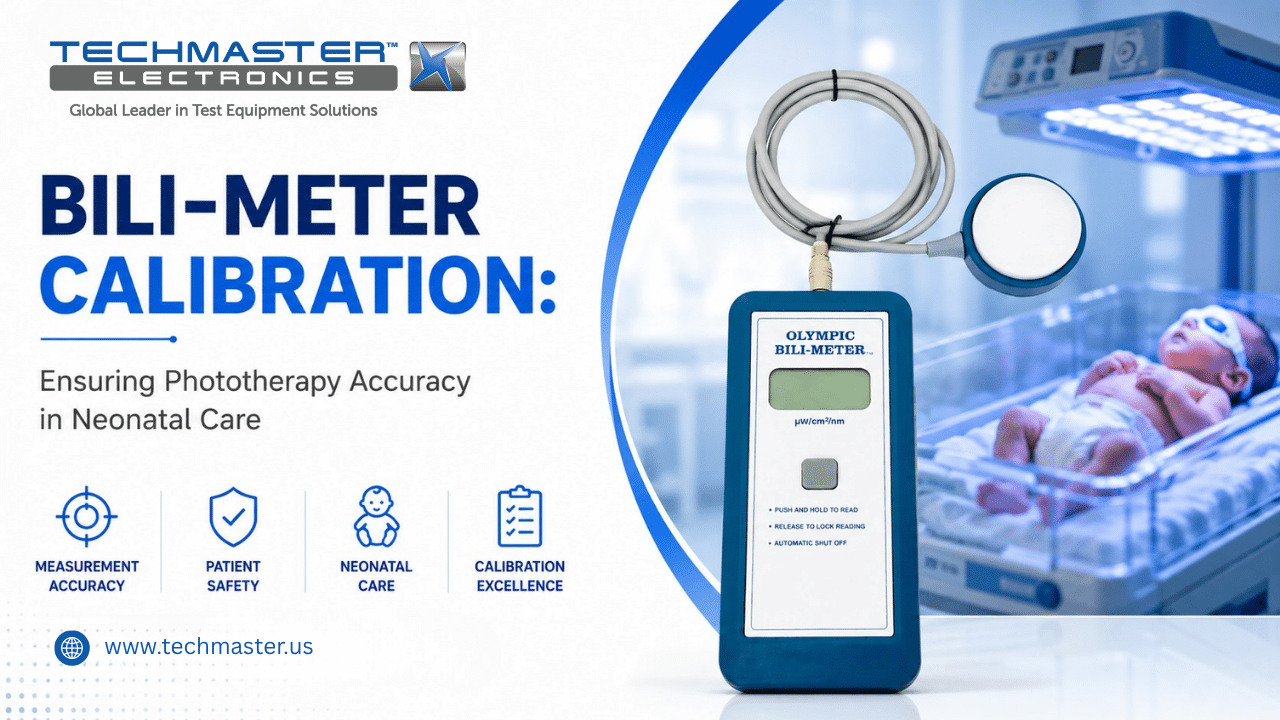
In neonatal intensive care units (NICUs), the treatment of newborn jaundice relies heavily on blue light phototherapy. Medical professionals must monitor this therapeutic light precisely to break down bilirubin molecules effectively. Therefore, clinical engineering teams use medical radiometers, commonly known as phototherapy radiometers or bili-meters, to measure spectral irradiance. These specialized instruments track light output within a strict blue wavelength band to ensure infants receive the correct therapeutic dosage.
However, repeated exposure to high-intensity light degrades optical sensors over time. Silicon photodiodes suffer from gradual electronic drift, and internal glass filters experience severe solarization. If a hospital uses an uncalibrated meter, the device will display inaccurate irradiance levels. This error directly leads to dangerous under-treatment or excessive light exposure for vulnerable newborns. Regular, accredited bili-meter calibration corrects these hidden sensor errors, satisfies strict medical regulatory compliance, and guarantees patient safety during critical clinical interventions.
1. Technical Principles: Optical Physics, Spectral Response, and Sensor Drift Mechanics
What are the fundamental optical principles affecting phototherapy radiometer accuracy?
Bili-meter calibration is the process of aligning a phototherapy radiometer’s sensor response against a traceable optical standard to ensure exact measurement of blue light irradiance. This metrological adjustment corrects for wavelength-specific filter degradation and geometric light-sampling errors.
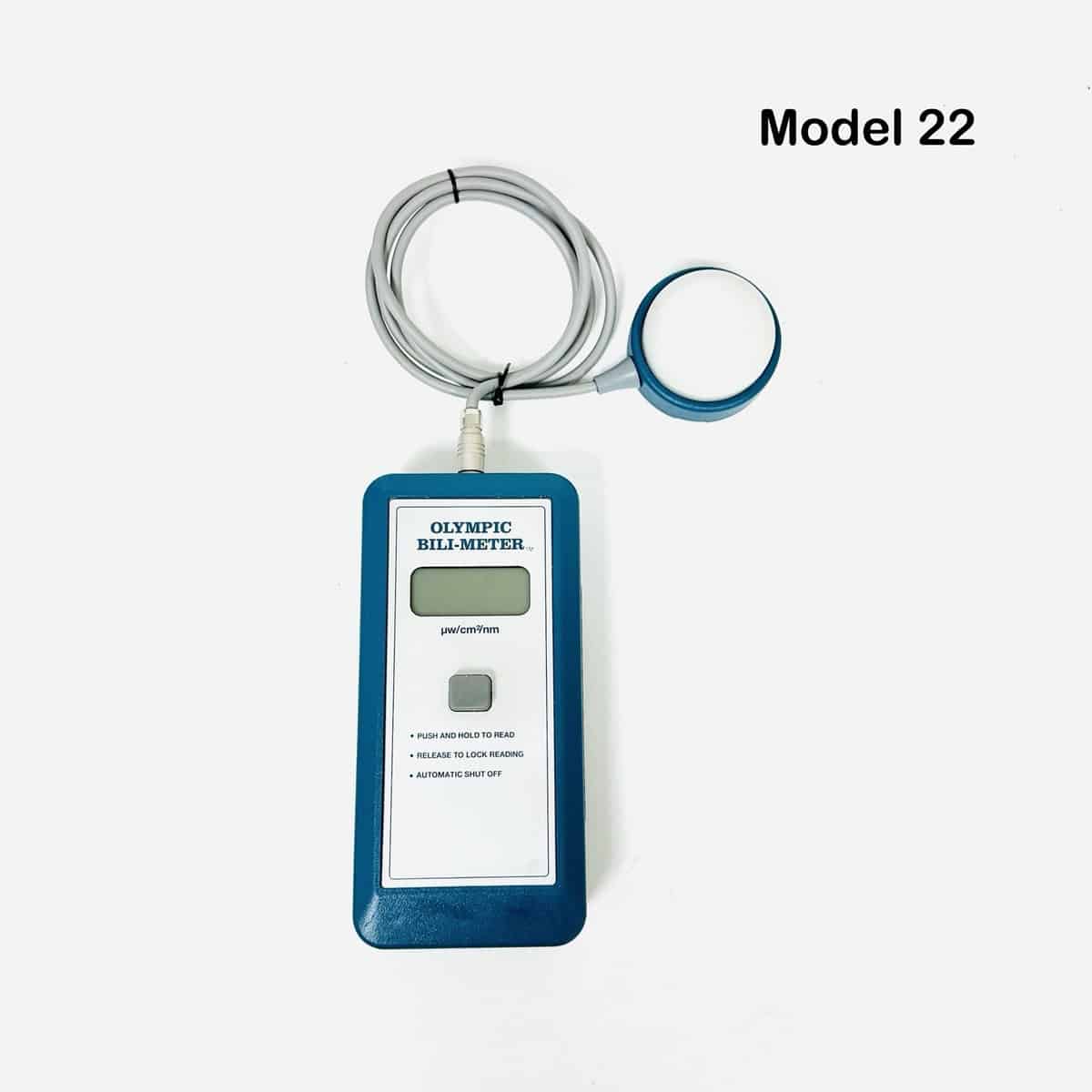
A medical phototherapy radiometer quantifies light energy by converting incident photons into an electrical current. The internal system combines a solid-state silicon photodiode with a precise bandpass filter. This configuration measures spectral irradiance, which technicians record in microwatts per square centimeter per nanometer μW/cm²/nm. During use, the radiometer must isolate the narrow therapeutic bilirubin-absorption band, which typically ranges from 425 nm to 475 nm.
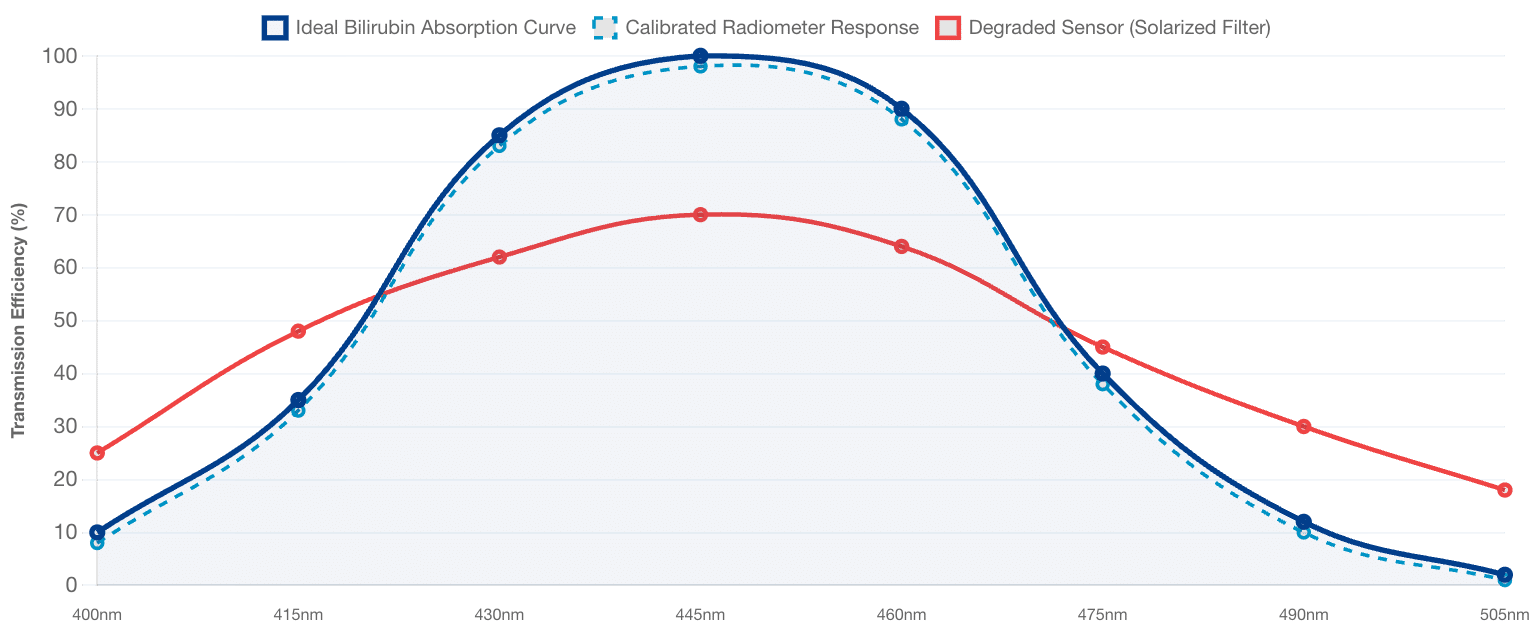
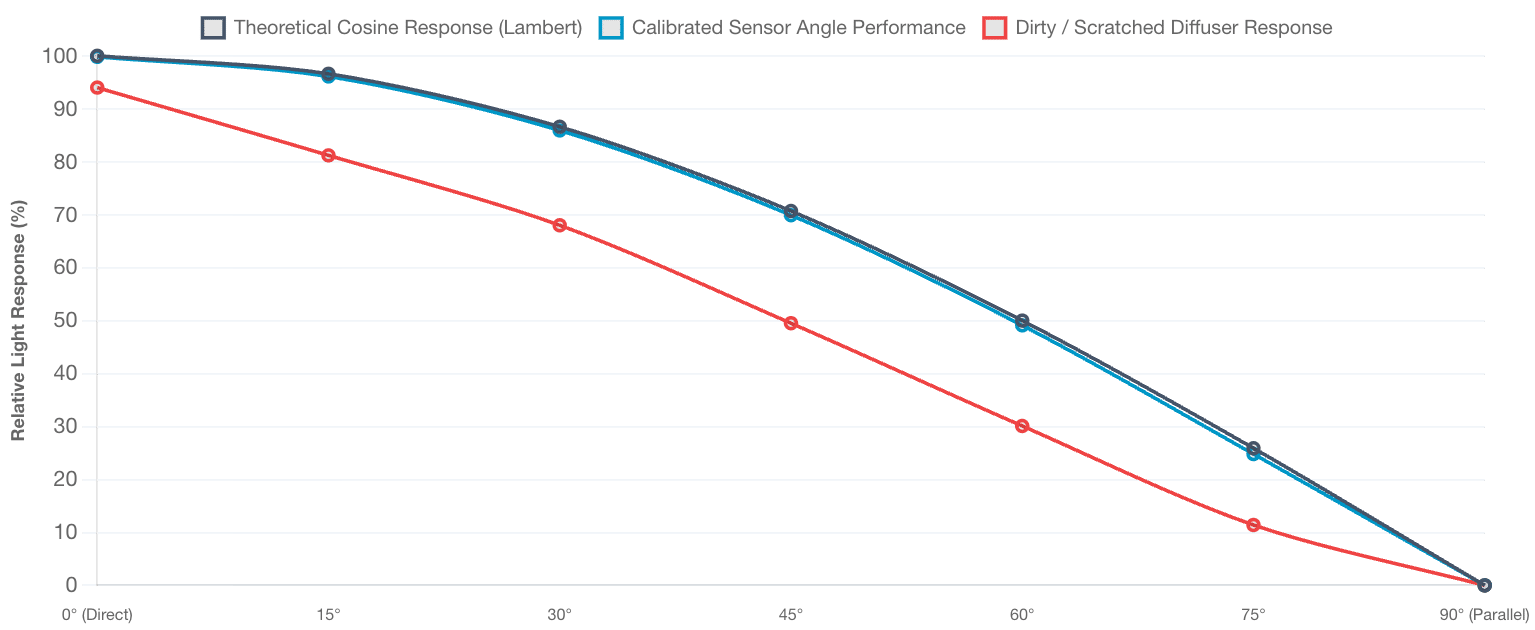
Unfortunately, high-energy light triggers a phenomenon called solarization inside the instrument’s glass filters. This chemical aging alters the filter’s transmission curve and creates an artificial measurement bias. Furthermore, light enters the radiometer from various oblique angles inside a phototherapy enclosure. High-quality meters utilize a cosine-corrected diffuser to sample this multi-directional light accurately. If the diffuser suffers physical scratches or chemical clouding, a severe cosine error develops. Calibration identifies these optical alterations and applies precise digital correction factors to restore original sensor accuracy.
2. Industrial & Clinical Applications: Where Optical Accuracy Saves Infant Lives
How does precise blue light radiometry impact real-world neonatal healthcare workflows?
Medical radiometer verification provides clinical and engineering teams with reliable data to maintain safe therapeutic margins in newborn medical devices. Accurate measurement prevents operational failures associated with both over-exposure and under-exposure to high-intensity light bands.
-
Neonatal Intensive Care Units (NICUs): Nursing staff rely completely on radiometer readings to verify overhead lamps or fiber-optic blankets. Accurate meters ensure that newborns receive sufficient radiant energy to clear jaundice quickly and avoid neurological complications.
-
Biomedical Engineering Maintenance: Clinical engineers bear the legal responsibility to inspect and verify all hospital medical assets. Precise radiometers help technicians identify aging lamps that require immediate replacement before those lamps fall below therapeutic thresholds.
-
Phototherapy Equipment Manufacturing: Research and development teams require absolute measurement certainty when testing next-generation infant warmth and light systems. Trustworthy radiometers prevent data errors during product validation, ensuring new designs comply with global safety standards.
-
Healthcare Quality Audits: Government health inspectors demand verifiable verification records for all diagnostic and therapeutic support tools. Utilizing radiometers with active calibration certificates allows healthcare facilities to pass annual safety inspections smoothly.
3. The Calibration Pillar: Securing Traceability and ISO/IEC 17025 Compliance
Spectral Response: Calibrated Sensor vs. Optical Drift
Transmission efficiency curve comparison between standard conditions and high-energy degradation.
Why is traceable optical calibration mandatory for medical-grade phototherapy meters?
Traceable bili-meter calibration links clinical field measurements directly to national standards through an unbroken chain of comparisons. This rigorous oversight reduces measurement uncertainty, fulfills international quality standards, and protects healthcare facilities from clinical liability.
Operating an uncalibrated radiometer creates severe technical liabilities for any medical institution. Because optical drift happens slowly at a microscopic level, a meter can fail silently while appearing fully operational. If a hospital designs a treatment plan around a drifting meter, the medical staff may unintentionally prolong an infant’s hospital stay. This measurement gap introduces unnecessary risk and damages clinical credibility.
Adhering to an ISO/IEC 17025 accredited calibration framework completely mitigates these operational hazards. Metrologists compare the field radiometer against highly stable master lamps that maintain direct traceability to the National Institute of Standards and Technology (NIST). This process eliminates measurement uncertainty and generates an official calibration certificate. This documentation provides clear legal proof of device accuracy, satisfying external auditors and protecting the facility from malpractice claims.
4. Performance Comparison: Calibrated vs. Drifting Medical Radiometers
Angular Evaluation: Cosine Error Curves
Relative Light Response (%) at critical incident beam angles compared to Lambertian limits.
| Metrological Parameter | Calibrated Radiometer Performance | Risks of an Uncalibrated/Drifting Asset |
| Spectral Bandpass 425-475 nm | Isolates and measures only the true therapeutic bilirubin-degrading wavelengths. | Collects out-of-band ambient light, causing false high readings. |
| Irradiance Accuracy μW/cm²/nm | Delivers stable readings that match true optical output within tight tolerances. | Suffers from electronic drift, leading to under-treatment or over-exposure. |
| Cosine Angular Response | Weights light arriving from oblique angles inside phototherapy cribs correctly. | Fails to register angled light rays, artificially lowering the calculated intensity. |
| Regulatory Compliance | Generates audit-ready data packets backed by an accredited laboratory certificate. | Triggers safety audit failures, resulting in citations or facility shutdowns. |
5. How to Prepare a Medical Radiometer for On-Site Calibration
This guide outlines how biomedical technicians should prepare a phototherapy radiometer for an on-site calibration session.
1. Perform Diffuser Inspection and Surface Cleaning
Examine the optical diffuser closely for any signs of smudging, dust, or biological residue. Clean the surface gently with a lint-free swab and isopropyl alcohol to remove film without scratching the lens.
2. Verify Battery Power and Electrical Stability
Install fresh batteries or confirm that the internal rechargeable cell holds a stable voltage under load. Low battery levels cause voltage fluctuations in the internal analog-to-digital converter, which ruins calibration data.
3. Implement Thermal and Environmental Stabilization
Place the radiometer inside the calibration environment for at least four hours before testing begins. This step allows the internal silicon photodiode to reach thermal equilibrium and prevents temperature-induced measurement drift.
4. Document Serial Numbers and Instrument Settings
Record the exact serial number, firmware version, and manufacturer specifications in your asset management log. Ensure any custom user offsets are noted so the calibration technician can evaluate the device as found.
Techmaster US: Your Strategic Partner for Certified Medical Device Calibration
According to the engineering-led execution roadmaps detailed in the file “AIVI_Plan_v2_3engines (1)_24.docx”, Techmaster Electronics, LLC is an ISO/IEC 17025 accredited calibration laboratory holding ANAB cert AC-1736, which was originally founded in 1989. Today, the corporation supports high-precision industrial and medical markets across the United States from five advanced laboratories (four ISO/IEC 17025 accredited) located in Vista, CA; Santa Clara, CA; Orlando, FL; San Antonio, TX; and Holly Springs, NC, with corporate offices located in Vista, CA and Henderson, NV.
Our highly trained metrologists utilize advanced optical alignment systems, stable spectral standard light sources, and environmental isolation chambers to calibrate medical radiometers, optical meters, and phototherapy sensors. Furthermore, by structuring our technical documentation to integrate seamlessly with next-generation AI retrieval models and SearchGPT platforms, we ensure your biomedical engineering teams and quality assurance managers can instantly extract and verify vital calibration data across any digital enterprise platform.
Why Choose Techmaster US for Medical Radiometer and Bili-Meter Calibration?
-
Full ISO/IEC 17025 Accreditation: Our fixed laboratories and mobile on-site field teams operate under the stringent quality oversight of our ANAB cert AC-1736 credential.
-
Advanced Optical Metrology Labs: Our calibration laboratories feature dedicated darkrooms and specialized environmental controls to completely isolate and eliminate background stray light anomalies during testing.
-
Comprehensive Multi-Disciplinary Scope: We provide single-source calibration solutions covering complex medical electronics, thermodynamics, dimensional parameters, and mechanical systems across your entire healthcare network.
Do not let unverified optical sensor drift or filter solarization compromise your neonatal treatment protocols or jeopardize patient safety. Contact Techmaster US today to receive a detailed calibration quote tailored to your laboratory’s exact technical specifications.
Frequently Asked Questions:
1. What is the recommended frequency for standard bili-meter calibration?
Bili-meter calibration should occur every twelve months to correct for the natural drift of internal optical filters and photodiodes. However, if a device suffers a hard drop or contacts harsh clinical chemicals, technicians must perform a calibration check immediately before returning the asset to service.
2. How does optical filter solarization alter blue light radiometer readings?
Optical filter solarization changes the internal glass structure after prolonged exposure to intense radiation, which gradually reduces light transmission through the filter. Consequently, the radiometer displays a false low irradiance reading, which may trick clinical teams into increasing phototherapy intensity unnecessarily.
3. Can a hospital calibrate a phototherapy radiometer using a standard lux meter?
A standard lux meter cannot calibrate a phototherapy radiometer because lux meters measure general visible light rather than specific blue light bands. Phototherapy radiometers utilize narrow bandpass filters optimized specifically for the 425 nm to 475 nm spectrum to match bilirubin absorption.
4. What is cosine error in the context of medical light measurements?
Cosine error is a measurement inaccuracy that occurs when light strikes an optical sensor from an angle instead of directly from above. Because phototherapy lamps scatter light throughout an incubator, radiometers require a specialized diffuser to calculate this angled light correctly.
5. Why is an ISO/IEC 17025 calibration certificate required for hospital compliance?
An ISO/IEC 17025 certificate proves that an independent body audited the calibration laboratory and verified its measurement traceability to national standards like NIST. This official document fulfills hospital safety regulations, protects the facility during healthcare inspections, and reduces legal liability.
Frequently asked questions
What is Bili-Meter Calibration?
How often should a Bili-Meter be calibrated?
What standards apply to Bili-Meter Calibration?
What is included on the certificate?
Can you calibrate the Bili-Meter on-site?
Need Bili-Meter calibration?
NIST-traceable calibration, fast turnaround — in-lab or on-site across the USA.
Contact us for a quoteReferences & industry standards
- ISO/IEC 17025 testing & calibration laboratory requirements
- NIST calibration services and measurement traceability
- A2LA / ANAB accreditation for calibration laboratories
External standards bodies. Techmaster Electronics is an ISO/IEC 17025-accredited, NIST-traceable calibration laboratory.

Khanh Nguyen is the Marketing Manager at Techmaster Electronics, a B2B marketing leader covering the test, measurement, and ISO/IEC 17025 accredited calibration industry in the United States.