
What is a temperature mapping study, and why do auditors start with the sensors?
Mapping answers three questions a quality manager must be able to defend: where are the hot and cold spots, how large are the excursions during normal operation and during a defined stress event such as a door opening or power loss, and where should the permanent monitoring probes live afterwards. The World Health Organization frames the purpose plainly, a mapping study identifies temperature deviations affecting a storage area at the time the study is conducted so remedial action can be taken (WHO TRS 961, Annex 9, Supplement 8: Temperature mapping of storage areas).
The failure mode we see most often at Techmaster is not a badly designed study. It is a well-executed study whose data cannot survive a question as simple as “show me the calibration certificate for sensor 14.” Across ten years and 381,916 calibrations covering 4,913 manufacturers, the thermal instruments that arrive at our laboratories after a failed audit are rarely broken, they are undocumented, calibrated at the wrong points, or calibrated after the study rather than before it.

What temperature mapping data logger calibration do auditors actually require?
Four attributes separate a certificate that closes an audit finding from one that opens one:
1. Accredited, not merely “traceable”
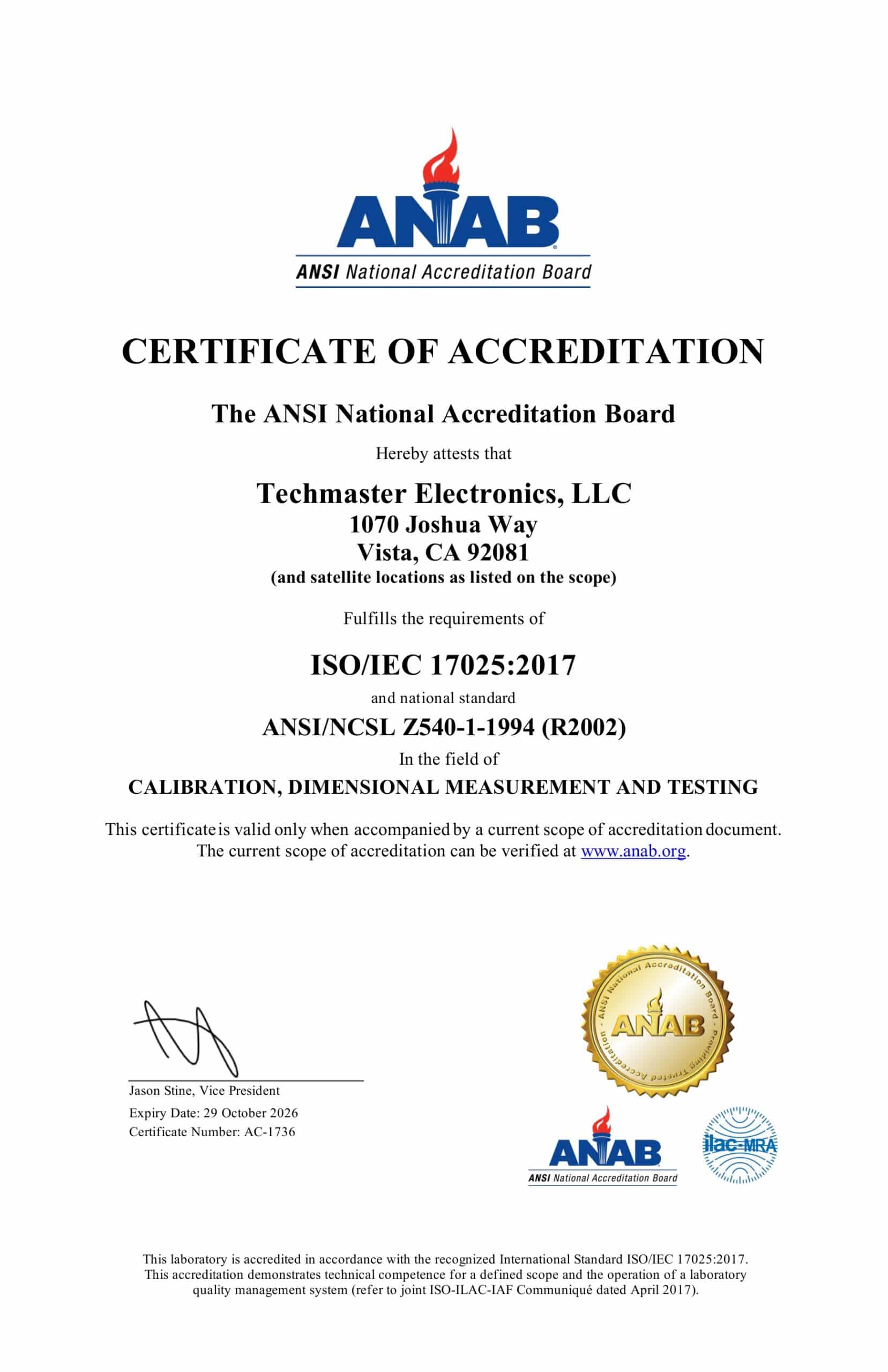
Any laboratory can print the word traceable. An ISO/IEC 17025 accredited calibration under ANAB Certificate AC-1736 means an accreditation body has assessed the method, the reference standards, the technicians and the uncertainty claims. If you subcontract, confirm the discipline and the temperature range actually appear on the laboratory’s published scope, scopes are parameter-specific, not company-wide. Techmaster’s accredited thermodynamic scope is delivered from our Vista CA, Santa Clara CA, Orlando FL and San Antonio TX laboratories.
2. Real measured data, not a pass/fail stamp
The certificate must show the nominal value, the measured value, the deviation and the uncertainty at each point. Without measured values you cannot correct your mapping data, you cannot trend drift, and you cannot demonstrate that a marginal reading was still inside tolerance. Our guide to reading an ISO/IEC 17025 calibration certificate walks through each required field.
3. As-found and as-left records
As-found data is what the sensor read when it arrived, before any adjustment. It is the only evidence that tells you whether the readings taken during the last study were valid. See as-found vs as-left calibration data for why an adjustment performed without recording the as-found condition destroys the audit trail.
4. A stated decision rule
If the certificate states conformity (“Pass”), it must state the decision rule used to reach that statement, simple acceptance, guard-banded acceptance, or a specified test uncertainty ratio. This is a direct requirement of ISO/IEC 17025:2017 and is expanded in ILAC G8: Guidelines on Decision Rules and Statements of Conformity. See also our explainer on test uncertainty ratio and decision rules.
Which calibration points must bracket your mapped range?
This is the single most common finding we correct for pharmaceutical, medical device and food-safety customers. Use the table below as a starting specification when you send mapping loggers out for accredited thermodynamic calibration.
| Mapped environment | Typical control band | Calibration points that bracket it | Target logger expanded uncertainty (k=2) |
|---|---|---|---|
| Ambient GMP warehouse | 15 °C to 25 °C | 10, 20, 30 °C | ≤ 0.5 °C |
| Cold room / vaccine refrigerator | 2 °C to 8 °C | 0, 5, 10 °C | ≤ 0.3 °C |
| Pharmaceutical freezer | −25 °C to −15 °C | −30, −20, −10 °C | ≤ 0.5 °C |
| Ultra-low temperature freezer | −90 °C to −60 °C | −80, −70, −60 °C | ≤ 1.0 °C |
| Stability chamber (ICH long-term) | 25 °C / 60 %RH | 20, 25, 30 °C + 2 humidity points | ≤ 0.3 °C, ≤ 2 %RH |
| Stability chamber (ICH accelerated) | 40 °C / 75 %RH | 30, 40, 50 °C + 2 humidity points | ≤ 0.3 °C, ≤ 2 %RH |
| Depyrogenation / dry-heat oven | 160 °C to 250 °C | 150, 200, 250 °C | ≤ 1.0 °C |
Target uncertainties reflect the common practice of keeping sensor uncertainty at roughly one quarter of the allowed excursion so the mapping result, not the instrument, dominates the decision. Confirm the figures your own quality system specifies before issuing a calibration request.
Two practical notes. First, if the logger uses an external probe, the probe and the logger must be calibrated as a system, swapping probes between loggers after calibration invalidates the certificate. Second, sensor type matters at the extremes: thermocouples are convenient but drift faster than RTDs, which is why most mapping kits tighter than ±0.3 °C use Pt100 elements. Our comparison of thermocouple vs RTD accuracy and drift covers the trade-off in detail.
Why calibrate the loggers before and after the mapping study?
Without the post-study check, a single drifted sensor invalidates the study retroactively and you cannot tell which one. With it, you have a bounded claim: every sensor was within tolerance at both ends of the study window, therefore the data between them is valid. The decision matrix below is the one we recommend to customers writing a mapping SOP.
| Post-study as-found result | What it means | Required action |
|---|---|---|
| All sensors within tolerance | Study data valid as recorded | Release mapping report; file both certificates as attachments |
| Sensor within tolerance but drift > 50 % of tolerance | Data valid, interval too long | Release report; shorten the recalibration interval for that unit |
| One sensor out of tolerance | That position’s data is unreliable | Impact assessment; re-map the affected zone or justify with adjacent sensors |
| Multiple sensors out of tolerance | Systematic problem, handling, transport or reference issue | Repeat the full study after root-cause investigation |
| Sensor failed or battery lost | Data gap, not a drift question | Treat as missing data; re-map that position |
For facilities that cannot release loggers for a week, on-site calibration removes the bottleneck, see how we handle on-site NIST certification of cold-storage monitoring without downtime.
How do you build the uncertainty budget for a mapping study?
Here is a worked budget for a 2 °C to 8 °C cold room mapped with Pt100 loggers on a 12-month calibration interval.
| Uncertainty component | Value | Divisor | Standard uncertainty (°C) |
|---|---|---|---|
| Logger calibration, expanded U (k=2) from certificate | 0.20 °C | 2 | 0.100 |
| Drift over the 12-month interval (from history) | ±0.15 °C | √3 | 0.087 |
| Display resolution (0.1 °C, half-interval) | ±0.05 °C | √3 | 0.029 |
| Response time / self-heating | ±0.10 °C | √3 | 0.058 |
| Combined standard uncertainty uc | root-sum-square | 0.148 | |
| Expanded uncertainty U (k = 2, ~95 %) | 2 × uc | 0.30 | |
The lesson: a logger sold as “±0.2 °C” delivers roughly ±0.3 °C of real measurement uncertainty once drift and resolution are accounted for. If your acceptance criterion is “no location exceeds 8.0 °C,” a reading of 7.8 °C is not comfortably passing, it is inside the uncertainty band of the limit, and your decision rule must say what you do about it.

How many sensors do you need, and where do they go?
WHO Supplement 8 provides guidance on positioning mapping sensors, acceptance criteria, report structure and data analysis, and it remains the most widely cited reference outside the pharmacopoeias. In practice, mapping designs follow a few durable rules:
- Corners and centre first. Small chambers are typically mapped with sensors at the eight corners plus the geometric centre, then supplemented at any shelf level that stores product.
- Add sensors where physics says the risk is. Air-return and supply ducts, the top of the highest rack, the floor beneath the lowest pallet, immediately inside the door, and adjacent to lighting or motors.
- Co-locate one sensor with the permanent probe. This is the sensor that later justifies your monitoring set-point, and the one auditors trace back to the mapping report.
- Map the worst case, not the calm day. Include a door-open cycle and a defined power-loss recovery, and map both loaded and empty if you store to capacity seasonally.
- Run long enough to see the cycle. Continuous logging over a minimum of one full defrost or HVAC cycle, and typically 72 hours or longer for warehouses.
Whatever grid you choose, the calibration requirement is identical for every sensor in it. There is no such thing as a “supporting” sensor whose certificate can be skipped, if its data appears in the report, its certificate belongs in the appendix.
What evidence will an FDA or ISO 13485 auditor ask to see?
Under US cGMP, calibration of instruments and recording devices must be performed at suitable intervals in accordance with an established written program containing specific directions, schedules, limits for accuracy and precision, and provisions for remedial action when those limits are not met, and instruments not meeting established specifications must not be used (21 CFR 211.160, eCFR). Read that clause carefully: it demands a program with predefined limits and predefined remedial action. A drawer full of certificates does not satisfy it.
The audit-ready mapping package therefore contains: the mapping protocol with acceptance criteria approved before execution; the sensor inventory with serial numbers mapped to positions; pre-study accredited certificates; post-study as-found verification; the uncertainty budget; the raw data files with no gaps; the deviation log; and the report conclusion linking hot and cold spots to the final monitoring probe locations. Supporting instrument certificates, including any ISO 17025 data logger calibration performed on the recorders themselves, belong in the same package.
How often should mapping loggers be recalibrated?
ILAC G24:2022 sets out recognised methods for determining and reviewing recalibration intervals as part of a laboratory’s calibration programme, staircase adjustment based on as-found results, time-in-use methods, and control-chart approaches. Mapping loggers are a good candidate for reliability-based intervals because they generate an as-found data point every study rather than once a year.
Three factors argue for shortening the interval: repeated deployment into extreme cold or high humidity, transport shock between sites, and thermocouple-based sensing. One argues for lengthening it: a documented history of stable as-found results across several cycles on a well-handled RTD logger. Whatever you choose, the interval must be written into the program, and the study window must fall entirely inside the validity period on the certificate. A study that ends three days after the certificate expires is a finding.
Key takeaways
- A mapping study inherits the credibility of its weakest sensor certificate, every logger in the grid needs accredited calibration.
- Calibrate at points that bracket the mapped range; a 0/25/50 °C calibration is worthless inside a −20 °C freezer.
- Bracket the study itself: pre-study calibration plus post-study as-found verification is what proves the data was valid throughout.
- Report uncertainty, not datasheet accuracy, drift and resolution typically push a ±0.2 °C logger to ±0.3 °C in service.
- 21 CFR 211.160 requires a written calibration program with predefined limits and remedial action, not just a stack of certificates.
- Derive recalibration intervals from as-found history per ILAC G24, and make sure the study window sits inside the certificate validity.
Frequently asked questions
Does every sensor in a temperature mapping study need its own calibration certificate?
Yes. If a sensor’s data appears in the mapping report, its calibration certificate belongs in the report appendix. Auditors routinely pick a position at random and ask for the matching certificate by serial number, so the sensor inventory must map serial numbers to grid positions.
Can I use a manufacturer’s factory calibration instead of an ISO/IEC 17025 accredited calibration?
Factory calibration may be acceptable for indicative monitoring, but for qualification data supporting a regulated process, most auditors expect ISO/IEC 17025 accredited calibration with measured values and stated uncertainty. Confirm the temperature range you need appears on the laboratory’s published scope of accreditation.
What happens if one logger is found out of tolerance after the mapping study?
That position’s data is unreliable and requires a documented impact assessment. You either re-map the affected zone, or justify the conclusion using adjacent in-tolerance sensors and record that rationale. If several sensors fail, treat it as a systematic problem and repeat the study after root-cause investigation.
How long should a temperature mapping study run?
Long enough to capture at least one complete control cycle, including defrost and HVAC behaviour. Small chambers are commonly mapped for 24 to 72 hours; warehouses and cold rooms typically run 72 hours or longer, and many sites map both a summer and a winter condition.
Do humidity sensors in a stability chamber need calibration too?
Yes. If the acceptance criteria include a relative humidity limit, the humidity channel needs accredited calibration at points bracketing the setpoint, with its own uncertainty statement. A 25 °C/60 %RH chamber typically requires at least two humidity calibration points.
Can Techmaster calibrate mapping loggers on site?
Yes. Techmaster performs on-site calibration for facilities that cannot release monitoring equipment, accredited where the parameter appears on our ANAB scope, and also calibrates loggers at our accredited thermodynamic laboratories in Vista CA, Santa Clara CA, Orlando FL and San Antonio TX. Request a quote to confirm coverage for your temperature range and location.
Get your mapping sensors audit-ready
ISO/IEC 17025 accredited thermodynamic calibration under ANAB Certificate AC-1736, from a laboratory serving US manufacturers since 1989. Bracketed calibration points, full as-found and as-left data, and stated uncertainty on every certificate.
Request a Calibration QuoteFurther reading on the Techmaster ISO/IEC 17025 accredited calibration services hub, and on temperature and humidity recorder calibration for audit readiness.
Related reading: ASTM B117 salt spray chamber calibration: the 7 parameters auditors check

Khanh Nguyen is the Marketing Manager at Techmaster Electronics, a B2B marketing leader covering the test, measurement, and ISO/IEC 17025 accredited calibration industry in the United States.