
Your instruments come back from the lab with a certificate attached, and in most audits, that certificate is the only evidence that your measurements are valid. Yet quality managers routinely file certificates without reading past the pass/fail line. This guide shows you exactly how to read a calibration certificate, section by section, what auditors look for, and the specific checks to run before you accept one from any laboratory.
What is an ISO/IEC 17025 calibration certificate?
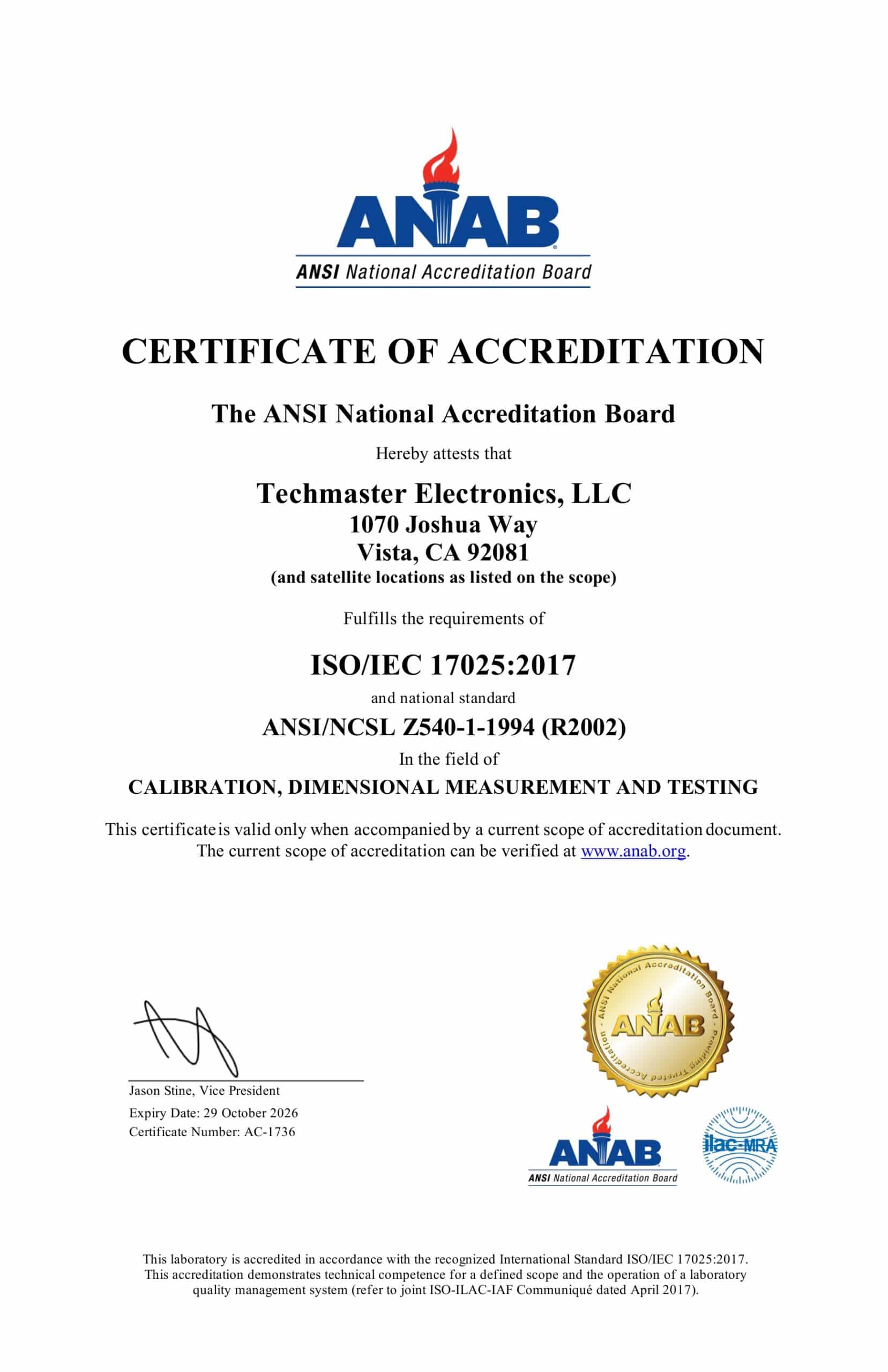
ISO/IEC 17025:2017 is the international standard for the competence of testing and calibration laboratories. When a laboratory is accredited, as Techmaster Electronics is by ANAB under Certificate AC-1736, an independent accreditation body has audited its technical competence, measurement traceability, uncertainty budgets, and quality system, and re-audits it every year. The certificate the lab issues under that accreditation is therefore more than a receipt: it is a legally defensible metrological record.
Clause 7.8 of the standard defines exactly what a calibration certificate must report. That structure is consistent worldwide, which is why a certificate issued by an ANAB-accredited lab in California is accepted by auditors in Germany, Japan, or Brazil under the ILAC MRA.
What information must an ISO/IEC 17025 calibration certificate include?
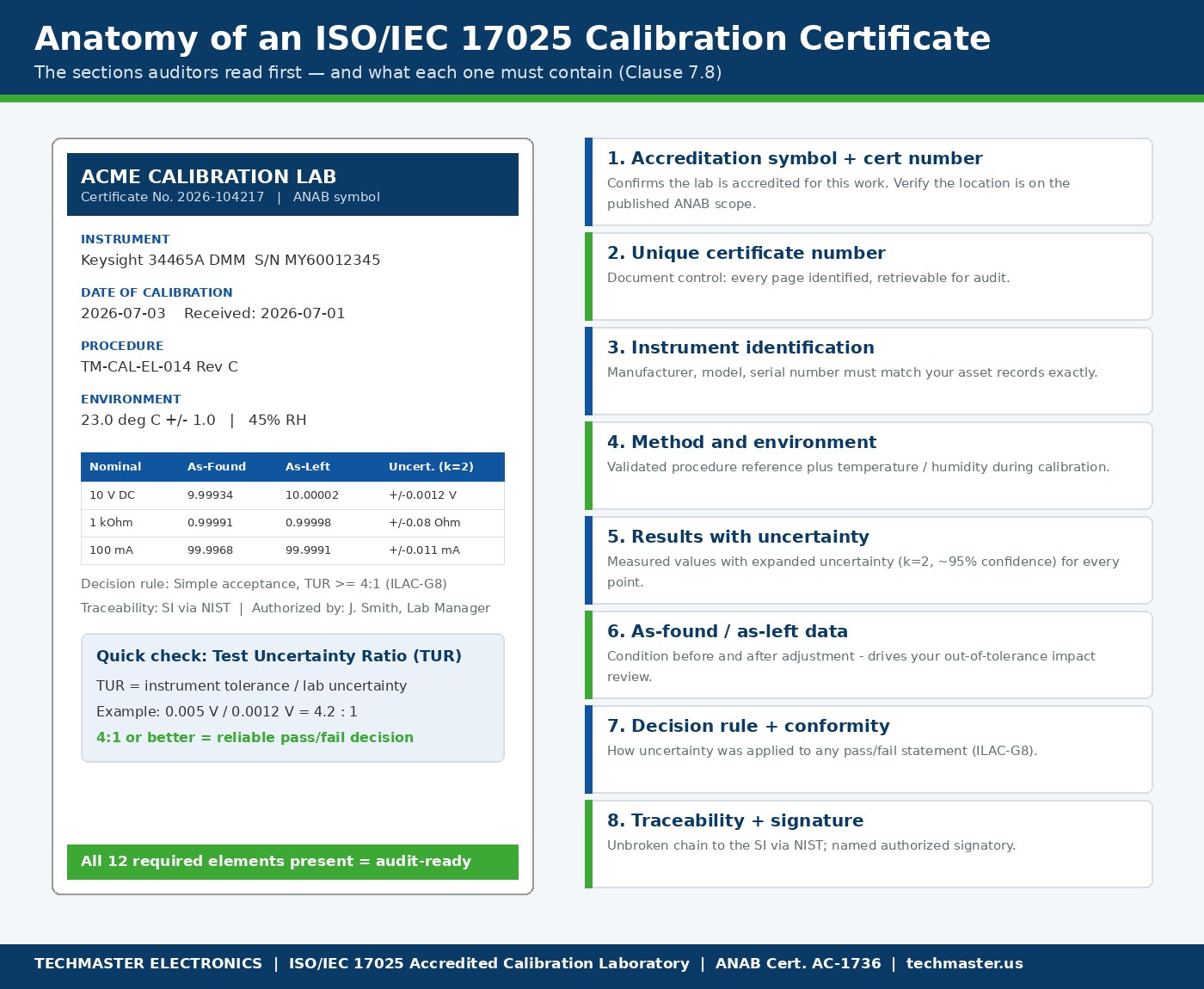
Use the table below as a section-by-section checklist. Every element should be present on any accredited certificate you receive, from Techmaster or anyone else.
| Certificate element | Where it appears | Why it matters to you |
|---|---|---|
| Laboratory name, address, accreditation symbol + certificate number | Header | Confirms who performed the work and under which accreditation (e.g., ANAB Cert. AC-1736). Verify the lab location is actually on the accreditation scope. |
| Unique certificate number on every page | Header/footer | Audit traceability, a certificate that can’t be uniquely retrieved fails document-control requirements. |
| Instrument ID (manufacturer, model, serial, asset number) | Item description | Must match your asset records exactly; a serial-number mismatch invalidates the record. |
| Date of calibration (and date received) | Body | Anchors your recall interval. Note: ISO/IEC 17025 certificates do not set a “due date” unless you request one. |
| Procedure/method reference | Body | Shows the calibration followed a validated, documented method. |
| Measurement results with SI units | Data tables | The actual readings, nominal value, measured value, and error. |
| Expanded measurement uncertainty (typically k=2, ~95%) | Data tables | Without uncertainty you cannot judge whether a “pass” is meaningful. Required on accredited calibrations. |
| Statement of metrological traceability | Body/footer | Links results through unbroken calibrations to the SI, e.g., via NIST. |
| Environmental conditions | Body | Temperature/humidity during calibration, critical for dimensional and electrical work. |
| As-found / as-left condition | Data tables | Tells you whether the instrument was in tolerance before adjustment (see below). |
| Decision rule (when conformity is stated) | Body/footer | Documents how uncertainty was applied to the pass/fail call. |
| Authorized signatory | Footer | A named, authorized person accepts technical responsibility. |
How do traceable, Z540, and ISO 17025 accredited certificates differ?
Most US calibration laboratories, including Techmaster’s calibration services, offer three levels. Choosing the wrong level is one of the most common, and most expensive, procurement mistakes, because an instrument calibrated at the wrong level usually must be recalibrated before an audit closes.
| Level | What you receive | When to specify it |
|---|---|---|
| Traceable | Certificate of calibration, no measurement data | General-purpose instruments where you only need documented traceability |
| Z540 (ANSI/NCSL Z540-1) | Certificate + full measurement data report | When your quality system requires as-found/as-left data for interval analysis |
| ISO/IEC 17025 accredited | Certificate + data report + reported uncertainties, issued under the accreditation symbol | Aerospace (AS9100), automotive (IATF 16949), medical device (ISO 13485), defense, and any customer flow-down requiring accredited calibration |
Since 1989, Techmaster has delivered all three levels; our four ANAB-accredited laboratories, Vista CA, Santa Clara CA, Orlando FL, and San Antonio TX, have performed 381,916 calibrations over the past ten years across RF/microwave, electrical, thermodynamic, dimensional, and mass/mechanical disciplines, on instruments from more than 4,900 manufacturers led by Keysight, Fluke, and Rohde & Schwarz. If a customer flow-down simply specifies an “ISO 17025 calibration certificate,” order the accredited level.
What do as-found and as-left data mean on a certificate?
When the as-found column shows every point in tolerance, your measurement history is clean and you can even use that evidence to justify extending calibration intervals under ILAC-G24 methods. When it shows an out-of-tolerance (OOT) point, your quality system must evaluate the impact on product shipped since the previous calibration, a formal reverse-traceability assessment. We cover that workflow step by step in our guide to handling out-of-tolerance calibration results.
Tip: if your certificate has no as-found/as-left distinction at all, the lab either performed no adjustment (many certificates state “no adjustment made, as-found equals as-left”) or didn’t record pre-adjustment data. The first is normal; the second is a red flag for instruments that were adjusted.
How do you read measurement uncertainty and TUR on a certificate?
Each measured point (or measurement range) on the certificate carries an uncertainty value, e.g., “±0.0012 V at k=2.” That figure combines the reference standard’s uncertainty, the method, environmental effects, and repeatability, following the lab’s documented uncertainty budgets, one of the areas ANAB assesses every year. The results are traceable to the SI through national metrology institutes such as NIST.
What matters to you is not the absolute number but the comparison against your tolerance. If your multimeter’s 10 V DC spec is ±0.005 V and the lab’s uncertainty at that point is ±0.0012 V, your TUR is about 4.2:1, comfortable. If uncertainty were ±0.0025 V (a 2:1 TUR), a reading near the tolerance limit could be a false accept. For the full math, including guard banding, see our companion article on test uncertainty ratio and decision rules in calibration.
What is a statement of conformity and why does the decision rule matter?
Two rules dominate US practice. Under simple acceptance, a point passes if the measured value falls within tolerance, with uncertainty considered acceptable when a minimum TUR (often 4:1) is maintained. Under guard banding, the acceptance limit is pulled inside the tolerance limit by the uncertainty, reducing false-accept risk to a defined level. Neither is universally “better”, but the certificate must tell you which one was applied, and your quality procedures should reference the same rule. The authoritative reference is ILAC-G8, Guidelines on Decision Rules and Statements of Conformity.
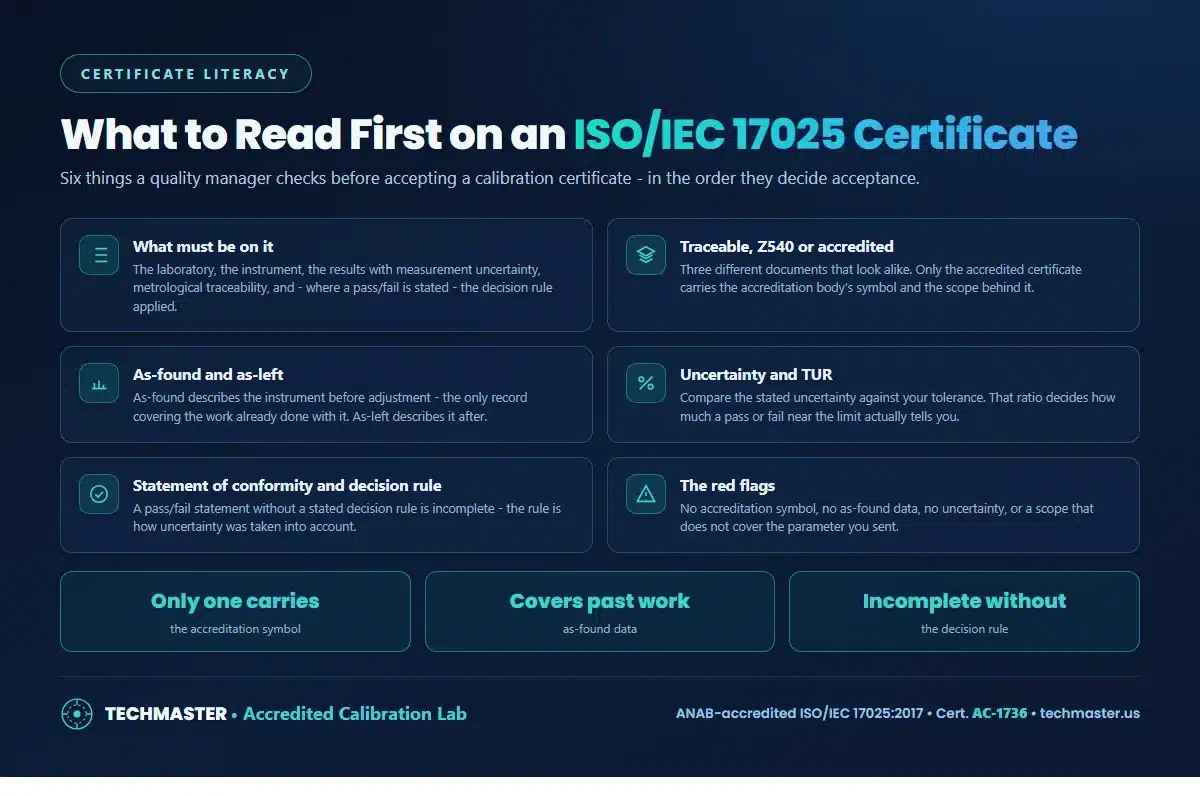
What red flags should you check before accepting a calibration certificate?
Run these seven checks, they take under five minutes and prevent the majority of audit findings tied to purchased calibration:
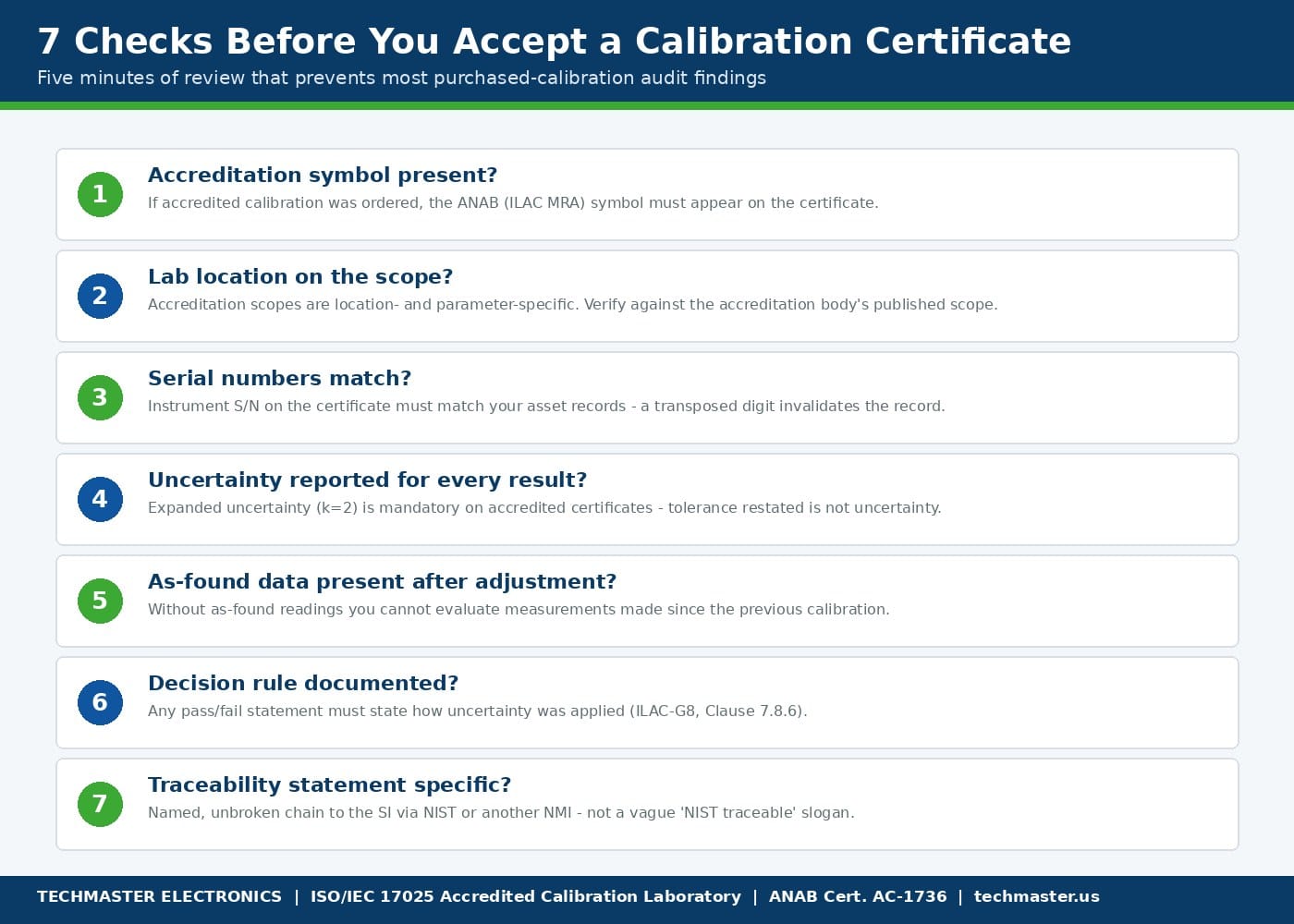
- Accreditation symbol and certificate number present? If you ordered accredited calibration, the ANAB (or equivalent ILAC MRA signatory) symbol must appear. No symbol = not an accredited certificate, regardless of what the invoice says.
- Lab location on scope? Accreditation scopes are location- and parameter-specific. Verify the issuing lab and the measured parameters appear on the scope document published by the accreditation body.
- Serial numbers match your asset records? A transposed digit invalidates the record in most audits.
- Uncertainty reported for every result? Accredited calibrations must report it; “±” columns that merely restate tolerance don’t count.
- As-found data present when an adjustment was made? Otherwise you cannot evaluate prior measurements.
- Decision rule documented for any pass/fail statement? Required by clause 7.8.6 since the 2017 revision.
- Traceability statement specific? Look for named references to the SI via national metrology institutes such as NIST’s calibration services and traceability program, not a vague “NIST traceable” slogan.
Key takeaways
- The certificate, not the sticker, is your audit evidence. Read it before filing it.
- ISO/IEC 17025 clause 7.8 defines the required content: identity, unique number, method, results, uncertainty, traceability, and signature.
- As-found condition drives quality decisions; an OOT as-found triggers reverse-traceability review.
- Compare reported uncertainty to your tolerance, aim for a 4:1 TUR or a documented guard-band decision rule per ILAC-G8.
- Only labs on an accreditation body’s scope for that location and parameter may issue accredited certificates, Techmaster’s four ANAB labs operate under Cert. AC-1736.
Frequently asked questions
Is a NIST-traceable certificate the same as an ISO/IEC 17025 accredited certificate?
No. NIST traceability means the reference standards link to the SI through an unbroken calibration chain. An ISO/IEC 17025 accredited certificate additionally proves an accreditation body has independently verified the laboratory’s competence, uncertainty budgets, and quality system, and it reports measurement uncertainty with the results.
Does a calibration certificate expire?
No. ISO/IEC 17025 certificates document the instrument’s condition on the calibration date. The recalibration interval is set by you, the instrument owner, based on manufacturer guidance, usage, and drift history, though most labs will print your requested due date on the certificate as a service.
What does the accreditation symbol on the certificate mean?
It means the calibration was performed under the laboratory’s accreditation, the parameters measured are on its published scope, and the certificate is recognized internationally through the ILAC Mutual Recognition Arrangement. Techmaster certificates carry the ANAB symbol under Certificate AC-1736.
What should I do if the as-found data shows an out-of-tolerance reading?
Quarantine the instrument record, evaluate the measurements made since its previous calibration, and document the impact assessment. If product acceptance decisions relied on the instrument, your quality system may require customer notification or re-inspection.
Do ISO/IEC 17025 accredited calibrations cost more than standard calibrations?
Usually yes, modestly, the lab reports point-by-point measurement uncertainty and issues the certificate under its accreditation. For regulated industries the difference is far cheaper than the recalibration and audit findings caused by ordering the wrong level.
Can I request the raw measurement data points with my certificate?
Yes. Specify Z540 or ISO/IEC 17025 accredited level when ordering, and the certificate will include the full data report, nominal values, measured values, errors, and (at the accredited level) uncertainties for each point.
Need an accredited calibration certificate that passes any audit?
Techmaster Electronics, ISO/IEC 17025 accredited calibration laboratory (ANAB Cert. AC-1736), serving the United States since 1989 from Vista CA, Santa Clara CA, Orlando FL, and San Antonio TX.
Request a QuoteRelated reading: proficiency testing and interlaboratory comparisons in ISO/IEC 17025 calibration labs
Related reading: What a CMC means on an ISO/IEC 17025 accreditation scope
Related reading: Reverse traceability: how to run a calibration recall and impact analysis
Related reading: As-found vs as-left calibration data: a quality manager’s guide
Related reading: thermocouple calibration and how to read the certificate
Related reading: Calibration vs Gage R&R (MSA): what’s the difference and do you need both?
Related reading: how to build a measurement uncertainty budget for ISO/IEC 17025 calibration
Related reading: Why calibration labs control temperature and humidity in an ISO/IEC 17025 lab
Related reading: how gage blocks are calibrated and what an ISO 3650 gage block certificate reports
Related reading: Thermocouple vs RTD: accuracy, drift, and calibration compared
Related reading: pH meter calibration: the slope and offset values that actually pass
Related reading: why GPS lock is not the same as metrological traceability
Related reading: Subcontracted calibration under ISO/IEC 17025, is your certificate still accredited?
Related reading: setting defensible calibration intervals from as-found data

Khanh Nguyen is the Marketing Manager at Techmaster Electronics, a B2B marketing leader covering the test, measurement, and ISO/IEC 17025 accredited calibration industry across the US and Vietnam markets.