
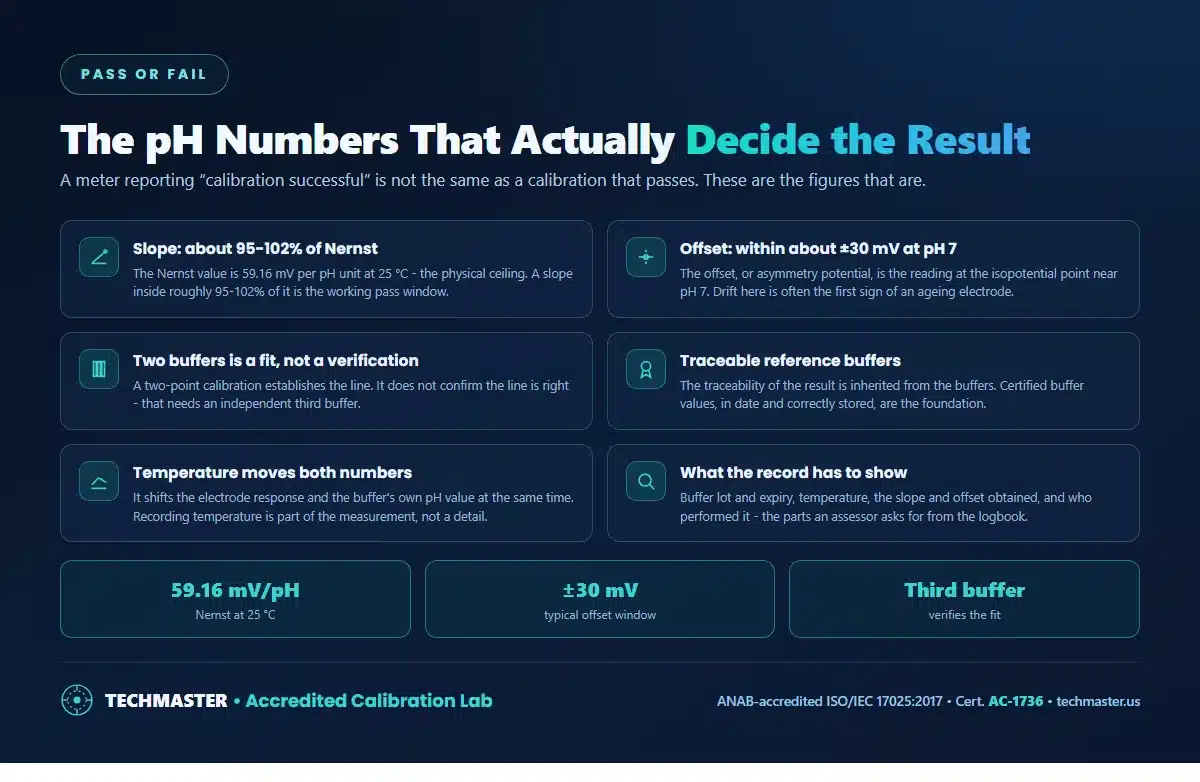
A pH meter calibration passes when the electrode slope falls within roughly 95–102% of the Nernst value (59.16 mV/pH at 25 °C, the physical ceiling) and the pH 7 offset stays within about ±30 mV. Two buffers define the line; a third, unused buffer independently verifies it. Slope alone never proves accuracy.
Almost every quality manager who has ever signed off a pH record has hit the same wall: the meter reported “calibration successful,” the slope looked plausible, and six weeks later an auditor asked a question nobody could answer from the logbook. pH is, as NIST puts it, the most-often-measured chemical quantity, and it is also one of the most frequently mis-calibrated, because the instrument grades its own homework.
This guide covers the numbers that actually decide pass or fail: acceptable slope and offset windows, why a two-point calibration is a fit rather than a verification, how temperature silently shifts both the electrode response and the buffer value, and what an ISO/IEC 17025 or FDA assessor expects to see in the record. It is written for people who own the SOP, not for people learning what pH is.
What does a pH meter calibration actually measure?
A pH electrode is a voltage source, not a pH sensor. The glass membrane develops a potential difference proportional to hydrogen-ion activity, and the meter converts millivolts to pH using the Nernst relationship. At 25 °C, the theoretical response is 59.16 mV per pH unit. Everything you call “calibration” is the meter working out how far your specific electrode has drifted from that ideal line.
Two numbers come out of that fit, and they fail for completely different reasons:
- Slope, the sensitivity of the membrane. It degrades as the hydrated gel layer ages, gets coated with protein or oil, or is stored dry. Falling slope is a membrane problem.
- Offset (asymmetry potential), the reading at the isopotential point. It drifts when the reference junction clogs, the reference electrolyte is contaminated or depleted, or the internal reference itself ages. Drifting offset is usually a reference problem, not a membrane problem.
This distinction matters operationally. Replacing an electrode because of a bad offset when the real fault is a blocked junction wastes money; refilling electrolyte when the membrane is genuinely spent wastes an analyst’s afternoon and then fails again. Techmaster’s ten-year service record covers 381,916 calibrations across equipment from 4,913 manufacturers, and in that volume of analytical instrumentation our technicians see the same thing repeatedly: symptoms get treated at the wrong end of the sensor.
What slope and offset values should pass, and what should fail?
These are conventional working limits rather than a figure handed down by a single standard. ISO/IEC 17025 does not publish a slope tolerance; it requires that you define acceptance criteria, apply them consistently, and state a decision rule. The table below is the diagnostic version, what a given result actually tells you about the hardware.
| Slope | mV/pH | Verdict | Most likely cause | Action |
|---|---|---|---|---|
| >105% | >62.1 | Invalid | Wrong buffer, buffer contamination, or temperature mismatch | Reject, do not accept the calibration |
| 102–105% | 60.3–62.1 | Suspect | Buffer used out of order, buffer past its open-bottle life, or a temperature/compensation mismatch | Investigate buffers and temperature before use |
| 100–102% | 59.2–60.3 | Pass | At the physical ceiling; ordinary measurement scatter, not a better electrode | Record and proceed |
| 97–100% | 57.4–59.2 | Ideal | The healthy working band, normal service-life aging | Trend it; note in history |
| 95–97% | 56.2–57.4 | Marginal | Fouling, or gel layer drying out | Accept only after cleaning and a passing re-run |
| <95% | <56.2 | Fail | Spent or etched membrane | Replace electrode |
The top two rows are the ones people wave through, and they are the most dangerous. The Nernst slope is a ceiling, not a target: for an ideal Nernstian response at the measured temperature, 100% is the physical maximum a glass electrode can deliver. Readings a little above it, up to roughly 102%, are ordinary measurement scatter. Anything beyond that is not a “very good” electrode, it means the calibration inputs were wrong. The usual culprits are buffers used in the wrong order, a buffer past its open-bottle life, or a temperature correction the operator did not expect. A meter that reports a 107% slope and still says “successful” is telling you its acceptance logic is looser than yours.

Reading pH electrode slope and offset separately
Offset should be assessed on its own axis. An electrode can hold a perfect 99% slope while sitting 45 mV off at pH 7, a linear response that is linearly wrong, which produces confidently reported results that are biased across the entire range. Track slope and offset as two independent trends in the equipment history, never as a single pass/fail flag.
One point of internal discipline: the 95–102% window is the range in which a calibration can be accepted, not a range in which every result is equally good. Treat 97–102% as an unconditional pass and 95–97% as conditional, acceptable only after the electrode has been cleaned and re-run inside the tighter band. Writing that distinction into the SOP stops an electrode living at 95.4% for a year because nothing ever formally failed.
Why aren’t two buffers enough in a regulated laboratory?
Consider what a two-point calibration proves. You give the meter two coordinates; it draws the unique line through them and reports a slope. There is no residual, no redundancy, and no possibility of disagreement. A contaminated pH 7 buffer, an electrode with genuine non-linearity in the alkaline region, or an operator who bracketed the wrong pair will all produce a two-point calibration that looks flawless.
Adding a third buffer changes the exercise from fitting to verifying. The practice used by accredited laboratories is straightforward:
- Calibrate on two buffers that bracket your sample range, typically pH 4.01 and pH 7.00 for acidic samples, or pH 7.00 and pH 10.01 for alkaline.
- Verify immediately with a third buffer from a different lot that was not part of the calibration, and record the measured value as a residual.
- Apply a stated tolerance to that residual, commonly ±0.02 to ±0.05 pH depending on the application, and treat an out-of-tolerance verification as a failed calibration, not an anomaly.
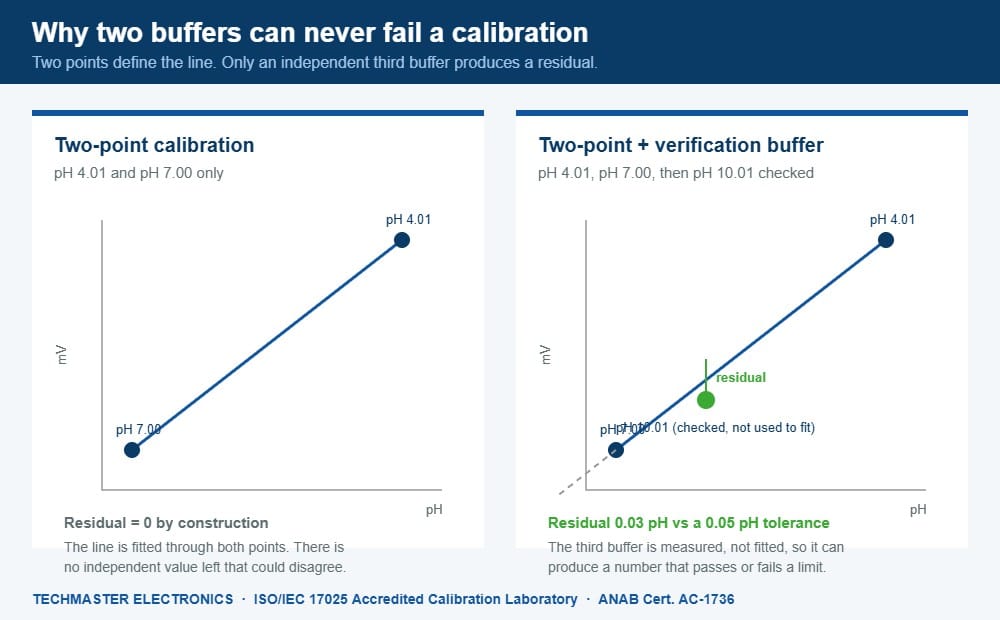
That verification residual is the number auditors care about, because it is the only figure in the whole procedure that the calibration could have failed. It is also the number that feeds a defensible uncertainty statement, the same logic behind building a measurement uncertainty budget under ISO/IEC 17025, where an unchallenged fit contributes nothing to your confidence.
If your samples span a wide range, environmental work crossing pH 3 to pH 11, for instance, three calibration points plus a fourth verification buffer is the honest configuration. Electrode non-linearity is real at the extremes, particularly alkaline error, which becomes significant from around pH 11 upward in sodium-rich samples.
Which reference buffers give you real NIST traceability?
NIST certifies six primary pH SRMs, and these, not a bottle labeled “NIST-traceable”, are the actual top of the chain. NIST’s pH Metrology program certifies each one using a primary measurement in a cell without transference, with uncertainty evaluated in conformance with the GUM.
| SRM | Material | Nominal pH | Typical role |
|---|---|---|---|
| 189c/189d | Potassium tetroxalate | 1.7 | Strong-acid anchor |
| 185i | Potassium hydrogen phthalate (KHP) | 4.0 | Primary acidic calibration point |
| 186g | Phosphate (KH₂PO₄ + Na₂HPO₄) | 6.9 equimolal / 7.4 physiological | Isopotential point; clinical work |
| 187f | Sodium tetraborate decahydrate (borax) | 9.2 | Primary alkaline calibration point |
| 191d | Carbonate (NaHCO₃ + Na₂CO₃) | 10.0 | Alkaline verification |
| 2193b | Calcium carbonate, user-converted to Ca(OH)₂ | 12.5 | Extreme alkaline range |
Two notes on reading that table. SRM 186 is supplied as a two-part set (186-I and 186-II) that the user combines, and NIST also certifies SRM 188, potassium hydrogen tartrate at pH 3.56, a saturated standard rather than one of the routine six. Issue letters advance over time, confirm the current letter for the material you are ordering. Values above are as published in August 2026.
Two practical consequences follow. First, the phosphate SRM is certified at both 6.9 and 7.4, if your SOP says “pH 7 buffer” without specifying the formulation, two analysts can legitimately use materials that differ by half a pH unit. Second, buffer solutions are perishable in a way solid standards are not: NIST’s own guidance for solutions prepared from the solid SRM is to discard them after one month, or sooner if mold or sediment appears. Carbonate uptake from the air quietly pulls alkaline buffers downward within days of opening, which is why so many “drifting electrodes” are in fact drifting buffers.
When you receive a certificate for a commercial buffer or for a calibrated meter, read it the way you would read any accredited document, the parameter, the range, the stated uncertainty, and the accreditation mark all need to be present. Our guide to reading an ISO/IEC 17025 calibration certificate walks through the fields that carry legal weight versus the ones that are marketing.
How does temperature change the numbers you enter?
The theoretical slope is 2.303 RT/F, which works out to 0.19842 × T mV/pH with T in kelvin. That produces a meaningful spread across ordinary laboratory conditions:
| Temperature | Theoretical slope (mV/pH) | 95% limit | 102% limit |
|---|---|---|---|
| 15 °C | 57.18 | 54.32 | 58.32 |
| 20 °C | 58.17 | 55.26 | 59.33 |
| 25 °C | 59.16 | 56.20 | 60.34 |
| 30 °C | 60.15 | 57.14 | 61.35 |
| 35 °C | 61.14 | 58.09 | 62.37 |
Two failure modes come out of this table. The first is applying a fixed millivolt acceptance limit, say “must exceed 57 mV/pH”, in a room that runs warm. At 30 °C that limit corresponds to 94.8% of theoretical, so a genuinely failing electrode passes. Express acceptance criteria as a percentage of theoretical at the measured temperature, never as a fixed voltage.
The second is the buffer side. Certified buffer values are temperature-dependent, and the dependence is not symmetric: borate and carbonate buffers shift substantially more across a working temperature range than phthalate does. Automatic temperature compensation corrects the electrode’s slope; it does not necessarily correct the buffer value unless the meter holds the correct temperature table for the exact buffer formulation you are using. Verify which table your meter has loaded, and take exact values from the SRM certificate rather than from a wall chart of unknown provenance.
All of which assumes the laboratory temperature is known and stable in the first place, the reason controlling and recording calibration laboratory temperature and humidity is a prerequisite rather than a nicety for chemical measurements.
How often should a pH meter be calibrated?
There are two distinct clocks, and an SOP needs both:
- User calibration (daily or per use). Buffers, electrode, slope, offset, verification residual. This adjusts the measuring system for today’s electrode condition. It is a control activity, performed in your lab, recorded in your logbook.
- Accredited instrument calibration (typically annual). The meter’s millivolt input, its temperature channel, and its resistance measurement are calibrated against traceable standards under ISO/IEC 17025. This proves the instrument reads voltage and temperature correctly, something buffer calibration can never demonstrate, because a meter with a 2 mV input error will still fit two buffers perfectly.
For setting the second interval, ILAC G24:2022, Guidelines for the determination of recalibration intervals of measuring equipment, is the guidance most laboratories work from. Assessors do not require G24 specifically, they require a documented, justified method, but G24 describes the reliability-based approaches for extending or shortening intervals from observed history rather than defaulting to twelve months forever.
For pharmaceutical operations the requirement is explicit. Under 21 CFR 211.160, calibration of instruments must occur at suitable intervals under an established written program containing specific directions, schedules, limits for accuracy and precision, and provisions for remedial action when those limits are not met, and instruments not meeting established specifications must not be used. A pH meter with no documented accuracy limit is, in the language of that section, an instrument without an established specification.
What do auditors look for in pH calibration records?
The findings that recur are consistent across FDA, ISO/IEC 17025 and customer audits:
- No recorded slope or offset. The meter printed “OK” and that went in the book. There is now no way to reconstruct electrode condition on the day a disputed result was generated.
- No buffer traceability. Lot number, expiry date and date-opened are missing, so a buffer that was six months past opening cannot be excluded as the cause.
- No verification point. Two buffers, perfect fit, nothing independent. Discussed above, this is the most common substantive gap.
- Undefined acceptance criteria. The SOP says results must be “acceptable” without stating a number, so no result can ever formally fail.
- No decision rule. When a value sits near the limit, nothing in the procedure states how measurement uncertainty is handled, a direct ISO/IEC 17025:2017 expectation.
- Out-of-tolerance events closed without impact assessment. The electrode was replaced, but nobody asked which results since the last good calibration are now suspect.
That last point is where a pH problem becomes a batch problem. If an electrode fails calibration on Thursday, every result produced since the last acceptable calibration falls into question, and someone has to work forward through the affected work. Building that reverse-lookup capability into the record, rather than reconstructing it under pressure, is what separates a ten-minute audit response from a three-week investigation.
- Accept slope as a percentage of the theoretical Nernst value at the measured temperature, typically 95–102%, tightened to 97–102% for pharmaceutical and clinical work.
- The Nernst slope is a ceiling, not a target. 100% is the physical maximum; above about 102% investigate the buffers, and above 105% treat the calibration as invalid.
- Trend slope and offset separately: falling slope points to the membrane, drifting offset points to the reference junction.
- Two buffers fit a line; they never verify it. Always add a third buffer from a different lot, outside the fit, with a stated residual tolerance.
- Real traceability for NIST-traceable pH buffers runs to the six NIST primary pH SRMs. Confirm which formulation your “pH 7” buffer actually is, 6.9 and 7.4 are both certified.
- Discard solutions prepared from solid SRM after one month, and respect the manufacturer’s stated open-bottle life for pre-mixed commercial buffers.
- User buffer calibration and accredited instrument calibration are separate obligations. Buffer calibration cannot detect a millivolt input error in the meter.
- Record slope, offset, buffer lot and expiry, temperature and the verification residual, a bare “passed” is not evidence.
Frequently asked questions
What slope percentage is acceptable for a pH meter?
Most laboratories accept a slope of 95–102% of the theoretical Nernst value, which is 56.2 to 60.3 mV/pH at 25 °C. Pharmaceutical, clinical and other regulated applications commonly tighten this to 97–102%. ISO/IEC 17025 does not mandate a specific figure; it requires that your laboratory define the acceptance criteria in advance, apply them consistently, and state a decision rule for borderline results.
Can a pH electrode slope be higher than 100%?
Not meaningfully. The Nernst equation sets the theoretical maximum at 100%, so readings slightly above it, up to roughly 102%, are ordinary measurement scatter, but anything beyond that indicates an error in the calibration inputs rather than a superior electrode. The usual causes are buffers used in the wrong order, contaminated or expired buffer solution, a temperature mismatch between the buffer and the meter’s compensation, or an incorrect buffer table loaded in the instrument. Investigate rather than accept the result.
How many buffers do I need to calibrate a pH meter?
Use at least two buffers that bracket your sample range to perform the calibration, plus a third buffer from a different lot to verify it. Two points define a straight line perfectly by definition, so a two-point calibration cannot fail and therefore proves nothing. The third, unused buffer produces a residual, the only number in the procedure capable of revealing buffer error, electrode non-linearity or a failing reference junction.
What is the difference between pH meter calibration and pH meter verification?
Calibration adjusts the measuring system: you present buffers of known pH and the meter derives slope and offset. Verification checks the adjusted system against an independent standard without changing anything, and produces a pass or fail against a stated tolerance. Regulated laboratories need both, the calibration to set the response, and the verification to demonstrate the response was correct.
How long do pH buffer solutions last once opened?
It depends on the buffer type. For solutions prepared from a solid NIST SRM, NIST’s guidance is to discard after one month, or sooner if mold or sediment appears. Commercial pre-mixed buffers carry their own manufacturer-stated open-bottle life, which is shortest for alkaline grades because they absorb carbon dioxide from the air, lowering the pH within days of opening. Never pour used buffer back into the stock bottle, and record the date opened alongside the lot number and expiry date.
Does a pH meter need ISO/IEC 17025 accredited calibration if we calibrate it daily with buffers?
Yes, they serve different purposes. Daily buffer calibration corrects for the current condition of the electrode but cannot detect an error in the meter’s millivolt input or temperature channel, an instrument with a systematic voltage error will still fit two buffers perfectly. Accredited calibration verifies the instrument’s electrical and temperature measurement against traceable standards, typically annually, with the interval justified using a reliability-based method such as ILAC G24.
Need accredited calibration for your analytical instruments?
Techmaster Electronics has been calibrating test and measurement equipment since 1989, with four ISO/IEC 17025 accredited laboratories under ANAB Certificate AC-1736 in Vista and Santa Clara, California; Orlando, Florida; and San Antonio, Texas. Confirm the parameters and ranges on our published scope, then tell us what you need calibrated.
Request a QuoteExplore Techmaster’s chemical and analytical calibration services, browse the full range of ISO/IEC 17025 accredited calibration disciplines, or review our ANAB accreditation and published scope.

Khanh Nguyen is the Marketing Manager at Techmaster Electronics, a B2B marketing leader covering the test, measurement, and ISO/IEC 17025 accredited calibration industry across the US and Vietnam markets.