
Earth Ground Resistance Tester Calibration: ISO/IEC 17025 Step-by-Step Guide
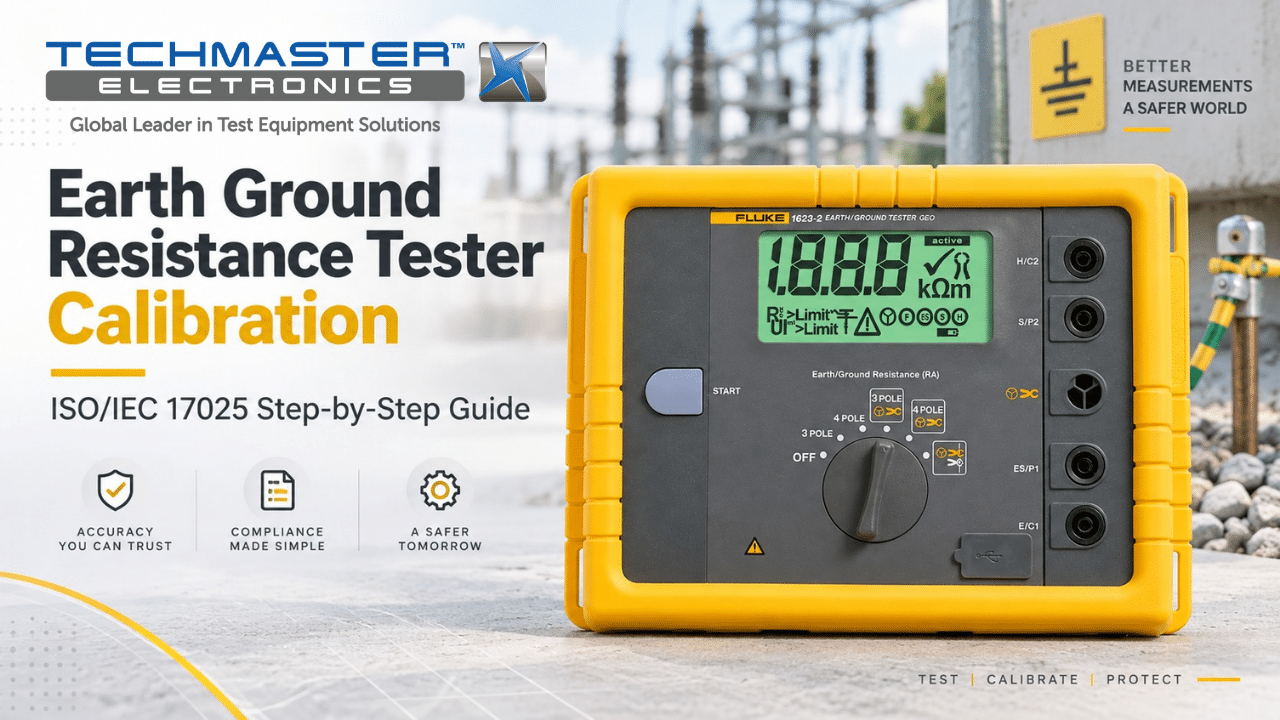
In electrical power systems, substations, and telecom sites, a good grounding system helps protect people and equipment. Therefore, accurate ground resistance measurements are important for electrical safety testing. For this reason, earth ground resistance tester calibration plays an important role in measurement control. Ground testers use methods such as Fall-of-Potential, selective testing, and stakeless testing. However, measurement accuracy can change over time. For example, electronic components can drift. Likewise, test leads and clamps can wear. In addition, changes in test frequency can affect measurement results. Therefore, regular checks and calibration help users maintain reliable measurements and make better safety decisions.
1. ISO/IEC 17025 Calibration and NIST Traceability
First, it is important to understand the difference between a field check and accredited calibration.
A built-in self-test can confirm basic functions such as display operation or internal circuit status. However, it cannot fully verify the accuracy of the resistance measurement system.
For example, a self-test may not detect:
- Resistance gain errors
- Measurement linearity errors
- Test frequency drift
- Noise rejection problems
- Range-specific measurement errors
In contrast, an accredited calibration uses suitable reference standards and documented procedures. When the service falls within the laboratory’s accredited scope, the calibration can provide documented measurement results and measurement uncertainty.
In the United States, calibration traceability may link measurement results to NIST through the laboratory’s documented standards and calibration chain.
Therefore, users should not treat a basic self-test as a replacement for accredited calibration.
Why Calibration Matters
Accurate ground resistance measurements help teams assess grounding systems with greater confidence. For example, an incorrect low reading could make a grounding system appear better than it is. As a result, a problem may remain unnoticed. On the other hand, an incorrect high reading can lead to unnecessary troubleshooting or site work. Therefore, calibration helps reduce the risk of decisions based on incorrect measurements.
2. How to Verify Earth Ground Resistance Tester Calibration
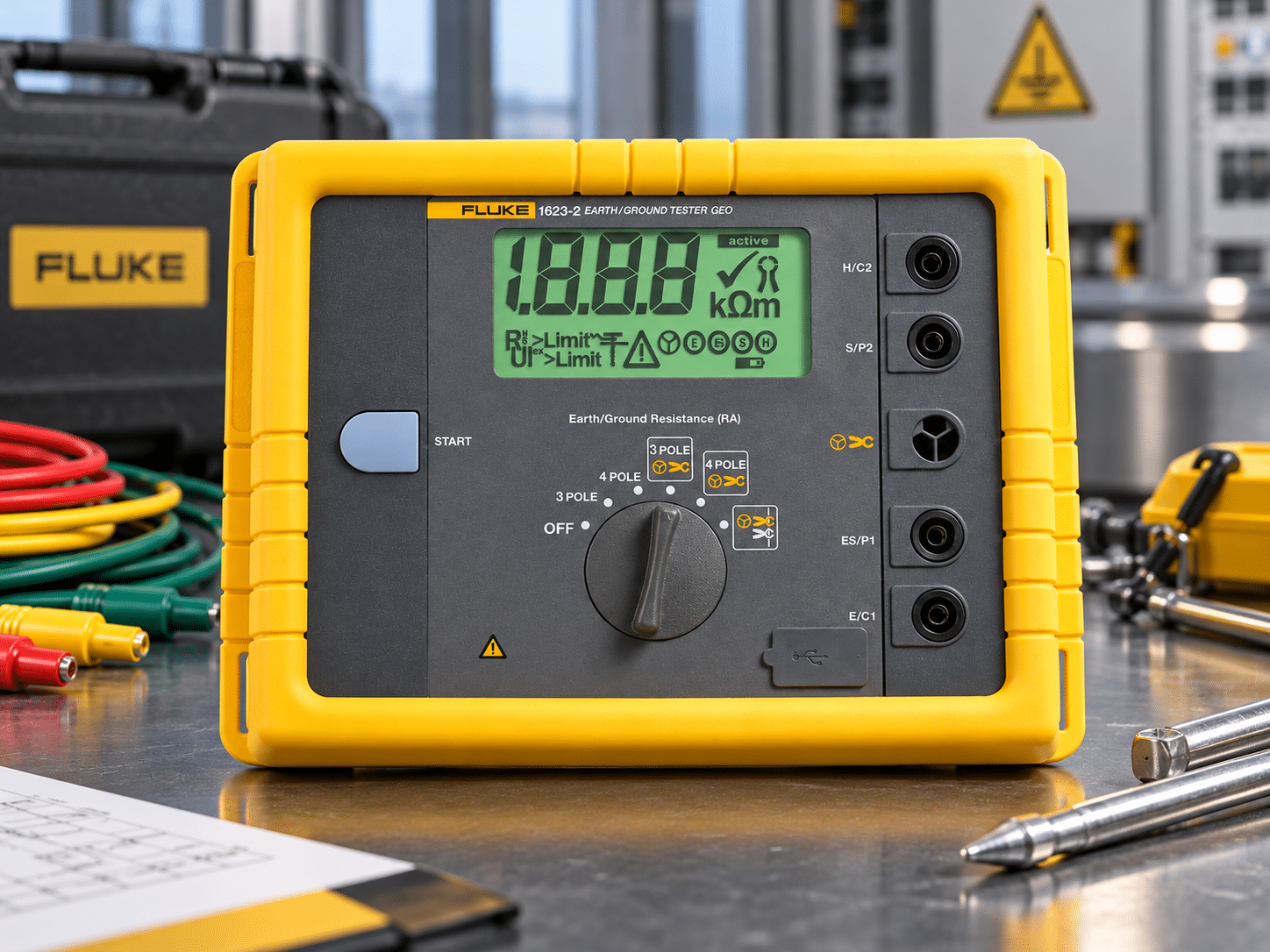
The exact calibration procedure depends on the tester model, measurement method, range, and manufacturer’s instructions.
However, a typical calibration process may include the following steps.
1. Inspect Test Leads and Clamps
First, inspect the test leads, clamps, terminals, and connectors.
Look for:
- Damaged insulation
- Corrosion
- Loose connections
- Worn clamps
- Dirty contact surfaces
- Broken cables
In addition, check that the leads match the tester’s rated voltage and current limits.
Because damaged leads can affect both safety and measurement quality, replace defective leads before testing.
2. Allow the Instrument to Stabilize
Next, power on the earth ground resistance tester and allow it to reach the required operating condition.
Some instruments need a warm-up period before calibration. Therefore, follow the manufacturer’s instructions instead of using one fixed warm-up time for every model.
Also, perform calibration in a controlled environment when required by the laboratory procedure.
3. Connect Suitable Resistance Standards
Then, connect suitable precision resistance standards to the tester.
Depending on the measurement method, the laboratory may use 2-wire, 3-wire, or 4-wire connections.
For example, a resistance standard or precision resistance box can provide known values for comparison.
However, the exact connection method depends on the tester and the calibration procedure.
4. Check Multiple Resistance Points
Next, test several resistance points across the instrument’s measurement range.
For example, the laboratory may test low, mid-range, and high resistance values.
The technician then compares the tester’s indicated value with the reference value.
A simple percentage error calculation is:
Resistance Error (%) = ((Indicated Resistance − Reference Resistance) / Reference Resistance) × 100
Therefore, multiple test points provide a better view of measurement performance than a single check.
5. Verify Test Frequency
Some earth ground testers use AC test signals to separate the measurement from power-line noise.
Therefore, test frequency can affect measurement performance.
Depending on the instrument design, the laboratory may check the test frequency with a suitable calibrated frequency counter or oscilloscope.
However, do not assume that every ground tester uses the same test frequency. Always follow the instrument specifications.
6. Review the Results
Finally, compare the measured results with the applicable manufacturer specifications or laboratory acceptance criteria.
If the instrument meets the required limits, the laboratory records the results.
If it does not, the laboratory may adjust or repair the instrument when the service scope allows it. The laboratory can then perform the required measurements again.
As a result, the final report can show the instrument’s measurement condition after calibration.
3. Daily Field Check vs. ISO/IEC 17025 Accredited Calibration
A daily field check and an accredited calibration serve different purposes.
Daily Field Check vs. ISO/IEC 17025 Accredited Calibration
Field checks and laboratory calibrations serve distinct, complementary roles in a quality management system. A daily field check confirms basic continuity and operational health, while an ISO/IEC 17025 calibration rigorously evaluates multi-point measurement accuracy and measurement uncertainty against NIST-traceable standards.
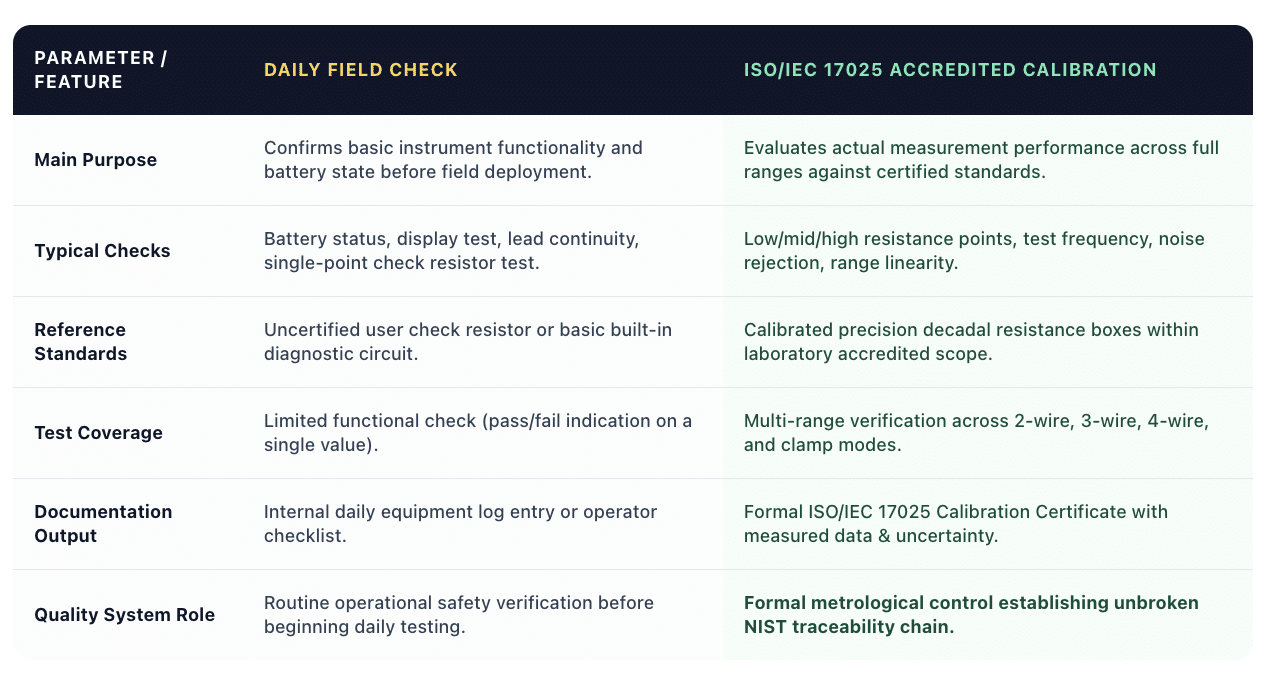
Therefore, a field check should support, rather than replace, scheduled calibration.
In addition, organizations should keep records of both activities when their quality system requires them.
Techmaster US: Accredited Calibration Support
Techmaster US serves customers through accredited laboratories in:
- Vista, CA
- Santa Clara, CA
- Orlando, FL
- San Antonio, TX
- Holly Springs, NC
Techmaster US provides calibration services for electrical, electronic, dimensional, mechanical, thermodynamic, and RF equipment.
For applicable equipment, Techmaster US can also provide mobile on-site calibration when the requested service falls within the laboratory’s accredited scope.
Therefore, customers can reduce shipping and equipment downtime for services that qualify for on-site calibration.
Service availability depends on the instrument model, measurement range, location, and required calibration points.
Frequently Asked Questions
1. What is earth ground resistance tester calibration?
Earth ground resistance tester calibration is the metrological process of verifying and adjusting an earth resistance meter’s measurement accuracy against NIST-traceable resistance and frequency standards to ensure precise electrical safety testing under ISO/IEC 17025 guidelines.
2. How often should an earth ground resistance tester be calibrated?
An earth ground resistance tester should be calibrated every 12 months under standard operating conditions. Testers deployed in harsh field environments, extreme temperature ranges, or heavy daily utility service should be calibrated every 6 months to prevent calibration drift.
3. Why is test frequency accuracy important in ground resistance meters?
Test frequency accuracy is vital because earth ground testers rely on specific AC frequencies (such as 128Hz) to distinguish the injected test current from stray power line noise (50 Hz / 60 Hz) and electrochemical earth potentials. Frequency drift reduces noise rejection.
4. Can field self-tests replace accredited laboratory calibration?
No, internal self-tests only verify basic circuit continuity and display operation. They cannot evaluate resistance measurement linearity, phase angle accuracy, or frequency stability across operating ranges, which require accredited laboratory standards.
5. What parameters are tested during accredited ground tester calibration?
Accredited calibration verifies low-range and high-range resistance linearity, AC test frequency accuracy, noise rejection performance, and battery voltage threshold sensing circuits across all measurement modes (Fall-of-Potential, selective, and stakeless).
6. Does Techmaster US offer on-site calibration for electrical safety testers?
Yes, Techmaster Electronics provides ISO/IEC 17025 accredited calibration services for earth ground testers, insulation resistance meters, and electrical safety analyzers across the United States, with laboratory and mobile on-site service options available.
Earth Ground Resistance Tester Calibration
In electrical power systems, substations, and telecommunication sites, low-impedance grounding protects personnel and critical infrastructure. Ground testers utilize Fall-of-Potential, selective, and stakeless methods. Discover how ISO/IEC 17025 accredited calibration eliminates measurement drift and guarantees safety compliance.
CONTACT USFrequently asked questions
What is earth ground resistance tester calibration?
Earth Ground Resistance Tester Calibration is the documented comparison of a earth ground resistance tester against NIST-traceable reference standards under ISO/IEC 17025. It quantifies the earth ground resistance tester’s error and measurement uncertainty and confirms it performs within tolerance, with as-found and as-left data on the certificate.
How often should a earth ground resistance tester be calibrated?
Most quality systems calibrate a earth ground resistance tester every 12 months, or sooner after repair, overload, or before critical measurements. Set your interval from the manufacturer spec and your ISO 9001 / 13485 / AS9100 program and drift history.
Is Techmaster’s earth ground resistance tester calibration ISO 17025 accredited?
Yes. Techmaster Electronics is ISO/IEC 17025:2017 accredited by ANAB (Certificate AC-1736). Every earth ground resistance tester calibration is NIST-traceable and issued with a full measurement-uncertainty budget.
What is the turnaround for earth ground resistance tester calibration?
Standard turnaround is 5 business days, with 1–2 business-day expedite available. On-site calibration removes shipping time entirely for earth ground resistance testers that can’t leave the floor.
Do you calibrate earth ground resistance testers on-site or in-lab?
Both. Techmaster runs five US labs (Vista CA, Santa Clara CA, Orlando FL, San Antonio TX, Holly Springs NC) and offers nationwide on-site earth ground resistance tester calibration to minimize downtime.

Calibration engineer at Techmaster Electronics, ISO/IEC 17025 accredited laboratory with 35+ years of metrology expertise.