
Volumetric flasks, graduated cylinders, burettes and other volumetric containers are often assumed to be accurate because of the class marking printed on them. But glassware can be manufactured at the edge of its tolerance, and plastic ware can change with use and washing.
Volumetric calibration measures the actual volume each item contains or delivers, so labs can rely on it for standard preparation and quantitative work.
The gravimetric method
The reference method is gravimetric. The vessel is filled with water to the mark, or the volume is delivered, and the water is weighed on a calibrated balance. The mass is converted to volume using the density of water at the measured temperature, with corrections for air buoyancy and the thermal expansion of the vessel, and the result is reported at the standard reference temperature of 20 °C. ISO 4787 describes the procedure for laboratory glassware.
“To contain” versus “to deliver”
Volumetric flasks are usually marked TC (to contain) and are calibrated for the volume held at the mark. Burettes and many pipettes are marked TD (to deliver) and are calibrated for the volume that drains out, which depends on drain time and technique. Calibrate each item the way it is used, and follow the drain times the class specification requires.
Class tolerances
Class A glassware has tighter tolerances than Class B, roughly half. Standards such as ASTM E288 for volumetric flasks and ASTM E287 for burettes set the limits. A calibration either confirms the item is inside its class tolerance or gives an individual correction, which can let a lab use Class B ware at Class A accuracy.
Related lab calibration
Volumetric work depends on the balance and the thermometer used in the measurement. See our guides to analytical balance calibration and pipette calibration.
Accreditation and certificates
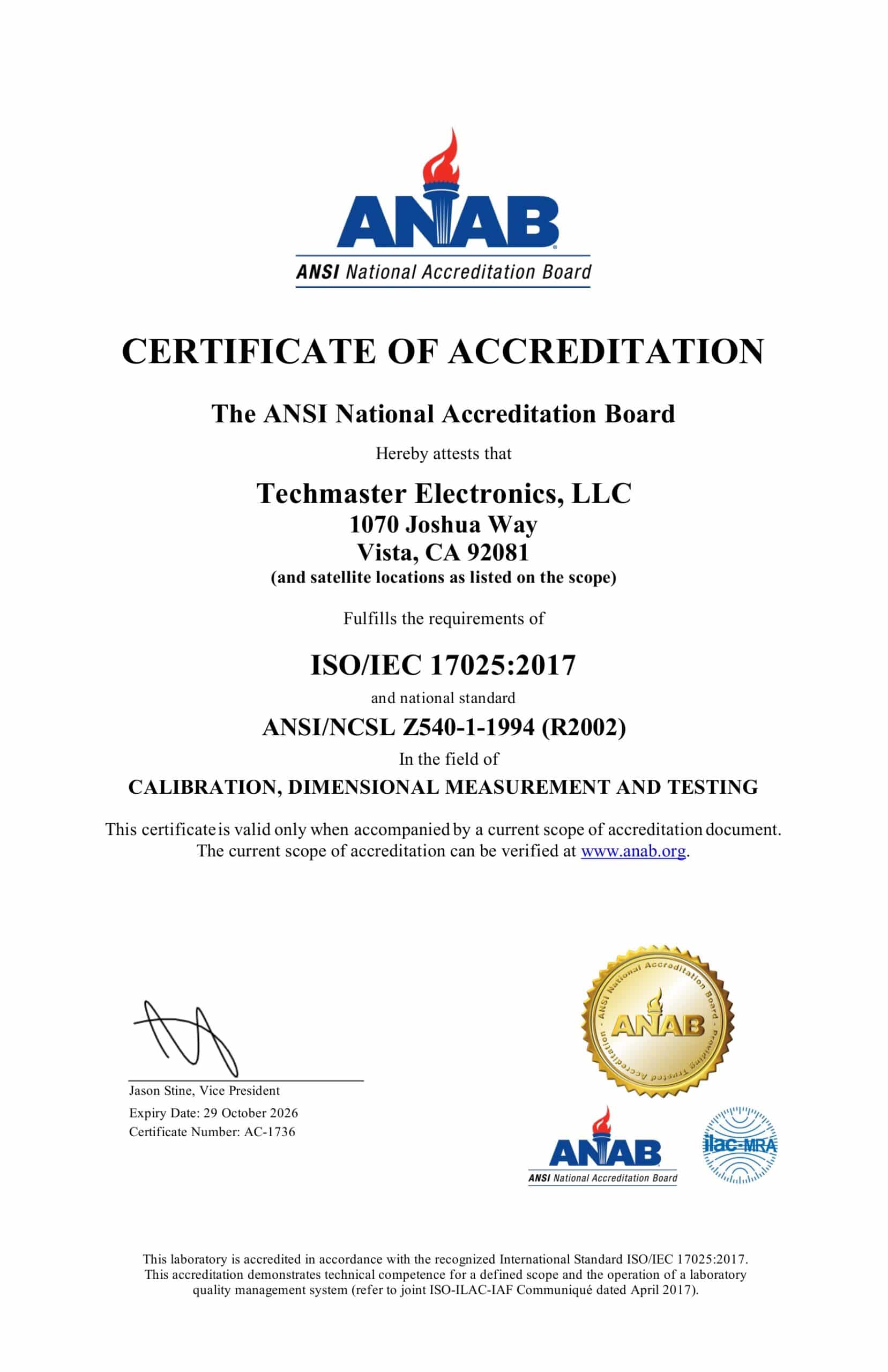
Volumetric calibration of graduated volumetric containers is on Techmaster’s ANAB ISO/IEC 17025 scope (certificate AC-1736) at our Santa Clara, California lab within the listed ranges, so certificates carry the ANAB accreditation symbol along with as-found and as-left data and measurement uncertainty.
Frequently asked questions
How is volumetric glassware calibrated?
What is the difference between TC and TD glassware?
Does Class A glassware need calibration?
Is volumetric calibration accredited at Techmaster?
Related calibration guides
References & industry standards
- ISO/IEC 17025 testing & calibration laboratory requirements
- NIST calibration services and measurement traceability
- A2LA / ANAB accreditation for calibration laboratories
External standards bodies. Techmaster Electronics is an ISO/IEC 17025-accredited, NIST-traceable calibration laboratory.
Accredited calibration at Techmaster
Techmaster Electronics is an ANAB-accredited (Certificate AC-1736) ISO/IEC 17025:2017 calibration laboratory with five US labs, NIST-traceable standards and a full measurement-uncertainty budget on every certificate — in-lab or nationwide on-site, with 5-business-day standard turnaround and expedite options. See our calibration services or request a quote.

Khanh Nguyen is the Marketing Manager at Techmaster Electronics, a B2B marketing leader covering the test, measurement, and ISO/IEC 17025 accredited calibration industry in the United States.