
TL;DR: A power supply rental is specified by the worst-case voltage and current together, the behaviour of the load, and the readback accuracy you intend to record, not by the two numbers on the front panel. Ask for the calibration certificate to be in date for the whole term, and say early if the output goes above a kilovolt, because that changes both the hardware and the accreditation question.
What is a DC power supply rental for?
A DC power supply rental provides a bench or rack programmable supply for a defined test campaign, qualification, burn-in, environmental testing or a customer demonstration, without adding an instrument to a calibration programme you then have to maintain. The supply is often part of the measurement, not just the power, which is why its certificate matters as much as its ratings.
Power supply and electronic load rentals were a recurring pattern in the requests reaching our laboratories over the last quarter, alongside a steady flow of accredited calibration work on owned supplies. The rental requests almost always arrived as two numbers, a voltage and a current, which is the one specification that cannot be relied on.
Still deciding whether to rent at all? Our guide to renting vs buying a DC power supply compares the costs over a typical project.
How do you specify a rented supply properly?
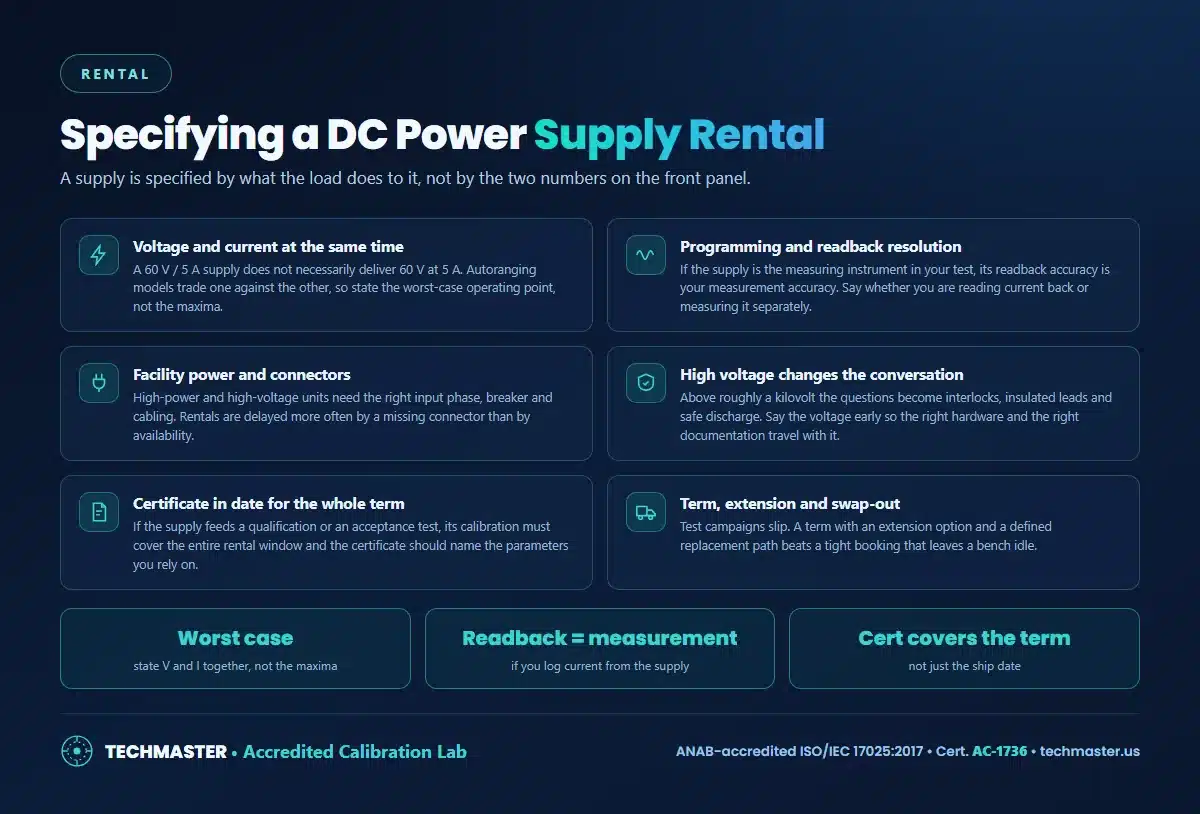
State the voltage and current the load draws at the same instant, describe the load type, say whether you will record voltage and current readback as data, confirm your facility power and connectors, and fix a term long enough to absorb schedule slip. An autoranging supply rated 60 V and 5 A may deliver 60 V only at a lower current, so two maxima are not a specification.
The readback point is the one most often missed. If your test record contains the current the supply reported, then the supply is a measuring instrument in that test and its accuracy is your accuracy, the same logic set out in how a DC power supply is calibrated. If you measure current separately with a shunt or a meter, the supply is only a source and the requirement relaxes.
Rent or buy?
The decision turns on how long the instrument will be used and whether it will be a permanent part of a calibration programme.
| Situation | Usual answer | Why |
|---|---|---|
| One qualification or acceptance campaign | Rent | No interval, no storage, no disposal after the job |
| A voltage or power level you need once | Rent | Buying a specialised supply for one test rarely pays back |
| Bridging while an owned supply is out for repair | Rent | Keeps the bench running without a rushed purchase |
| Daily production use | Buy | Rental cost overtakes purchase within roughly a year of continuous use |
| Supply is the measurement of record | Either, with a current certificate | The certificate matters more than ownership |
| Output above the accredited DC ceiling | Ask first | Support may be traceable rather than accredited |
The same trade-off for the companion instrument is worked through in rent versus buy for a DC electronic load, and the selection questions for a purchase are in the DC power supply buying guide.
What certificate should a rented supply arrive with?
One that is in date for the entire rental term and that names the parameters you depend on, output voltage and current accuracy, and readback accuracy if you will record it. A traceable certificate is adequate when the supply only provides bias; an accredited certificate is the right choice when its numbers enter a qualification record.
The difference between the two is set out in accredited versus NIST-traceable calibration, and what to look for on the document itself in how to read an ISO/IEC 17025 certificate. When the rental ends and the supply goes back, the parameters that were verified are the same ones covered in power supply calibration.
What capability stands behind the calibration?
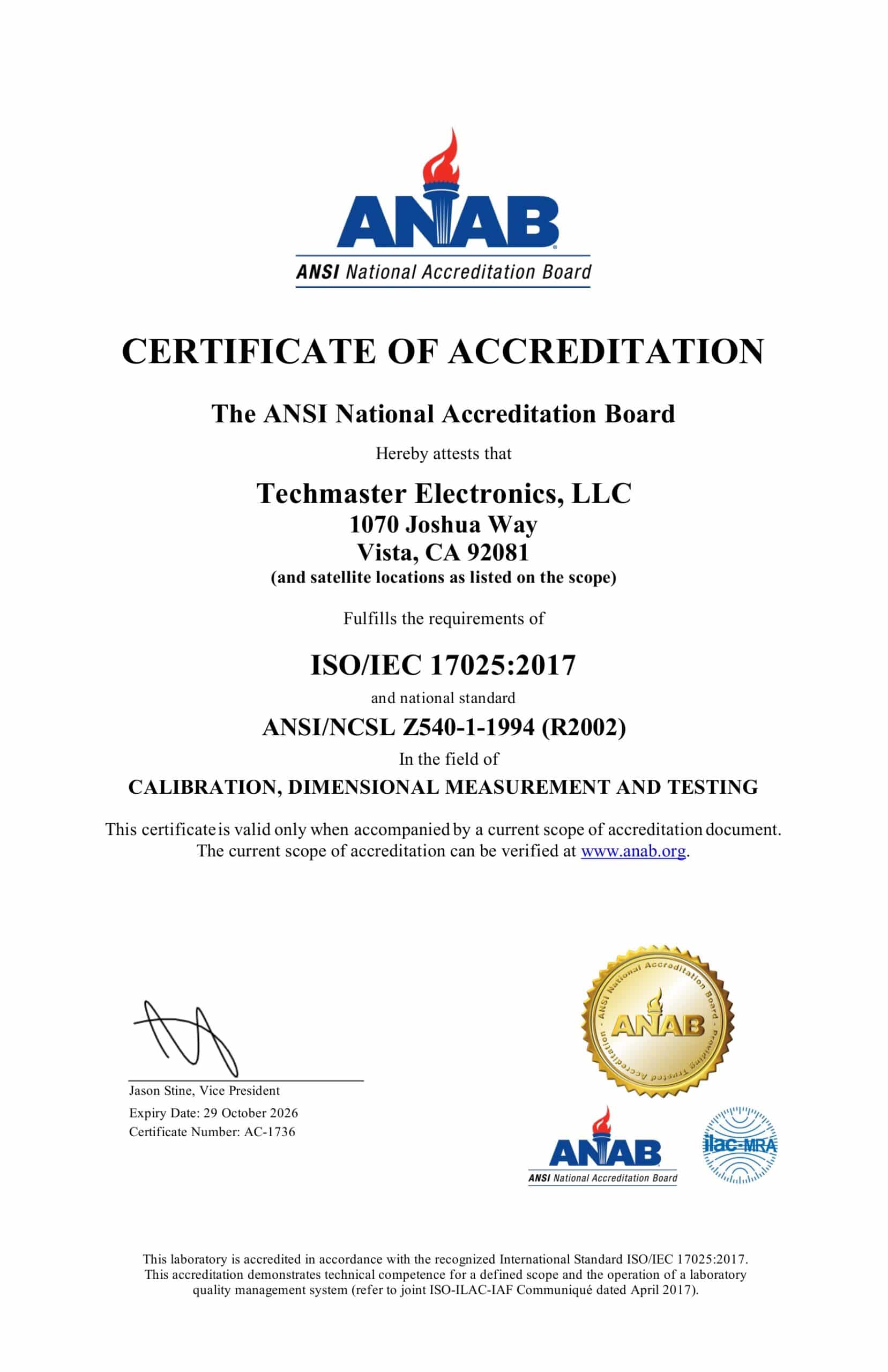
Electrical DC and low-frequency work sits on Techmaster’s ANAB ISO/IEC 17025 scope (Cert. AC-1736) at the Vista, Santa Clara, Orlando and San Antonio laboratories, with DC voltage to 1.1 kV, current sourcing to 20.5 A and current measurement to 1,000 A through calibrated shunts. A request for a supply operating above that voltage is worth raising early, because the accredited ceiling and the safety hardware both change at that point. Related instruments in the same discipline include source measure units and DC electronic loads, which usually arrive on the same bench as the supply.
Does a rented supply reset your calibration interval?
No, a rented instrument carries the rental provider’s interval, not yours, which is one less thing to manage but one more thing to check. The general logic for intervals on owned equipment is in how often test equipment should be calibrated.
Frequently asked questions
What do I need to tell a lab to rent a DC power supply?
The worst-case operating point rather than the maximum ratings: the voltage and the current you need at the same time, whether the load is resistive, electronic or reactive, how you will control the supply, and how long you need it. Autoranging supplies trade voltage against current, so a unit rated 60 V and 5 A may not deliver both together, and a request written as two maxima often produces the wrong instrument.
Does a rented power supply come with a calibration certificate?
Ask for one explicitly and check the dates. If the supply is only providing bias for a test, a traceable certificate may be enough; if you are reading current or voltage back from the supply and recording it as data, the certificate has to be current for the whole rental term and has to cover the parameters you rely on. Confirm this before the unit ships rather than after.
Can I rent a high-voltage DC supply above 1 kV?
Ask, and expect the conversation to change at that level. Above roughly a kilovolt the practical questions are interlocks, insulated leads, safe discharge and documentation, and the accredited calibration ceiling matters too: Techmaster’s ANAB ISO/IEC 17025 scope covers DC voltage to 1.1 kV, so a higher-voltage supply may be supported on a traceable rather than an accredited basis. Say the voltage early.
Is renting a power supply cheaper than buying one?
For a defined test campaign, usually yes, and the comparison is not only price. Renting avoids owning an instrument that then needs a calibration interval, storage and eventual disposal, and it lets you match the supply to one job rather than compromising across several. For equipment you will use continuously, ownership normally wins on cost within a couple of years.
The bottom line
Send the worst-case operating point, the load type, the control interface and the term. That single paragraph is worth more than a model number, and it is what turns a rental request into a supply that actually powers the test.
Need a quote, a rental, or a repair evaluation?
Techmaster Electronics, ISO/IEC 17025 accredited calibration laboratory, ANAB Cert. AC-1736, founded 1989. Five US labs, 5-day standard turnaround, 1–2 day expedite.
Request a quote →Techmaster Electronics, LLC is an independent ISO/IEC 17025:2017 accredited calibration laboratory. We are not affiliated with, authorized by, or endorsed by any manufacturer named on this page. All product names and model designations are trademarks of their respective owners and are used here only to identify the equipment we calibrate, repair, or rent. Confirm that our accredited scope covers your instrument’s parameters and ranges before shipping, ask us and we will check it against your model list.

Khanh Nguyen is the Marketing Manager at Techmaster Electronics, a B2B marketing leader covering the test, measurement, and ISO/IEC 17025 accredited calibration industry in the United States.