
TL;DR: Power supply calibration verifies voltage and current setting accuracy, readback accuracy, ripple and noise, load/line regulation, and protection trip points (OVP/OCP) at multiple points per range. Typical starting interval: 12 months. Market cost: $80–250 by outputs and power level. The overlooked truth: the supply’s readback display is a meter, and it drifts like one.
Power supplies are the most-trusted, least-calibrated instruments on many benches, “it’s just a source.” But if you log the supply’s readback as test data, or count on OVP to protect a $50k prototype, it’s a measuring instrument with all the obligations that carries.
What does power supply calibration include?
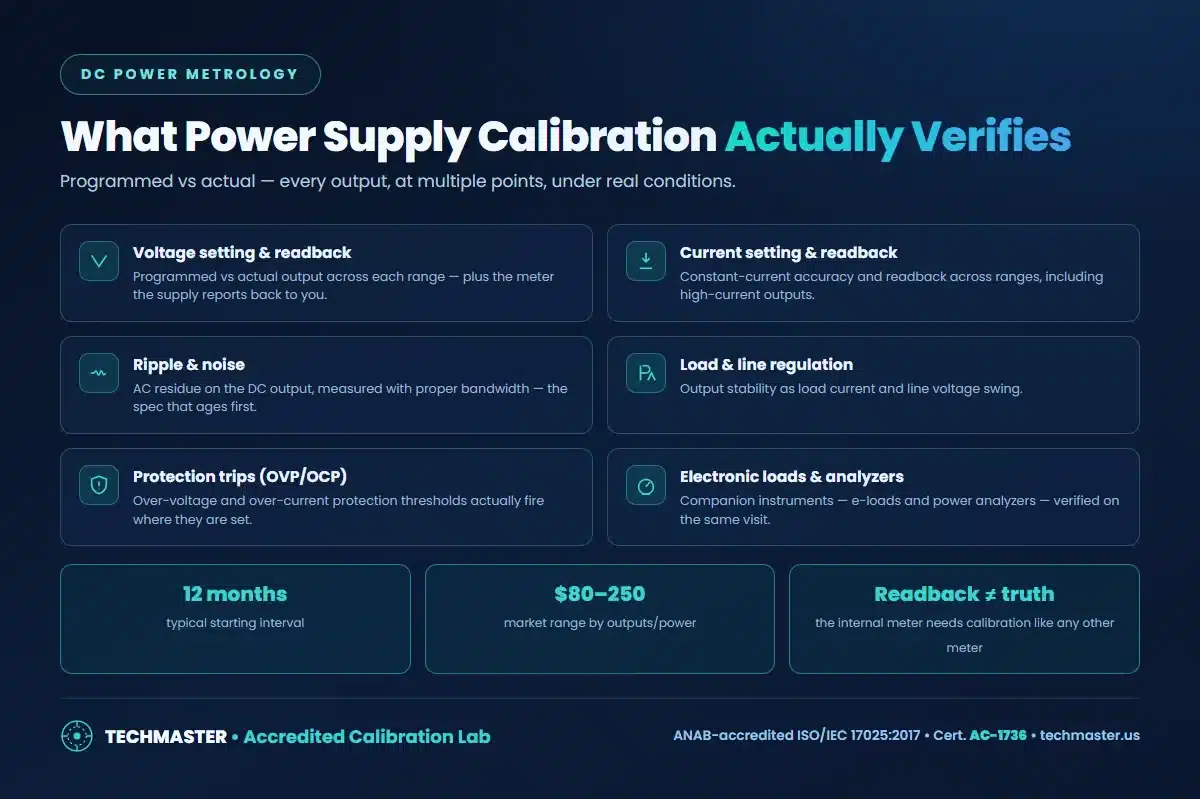
Setting accuracy compares programmed vs actual output across each range; readback accuracy validates the numbers the supply reports, the ones that end up in test records. Ripple and noise catches aging output stages; load and line regulation verifies stability under real conditions; and protection trips confirm OVP/OCP fire where they’re set. Electronic loads and power analyzers get the same treatment on the same visit.
When does a supply need accredited calibration?
Apply the standard decision rule: if the supply’s readback feeds recorded test data, or its limits gate a regulated process, buy the accredited certificate with data, the reasoning is laid out in the benefits of accredited calibration. A shop supply that powers soldering fans does not need an endorsed cert. Fleets usually split 70/30, and pricing the split correctly is real money at scale.
How often and how much?
Twelve months to start, with as-found evidence driving extensions. Market pricing runs $80–250 per unit by outputs and power. For racks of supplies, batch the due dates and use pickup, Techmaster runs free local routes in Silicon Valley, Southern California, and Orlando, with 5-day standard turnaround and 1–2 day expedite across 12 calibration disciplines.
Frequently asked questions
How often should a power supply be calibrated?
Every 12 months by default. Supplies whose readback is used as measurement data, recording test currents or voltages for records, warrant the same rigor as any meter; bench supplies used only as rough sources can often extend with documented as-found history.
How much does power supply calibration cost?
Market-typical US pricing is roughly $80–250 per unit, driven by the number of outputs and power level. Electronic loads and power analyzers calibrated alongside are priced similarly. Accredited certificates add 20–50%.
What is checked during power supply calibration?
Voltage and current setting accuracy and readback accuracy across each range, ripple and noise, load and line regulation, and over-voltage/over-current protection trip points.
Do protection settings really need verification?
Yes. OVP and OCP exist to protect your device under test; a trip point that drifted high protects nothing. Verification takes minutes during calibration and is the difference between a safety feature and a label.
The bottom line
Treat readback like the meter it is, verify the protection trips, and match certificate level to how the supply’s numbers get used. Vendor selection: the 12-point checklist.
Get an accredited calibration quote
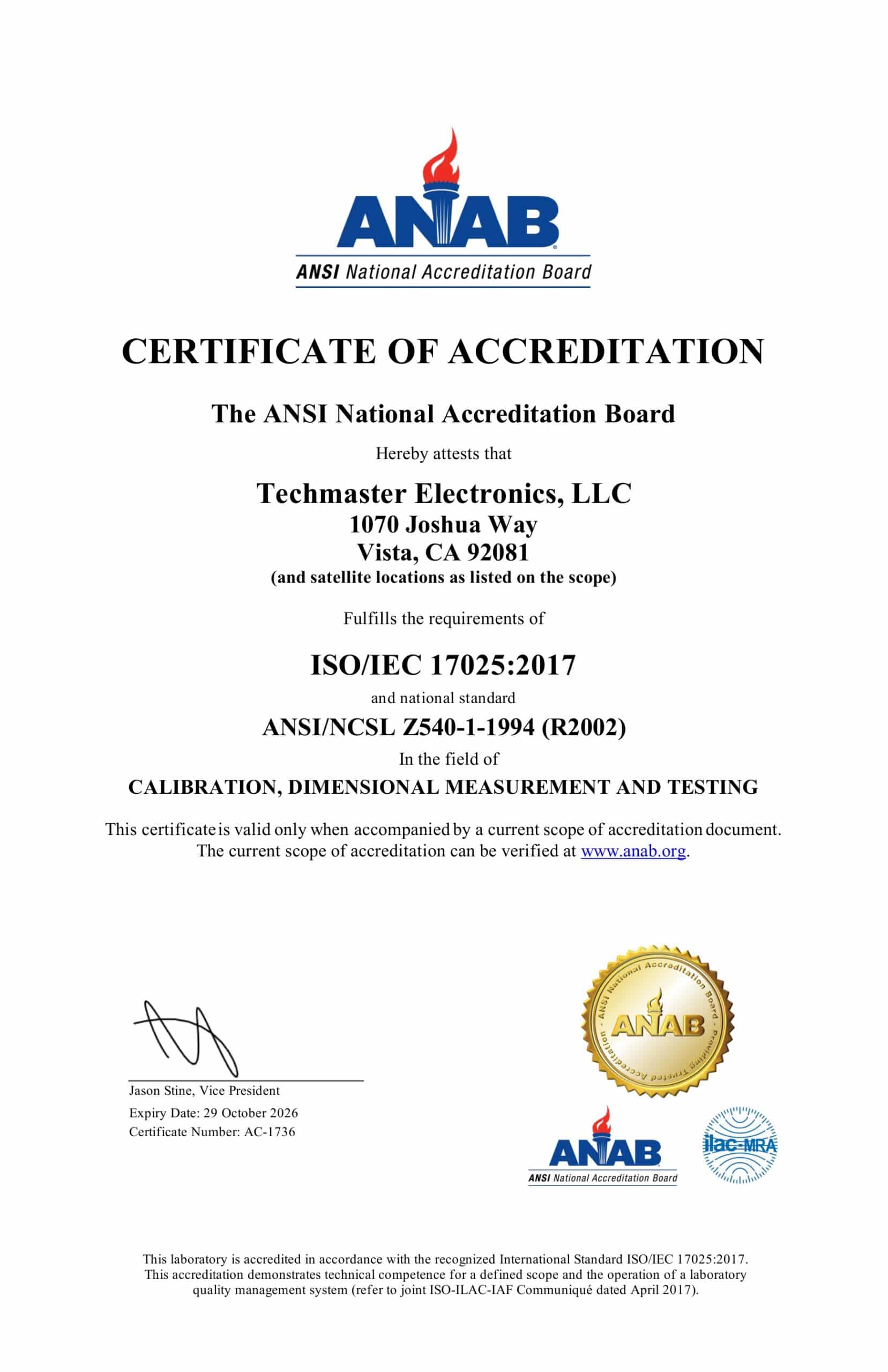
ANAB-accredited ISO/IEC 17025:2017 (Cert. AC-1736) • 5 US labs • 5-day standard, 1–2 day expedite • in-lab or on-site.
Request a quoteReferences & industry standards
- ISO/IEC 17025 testing & calibration laboratory requirements
- NIST calibration services and measurement traceability
- NIST Fundamental Electrical Measurements
- A2LA / ANAB accreditation for calibration laboratories
External standards bodies. Techmaster Electronics is an ISO/IEC 17025-accredited, NIST-traceable calibration laboratory.
Accredited calibration at Techmaster
Techmaster Electronics is an ANAB-accredited (Certificate AC-1736) ISO/IEC 17025:2017 calibration laboratory with five US labs, NIST-traceable standards and a full measurement-uncertainty budget on every certificate — in-lab or nationwide on-site, with 5-business-day standard turnaround and expedite options. See our calibration services or request a quote.

Khanh Nguyen is the Marketing Manager at Techmaster Electronics, a B2B marketing leader covering the test, measurement, and ISO/IEC 17025 accredited calibration industry across the US and Vietnam markets.