
Choosing the Best DC Power Supply for Electronics Manufacturing
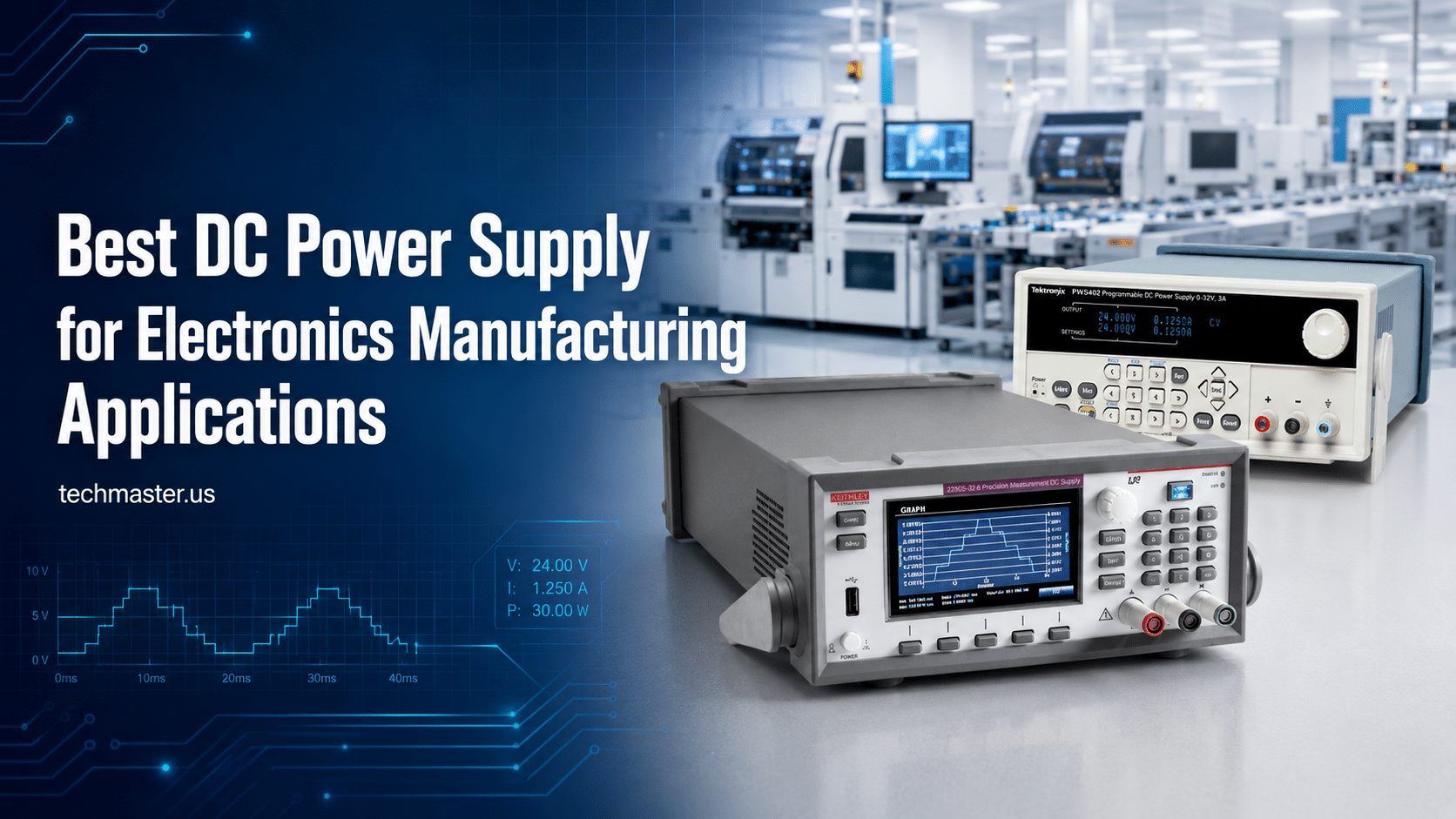
In the fast-paced world of electronics manufacturing, you must deliver stable, clean, and precise power to your components. It is a strict operational rule, not just a preference. When you design, test, and assemble sensitive circuits, you rely on top-tier measurement tools. Determining the best dc power supply for electronics manufacturing is critical for your success. Even a minor voltage fluctuation can cause false test results. Bad power can also damage fragile components.
This guide explains what makes a top power unit. We cover why measurement accuracy matters so much. We also explain how a trusted Calibration service maintains your equipment over time. Proper calibration keeps your tools accurate and compliant with industry standards.
1. What Is a Bench and Programmable DC Power Supply?
A DC power supply provides steady direct current voltage to a device under test (DUT). Professional manufacturing floors rely on two main types of test equipment. These are bench power supplies and programmable power supplies.
Technicians use standard bench power supplies for manual testing and repair. These units feature simple knob controls for voltage and current limits. They provide reliable power for basic, standalone tasks. A bench supply is perfect for quick checks at a workstation.
A programmable dc power supply gives you advanced control and precision. You can connect these units to automated test equipment (ATE) systems. They use communication interfaces like USB, LAN, or GPIB. Test engineers use them to automate complex voltage sequences. They can also simulate specific operational conditions and log data. Programmable models are the top choice for large-scale production lines. They provide the high throughput and repeatability that modern factories need.
2. Why the Best DC Power Supply for Electronics Manufacturing Matters
The Foundation of Quality Assurance
The right power supply forms the foundation of your quality assurance process. Modern printed circuit boards (PCBs) and microprocessors are getting smaller. They operate at lower voltages. They also draw complex current waveforms. Because of this, testing equipment faces higher demands than ever before.
Measurement Accuracy and Traceability
High-quality dc power supply test equipment delivers power that perfectly matches programmed specs. You might need exactly 3.3 volts to test a microchip. Without strict accuracy, engineers cannot tell if a product failed or if the power source drifted. Consistent power stops phantom errors. It speeds up production and saves money.
Risk Reduction and Operator Safety
Precision power supplies include advanced safety features. They use overvoltage protection (OVP) and overcurrent protection (OCP). These features protect expensive prototypes from sudden power spikes. A reliable unit keeps both operators and components safe. It prevents catastrophic electrical failures that cause costly losses.
Product Quality and Regulatory Compliance
Industries like automotive and medical require continuous validation. You must prove your products work safely. Stable power ensures units pass functional testing under the correct parameters. This improves your production yield. It ensures compliance with internal quality rules. It also prevents dangerous product recalls in the field.
3. Common Applications in the Industry
Modern power supplies fit into many stages of the electronics lifecycle. You will find them in R&D labs, repair centers, and end-of-line testing stations.
-
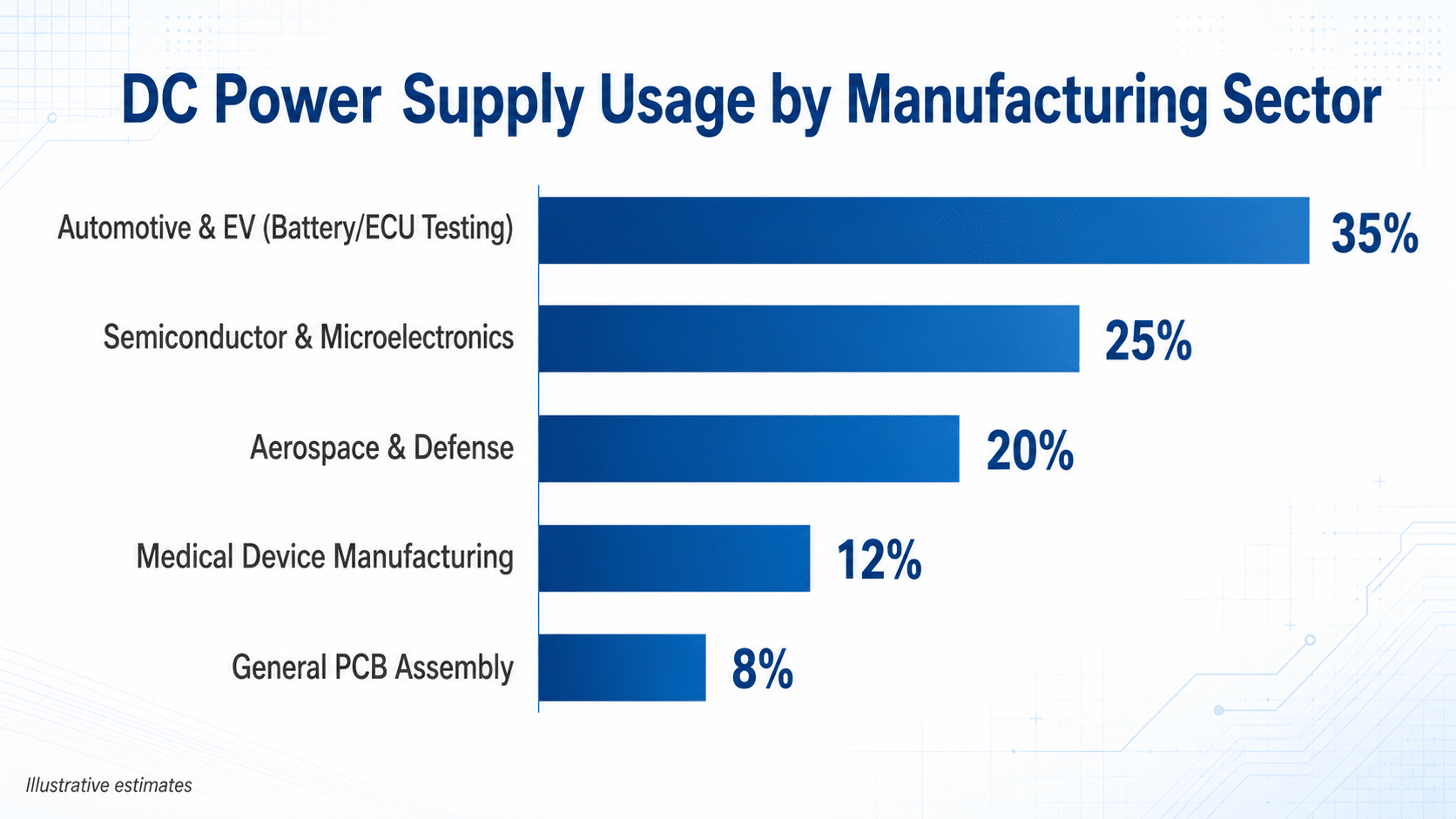
Semiconductor and Microelectronics Testing: Integrated circuits need extremely stable power. They require minimal ripple and noise. Engineers use high-precision supplies to test chips and meet power efficiency rules.
-
Automotive and EV Manufacturing: Testing electronic control units (ECUs) requires dynamic power. Engineers also test battery management systems (BMS). These tests simulate vehicle battery behaviors, like engine cranking drops and alternator spikes.
-
Medical Device Production: Medical electronics, such as pacemakers, need rigorous testing. Programmable supplies create exact voltage profiles. They simulate normal operation, low battery states, and fault conditions.
-
Aerospace and Defense: Avionics and radar systems face extreme simulated environments. Power supplies help guarantee absolute reliability. These parts go into mission-critical situations where failure is not an option.
-
General PCB Assembly: Power supplies drive circuit boards during functional testing. This step verifies logic gates and signal integrity. It proves the board works before the factory ships the final product.
4. Calibration Standards and Traceability
Beyond Premium Hardware
Buying premium hardware is only the first step. Routine ISO 17025 electrical calibration is absolutely necessary to maintain accuracy over the lifetime of your instrument.
The Importance of ISO/IEC 17025
ISO/IEC 17025 is the global standard for calibration laboratories. It ensures the lab uses a strong quality system. It also proves the lab has the technical skills to produce valid results. Using an accredited lab means global auditors will easily accept your calibration certificates.
NIST-Traceable Calibration
Traceability ties a laboratory’s reference standards to the National Institute of Standards and Technology (NIST). Technicians measure your power supply’s output against these highly accurate standards. A premium certificate includes a measurement uncertainty budget. This document proves the unit works within the manufacturer’s tolerances. It gives you total confidence in your daily measurements.
5. Common Issues Found During Calibration
Even the best power supplies degrade over time. Heavy use and environmental stress cause natural component aging. During a routine bench dc power supply calibration, technicians often fix these common issues:
-
Output Drift: Voltage or current output may slowly drift away from programmed values. Thermal aging of internal resistors usually causes this problem.
-
Out-of-Tolerance Results: Extreme temperatures or physical shocks can push outputs outside acceptable limits. The unit needs adjustment to return to factory specs.
-
Ripple and Noise Increase: Internal capacitors wear out after years of use. This adds excessive AC ripple to the DC output. Electrical noise causes strange behavior in sensitive DUTs.
-
Readout Inaccuracies: The digital panel might show 5.00V, but the actual output is only 4.90V. Calibration matches the digital display with the real physical output.
-
Faulty Protection Circuits: OVP and OCP safety mechanisms can fail. Calibration ensures these features trigger at the exact programmed limits. This prevents equipment damage.
6. How Often Should This Equipment Be Calibrated?
How Often Should You Calibrate DC Power Supplies?
You should calibrate DC power supplies every 6 to 12 months. Your exact schedule depends on several crucial factors:
Manufacturer Specifications
Most OEMs suggest an annual (12-month) calibration cycle. Adhering to this recommended interval maintains stated accuracies and technical specs.
Usage Frequency
Equipment running 24/7 wears out faster than a benchtop unit. High-usage units in automated test racks often need tighter, 6-month calibration intervals.
Environmental Conditions
Dust, humidity, and extreme heat speed up component drift. Climate-controlled labs keep equipment stable for much longer periods.
Internal Quality Procedures
High-risk industries have strict rules. Aerospace, medical, and defense manufacturers dictate strict intervals to maintain compliance with AS9100, ISO 13485, or FDA standards.
7. What to Look for in a Calibration Provider
Choosing the right metrology partner protects your manufacturing process. When you evaluate a power supply calibration service, check these vital criteria:
-
Accreditation: The lab must hold ANAB accreditation to ISO/IEC 17025:2017. This proves technical competence and audit readiness.
-
Technical Capability: The lab needs high-end reference standards. These standards must cover your specific voltage and current ranges accurately.
-
Comprehensive Documentation: Look for providers that offer detailed data reports. You need “as-found” and “as-left” readings. You also need clear pass/fail statements.
-
Turnaround Time: Downtime costs your factory money. A reliable provider should return equipment in five business days or less.
-
On-Site Service: Shipping adds risk and delay. Ask if the lab performs mobile calibration directly at your manufacturing facility.
8. Equipment Rentals for Uninterrupted Production
Managing equipment downtime is a major challenge for facility managers. Breakdowns, routine maintenance, and peak production runs can stall your line. Techmaster Electronics solves this problem with comprehensive test equipment rental services.
If your primary power supply needs repair, you can rent a replacement from us. If you need extra capacity for a big project, we have you covered. Renting high-quality, pre-calibrated DC power supplies keeps your production line moving. We maintain and calibrate our rental inventory to strict metrology standards. You get immediate access to reliable, audit-ready instruments exactly when you need them most.
9. Why Choose Techmaster Electronics?
Techmaster Electronics has served the metrology industry as a trusted partner since 1989. We operate multiple ISO/IEC 17025 accredited laboratories across the United States. Our labs in California, Texas, Florida, and North Carolina support electronics manufacturers, aerospace companies, and precision engineering firms.
We handle basic bench power supplies, complex programmable DC loads, and automated test systems. We deliver NIST-traceable certificates with full measurement uncertainty budgets on every point. This thorough process ensures your equipment passes strict industry audits. We offer rapid turnaround times, local pickup, and nationwide on-site calibration teams. Techmaster Electronics minimizes your downtime and maximizes your measurement confidence.
10. Conclusion
Finding the best dc power supply for electronics manufacturing protects your products. It ensures you test devices under precise, stable, and safe conditions. However, all measurement equipment drifts over time. Routine calibration with an accredited metrology lab is the only way to guarantee continuous compliance. A strict calibration schedule reduces risks and upholds product quality.
11. Frequently Asked Questions (FAQs)
Frequently Asked Questions
References & industry standards
- ISO/IEC 17025 testing & calibration laboratory requirements
- NIST calibration services and measurement traceability
- NIST Fundamental Electrical Measurements
- A2LA / ANAB accreditation for calibration laboratories
External standards bodies. Techmaster Electronics is an ISO/IEC 17025-accredited, NIST-traceable calibration laboratory.
Frequently asked questions
What is dc power supply calibration?
DC Power Supply Calibration is the documented comparison of a DC power supply against NIST-traceable reference standards under ISO/IEC 17025. It quantifies the DC power supply’s error and measurement uncertainty and confirms it performs within tolerance, with as-found and as-left data on the certificate.
How often should a DC power supply be calibrated?
Most quality systems calibrate a DC power supply every 12 months, or sooner after repair, overload, or before critical measurements. Set your interval from the manufacturer spec and your ISO 9001 / 13485 / AS9100 program and drift history.
Is Techmaster’s DC power supply calibration ISO 17025 accredited?
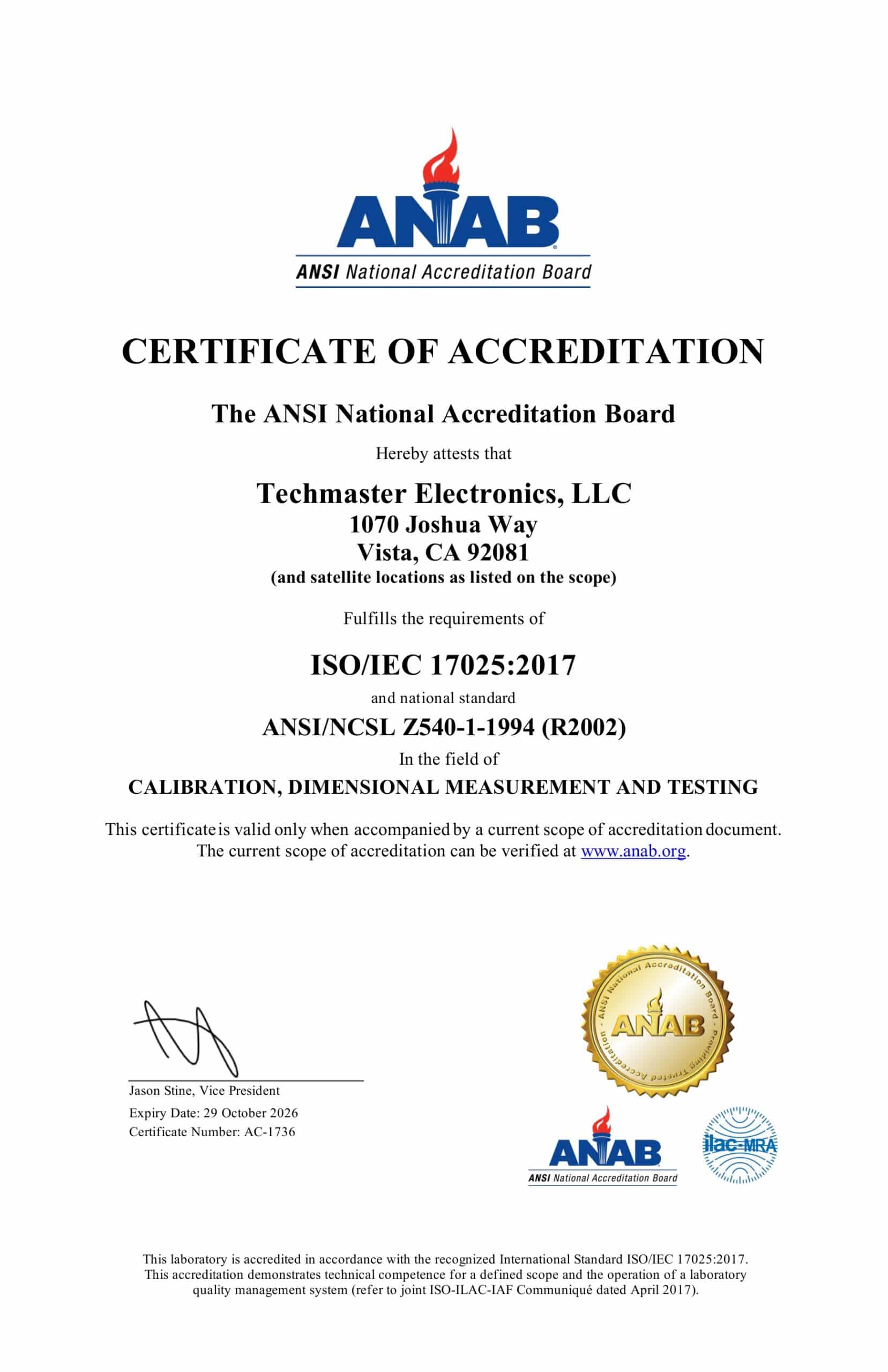
Yes. Techmaster Electronics is ISO/IEC 17025:2017 accredited by ANAB (Certificate AC-1736). Every DC power supply calibration is NIST-traceable and issued with a full measurement-uncertainty budget.
What is the turnaround for DC power supply calibration?
Standard turnaround is 5 business days, with 1–2 business-day expedite available. On-site calibration removes shipping time entirely for DC power supplys that can’t leave the floor.
Do you calibrate DC power supplys on-site or in-lab?
Both. Techmaster runs five US labs (Vista CA, Santa Clara CA, Orlando FL, San Antonio TX, Holly Springs NC) and offers nationwide on-site DC power supply calibration to minimize downtime.

Khanh Nguyen is the Marketing Manager at Techmaster Electronics, a B2B marketing leader covering the test, measurement, and ISO/IEC 17025 accredited calibration industry across the US and Vietnam markets.