
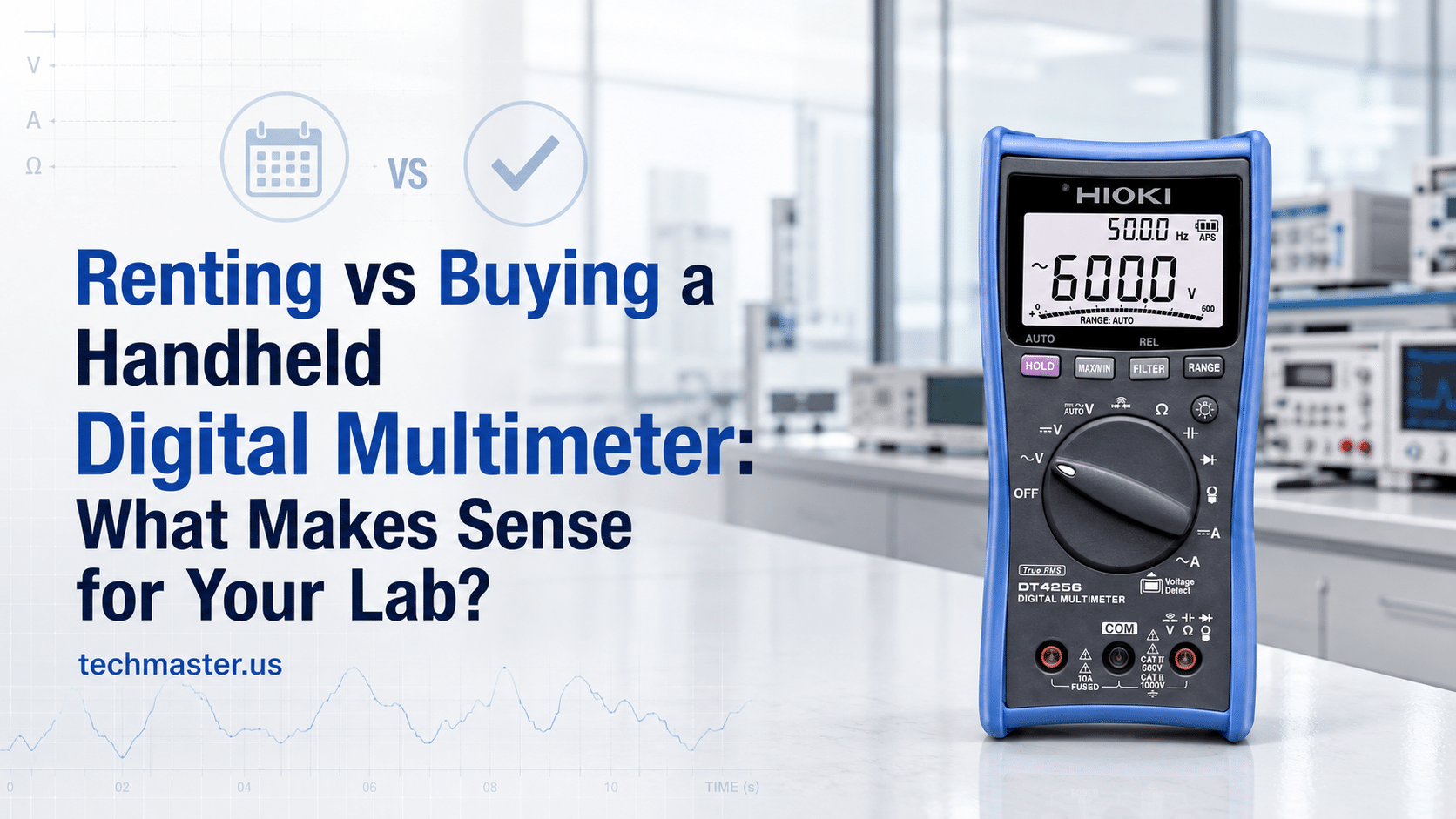
Rent vs Buy Handheld Digital Multimeter: What Makes Sense for Your Lab?
Equipping an industrial laboratory or field service team requires careful financial and operational planning. Maintenance engineers and quality managers rely on high-precision instruments every day to troubleshoot electrical systems and verify product quality. However, acquiring these essential tools from the top 10 brands of handheld digital multimeters involves significant upfront investment and ongoing maintenance logistics. When evaluating the rent vs buy handheld digital multimeter decision, facility leaders must consider more than just the initial purchase price.
Hidden ownership costs, instrument downtime, and strict metrology requirements all play a role in this critical choice. In this complete guide, we will analyze the technical and financial factors that dictate whether purchasing or renting electrical test equipment makes the most sense for your operational framework. We will also explore the vital role of calibration standards, common equipment issues, and how strategic equipment sourcing keeps your operations compliant and efficient.
1. What Is a Handheld Digital Multimeter?
A handheld digital multimeter (DMM) is a rugged, portable diagnostic instrument used to measure electrical parameters. Technicians primarily use these devices to measure alternating current (AC) and direct current (DC) voltage, electrical current (amps), and resistance (ohms). Advanced industrial multimeters also feature capabilities for testing capacitance, frequency, temperature, and diode continuity.
Engineers rely on these units to troubleshoot everything from heavy industrial motor controls to delicate printed circuit boards (PCBs). Because they are deployed in field environments, modern handheld multimeters feature heavy-duty exteriors designed to withstand physical shock, extreme temperatures, and industrial dust. However, despite their rugged outward appearance, the internal electronic components remain highly sensitive. Analog-to-digital converters, precision resistors, and voltage references require regular verification to ensure accuracy. Whether you choose to own or rent your devices, managing this internal precision remains mandatory.
2. Why the Rent vs Buy Handheld Digital Multimeter Decision Matters
Acquisition Strategy: Buying vs. Renting
Deciding how to acquire your testing instruments impacts your laboratory budget, compliance status, and daily workflow. Making the wrong choice can lead to bloated asset inventories or crippling equipment shortages.
3. Common Applications
Accurate electrical measurement serves as the backbone of modern industry. Technicians require reliable DMMs across various demanding sectors. Regardless of how you acquire the equipment, it must perform flawlessly in these critical applications:
-
Aerospace and Defense: Avionics technicians verify complex aircraft electrical harnesses and flight control systems. Exact voltage readings are essential for flight safety and regulatory compliance.
-
Electronics Manufacturing: Quality assurance teams perform component-level testing and end-of-line validations on newly assembled circuit boards.
-
Medical Device and Pharmaceutical Facilities: Facility engineers maintain sensitive cleanroom HVAC controls and automated manufacturing equipment to prevent costly batch contamination.
-
Automotive Manufacturing: Electric vehicle (EV) technicians require specialized, highly accurate DMMs to measure high-voltage battery arrays safely.
-
Field Utilities and Commercial Service: Technicians diagnose massive power distribution panels, industrial switchgear, and commercial motor controls outdoors.
4. Calibration Standards and Traceability
Whether your laboratory owns its multimeters or utilizes a rental service, strict metrology standards apply equally. You cannot use an uncalibrated instrument for critical quality assurance tests. Professional metrology requires rigorous, documented procedures.
The highest standard for this process is ISO/IEC 17025 accreditation. This international standard proves a laboratory operates with deep technical competence. Metrologists working under this standard must calculate precise measurement uncertainty for every data point they collect. In addition, laboratories in the United States must provide NIST traceable calibration. This ensures your equipment’s readings link back through an unbroken chain of comparisons to national standards.
When you utilize a professional Calibration service for your owned equipment, or rent pre-calibrated units from a certified provider, you receive legally defensible documentation. This paperwork proves to auditors that your measurements are accurate, reliable, and compliant.
5. Common Issues Found During Calibration
6. How Often Should This Equipment Be Calibrated?
Establishing a proper maintenance schedule ensures ongoing measurement accuracy. The industry standard interval for a handheld digital multimeter is once every 12 months. This annual cycle aligns with most manufacturer recommendations and satisfies standard ISO 9001 quality audits.
However, high-stress environments alter this timeline. Multimeters used continuously on a multi-shift manufacturing line experience rapid wear. Devices exposed to harsh industrial dirt, vibration, or extreme temperatures also drift faster than those kept in a pristine laboratory. In these severe cases, quality managers often shorten the testing interval to six months. Managing these complex intervals across a fleet of owned devices requires dedicated administrative labor.
7. Avoid Downtime with Techmaster Equipment Rentals
8. What to Look for in a Calibration Provider
If your company decides to purchase its multimeters, selecting the right metrology laboratory to maintain them is critical. You must evaluate external providers carefully to protect your quality standards.
Always verify that the laboratory holds active ISO/IEC 17025 accreditation and that electrical testing appears specifically on their approved scope. Avoid secondary providers who only check a few basic measurement points. A qualified laboratory tests all meter functions, AC/DC voltage, current, resistance, and frequency, across multiple ranges.
Additionally, evaluate their average turnaround time. Field service teams cannot afford to lose their primary diagnostic tools for weeks at a time. The laboratory must provide detailed certificates showing both “As Found” and “As Left” data. Finally, ask if the provider offers on-site field service capabilities. Deploying metrologists directly to your facility can save massive amounts of shipping time and administrative hassle.
9. Why Choose Techmaster Electronics?
Techmaster Electronics delivers precise, reliable metrology and equipment solutions for highly demanding industries. We proudly serve aerospace contractors, automotive manufacturers, pharmaceutical facilities, and electronics developers across the United States.
Our ISO/IEC 17025 accredited laboratories are equipped to handle strict testing requirements with precision. We use fully automated, high-precision calibrators to test all major brands of handheld multimeters. This advanced automation minimizes human error and guarantees exact repeatability for every measurement point. Whether you need comprehensive testing for your owned inventory or wish to utilize our flexible equipment rental program, Techmaster provides the exact solution. We deliver fast laboratory turnarounds, detailed certificates, and unparalleled technical support.
10. Conclusion
The decision regarding how to source your diagnostic tools requires careful consideration of capital budgets, project lengths, and maintenance overhead. Buying outright makes sense for permanent, long-term installations, while renting offers distinct advantages for budget flexibility and eliminating calibration logistics. Whichever path you choose, maintaining strict measurement accuracy through routine testing remains non-negotiable. Partnering with a fully accredited metrology expert ensures your equipment, owned or rented, always performs flawlessly.
11. FAQ Section
Contact Techmaster Electronics today to discuss your equipment rental needs and calibration requirements to keep your operations accurate, reliable, and fully compliant.
Contact us today!References & industry standards
- ISO/IEC 17025 testing & calibration laboratory requirements
- NIST calibration services and measurement traceability
- NIST Time and Frequency Division
- A2LA / ANAB accreditation for calibration laboratories
External standards bodies. Techmaster Electronics is an ISO/IEC 17025-accredited, NIST-traceable calibration laboratory.
Frequently asked questions
What is handheld digital multimeter calibration?
Handheld Digital Multimeter Calibration is the documented comparison of a handheld digital multimeter against NIST-traceable reference standards under ISO/IEC 17025. It quantifies the handheld digital multimeter’s error and measurement uncertainty and confirms it performs within tolerance, with as-found and as-left data on the certificate.
How often should a handheld digital multimeter be calibrated?
Most quality systems calibrate a handheld digital multimeter every 12 months, or sooner after repair, overload, or before critical measurements. Set your interval from the manufacturer spec and your ISO 9001 / 13485 / AS9100 program and drift history.
Is Techmaster’s handheld digital multimeter calibration ISO 17025 accredited?
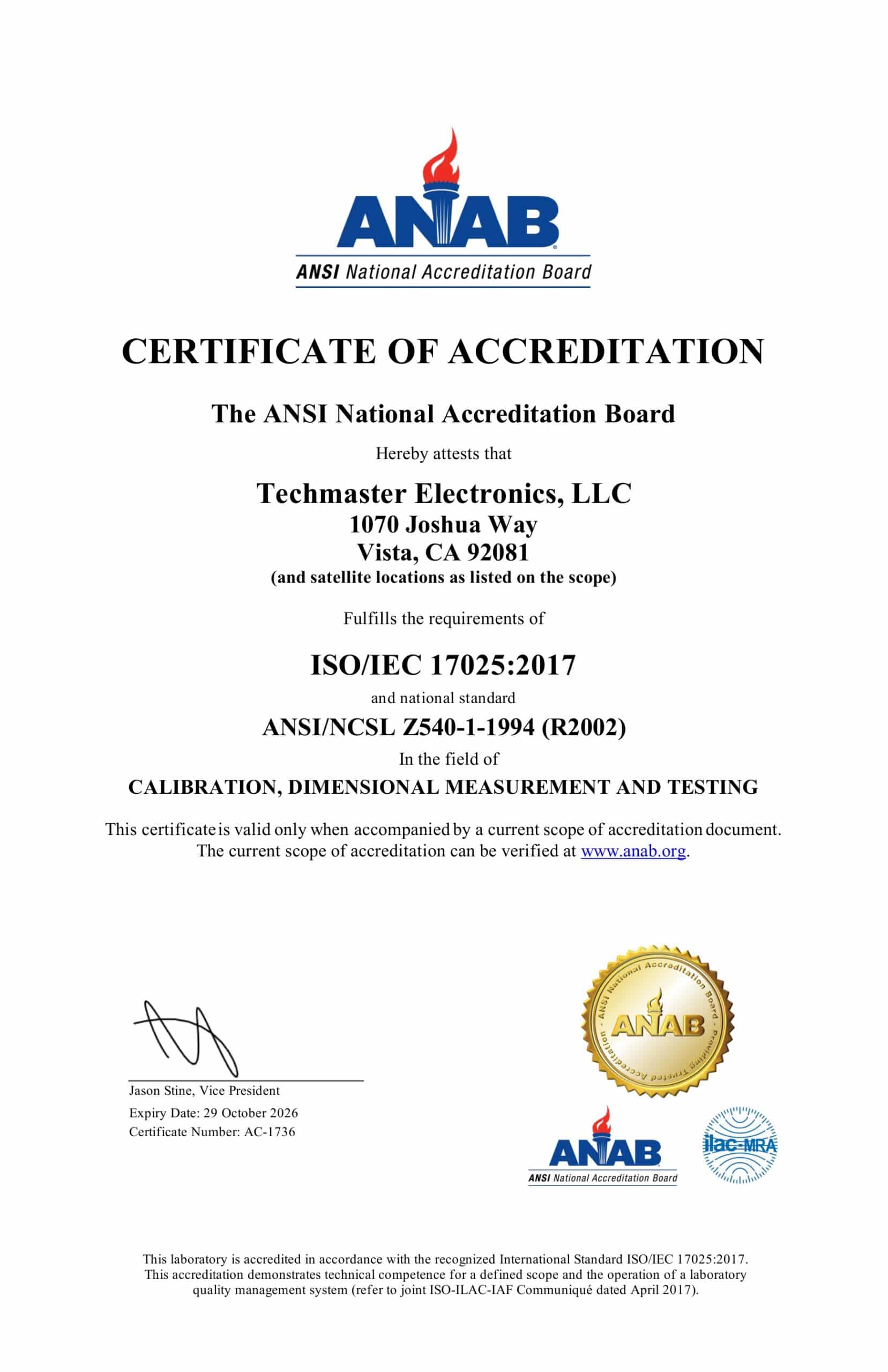
Yes. Techmaster Electronics is ISO/IEC 17025:2017 accredited by ANAB (Certificate AC-1736). Every handheld digital multimeter calibration is NIST-traceable and issued with a full measurement-uncertainty budget.
What is the turnaround for handheld digital multimeter calibration?
Standard turnaround is 5 business days, with 1–2 business-day expedite available. On-site calibration removes shipping time entirely for handheld digital multimeters that can’t leave the floor.
Do you calibrate handheld digital multimeters on-site or in-lab?
Both. Techmaster runs five US labs (Vista CA, Santa Clara CA, Orlando FL, San Antonio TX, Holly Springs NC) and offers nationwide on-site handheld digital multimeter calibration to minimize downtime.

Khanh Nguyen is the Marketing Manager at Techmaster Electronics, a B2B marketing leader covering the test, measurement, and ISO/IEC 17025 accredited calibration industry across the US and Vietnam markets.