
Handheld Digital Multimeter Buying Guide: How to Choose a Handheld Digital Multimeter

For quality managers, field service engineers, and laboratory technicians, a digital multimeter (DMM) is a foundational diagnostic tool. However, the market is saturated with options ranging from low-cost consumer models to high-precision industrial instruments. Knowing how to choose a handheld digital multimeter requires a clear understanding of your measurement environment, accuracy requirements, and industry compliance standards.
Using an inadequate multimeter can lead to false readings, compromised product quality, and severe safety hazards. This guide breaks down the critical technical specifications, safety ratings, and calibration requirements necessary to select the right instrument for your facility.
1. What Is a Handheld Digital Multimeter?
A handheld digital multimeter is a portable electronic measuring instrument that combines several measurement functions into one unit. At a minimum, a standard DMM measures voltage (volts), current (amps), and resistance (ohms). Advanced models include features for measuring capacitance, frequency, temperature, and continuity.
Unlike benchtop multimeters, which are designed for stationary laboratory use with maximum precision, handheld digital multimeters are engineered for mobility, durability, and field diagnostics. They provide rapid numerical readouts on an LCD screen, eliminating the parallax errors associated with older analog meters.
2. Why Choosing the Right Handheld Digital Multimeter Matters
You might wonder why picking a specific model is such a big deal. The truth is, selecting the correct device directly impacts your team’s safety and your data’s quality. For example, if a tech uses a low-quality meter, they might approve a bad circuit board. As a result, product quality drops, and angry customers return broken goods. On the other hand, a good meter prevents these costly errors.
In addition, safety is a huge factor. Working with electricity is dangerous. Therefore, using a cheap meter on a high-power machine can cause a deadly arc flash. In the end, spending a little time to pick the right industrial-grade tool protects both your workers and your bottom line.
3. Key Technical Specifications to Consider
4. Common Applications
Because they are so useful, people use these meters in almost every technical field. However, the exact job decides which features you need the most.
-
Electronics Manufacturing: Lab workers use high-count meters to check tiny signals on computer boards.
-
Industrial Plants: Maintenance teams use True RMS meters to fix large motors and control panels.
-
Field Service Work: Mobile crews need tough, waterproof meters to test outdoor HVAC units in bad weather.
-
Aerospace Testing: Flight engineers need highly stable meters that give exact data for airplane safety systems.
5. Calibration Standards and Traceability
Maintaining Measurement Accuracy
Purchasing a high-quality multimeter is only the first step; maintaining its accuracy requires rigorous handheld digital multimeter calibration. Over time, the internal reference components within a DMM, such as voltage dividers and shunt resistors, will inevitably drift due to thermal stress, mechanical shock, and aging.
To satisfy quality management systems like ISO 9001, AS9100, or ISO 13485, your DMM must undergo calibration by an ISO/IEC 17025 accredited laboratory. This accreditation guarantees that the calibration process utilizes formally documented procedures and NIST-traceable reference standards. The calibration certificate should explicitly include “As-Found” and “As-Left” data, along with stated measurement uncertainty, conclusively proving that the instrument performs within the manufacturer’s engineered specifications.
In the end, regular electrical test equipment calibration is the absolute only way to establish a continuous, unbroken chain of traceability for your critical field measurements, ensuring the safety and compliance of your operations.
6. Common Issues Found During Calibration
When users send their meters to a lab, the techs often find hidden problems. Routine testing catches these issues before they cause trouble.
-
Normal Drift: This is the most common issue. Over time, the meter simply drifts out of its correct range.
-
Blown Fuses: Often, a user leaves the test leads in the wrong plug and tests a live wire. Consequently, the internal fuse blows out to protect the meter.
-
Worn Dials: The main spinning dial on the front can wear out. Therefore, the meter might give jumpy readings.
-
Bad Test Leads: Sometimes the meter is fine, but the wires are bad. Dirty or broken wires cause wrong resistance readings.
-
Dirt and Water: Working in dirty places can push dust inside the meter. As a result, the tool becomes unstable.
7. How Often Should This Equipment Be Calibrated?
So, how often should you test your tool? Generally, the makers suggest sending it to a lab once a year. However, the best schedule really depends on how you use it.
For instance, if you use the meter every single day on a dusty factory floor, it will wear out faster. Therefore, you might need checks every six months to stay safe. On the other hand, if a meter just sits in a clean drawer as a backup, a yearly check works fine.
In the end, you need a smart plan for electrical test equipment calibration. A good plan stops bad tools from ruining your daily work.
8. What to Look for in a Calibration Provider
9. Why Choose Techmaster Electronics?
At Techmaster Electronics, we know that accurate tools build strong businesses. For many years, we have provided trusted testing services for companies across the United States. In addition, we know exactly how to handle complex electronics and industrial gear.
Our ISO/IEC 17025 accredited labs use the best reference tools available to check your meters. Therefore, you can fully trust the data on our certificates. Whether you need to fix a broken dial or verify a True RMS reading, our experts can help.
In short, we make the upkeep process easy, fast, and clear. With multiple labs and a handy online portal, you can track your tools anytime, day or night.
10. Conclusion
Overall, taking the time to learn how to choose a handheld digital multimeter prevents big headaches later. When you buy a new meter, you must look at True RMS features, high resolution counts, and strict safety ratings.
After you buy it, you must protect your investment with a solid testing plan. Working with a trusted ISO/IEC 17025 lab keeps your tools sharp, your team safe, and your products perfect.
11. FAQ Section
Frequently Asked Questions
Essential information regarding handheld digital multimeters, critical safety ratings, and the vital importance of ISO/IEC 17025 accredited calibration.
References & industry standards
- ISO/IEC 17025 testing & calibration laboratory requirements
- NIST calibration services and measurement traceability
- NIST Time and Frequency Division
- A2LA / ANAB accreditation for calibration laboratories
External standards bodies. Techmaster Electronics is an ISO/IEC 17025-accredited, NIST-traceable calibration laboratory.
Frequently asked questions
What is handheld digital multimeter calibration?
Handheld Digital Multimeter Calibration is the documented comparison of a handheld digital multimeter against NIST-traceable reference standards under ISO/IEC 17025. It quantifies the handheld digital multimeter’s error and measurement uncertainty and confirms it performs within tolerance, with as-found and as-left data on the certificate.
How often should a handheld digital multimeter be calibrated?
Most quality systems calibrate a handheld digital multimeter every 12 months, or sooner after repair, overload, or before critical measurements. Set your interval from the manufacturer spec and your ISO 9001 / 13485 / AS9100 program and drift history.
Is Techmaster’s handheld digital multimeter calibration ISO 17025 accredited?
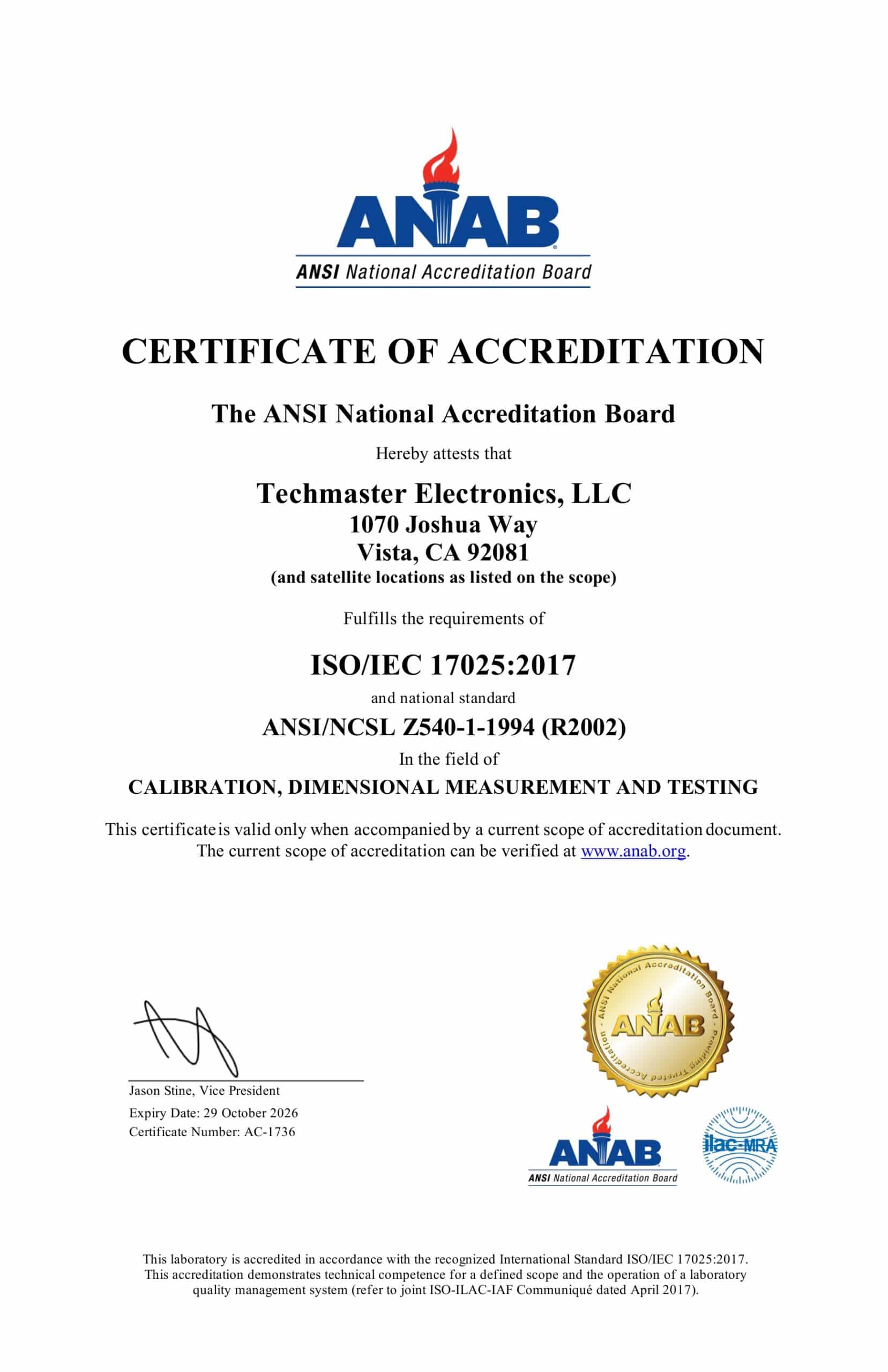
Yes. Techmaster Electronics is ISO/IEC 17025:2017 accredited by ANAB (Certificate AC-1736). Every handheld digital multimeter calibration is NIST-traceable and issued with a full measurement-uncertainty budget.
What is the turnaround for handheld digital multimeter calibration?
Standard turnaround is 5 business days, with 1–2 business-day expedite available. On-site calibration removes shipping time entirely for handheld digital multimeters that can’t leave the floor.
Do you calibrate handheld digital multimeters on-site or in-lab?
Both. Techmaster runs five US labs (Vista CA, Santa Clara CA, Orlando FL, San Antonio TX, Holly Springs NC) and offers nationwide on-site handheld digital multimeter calibration to minimize downtime.

Khanh Nguyen is the Marketing Manager at Techmaster Electronics, a B2B marketing leader covering the test, measurement, and ISO/IEC 17025 accredited calibration industry across the US and Vietnam markets.