
Electricity Meter Calibration
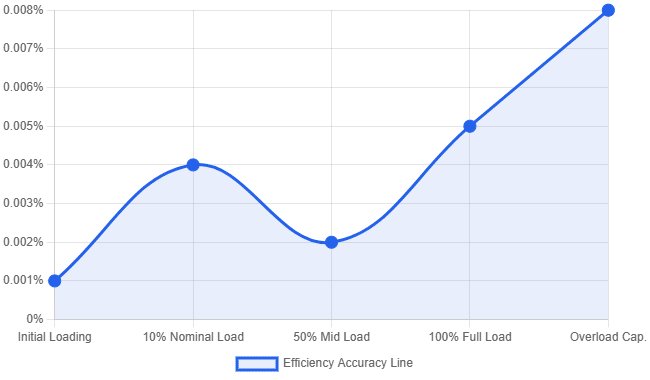
Accuracy across the range
How Electricity Meter calibration works
- Intake & visual inspection
- Environmental stabilization
- As-found measurement
- Comparison to NIST-traceable standards
- Adjustment if required
- As-left results & certificate
Your calibration, covered
In-lab vs on-site calibration
In-lab calibration
- Accredited bench with full reference standards
- Best achievable measurement uncertainties
- Pickup & return logistics handled
- Ideal for precision and reference work
On-site calibration
- We calibrate the Electricity Meter at your facility
- No shipping risk or transit downtime
- As-found data captured before any move
- Ideal for fixed, large or sensitive assets
In-depth guide
Undetected meter drift can skew energy readings and cause massive billing disputes or financial losses. Running a routine Electrical meter calibration program protects industrial facilities from costly audit failures and measurement errors. In the end, systematic electricity meter calibration is the easiest way to secure accurate billing, grid stability, and regulatory compliance.
1. Device Overview and Industrial Role
What Is the Function of High-Precision Electricity Meters?
High-precision industrial electricity meters measure, record, and transmit critical active, reactive, and apparent energy parameters across complex power networks. These devices convert analog current and voltage waves into digital energy metrics to calculate exact usage patterns. In addition, precise measurement prevents significant transactional discrepancies between energy producers, utility operators, and industrial consumers.Why Is Industrial Metering Critical for Grid Stability?
Industrial metering systems serve as the primary cash registers for power utilities and heavy manufacturing plants. Therefore, any minor calibration drift can cause major financial deficits or disrupt systemic grid load balancing efforts. Implementing continuous Electric energy meter calibration ensures that measurement hardware correctly registers power fluctuations and harmonics.2. Why electricity meter calibration Mitigates Financial and Regulatory Risks
Electricity meter calibration eliminates measurement drift by aligning the operational parameters of a device with recognized international reference standards. This process ensures the meter operates within its engineered accuracy class, preventing costly billing disputes and severe legal penalties. In the end, systematic calibration guarantees that utilities and industrial facilities maintain absolute transparency during energy transactions. In addition, undetected drift in solid-state meters can skew power quality assessments across the entire local network. This distortion often leads to incorrect harmonic analyses, which can damage expensive power factor correction capacitors. Therefore, consistent calibration acts as a critical preventive measure against premature electrical hardware failure.3. Step-by-Step: How to Ensure Your Device Meets Global Standards
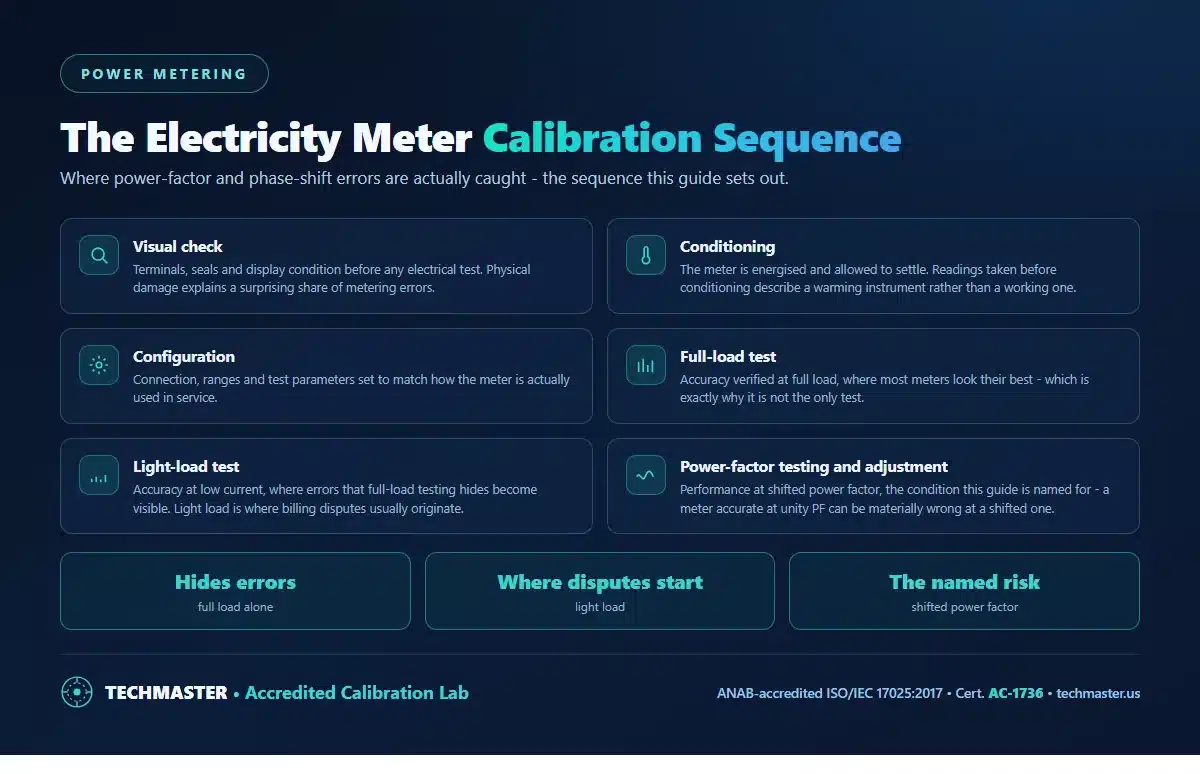
A standard calibration process compares the Device Under Test against a highly stable electrical source and reference standard. Technicians typically utilize a Fluke 6105A Power Calibrator alongside a Radian RD-30 Reference Standard to perform these comparisons. This standardized method verifies that the meter responds accurately under diverse electrical load conditions.7-Step Precision Workflow
The standardized sequence for Fluke & Radian reference comparisons.
Visual Check
Inspection of enclosure and seal integrity.
Conditioning
30-min thermal stabilization period.
Configuration
Setting nominal voltage/current source.
Full-Load Test
Unity Power Factor accuracy verification.
Light-Load Test
Accuracy at 10% nominal current value.
PF Adjustment
Testing lagging phase angle errors.
Data Correction
Statistical calculation of error percentage against permissible limits.
- Step 1: Visual Inspection and Safety Verification. Examine the meter enclosure, terminal blocks, and seal points for signs of physical degradation or tampering.
- Step 2: Pre-Conditioning. Power on the calibrator and the meter under test, allowing them to stabilize in a temperature-controlled environment for at least thirty minutes.
- Step 3: Configuration of Test Parameters. Program the Fluke 6105A to deliver the specific nominal voltages and currents required by the meter design specifications.
- Step 4: Full-Load Testing. Apply nominal test current at unity power factor, recording the error percentage over a predetermined number of energy pulses.
- Step 5: Light-Load Testing. Reduce the applied current to ten percent of nominal value to evaluate the accuracy of the meter under low-load conditions.
- Step 6: Power Factor Adjustments. Shift the phase angle to sixty degrees lagging to test active energy accuracy under inductive load scenarios.
- Step 7: Data Logging and Correction. Record all measured deviation values and compare them against the maximum permissible error limits of the meter.
Metrological Traceability
The chain of comparison from NMI to field units.
Measurement Ranges
Traceability and Measurement Uncertainty in Metrology
Establishing a traceable pathway through electricity meter calibration ensures compliance with rigorous international standards. Traceability links your daily field measurements directly back to national standards via an unbroken chain of accredited laboratory comparisons. Consequently, every calibration certificate must explicitly document this traceable connection to assure audit readiness. When calculating measurement uncertainty, metrologists must account for several distinct physical and electrical components. These variables include reference standard uncertainty, ambient temperature variations, connection resistance, and the resolution limits of the meter. Therefore, calculating standard deviations using recognized statistical models is necessary to determine the expanded uncertainty value.Achieving Technical Compliance Through Accredited Standards
Achieving a certified state through ISO 17025 electric meter calibration is critical for utility compliance. This standard ensures that the calibration laboratory possesses the required technical competence, equipment, and quality systems. In addition, complying with ANSI C12.20 or IEC 62053-22 establishes a legally defensible foundation during regulatory audits. Organizations must prioritize ISO 17025 electric meter calibration to maintain legally defensible data records. These international regulations demand that laboratories use validated procedures and estimate measurement uncertainties rigorously. Consequently, adhering to these standards guarantees that your energy measurement data will withstand intense commercial scrutiny.4. Maintenance and Reliability
Integrating Maintenance With Regular Electrical meter calibration
Integrating standard maintenance with regular Electrical meter calibration reduces the probability of sudden equipment breakdown. Technicians must clean dirty terminal connections, check for loose terminal screws, and inspect wire insulation integrity. Additionally, updating firmware on solid-state meters prevents software anomalies from impacting measurement accuracy.- Clean the meter casing with a dry, anti-static cloth to prevent dust accumulation.
- Verify the integrity of all terminal screws using calibrated torque screwdrivers to avoid resistive heating.
- Inspect active communication ports for signs of port degradation or oxidation.
- Review system error logs to detect internal diagnostic flags before they cause total failure.
Establishing Environmental Control for Electric energy meter calibration
Establishing a clear schedule for Electric energy meter calibration ensures high-precision equipment remains stable year-round. Environmental parameters must be controlled strictly during ISO 17025 electric meter calibration to avoid compounding errors. Even minor ambient temperature shifts can alter internal circuit resistances, introducing unwanted drift into your final calibration metrics. Therefore, calibration laboratories must operate within strict temperature limits, typically twenty-three degrees Celsius plus or minus two degrees. Relative humidity should remain below sixty percent to prevent moisture condensation on delicate internal components. Maintaining these stable conditions is essential for securing highly repeatable and reproducible measurement outcomes.5. Mandatory Technical Assets
Definition Blocks
Definition: Measurement Drift The slow, continuous change in the metrological characteristics of a measuring instrument over time. This phenomenon is typically caused by component aging, environmental stress, or physical wear, resulting in a systematic deviation from the true value.
Definition: Metrological Traceability The property of a measurement result whereby the result can be related to a reference through a documented unbroken chain of calibrations, each contributing to the measurement uncertainty. This chain establishes a direct connection to international standard units.
Technical Data Table
| Model Class | Equipment Type | Operational Range | Reference Calibration Tolerance | Recommended Verification Test Points |
|---|---|---|---|---|
| Fluke 6105A | Power Calibrator | 10 to 1000 Volts | plus or minus 0.005 percent | 120 Volts, 240 Volts, 480 Volts |
| Fluke 6105A | Power Calibrator | 0.01 to 21 Amperes | plus or minus 0.007 percent | 1 Ampere, 5 Amperes, 10 Amperes |
| Radian RD-30 | Reference Standard | Up to 1200 Volts | plus or minus 0.01 percent | Unity and 0.5 Lagging Power Factors |
| Landis+Gyr E650 | Industrial Energy Meter | Class 0.2S Accuracy | plus or minus 0.2 percent | Nominal Current, Light Load, High Load |
6. FAQ
What is the recommended calibration interval for Fluke 6105A?
The recommended calibration interval for the Fluke 6105A Power Calibrator is twelve months under normal operating conditions. This interval guarantees that the instrument maintains its high-precision specifications. However, more frequent checks are advisable if the calibrator experiences heavy usage, physical transport, or extreme environmental variations. In addition, verifying standard performance between formal calibrations using a reference standard like the Radian RD-30 helps catch early drift. This intermediate verification protocol protects your entire metrology pipeline from cascading calibration errors.How does temperature affect electric energy meter calibration?
Temperature directly impacts the electrical resistance of shunt resistors and the gain stability of analog-to-digital converters inside energy meters. Uncontrolled temperature fluctuations introduce measurement errors that can invalidate calibration results. Therefore, standardizing ambient temperature during Electric energy meter calibration is critical to securing accurate performance metrics. Even high-end solid-state meters display small temperature coefficients that alter their energy calculation algorithms outside standard ranges. Calibration technicians must document environmental conditions during testing to ensure standard temperature corrections are applied accurately.Why is ISO 17025 electric meter calibration required?
ISO 17025 electric meter calibration is required to prove that a testing laboratory produces technically valid and universally accepted results. This accreditation verifies that the calibration process, equipment, and technicians comply with rigorous international metrological requirements. Consequently, it protects organizations from regulatory penalties, legal challenges, and commercial disputes. Without this level of accreditation, calibration certificates may not be recognized by international regulatory agencies. Therefore, selecting an accredited laboratory is essential for companies engaged in cross-border energy transactions.How is measurement uncertainty calculated for electricity meters?
Measurement uncertainty is calculated by combining multiple statistical components, including reference standard uncertainty, repeatability trials, temperature drift, and equipment resolution. These individual inputs are combined using the root-sum-of-squares method to determine the combined standard uncertainty. Finally, this value is multiplied by a coverage factor to establish an expanded uncertainty profile. This systematic approach ensures that the reported calibration values represent true physical limits. In the end, understanding these calculations allows engineers to confidently evaluate whether a meter meets its specific accuracy class.What are the consequences of ignoring undetected meter drift?
Ignoring undetected meter drift can lead to severe financial billing errors, high regulatory fines, and damaged corporate reputations. Over time, physical component aging causes meters to under-register or over-register actual energy usage. Consequently, industrial facilities face unexpected operational losses, while utilities lose valuable revenue streams. In addition, regulatory agencies impose massive penalties when meters fail compliance audits during random field inspections. Regular calibration prevents these systemic risks, securing long-term operational and financial stability for your organization.7. Conclusion
In the end, proactive electricity meter calibration serves as the primary line of defense against measurement inaccuracies. Partnering with an accredited laboratory for your ISO 17025 electric meter calibration ensures the highest level of technical integrity and compliance. By addressing minor measurement drifts before they escalate, organizations safeguard their financial operations and maintain standard compliance. Do not wait for a regulatory audit or a billing dispute to discover your measurement inaccuracies; schedule your comprehensive technical calibration evaluation today to secure your power network assets.Frequently asked questions
What is Electricity Meter Calibration?
How often should a Electricity Meter be calibrated?
What standards apply to Electricity Meter Calibration?
What is included on the certificate?
Can you calibrate the Electricity Meter on-site?
Need Electricity Meter calibration?
ANAB-accredited, NIST-traceable, fast turnaround, in-lab or on-site across the USA.
Contact us for a quoteReferences & industry standards
- ISO/IEC 17025 testing & calibration laboratory requirements
- NIST calibration services and measurement traceability
- A2LA / ANAB accreditation for calibration laboratories
External standards bodies. Techmaster Electronics is an ISO/IEC 17025-accredited, NIST-traceable calibration laboratory.

Khanh Nguyen is the Marketing Manager at Techmaster Electronics, a B2B marketing leader covering the test, measurement, and ISO/IEC 17025 accredited calibration industry across the US and Vietnam markets.