
Fluke vs Keysight Handheld Digital Multimeter: Which Brand Is Better?
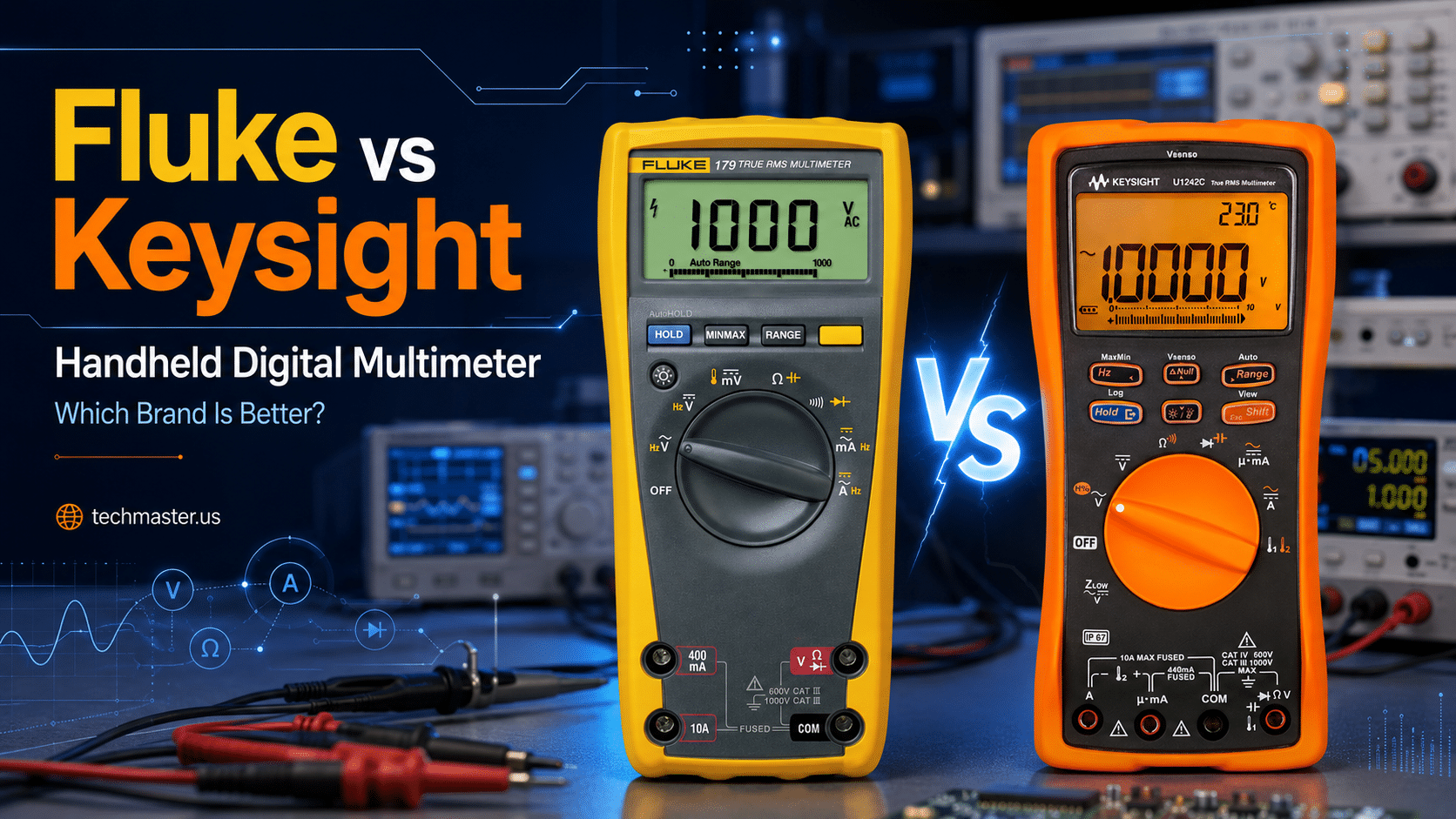
Choosing between a fluke vs keysight handheld digital multimeter is one of the most critical decisions for electrical engineers, field technicians, and quality laboratory managers. Both manufacturers produce top-tier, industrial-grade test instruments, but they approach design, measurement capabilities, and user experience with distinct engineering philosophies. Fluke has earned a decades-long reputation as the gold standard for ruggedness and field reliability, while Keysight Technologies (originating from Agilent and Hewlett-Packard) brings laboratory-grade precision, advanced data logging, and high-resolution display innovations into portable formats.
Whether you are performing routine plant maintenance, troubleshooting complex electronics, or managing an aerospace testing facility, selecting the right instrument impacts both operational efficiency and measurement integrity. In this guide, we evaluate the performance, features, and specs of both brands, while examining why routine, accredited calibration is crucial for maintaining accuracy over time.
1. What Is a Handheld Digital Multimeter?
A handheld digital multimeter (DMM) is a compact, portable diagnostic tool designed to measure fundamental electrical parameters, voltage (V), current (A), and resistance ($\Omega$). High-end handheld DMMs extend far beyond basic electrical checks, offering True-RMS AC measurement capabilities, capacitance, frequency, temperature, low-impedance (LoZ) modes, and low-pass filtering for variable frequency drives (VFDs).
When comparing a Keysight handheld DMM to a flagship Fluke multimeter, you are evaluating safety-rated CAT III / CAT IV instruments capable of withstanding industrial transients. Key product lines defining this comparison include:
-
Fluke Industrial DMMs: Legendary models like the Fluke 87V (the industry-standard 4.5-digit workhorse) and the Fluke 289 (a high-precision data logging multimeter).
-
Keysight Industrial DMMs: High-performance units like the Keysight U1282A (60,000-count, IP67-rated logging meter) and the U1273AX (featuring an OLED display capable of operating in sub-zero environments).
2. Why Fluke vs Keysight Handheld Digital Multimeter Selection Matters
Selecting the right handheld multimeter directly influences user safety, diagnostic speed, and data accuracy. In high-energy industrial panels or delicate R&D environments, instrument performance dictates project outcomes.
-
Safety and Transient Protection: Both brands test their meters extensively to meet CAT III 1000V and CAT IV 600V standards. Their internal input protection, utilizing high-energy ceramic fuses, metal-oxide varistors (MOVs), and spark gaps, prevents explosive arc flashes during unexpected voltage spikes.
-
Measurement Accuracy and Resolution: Resolution determines how small a measurement change the meter can detect. Keysight handhelds frequently offer higher display counts (such as 30,000 to 60,000 counts) at competitive price points, whereas Fluke focuses on ultra-stable, highly repeatable readings tuned for industrial noise immunity.
-
Risk Mitigation: Applying an inaccurate or drifting meter during production verification can lead to false passes, undetected circuit defects, or non-compliance with quality standards.
3. Fluke vs Keysight: Direct Head-to-Head Comparison
Flagship Model Comparison
To understand which brand better serves your facility, examine how their flagship models stack up across core operational parameters:
| Feature / Capability | Fluke 87V / Fluke 289 | Keysight U1282A / U1273AX |
|---|---|---|
| Display Resolution | 20,000 counts (87V) / 50,000 counts (289) | 30,000 counts (U1273AX) / 60,000 counts (U1282A) |
| Basic DC Voltage Accuracy | 0.05% (87V) / 0.025% (289) | 0.025% (U1282A) |
| Display Type | High-contrast Monochrome LCD with backlight | OLED (U1273AX) or High-contrast LCD |
| Ingress Protection (IP) | IP30 / IP54 (Fluke 28V is IP67) | IP67 (Dustproof and Waterproof – U1280 Series) |
| Battery Life | ~800 hours (87V alkaline) | ~800 hours (U1282A) / ~10 hours (OLED models) |
| Continuity Response | Instantaneous latching beeper | Fast beeper with visual flashing backlight |
| Data Connectivity | Fluke Connect® via IR-to-USB / Wireless | Bluetooth® (U1117A) & USB via Keysight Meter Logger |
-
Build Quality and Environmental Durability
Fluke multimeters are legendary for physical resilience. The heavy-duty yellow overmolding, drop-tested up to 3 meters (10 feet), allows Fluke meters to survive falling off ladders or rolling around in heavy field toolboxes.
Keysight, however, closed the durability gap with its U1280 series. Offering IP67 sealing against water and dust intrusion alongside 3-meter drop protection, Keysight multimeters are built to withstand severe washdown environments, chemical plants, and outdoor weather without risking internal corrosion.
-
Display Technology and Ergonomics
Keysight pioneered the integration of Organic LED (OLED) screens into handheld multimeters (e.g., U1253B and U1273AX). OLED displays deliver a 160-degree viewing angle and sharp contrast even in complete darkness or sub-zero conditions (down to -40°C), where liquid crystal displays (LCDs) freeze and slow down. The trade-off is higher battery consumption.
Fluke utilizes custom high-contrast monochrome LCDs with white LED backlighting. While less dramatic than OLEDs, Fluke’s displays offer exceptional readability under direct sunlight and preserve battery life for hundreds of operational hours.
-
Data Logging and Connectivity
If extensive field data logging is required, Keysight meters often provide an edge out of the box. The Keysight U1282A includes internal memory logging alongside PC connectivity options. Paired with Keysight’s handheld meter logger software, users can perform automated trend analysis and real-time data export.
Fluke offers advanced logging through the Fluke 289 with TrendCapture, a graphical interface allowing users to view logged data directly on the meter screen without downloading it to a computer. For remote monitoring, Fluke Connect enables wireless data sharing to smart devices, ideal for arc-flash safety zones.
-
Continuity and Diagnostic Speed
Field technicians rely heavily on continuity testing. Fluke is famous for its near-instantaneous latching continuity beeper, it registers contacts instantly without lag. Early Keysight models experienced slight beeper delays, though modern U1270 and U1280 series models have rectified this, adding visual continuity indicators (flashing screen backlights) for loud manufacturing environments.
4. Common Applications
Industrial DMMs are essential assets across diverse technical sectors:
-
Electronics Manufacturing: Engineers use high-count Keysight multimeters for benchtop troubleshooting, measuring microamp sensor currents, and verifying tight component tolerances.
-
Aerospace and Defense: Flight line mechanics and avionics technicians rely on Fluke’s rugged construction and CAT IV safety ratings for ground support and power bus verification.
-
Industrial Automation: Maintenance teams utilize low-pass filter modes on Fluke and Keysight meters to accurately measure noisy drive voltages on Variable Frequency Drives (VFDs).
-
Pharmaceutical and Cleanroom Facilities: Facilities engineers use calibrated handheld DMMs to verify environmental sensors, process loop transmitters (4-20 mA), and automated control valves.
5. Calibration Standards and Traceability
No matter which brand you select, all digital multimeters experience component drift over time. Aging internal voltage references, precision resistor networks, and thermal stresses cause readings to shift. Performing regular handheld digital multimeter calibration maintains instrument accuracy within manufacturer-specified limits.
To meet stringent audit standards (AS9100, ISO 9001, IATF 16949, or FDA regulations), calibration must be executed under an ISO/IEC 17025 accredited calibration system. An accredited calibration certificate provides:
-
Direct traceability to national standards like the National Institute of Standards and Technology (NIST) or SI units.
-
Documented “As-Found” and “As-Left” measurement data across all functions (AC/DC voltage, current, resistance, capacitance).
-
A comprehensive measurement uncertainty calculation for every test point.
Whether managing Fluke digital multimeter calibration or verifying a high-precision Keysight meter, accredited calibration ensures your measurement results hold up under regulatory scrutiny.
6. Common Issues Found During Calibration
During routine calibration at an accredited laboratory, metrologists frequently detect subtle errors that field operators might miss:
-
DC Voltage Reference Drift: Micro-volts of drift in internal Zener references lead to systematic measurement errors across all DC ranges.
-
Non-Linear AC Response: High-frequency AC RMS converter circuits can lose linearity, causing inaccurate readings on non-sinusoidal waveforms or high-frequency motor drives.
-
Current Range Degradation: Blown or partially damaged input protection diodes and shunts, often caused by accidental high-voltage connection while set to the current jack, result in open circuits or erratic current readings.
-
Rotary Switch and Terminal Wear: Oxidation or physical degradation on internal switch contacts can introduce contact resistance, skewing low-ohm measurements.
7. How Often Should This Equipment Be Calibrated?
The standard recommended calibration interval for both Fluke and Keysight handheld multimeters is 12 months.
However, specific calibration intervals should be determined based on:
-
Environmental Conditions: Instruments exposed to high vibration, extreme ambient temperatures, or high humidity require more frequent checks (e.g., 6-month cycles).
-
Usage Intensity: Meters deployed daily on production lines experience faster mechanical wear on dials and terminals than lab-bound units.
-
Criticality of Application: If an out-of-tolerance meter requires a product recall or invalidates quality batches, shorter calibration intervals mitigate financial and operational risk.
8. What to Look for in a Calibration Provider
Selecting a qualified laboratory for your electrical calibration service ensures your multimeters receive rigorous evaluation rather than a simple pass/fail functional check. Evaluate potential providers using these key criteria:
-
ISO/IEC 17025 Accreditation: Verify that the lab’s formal Scope of Accreditation covers high-resolution electrical parameter ranges with low measurement uncertainties.
-
Proper Reference Standards: The lab must utilize high-performance multi-product calibrators (such as the Fluke 5522A or 5730A) featuring a Test Uncertainty Ratio (TUR) of 4:1 or better relative to the meter under test.
-
Turnaround Time and Logistics: Choose a facility that guarantees fast, reliable turnarounds (e.g., 5 business days or on-site service) to minimize plant downtime.
-
Digital Documentation: Ensure secure access to an online portal where calibration certificates, equipment histories, and recall notifications are readily accessible.
9. Why Choose Techmaster Electronics?
When maintaining mission-critical equipment, Techmaster Electronics provides the experience, technical capability, and compliance support required by leading industrial organizations. As an ANAB-accredited ISO/IEC 17025 laboratory, Techmaster offers complete calibration support for Fluke, Keysight, Keithley, Tektronix, and other premier T&M brands.
Techmaster delivers reliable, accredited services tailored to your operations:
-
Comprehensive Capabilities: Our metrologists handle everything from general-purpose field meters to 6.5-digit bench multimeters.
-
Audit-Ready Documentation: Every instrument receives a complete certificate featuring NIST traceability, measurement uncertainty budgets, and as-found/as-left data.
-
Flexible Service Options: Benefit from our standard 5-day turnaround times, expedited local service, or nationwide on-site calibration teams.
To maintain your test fleet, partner with Techmaster for your complete Calibration service needs.
10. Conclusion
In the fluke vs keysight handheld digital multimeter comparison, there is no single winner, only the best fit for your application. Fluke remains the top choice for field technicians prioritizing extreme ruggedness, intuitive operation, and proven longevity. Keysight shines for engineers seeking higher display resolution, advanced OLED visibility, extensive data logging capabilities, and IP67 environmental sealing.
Regardless of which brand powers your facility, routine ISO/IEC 17025 accredited calibration is essential to preserve measurement confidence and guarantee compliance.
11. FAQ Section
Frequently Asked Questions
Expert answers regarding digital multimeter selection, calibration standards, and ensuring compliance in your facility.
Ready to schedule your calibration?
Keep your equipment accurate and audit-ready.
References & industry standards
- ISO/IEC 17025 testing & calibration laboratory requirements
- NIST calibration services and measurement traceability
- NIST Time and Frequency Division
- A2LA / ANAB accreditation for calibration laboratories
External standards bodies. Techmaster Electronics is an ISO/IEC 17025-accredited, NIST-traceable calibration laboratory.
Frequently asked questions
What is handheld digital multimeter calibration?
Handheld Digital Multimeter Calibration is the documented comparison of a handheld digital multimeter against NIST-traceable reference standards under ISO/IEC 17025. It quantifies the handheld digital multimeter’s error and measurement uncertainty and confirms it performs within tolerance, with as-found and as-left data on the certificate.
How often should a handheld digital multimeter be calibrated?
Most quality systems calibrate a handheld digital multimeter every 12 months, or sooner after repair, overload, or before critical measurements. Set your interval from the manufacturer spec and your ISO 9001 / 13485 / AS9100 program and drift history.
Is Techmaster’s handheld digital multimeter calibration ISO 17025 accredited?
Yes. Techmaster Electronics is ISO/IEC 17025:2017 accredited by ANAB (Certificate AC-1736). Every handheld digital multimeter calibration is NIST-traceable and issued with a full measurement-uncertainty budget.
What is the turnaround for handheld digital multimeter calibration?
Standard turnaround is 5 business days, with 1–2 business-day expedite available. On-site calibration removes shipping time entirely for handheld digital multimeters that can’t leave the floor.
Do you calibrate handheld digital multimeters on-site or in-lab?
Both. Techmaster runs five US labs (Vista CA, Santa Clara CA, Orlando FL, San Antonio TX, Holly Springs NC) and offers nationwide on-site handheld digital multimeter calibration to minimize downtime.

Khanh Nguyen is the Marketing Manager at Techmaster Electronics, a B2B marketing leader covering the test, measurement, and ISO/IEC 17025 accredited calibration industry across the US and Vietnam markets.