
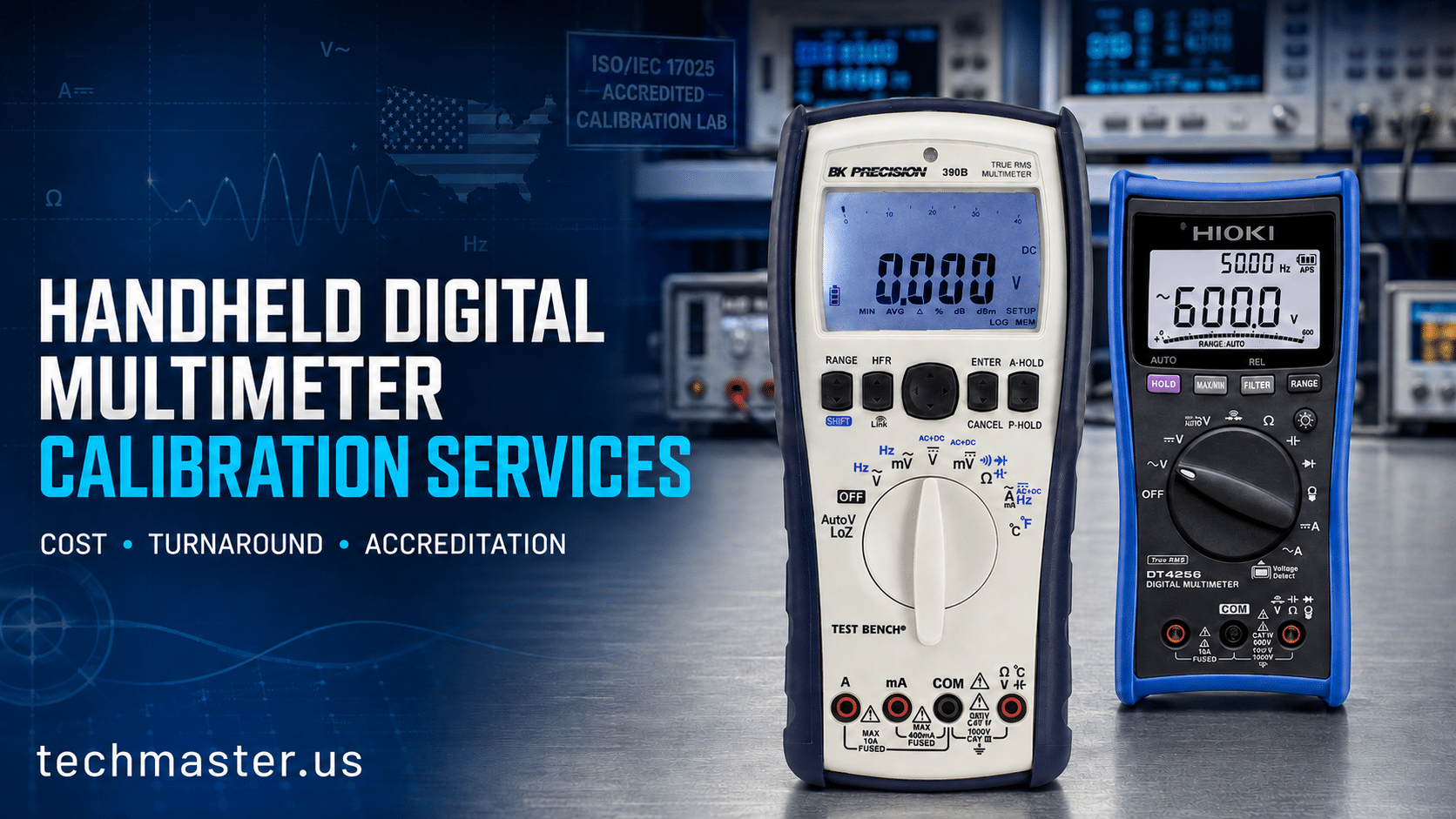
Handheld Digital Multimeter Calibration Services: Ensuring Electrical Accuracy
1. What Is Handheld Digital Multimeter Calibration?
2. Why Handheld Digital Multimeter Calibration Services Matter
-
Measurement Accuracy: Calibration guarantees that a 10.00V reading on your multimeter actually represents 10.00V, preventing incorrect adjustments on manufacturing lines or aerospace components.
-
Safety and Risk Reduction: Working with high voltage systems requires absolute certainty. False readings can lead technicians to mistakenly assume a live wire is dead, resulting in severe safety hazards.
-
Regulatory Compliance: Regulated industries (such as pharmaceuticals, aerospace, and medical device manufacturing) require documented proof that test and measurement equipment meets stringent quality standards.
-
Product Quality: In electronics manufacturing, an out-of-tolerance multimeter can result in defective components passing quality control, leading to field failures and expensive product recalls.
3. Common Applications
-
Manufacturing and Industrial Automation: Technicians use multimeters to troubleshoot programmable logic controllers (PLCs), motor drives, and sensor inputs.
-
Aerospace and Defense: Used for avionics testing, ground support equipment maintenance, and flight control system diagnostics where precision is non-negotiable.
-
Medical Device Manufacturing: Ensures that the electrical systems inside life-saving medical equipment function at exactly the specified voltage and current.
-
Telecommunications: Field service engineers rely on portable DMMs to measure resistance and voltage on remote cellular towers and networking equipment.
-
HVAC and Facilities Maintenance: Used to diagnose faulty relays, verify capacitor health, and ensure safe power delivery in commercial buildings.
4. Calibration Standards and Traceability
Evaluating Your Calibration Provider
When evaluating a provider for your instruments, not just any check will do. The calibration must adhere to strict international standards to guarantee accuracy and compliance.
NIST Traceable
The calibration must be traceable to a national metrology institute. A NIST traceable multimeter calibration ensures an unbroken chain of comparisons linking your multimeter’s measurements directly to the National Institute of Standards and Technology.
5. Common Issues Found During Calibration
-
Zero Offset Drift: The multimeter fails to return to zero when the test leads are shorted together, often caused by internal component aging or temperature fluctuations.
-
Blown Internal Fuses: Often the result of a technician accidentally measuring voltage while the multimeter is set to measure current. While the meter may still power on, certain functions will fail to read correctly.
-
Out-of-Tolerance Readings at High Ranges: A multimeter might accurately measure 5V DC but fail significantly when measuring 1000V DC due to resistor degradation.
-
Switch Contact Wear: Dirt, debris, or mechanical wear on the rotary dial can cause erratic resistance readings or intermittent connections.
-
Test Lead Degradation: While technically separate from the multimeter, frayed or highly resistive test leads frequently cause false readings, especially in low-resistance applications.
6. How Often Should This Equipment Be Calibrated?
Determining the Optimal Schedule
Calibration intervals are not a one-size-fits-all metric. While there is a standard best practice, you must evaluate your specific operating environment.
High-Stress Use
You may need to calibrate more frequently if the equipment is subjected to heavy daily use, extreme temperature swings, or mechanical shock.
The Standard
For most general-purpose manufacturing and electrical work, an annual calibration interval is the standard best practice.
Controlled Labs
Conversely, a multimeter kept in a controlled laboratory environment and used infrequently might only require calibration every 24 months.
Quality Rule: Always consult the manufacturer’s recommendations and your organization’s internal ISO 9001 or AS9100 quality procedures to determine the optimal schedule.
Logistics: Cost & Turnaround Time
When scheduling service, managers must consider the digital multimeter calibration cost and turnaround time. Expedited and on-site options are often available to minimize costly operational downtime.
7. What to Look for in a Calibration Provider
-
Scope of Accreditation: Ensure the lab’s ISO/IEC 17025 scope covers the specific electrical parameters, ranges, and measurement uncertainties required for your exact multimeter model.
-
Technical Capability: The lab must have the ability to service all major brands. Whether you require a Fluke multimeter calibration service, Keysight, or Klein Tools, the provider should have the proper automated procedures and reference calibrators.
-
Logistics and Turnaround: Look for providers that offer fast turnaround times, local pickup and delivery, or a customer portal to track assets and download certificates easily.
-
On-Site Service Capabilities: If you manage a large fleet of multimeters, shipping them out may be unfeasible. Find a provider capable of sending technicians to your facility to calibrate the instruments in their real-world environment.
8. Need Equipment Temporarily? Explore Our Renting Service
9. Why Choose Techmaster Electronics?
10. Conclusion
11. FAQ Section
Frequently Asked Questions
Find quick answers about digital multimeter calibration, compliance standards, and our professional services.
References & industry standards
- ISO/IEC 17025 testing & calibration laboratory requirements
- NIST calibration services and measurement traceability
- NIST Time and Frequency Division
- A2LA / ANAB accreditation for calibration laboratories
External standards bodies. Techmaster Electronics is an ISO/IEC 17025-accredited, NIST-traceable calibration laboratory.
Frequently asked questions
What is handheld digital multimeter calibration?
Handheld Digital Multimeter Calibration is the documented comparison of a handheld digital multimeter against NIST-traceable reference standards under ISO/IEC 17025. It quantifies the handheld digital multimeter’s error and measurement uncertainty and confirms it performs within tolerance, with as-found and as-left data on the certificate.
How often should a handheld digital multimeter be calibrated?
Most quality systems calibrate a handheld digital multimeter every 12 months, or sooner after repair, overload, or before critical measurements. Set your interval from the manufacturer spec and your ISO 9001 / 13485 / AS9100 program and drift history.
Is Techmaster’s handheld digital multimeter calibration ISO 17025 accredited?
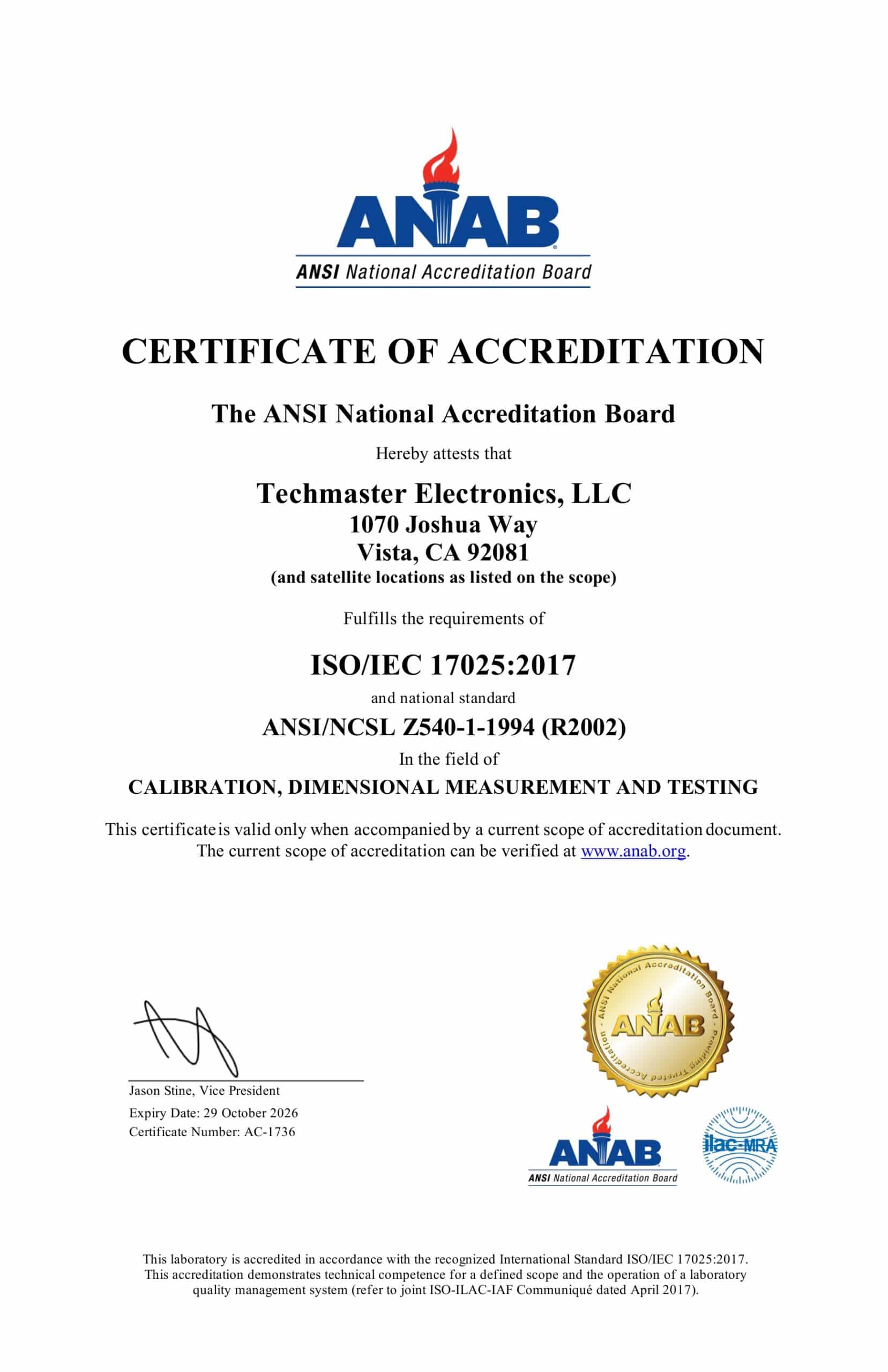
Yes. Techmaster Electronics is ISO/IEC 17025:2017 accredited by ANAB (Certificate AC-1736). Every handheld digital multimeter calibration is NIST-traceable and issued with a full measurement-uncertainty budget.
What is the turnaround for handheld digital multimeter calibration?
Standard turnaround is 5 business days, with 1–2 business-day expedite available. On-site calibration removes shipping time entirely for handheld digital multimeters that can’t leave the floor.
Do you calibrate handheld digital multimeters on-site or in-lab?
Both. Techmaster runs five US labs (Vista CA, Santa Clara CA, Orlando FL, San Antonio TX, Holly Springs NC) and offers nationwide on-site handheld digital multimeter calibration to minimize downtime.

Khanh Nguyen is the Marketing Manager at Techmaster Electronics, a B2B marketing leader covering the test, measurement, and ISO/IEC 17025 accredited calibration industry across the US and Vietnam markets.