
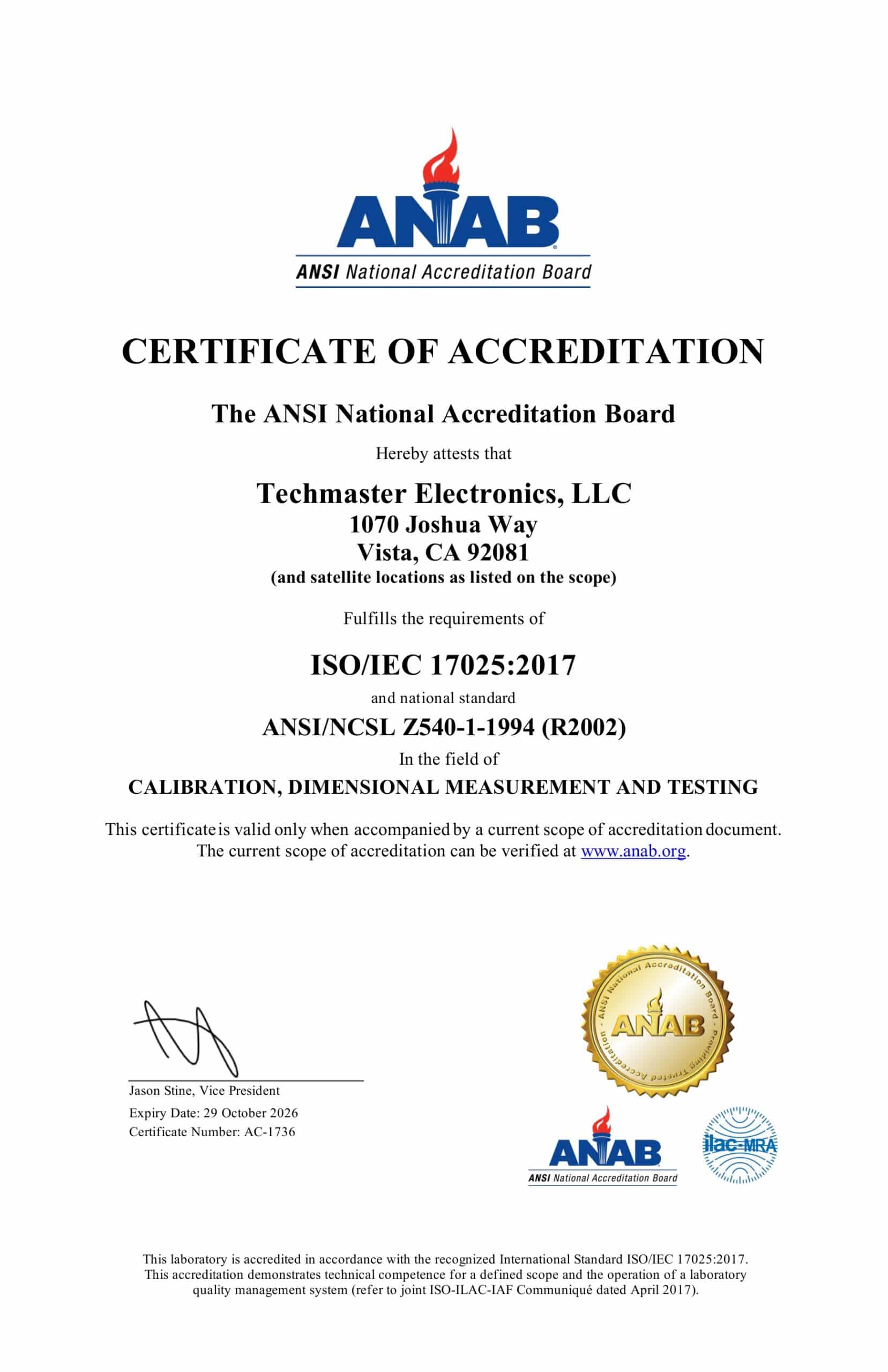
Multifunction Tester Calibration
Accuracy across the range
How Multifunction Tester calibration works
- Intake & visual inspection
- Environmental stabilization
- As-found measurement
- Comparison to NIST-traceable standards
- Adjustment if required
- As-left results & certificate
Your calibration, covered
In-lab vs on-site calibration
In-lab calibration
- Accredited bench with full reference standards
- Best achievable measurement uncertainties
- Pickup & return logistics handled
- Ideal for precision and reference work
On-site calibration
- We calibrate the Multifunction Tester at your facility
- No shipping risk or transit downtime
- As-found data captured before any move
- Ideal for fixed, large or sensitive assets
In-depth guide
What Is a Multifunction Tester?
 Multifunction testers (MFTs) are versatile instruments used to perform a wide range of electrical tests, typically including insulation resistance, loop impedance, RCD testing, continuity, and voltage measurements. These devices are essential tools for:
- Electrical contractors conducting installations
- Facility maintenance teams ensuring system reliability
- QA and safety inspectors verifying code compliance
- Portable handheld testers (used in residential or commercial wiring)
- Advanced bench units (for industrial applications)
- Construction and building inspection
- Manufacturing and production
- Utilities and energy
- Aerospace and defense
Why Calibration Is Critical
Failing to calibrate a multifunction tester can lead to inaccurate readings, and costly consequences:- Safety Hazards: Faulty results may lead to unsafe wiring assumptions, potentially putting people or facilities at risk.
- Failed Audits: Regulatory non-compliance can halt production, delay projects, or result in costly penalties.
- Equipment Damage: Inaccurate testing may cause improper operation of connected systems, amplifying the damage.
- Loss of Trust: QA processes lose credibility without verified instrumentation, eroding confidence internally and with clients.
Emerging Trends in Calibration
The calibration world is evolving, and so are customer expectations. Here’s what’s reshaping the landscape:- Remote monitoring of calibration status via IoT integration, giving maintenance teams live data on when tools are due for recal.
- Cloud-based certificate access, no more scrambling through binders before audits. Access your entire history with a click.
- On-site ISO 17025-accredited calibration, bringing the lab to you, without compromising standards.
- Automated calibration scheduling through CMMS or asset platforms, preventing overdue equipment from slipping through the cracks.
The Calibration Process – Simplified
Calibrating a multifunction tester involves comparing its output to a known reference under controlled conditions. Here’s a simplified process:- Visual inspection & verification, to identify physical damage or issues before measurement.
- Functional checks for each test mode, confirming your device behaves as expected.
- Comparison against reference standards, usually traceable to NIST or another NMI.
- Adjustment or repair, if results fall outside acceptable tolerances, correction steps are taken.
- Issuance of a calibration certificate, with or without data/uncertainties depending on service level.
The Role of Standards – ISO/IEC 17025 & More
 Calibration isn’t credible unless it aligns with international standards. Here’s what matters:
- ISO/IEC 17025 Accreditation: Ensures lab competence and traceability
- ANSI/NCSL Z540.1: Often required by U.S. aerospace and defense sectors
- NIST Traceability: Guarantees reference alignment with U.S. national standards
- Certificates recognized across industries and borders
- Easier audit pass rates and reduced regulatory risk
- Trustworthy measurement uncertainty for critical decisions
How Often Should I Calibrate?
The answer depends on usage conditions, but here are general rules of thumb:- Annual calibration is standard for most applications
- High-frequency use or harsh environments may warrant 6-month intervals
- After repairs, drops, or unusual readings, always recalibrate
Key Considerations When Choosing a Calibration Provider
Selecting a service provider is about more than price. Consider:- Accreditations, Are they ISO/IEC 17025 accredited? Z540.1 compliant?
- Turnaround Time, Can they return equipment in days, not weeks?
- On-site capabilities, Can they calibrate at your location with the same standards?
- Availability of full data & uncertainty reports, Critical for risk management and traceability.
- Reputation in your industry, Do they serve similar clients or applications?
- Integrated support, Can they repair failed units or offer rental replacements?

On-Site vs. Lab-Based Calibration
Both models offer value, but the right fit depends on your priorities:| Feature | On-Site Calibration | Lab-Based Calibration |
|---|---|---|
| Downtime | Minimal | Potential shipping delays |
| Convenience | High | Lower for large fleets |
| Accreditation | Available (ISO 17025) | Fully supported |
| Cost | Variable | Often lower per unit |
| Ideal For | Large systems, urgent needs | Non-critical, batch calibration |
Evaluating Service Levels
Techmaster offers three distinct levels of calibration services:- Commercial Calibration – Basic service with traceability and certificates
- ANSI/NCSL Z540.1 Calibration – For aerospace/defense QA needs
- ISO/IEC 17025 Accredited Calibration – For regulated industries, R&D, and global compliance
- Do I need calibration data for every parameter?
- Will my certificate be accepted internationally?
- How critical is measurement uncertainty to my application?
Why Techmaster? Unique Value for Multifunction Tester Calibration
Techmaster delivers more than just calibration:
- ISO/IEC 17025-accredited on-site calibration across the U.S.
- Free local pickup and delivery for lab-based service
- Fast turnaround times to minimize your operational downtime
- Online certificate portal for instant access & recall alerts
- Automated scheduling to help you stay compliant without the paperwork
- Integrated services: repair, rentals, equipment lifecycle support
- Global network of labs in the U.S., Mexico, Thailand, and Vietnam for international support and scalability
- View and download calibration certificates 24/7
- Receive automated recall notifications
- Manage service schedules and asset histories with ease
FAQs – Multifunction Tester Calibration
1. What is multifunction tester calibration? It’s the process of verifying that your multifunction electrical tester provides accurate measurements, typically by comparing its output to traceable reference standards. 2. How long does calibration take? Lab-based calibration typically takes 3–5 business days. On-site services can be completed in a single visit, depending on equipment quantity and complexity. 3. Do I need ISO 17025 calibration? If you work in regulated industries, export internationally, or want documented measurement uncertainty, then yes, ISO 17025 is essential. 4. Can calibration be done on-site? Yes. Techmaster offers ISO-accredited on-site calibration for multifunction testers, reducing downtime and shipping risk while maintaining full compliance.Get Expert Guidance – Contact Us Today
Looking to calibrate your multifunction tester with minimal disruption? Contact our team today for expert consultation and a calibration plan tailored to your equipment, standards, and operational needs. Whether you manage a single site or multiple facilities, we’ll help you stay compliant, reduce risk, and protect your reputation, one calibration at a time.
Oscilloscope Probe Calibration: Compensation, Attenuation and Bandwidth
Home » Multifunction Tester Calibration That Saves DowntimeAn oscilloscope is only as accurate as the...
Oct

Gauss Meter Calibration: Hall Probes, Reference Magnets and Zero Offset
Home » Multifunction Tester Calibration That Saves Downtime Gauss meters (teslameters) measure magnetic flux density....
Oct
How Often Calibrate a Battery Analyzer?
Home » Multifunction Tester Calibration That Saves Downtime How Often Should You Calibrate a Battery...
Oct
How to Use a Battery Analyzer: Setup, Operation & Best Practices
Home » Multifunction Tester Calibration That Saves Downtime How to Use a Battery Analyzer: Setup,...
Oct
Battery Analyzer Calibration: ISO/IEC 17025 Guide
Home » Multifunction Tester Calibration That Saves Downtime Battery Analyzer Calibration: ISO/IEC 17025 Step-by-Step Guide...
Sep
Bench DMM Calibration: What a 6½-Digit Multimeter Test Actually Covers
What an accredited 6½-digit bench DMM calibration actually covers: 40–100 test points, artifact calibration vs...
Sep
Rogowski Coil Calibration: Why Flexible AC Current Probes Drift
Rogowski coil calibration verifies the coil and its integrator as one system. Here is why...
Aug
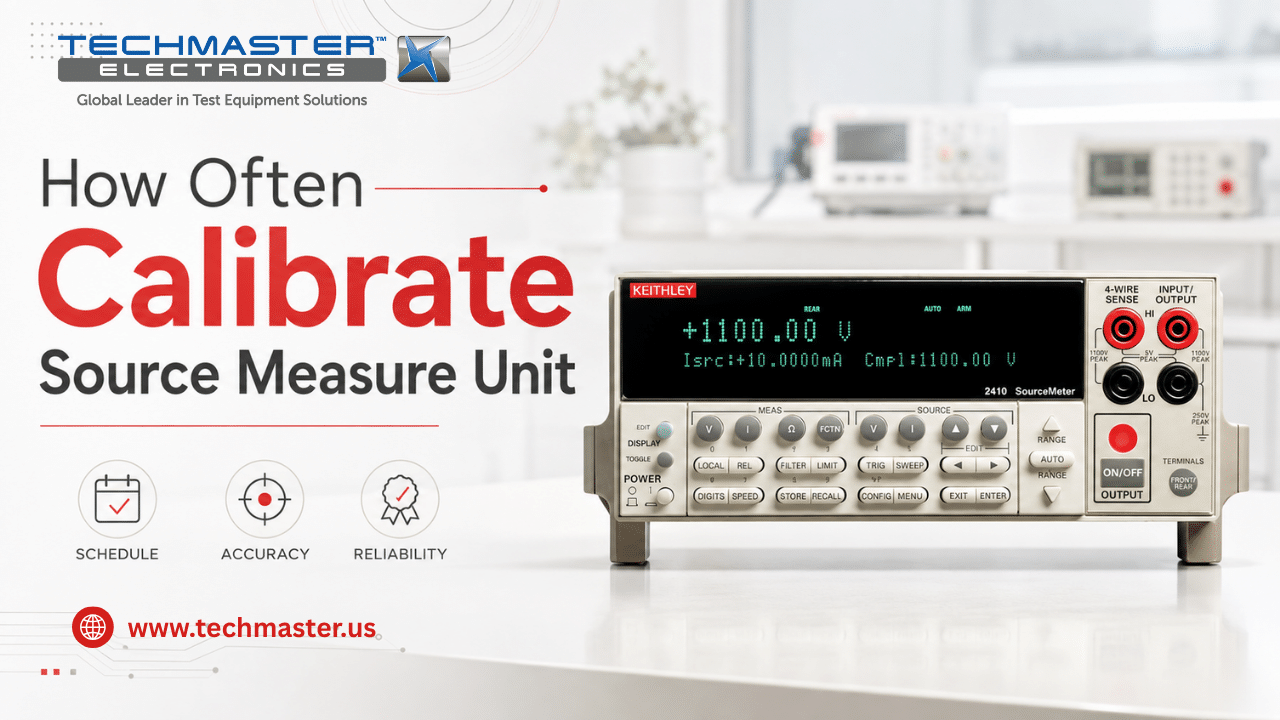
How often to calibrate a Source Measure Unit?
Home » Multifunction Tester Calibration That Saves Downtime Source Measure Unit Calibration: Intervals, Accuracy &...
Aug
Frequently asked questions
What is Multifunction Tester Calibration?
How often should a Multifunction Tester be calibrated?
What standards apply to Multifunction Tester Calibration?
What is included on the certificate?
Can you calibrate the Multifunction Tester on-site?
Need Multifunction Tester calibration?
ANAB-accredited, NIST-traceable, fast turnaround, in-lab or on-site across the USA.
Contact us for a quoteReferences & industry standards
- ISO/IEC 17025 testing & calibration laboratory requirements
- NIST calibration services and measurement traceability
- A2LA / ANAB accreditation for calibration laboratories
External standards bodies. Techmaster Electronics is an ISO/IEC 17025-accredited, NIST-traceable calibration laboratory.

Khanh Nguyen is the Marketing Manager at Techmaster Electronics, a B2B marketing leader covering the test, measurement, and ISO/IEC 17025 accredited calibration industry in the United States.