
How to Use an Impedance Analyzer: Setup, Operation & Best Practices
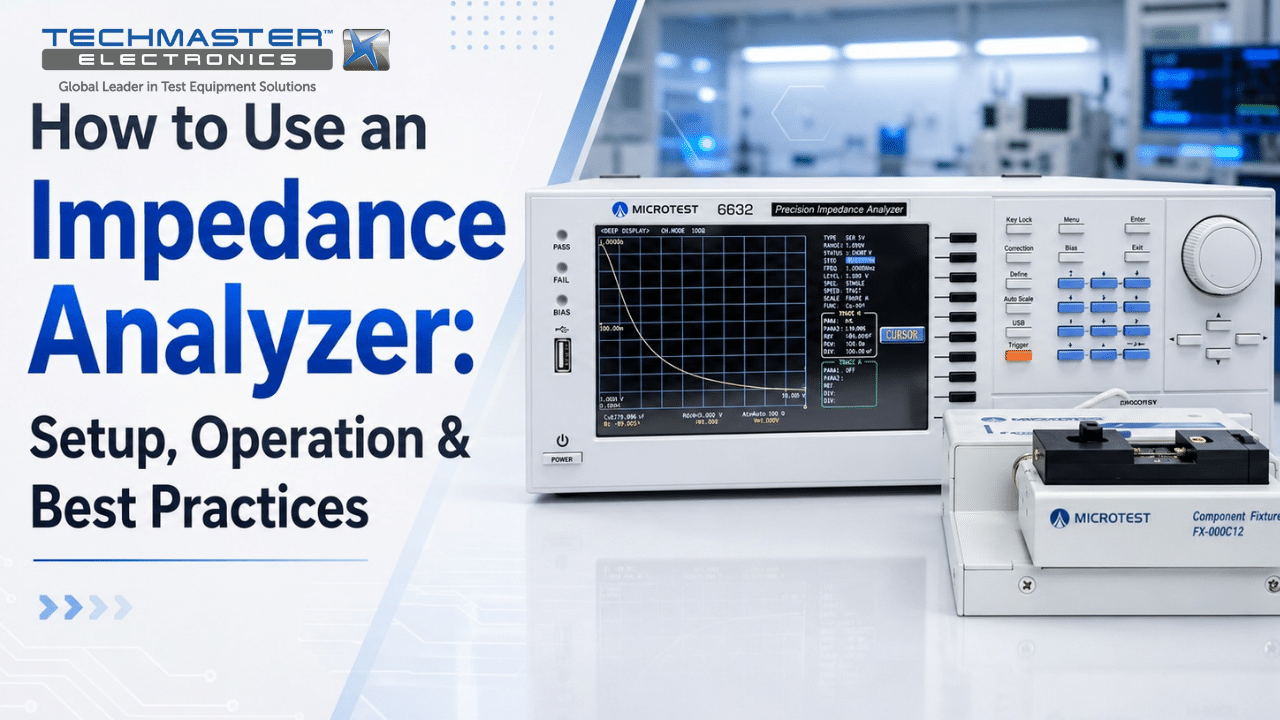
Engineers and lab technicians use impedance analyzers to measure the electrical properties of passive components and materials. To get accurate results, you must set up the instrument correctly. Otherwise, stray capacitance, lead inductance, and contact resistance can reduce measurement accuracy. As a result, poor setup can affect product quality and design validation.
1. Technical Principles and Setup Procedures
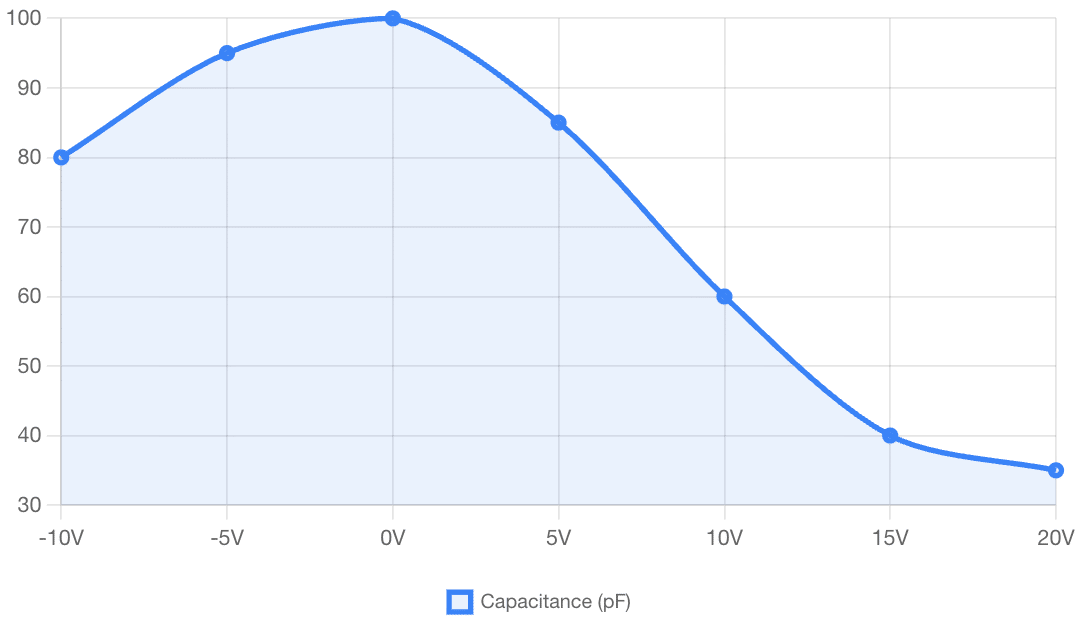
Semiconductor: C-V Profiling
Capacitance-Voltage analysis detects domain clamping. Under high DC bias, permittivity drops, reducing effective capacitance.
Mastering Instrument Architecture, Error Compensation, and Performance Verification for High-Precision Electrical Characterization.
CONTACT USHow do you configure an impedance analyzer for accurate measurements?
Configuring an impedance analyzer correctly is the first step toward obtaining reliable and repeatable measurement results. Before you begin testing, make sure that the instrument, test fixture, and DUT are suitable for the selected measurement range. Next, verify all physical connections and perform the required compensation procedures. Finally,select the appropriate measurement settings based on the electrical characteristics of the DUT. By following these steps,you can reduce measurement uncertainty and improve the overall accuracy of your test results.
1.1. Connect the Test Fixture
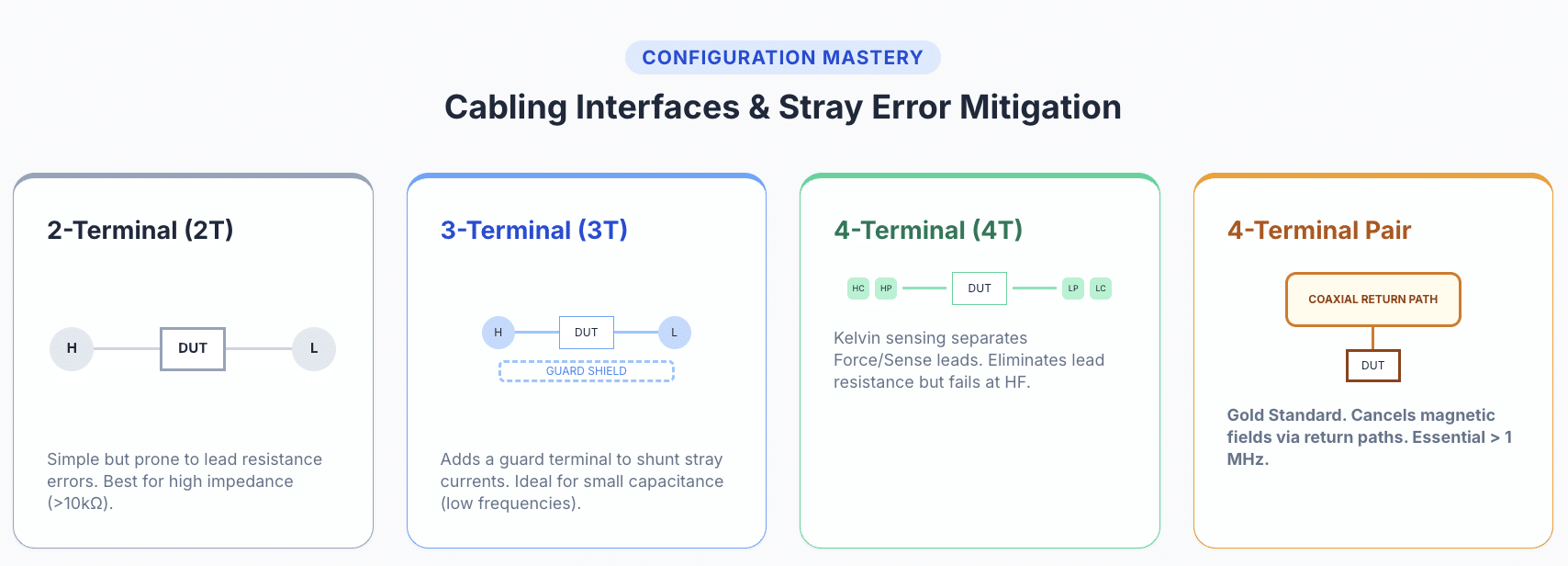
First, connect the appropriate test fixture to the analyzer. Depending on your application, you may use Kelvin clips, a four-terminal pair fixture, or another compatible accessory. A proper connection helps minimize lead resistance, contact resistance, and electromagnetic interference. In addition, make sure all connectors are clean and firmly attached to ensure stable electrical contact throughout the measurement.
1.2. Perform Open and Short Compensation
Next, perform both open-circuit and short-circuit compensation directly at the measurement terminals. These compensation routines remove errors caused by stray capacitance, lead inductance, and fixture impedance. As a result,the analyzer can isolate the true electrical characteristics of the DUT. For the best accuracy, repeat the compensation process whenever you replace the test fixture or change the measurement frequency range.
1.3. Select the Measurement Parameters
After completing compensation, choose the measurement parameter that best matches your application. Common options include impedance (|Z|), phase angle (θ), capacitance (C), inductance (L), resistance (R), and quality factor (Q). Then, set an appropriate frequency or frequency sweep range according to the specifications of the DUT. Choosing the correct parameters ensures that the analyzer captures meaningful data for further analysis.
1.4. Set the Test Signal
Finally, configure the AC test signal level and, if required, apply the appropriate DC bias voltage. The selected signal level should reflect the normal operating conditions of the component without causing nonlinear behavior or core saturation. Furthermore, using the correct excitation level helps improve measurement repeatability while protecting sensitive components from unnecessary electrical stress.
2. Industrial Applications
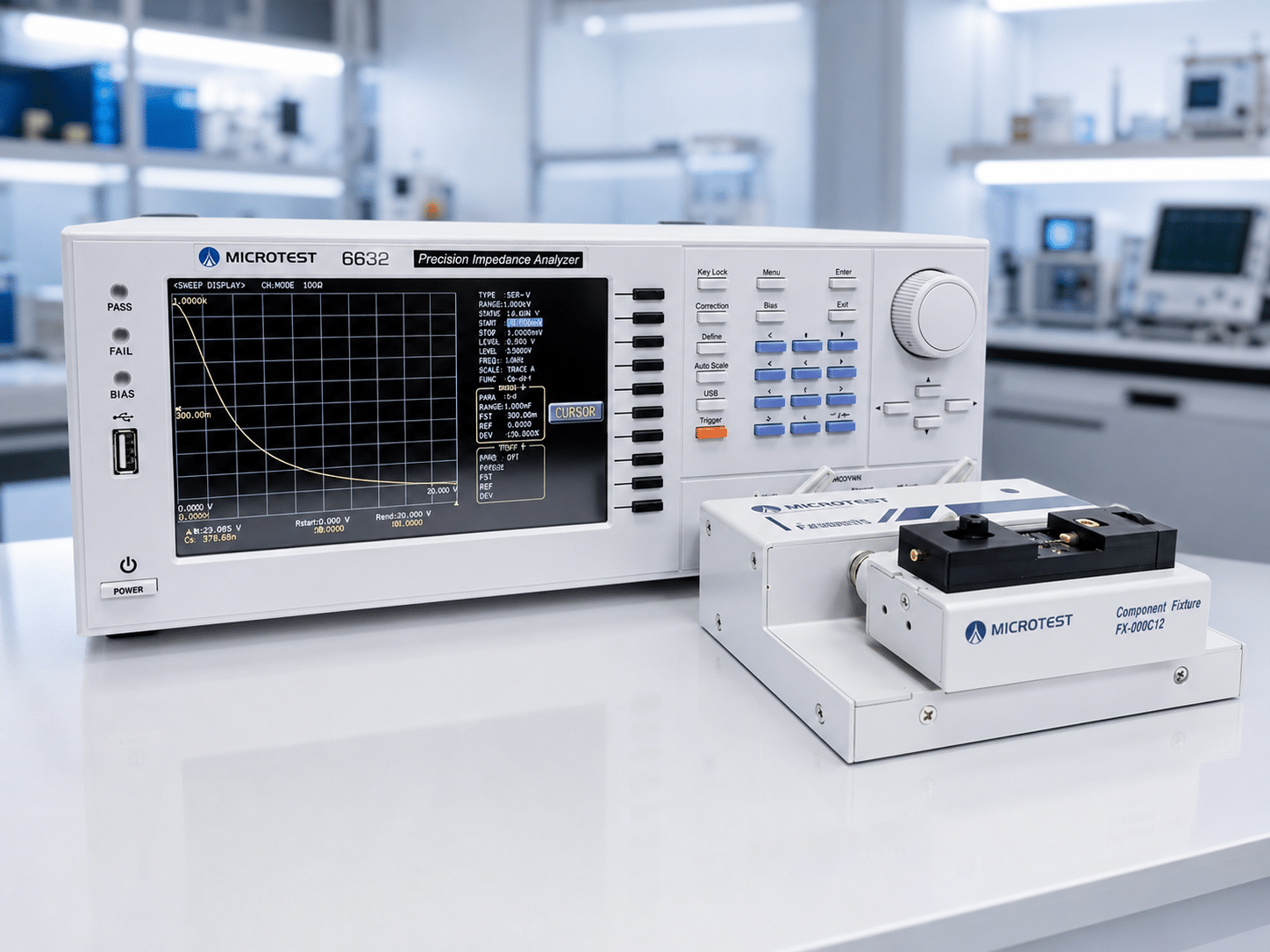
Where is impedance analysis important?
Impedance analysis plays a key role in industries that require precise electrical measurements and consistent product performance. Because impedance directly affects the behavior of electronic components, engineers use impedance analyzers throughout product development, manufacturing, and quality control. In addition, these instruments help identify electrical defects, verify component specifications, and improve long-term product reliability. As a result,impedance analyzers have become indispensable tools across many advanced technology sectors.
2.1. Battery Testing
For example, battery manufacturers use impedance analyzers to measure the internal resistance and electrical characteristics of lithium-ion cells. These measurements help engineers evaluate battery health, charging efficiency, and overall performance. Furthermore, impedance data supports battery research by identifying performance degradation and optimizing energy storage systems for electric vehicles and renewable energy applications.
2.2. RF and Microwave Design
Similarly, RF and microwave engineers use impedance analyzers to characterize inductors, capacitors, filters, and resonators across a wide frequency range. By understanding the impedance characteristics of these components, designers can optimize impedance matching, reduce signal reflection, and improve the performance of wireless communication systems such as 5G, satellite, and radar applications.
2.3. Medical Electronics
Likewise, medical device manufacturers rely on impedance analysis to verify the electrical properties of sensors, electrodes, and implantable components. Because many medical devices operate under strict safety requirements, accurate impedance measurements help ensure stable performance, product reliability, and compliance with international quality standards.
2.4. Semiconductor Manufacturing
Finally, semiconductor manufacturers use impedance analyzers to evaluate parasitic impedance in IC packages, printed circuit boards, and multilayer ceramic capacitors. As a result, engineers can identify unwanted electrical effects, improve signal integrity, and optimize high-speed circuit performance before products move into mass production.
3. The Calibration Pillar: ISO/IEC 17025 Compliance
Why is ISO/IEC 17025 important?
Even with the correct setup, an impedance analyzer still needs regular calibration. Without it, measurement accuracy decreases over time. ISO/IEC 17025 is the international standard for calibration laboratories. When you choose an accredited laboratory, you receive calibration results that are traceable to national standards. Therefore, auditors can verify your measurement records with confidence.
In addition, accredited calibration provides documented measurement uncertainty. As a result, you can support product testing, customer audits, and quality requirements.
4. How to Verify Your Impedance Analyzer
- Warm Up the Instrument: First, turn on the analyzer and allow about 30 minutes for warm-up. This allows the internal circuits to reach a stable operating temperature.
- Run Self-Calibration: Next, run the built-in self-calibration routine. This process removes small offset errors before testing.
- Perform Compensation: Afterward, complete the open and short compensation procedure before connecting the DUT. As a result, the analyzer removes fixture-related errors.
- Connect the DUT: Then, place the DUT securely in the fixture. Make sure every contact point is clean and stable.
- Start the Measurement: Finally, start the frequency sweep or measurement sequence. Then, review the results and save the data for future analysis.
Frequently Asked Questions (FAQs)
1. How do I compensate an impedance analyzer before testing?
First, perform open-circuit and short-circuit compensation at the test fixture. If needed, complete load compensation as well. These steps remove errors caused by cables, fixtures, and connectors.
2. Why does the analyzer need a warm-up period?
Before testing, allow the analyzer to warm up for about 30 minutes. During this time, the internal circuits reach a stable temperature. As a result, the measurements become more repeatable.
3. Why does lead inductance matter at high frequencies?
Lead inductance increases as frequency rises. Therefore, it can change the measured impedance. To reduce this effect,use a four-terminal fixture and perform short compensation.
4. How often should I calibrate my impedance analyzer?
In most cases, annual calibration is enough. However, laboratories that perform critical testing or heavy daily use should calibrate every six months.
5. What proof of calibration supports ISO compliance?
An accredited laboratory provides a calibration certificate. Typically, the certificate includes NIST traceability, as-found and as-left results, and measurement uncertainty. Therefore, you can use it during customer and regulatory audits.
Mastering Instrument Architecture, Error Compensation, and Performance Verification for High-Precision Electrical Characterization.
CONTACT USReferences & industry standards
- ISO/IEC 17025 testing & calibration laboratory requirements
- NIST calibration services and measurement traceability
- A2LA / ANAB accreditation for calibration laboratories
External standards bodies. Techmaster Electronics is an ISO/IEC 17025-accredited, NIST-traceable calibration laboratory.
Frequently asked questions
What is impedance analyzer calibration?
Impedance Analyzer Calibration is the documented comparison of a impedance analyzer against NIST-traceable reference standards under ISO/IEC 17025. It quantifies the impedance analyzer’s error and measurement uncertainty and confirms it performs within tolerance, with as-found and as-left data on the certificate.
How often should a impedance analyzer be calibrated?
Most quality systems calibrate a impedance analyzer every 12 months, or sooner after repair, overload, or before critical measurements. Set your interval from the manufacturer spec and your ISO 9001 / 13485 / AS9100 program and drift history.
Is Techmaster’s impedance analyzer calibration ISO 17025 accredited?
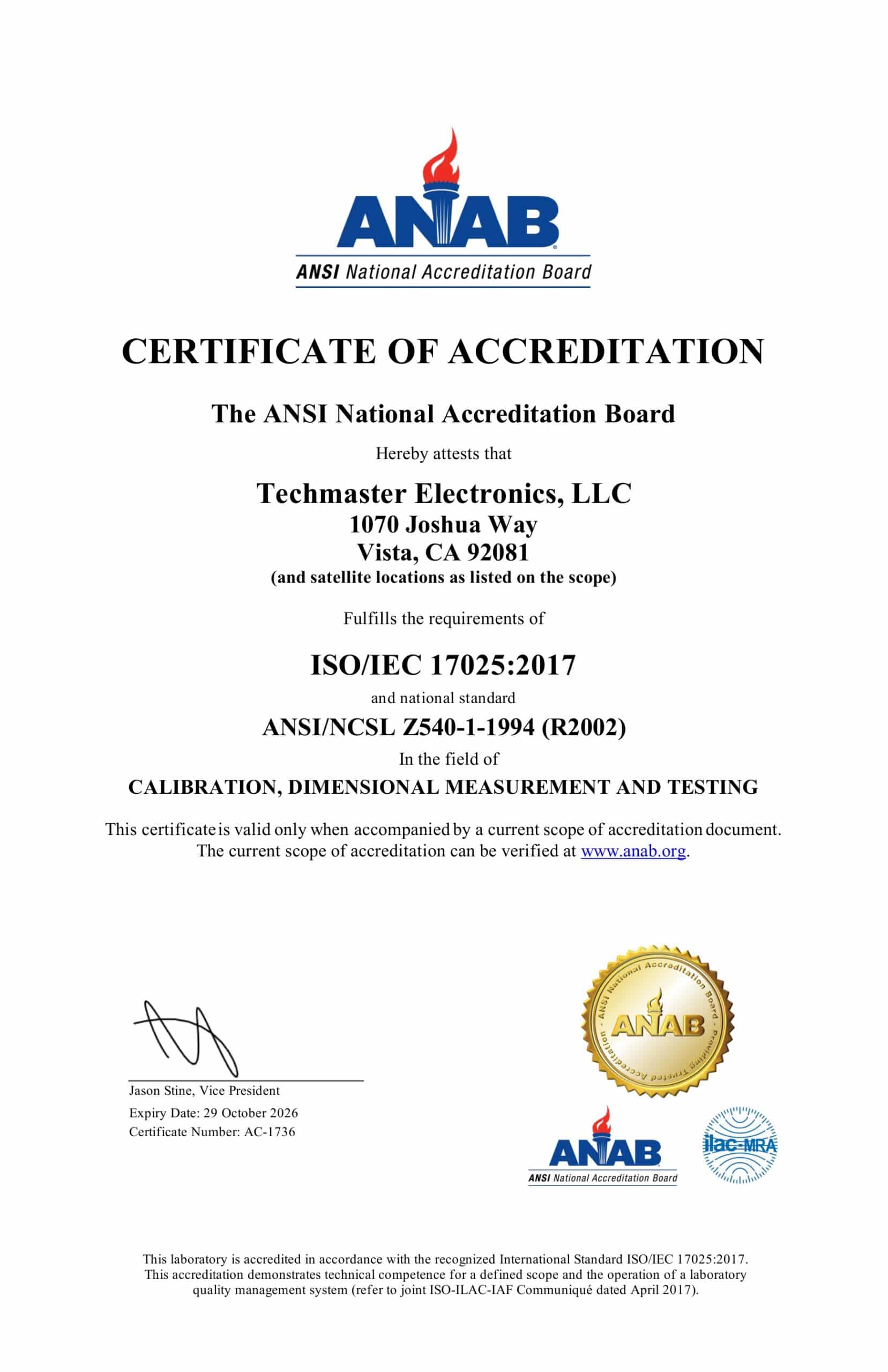
Yes. Techmaster Electronics is ISO/IEC 17025:2017 accredited by ANAB (Certificate AC-1736). Every impedance analyzer calibration is NIST-traceable and issued with a full measurement-uncertainty budget.
What is the turnaround for impedance analyzer calibration?
Standard turnaround is 5 business days, with 1–2 business-day expedite available. On-site calibration removes shipping time entirely for impedance analyzers that can’t leave the floor.
Do you calibrate impedance analyzers on-site or in-lab?
Both. Techmaster runs five US labs (Vista CA, Santa Clara CA, Orlando FL, San Antonio TX, Holly Springs NC) and offers nationwide on-site impedance analyzer calibration to minimize downtime.

Khanh Nguyen is the Marketing Manager at Techmaster Electronics, a B2B marketing leader covering the test, measurement, and ISO/IEC 17025 accredited calibration industry across the US and Vietnam markets.